But now in Christ Jesus you who once were far off have been brought near by the blood of Christ. For he is our peace; in his flesh he has made both groups into one and has broken down the dividing wall, that is, the hostility between us.
—Ephesians 2:13, 14
To fulfill these purposes, this church shall: . . . Study social issues and trends, work to discover the causes of oppression and injustice, and develop programs of ministry and advocacy to further human dignity, freedom, justice, and peace in all the world.
—ELCA Constitution, sec. 4.03.1
In January 2005, after nearly three years of work, the Task Force for ELCA Studies on Sexuality released its report and its three recommendations concerning the church’s policies relating to same-sex couples. From this report, the Church Council developed three resolutions, which were made public in April; two of these matched the recommendations of the task force, but the third differed. In August the Churchwide Assembly acted on these resolutions and the multiple amendments and substitute motions that were proposed from the floor. The first two resolutions were affirmed by the Assembly (the second with an amendment of wording, the effect of which was variously interpreted); the third was defeated, as were all of the substitute motions advanced by voting members. These dry facts give no hint of the turmoil, at the level of both intellectual exchange and practical maneuvering, that has characterized the ELCA since the 2001 Churchwide Assembly placed these disputes near the top of the agenda of our church. As a member of that task force, I have been invited to reflect on what “lessons for the church’s educational mission” might be derived from this experience. Perhaps counterintuitively, I would like to focus on what might be learned about peace.
If furthering “peace in all the world” is part of the mission of the church, then it is also the mission of Lutheran colleges and universities. We all, I suspect, carry around in our minds some very sentimental and romanticized notions of peace, notions that make it difficult to imagine that the controversy, anger, and alienation swirling around Lutheran teachings and policies relating to same-sex couples could be at all relevant to a ministry of peace, except as exemplifying its absence. Yet if we equate peace with the absence of disagreement, then truly there could be no peace, and all efforts to promote it would be futile. I would like to propose that we try, inspired by this passage from Ephesians, to equate peace, instead, with the absence of hostility and violence (and that we construe “violence” broadly as coercive force). Margaret Payne and James Childs quoted this scriptural text at the end of the letter with which they submitted the task force recommendations to the Church Council. Above their signatures, the letter closed, “In Christ’s peace.”
My theme, then, is “the fissured face of peace”—and by this I mean to invoke a rock face that is cleft, cracked, and broken. I dislike postmodern jargon, but “fissured” is one of the terms that I have found very helpful. “Fissures” point to contradictions, silences, disconnects, discontinuities, conflicts, and disagreements; but the important thing about fissures is that they do not go all the way through whatever medium (face) they disrupt.
When the task force was created, many expected—or at least hoped—that it would, by diligent and careful study, listening, and reasoning, produce peace in the church by supplying final and definitive answers to the questions at the heart of the controversy. The church longed for the restoration of tranquility and appointed a task force to achieve that. Not surprisingly, in the months after the task force report became public, considerable disappointment and criticism were voiced because the task force had not “settled the question.” In the first part of this article, I will review why the task force did not do what many had expected. The factors that account for the course the task force pursued involve us in reflection on the nature of moral controversies, the inevitability of change, and the ways in which communities undertake to deal with controversies, dissent, and challenges to received tradition and authority. While we may wish to think about all of these things in ways that draw upon the Christian and Lutheran understanding of our situation before God and before one another, we cannot think about them in isolation from a well-grounded understanding of the human condition, or the realities of (fallen) creation. To be careless on this point in our pursuit of peace is to end up chasing after some invention of our dreams. In the second section, then, I will draw upon Hannah Arendt’s incisive description of the human condition to highlight some of these indelible features of our creaturely being, and in the last section I will suggest some ways in which a deep and reverent understanding of the human condition might be accented in our colleges and universities, with the hope of enabling our graduates to disagree without hostility, to evaluate without hatred or condescension, to engage change in positive and constructive ways, and to embrace in hope and courage the difficult work of making our views more true, our judgments more reliable, and our institutions more humane and just.
Reasons for not “settling the question”
It is probably fair to say that the report pleased no one. Those who were not particularly invested in these questions either way were discouraged and disappointed to find that no final word had been spoken to end what has developed into a bitter controversy. They had been hopeful that there would be a definitive resolution one way or another that would, as they often put it, allow the church to “move on” and redirect its energy and passion toward other urgent concerns such as economic justice, the deteriorating situations in the Middle East and the Sudan, the health-care challenges we face in the United States, hunger and homelessness in our own country and in the world, and ecological degradation. The task force had been appointed to produce clarity and end a squabble, and since, as a practical matter, we did not do that, they judged that we had failed to fulfill the charge we were given.
Others saw the failure as a moral and theological one. To them, the report had the look of moral spinelessness—and it looked that way both to those who had hoped that the task force would affirm the existing policies and support their enforcement, and to those who had hoped that the task force would recommend revising those policies in the name of justice. In a list-serve e-mail released January 14, 2005 (the day after the report and recommendations were made public), Roy A. Harrisville III, Executive Director of Solid Rock Lutherans, condemned the report for failing to “reflect both the biblical faith of millions and the desire for a clear word from our Church leadership.” Focusing on the third recommendation, he wrote, “With this recommendation, the Task Force has stated that sexual boundaries do not matter now, if they ever did.” From the other side, our work was faulted for elevating church unity over both truth and justice. Larry Rasmussen, a Lutheran ethicist writing in The Network Letter, was particularly forceful in his criticism on this point. The outcome of years of work by the task force was marked by an “absence of the spirit and courage of a church of the Reformation” (4). Noting Luther’s own confidence that “the living, active Word of God that suffuses all creation can and might bring us all to a new place, as a church ever in need of reform,” he complained that “the daring, the venturesomeness, and the creativity that mark this joyful dynamic of Reformation freedom seem hedged about on every side in the Task Force report” (4). The task force had, in his view, “compromised the reformation” and “miss[ed] the chance to be Lutheran” (4, 5).
Lost in sin as we all are, it is more than possible that some or all of these negative assessments are accurate. Still, I cannot escape the sense that most of what has been written and said about our report fails to appreciate what may have been its most important contribution: its effort to give substance and meaning to the notion of the church as a community of moral deliberation. Of course, it is possible that we failed at that too, but that is a conversation that is still waiting to happen.
Moral judgments, moral conflicts
Moral conflicts arise out of the nature of moral judgment. All knowledge claims involve interpretation and judgment, even simple descriptions of fact and even empirical, scientific findings. The role of judgment, or what Michael Polanyi calls the personal coefficient of knowledge, is more obvious and more dominant in the domains of religion, philosophy, and ethics than in other spheres of human inquiry and conviction. All judgments are subject to dispute by others who judge differently, but such contestations are much more widespread in moral and religious matters because (1) the realities in question are complex, difficult to isolate, and comparatively elusive; (2) more people feel that they know enough, on the basis of their own experience, to speak out with an authoritative voice; and (3) the issues at stake cut so incisively into their own action, self-understanding, and interests that people feel compelled by reason of their own integrity to defend their views and convictions. The important thing to understand here is that no amount of goodwill or education is going to banish moral and religious disagreement.
Yet not all moral conflicts are alike. Conflicts arise for different reasons and the differences in cause have important implications for how, and even whether, the disagreement can be resolved.
- Some arise from inadequate understanding of the situation or defective reasoning about the situation. Conflicts of this sort are usually able to be resolved through education and careful critical analysis of the arguments offered by the opposing sides. Fortunately, the majority of our disagreements (moral and otherwise) are probably of this sort.
- Some arise because of deeper conflicts about underlying issues. These are harder to resolve because parties to the conflict first have to be brought to see that the ostensible subject of disagreement is not the actual subject of disagreement, and they then have to be willing to engage the conversation at the proper level.
- Some arise out of divergent judgments about the relative weight (or the proper ordering and balancing) of competing high-level values. Disputes of this kind can be impossible to resolve (centuries of disagreement between pacifist Christians and Christians who condone the carefully regulated use of fatal force provide a familiar example here).
- Some arise from divergent styles of moral reasoning. Here we might think of conflicts between ethicists who reason primarily in terms of goals or ends and ethicists who reason primarily from prima facie duties.2 Or we might think of ethicists who start with Scripture and ask how it applies to experience and ethicists who begin with experience and ask how Scripture illuminates experience.
- Some, it must be admitted, arise from sin, pride, sloth, bigotry, self-indulgence, and other forms of self-centeredness, viciousness, or bad faith.
In the discussion that follows, I am going to disallow appeal to the fifth reason as a way of accounting for our current disputes—though I notice that many people do appeal precisely to this explanation. I disallow it because (1) my own observations do not support it and (2) Christian charity requires that we put the best possible construction on the arguments of others.
The widespread disappointment reflects the fact that people thought this controversy was of the first variety—that it was a problem that could be resolved by concentrated study that would reveal what the church ought to do. I thought that myself when I began the work. But greater understanding has not yielded a resolution of this conflict; it actually seems sometimes to deepen the disagreement. Reflecting in his February 2005 newsletter on “What We’ve Learned about Ourselves” as a result of the years of study, Bishop Theodore Schneider noted that “there was a strong belief and hope across the church that if we all shared the same information we would be able to come to a consensus of agreement. Simply put, the problem was thought to be one of education.” The massive study efforts were not without effect. “We have learned a great deal about one another and, I believe, have come to a new appreciation of one another. But it does not appear that many minds were changed, just as the same appears to have been true on the Task Force itself.” And so, he concludes, another thing that “we have already learned is this: We may well live ourselves into change in this church and in our society, but we shall never argue ourselves into it” (2).
While study and education are hardly useless in the present case, it has become apparent that this controversy has deep and various roots, not all of which are actually ethical. I happen to have concluded that the controversy is primarily a controversy of the second sort and that the underlying issues are not actually moral or ethical at all, but for purposes of this article, it is not important whether the controversy is of the second, third, or fourth type. Whichever of these types it is, it is not a controversy that a task force can “settle” for the church. This is partly because such conflicts sometimes do end at an impasse, but it is mostly because where such deep and responsible disagreements arise, the church, as a whole community, must struggle toward a resolution. It cannot delegate that work to some subsidiary agency in the way that the work of study or fact-finding can be delegated. It was thus the considered judgment of the task force that time, forbearance, and widespread conversation would be required for this process to be carried through successfully—if it can be carried through at all. That was why we began by recommending that our church “concentrate on finding ways to live together faithfully in the midst of our disagreements.” Our second and third recommendations were offered as suggestions as to how the church might conduct itself as that continuing conversation unfolds.
Communities and their conflicts
Our recommendations notwithstanding, it is obvious that a number of different courses are open to a community when education and logical argument fail to persuade and produce one-mindedness or consensus. Not all of them are mutually exclusive, but only two of them seem conducive to the continuing dialogue and mutual discernment that distinguish a community of moral deliberation.
The most typical response is probably the determination to overcome dissent by an exercise of power. It is possible (and sometimes, for the common good, necessary) to compel obedience where agreement cannot be won by argument. Whether the obedience one is compelling is obedience to traditional authority, the law of the land, the will of a powerful elite, or the will of a voting majority, the method of resolution is the same. It is certainly the case that human communities cannot get on in an orderly way without such recourse to the exercise of power, but it does not follow that all fractious disagreements are best dealt with in this way. A defeated but unpersuaded faction can remain a source of significant discord. Moreover, in voluntary associations, compelling people to do things can get a little tricky. People are, after all, free to leave, and they often do.
Consequently, a true and final division of the house is another way of coping with deep and abiding disagreement. From its first meeting, the task force has been acutely aware that a significant number of current ELCA members believe that if other members cannot be brought to see moral truth as they do, the appropriate outcome would be the separation of ELCA Lutherans into smaller church bodies that are each more uniformly like-minded. If their interpretations and judgments do not prevail, those who believe that Scripture demands the affirmation and rigorous enforcement of current teachings and policies pertaining to sexual conduct appear to be prepared to leave the ELCA in order to form their own church. Should this occur, the congregations electing to remain identified as the ELCA would also constitute a more homogeneous church. In practice, this sort of redrawing of system boundaries is a common way of addressing intractable disputes in voluntary organizations, and in practice, this resolution often follows attempts to resolve disputes by an exercise of power. Of course, it should not be overlooked that an announcement by part of a community that they are moving toward separation is itself a fairly muscular exercise of power. Neither should it be overlooked that “church shopping” and the transition from “churched” to “unchurched” are other manifestations of this same phenomenon. Such maneuvers often seem more oriented toward comfort than toward peace (as the bitterness and disdain that afflict the newly established boundaries make plain). More importantly, if we habitually dissociate ourselves from people who see things differently, we may actually diminish any possibility of rendering our views more nearly true.
In the face of conflict, some members of a community may respond by trying to de-escalate the issue, recasting it as one that does not matter, or at least does not matter as much as (or in the way that) others in the community think it does. On its surface, this may seem like an irresponsible or even malicious technique for buying peace by trivialization. Yet when bitter controversies are fed (intentionally or unintentionally) by incendiary rhetoric, false dichotomies, misrepresentation of contending arguments, and unrelenting focus on worst-case scenarios, it can be a work of grace to try to enhance the community’s sense of balance and proportion. Such efforts represent something quite different from relativistic laissez-faire, nor do they entail any abdication of principle. They are, on the contrary, strategies that may be essential to the restoration of the degree of community necessary to allow honest and principled moral deliberation.
It is also open to a community to intentionally choose to accommodate legitimate divergence (by which I mean well-grounded, well-informed, principled disagreement) in order to continue together in conversation in the hope (perhaps only eschatological) that we may come to find some common ground. The period of accommodation may be comparatively brief and transitional or it may last for centuries. When Luther nailed his theses to the door, he was not proposing to split the community; he was inviting the community to talk together about difficult and contentious issues—to recognize its own divisions and try together to separate correctable corruption from legitimate dispute. The history of the Reformation and its aftermath teaches us how alien to human nature and to the infrastructure of human organizations this notion of accommodative, deliberative peace actually is. On the Christian biblical understanding, peace is not, as John Macquarrie points out, a normative, static condition that is, from time to time, regrettably disrupted by troublers of the communal equilibrium; rather, “peace is … a process and a task as man moves from potentiality to realization” (19). Reflecting on Eph. 2:13, he continues, “When Christ bequeathed the gift of peace to his followers and when as the climax of the beatitudes he commended the peacemakers, we can see in retrospect that this was not the promise of tranquillity but the invitation to continue a costly work” (22). The work of peace is the work of reconciliation.
The task force, as a microcosm of our church, could have, after all its study, listening, and argument, tried to “settle the question” by taking a vote and declaring the majority victorious and the majority’s views true. The task force did not do this, and in retrospect I have come to think that that was our most important contribution. I can make some guesses as to how such a vote would have turned out, but I truly do not know—because we never took it. We declined to exercise majority power out of respect for the conscience of those who, by reason of conviction and integrity, found themselves to be of different minds. In offering our church the report and recommendations that we offered, the task force modeled its belief that we are a community, and that communities (1) should seek to operate by consensus and (2) in the absence of consensus, do best if they acknowledge and accommodate their conflicts rather than either denying them or allowing them to flare into feuds.
Re-formation
Just as it is important not to identify peace with the absence of conflict, so it is important not to equate peace with stasis. We (the task force and the church at large) are in medias res—somewhere in the midst of one strand of the great, complex evolutionary process of being the church under the call of a living God who moves and acts in history. This is always the case; the current situation simply highlights this for us.
I have heard many people frame the problem in terms of whether or not the church should change. The question is not whether to change, but how to change. Even if the 2005 Churchwide Assembly had voted by an overwhelming majority to affirm existing teachings, practices, and policies and to uniformly enforce existing policies regarding lesbian and gay rostered ministers, the church would have changed. It would have become a church that, having scrutinized these teachings and all the reasons that people give for disagreeing with these teachings, had reaffirmed the teachings and policies in the face of that challenge and without concession to it. It would, by its very intentional act of reaffirming its received teachings, have become a church different from the church of thirty to fifty years ago in which the question simply did not come up because homosexual orientation was not acknowledged and same-sex couples were invisible.
Change can be good, neutral, or bad. Moreover, it can be all three at once—not just because different observers view it differently, but because the actual costs, burdens, and benefits of change fall differently on different sectors of a community and on different individuals. Change can be slow or rapid. Some favor slow change; others favor rapid change. The more one has invested in existing arrangements, the more one favors stability and (if change cannot be avoided) slow or evolutionary change—thus, people often become more averse to change as they age, while the young sometimes seem to specialize in rebellion. There are many other good reasons not to proceed precipitously (not least among them the fallibility of human judgments about the right and the good), and institutional churches (as contrasted with more volatile and ephemeral religious movements) tend to move very deliberately. Nonetheless, it is worth noting that highly significant changes often occur long before they are acknowledged, producing a kind of institutional cognitive dissonance or even something close to unintentional hypocrisy.
Social systems are extremely complex, and the impetus toward change tends to arise not from within a single component of a given system but from the friction between systems, between a comprehensive system and one or more internal subsystems, or between subsystems within a comprehensive system. Moreover, systems tend to have porous rather than rigid boundaries, and people tend to be “resourced” by more than one system (that is, we all participate in multiple social systems and subsystems). Consequently, communal life and organizational systems are not characterized by unanimous agreement. The affective bonds of loyalty and need are probably at least as important in maintaining a cohesive social system as the bonds arising from cognitive agreement. Yet in strong and durable communities, there tends to be a strong, rich, and comparatively comprehensive consensus (though this consensus ought probably to be thought about more on the model of what we might call family relationships rather than on the model of universal accord on a few central beliefs).3
“Consensus” is a hard word to define, but it is pretty clear that our church, considered nationally and considered particularly in light of the recorded votes of the Assembly, no longer has a strong consensus on the particular matter of just treatment of Lutheran same-sex couples in monogamous lifelong relationships. Some on the task force felt that there is no emerging consensus either. I, in contrast, suspect (partly on the basis of those votes at Churchwide Assembly4) that we are in fact seeing the slow emergence of a new consensus, but if so, it is still years away. In a just community, punishment of behaviors has to be backed and legitimated by strong consensus as to the unacceptability of the behavior in question; otherwise, the sanctions will seem to many to be arbitrary, unfair, and discriminatory. In the absence of consensus, the task force recommended that policy should not be altered (implicitly, but not explicitly, acknowledging that policy alteration should reflect consensus in the community). However, the task force paired that respect for existing policy with recommendations that this church (1) undertake the kind of continuing dialogue that would allow either the emergence of a new consensus or a “repristinization” of the old consensus and (2) in the interim practice prudential deference and forbearance in the enforcement of policies that came about under a consensus that no longer exists.
To the extent that ethics, policy, and leadership are always most fundamentally “about” the management of change, they demand great wisdom and discernment in differentiating among (1) what needs to be protected and preserved for the good of our common life, (2) what needs to be adapted or reinterpreted or renewed or reformed, and (3) what can be or needs to be relinquished or actively repudiated. As we have seen, the report and recommendations of the task force were bound to disappoint those who considered the controversy to be resolvable by careful study. However, if one thinks instead that the task force was called to assist the church in addressing change and in responding as Lutherans to conscientious and principled dissent, the report and recommendations will seem, not necessarily more satisfying, but less like a default or evasion. In Journey Together Faithfully, Part 2, the task force exposed the degree to which the church itself has already changed by displaying the range of views held by faithful Lutherans—a portrait of the church that was validated many times over by the debate and actions of the Assembly. The recommendations themselves were built upon the belief of the task force that we, as a church, are not at this time able to clearly discern, with respect to this particular issue, what needs to be protected and preserved, what needs to be renewed or reformed, and what ought to be relinquished. Rather than urging false closure, the task force urged continuing conversation in which all voices will be heard.
Features of the human condition
In speaking about judgment, about change and temporality, and about the nature of social systems, I have already begun the exploration of our situation as creaturely beings, but to this I now want to add some specific insights from the work of Hannah Arendt. In The Human Condition, first published in 1958 and continuously in print ever since, she begins with the indisputable observation that human beings are conditioned creatures; that is, we are the sort of creatures that exist in an environment on which we are dependent for our existence as the sort of creatures that we are. Although the conditions of our creatureliness “never condition us absolutely” (11), they are, nonetheless, the conditions of the possibility of our living and acting at all. We forget them or deny them at our peril. What, then, does she think these inexorable and empowering conditions are? “Life itself, natality and mortality, worldliness, plurality, and the earth” (11). Although she herself does not write from a religious perspective, there is much that Lutherans can learn from her treatment of our terrestrial, creaturely being—and from her darker insight that although “the earth is the very quintessence of the human condition,” human beings “[seem] to be possessed by a rebellion against human existence as it has been given” (2). It is possible, as she acknowledges, that science and technology are in the process of actively altering the human condition itself, but if we do not even know what it is that we are altering (and she identifies “thoughtlessness” as “among the outstanding characteristics of our time” [5]), we can hardly make reliable judgments about the direction or the consequences of that process. But leaving aside the question of whether human beings can, in fact, alter the very conditions and limits of our own conditioning reality, she confines herself “to an analysis of those general human capacities which grow out of the human condition and are permanent, that is, which cannot be irretrievably lost so long as the human condition is not changed” (6).
Life and earth require little explanation, but the other four dimensions of the human condition require more elaboration.
Natality and mortality capture “the [biological] conditions under which life has been given to man” (9). They can be gathered together as the two dimensions of earthliness. These she calls “the most general conditions of human existence” (8). We are finite, embodied, limited, perspective-bound creatures who grow, change, reproduce ourselves, and eventually decay and die. We must labor to sustain the biological processes that maintain life. In these dimensions, the human condition is not different from the conditions of all animal life, although we differ from the animals quite remarkably in our ways of meeting these necessities.
Worldliness names the uniquely human capacity to create layers of reality that are not given with our biological condition: linguistic systems; laws and systems for their development, amendment, and administration; markets, wealth, and money or other media of exchange; electrical power grids and communication networks; industrial complexes; knowledge and methods of inquiry that can be recorded and transmitted across geographical and temporal boundaries; social trust and moral expectations—to name only a few of the most obvious. We dwell in a biological ecosystem, but we also dwell in a constructed “world” of artefacts (Manhattan was not carved out of rock by natural forces) and in a transhistorical web of unspecifiably complex mental, social, and operational systems. Worldliness comprises our own “self-made conditions, which, their human origin and their variability notwithstanding, possess the same conditioning power as natural things” (9).
Plurality is “the condition of human action because we are all the same, that is, human, in such a way that nobody is ever the same as anyone else who ever lived, lives, or will live” (8). We lose sight of the extraordinary gift of being different—probably because so many of our most vexing problems arise out of this gift. Arendt urges us to appreciate the fact that the alternative to this would be a situation in which all human beings “were endlessly reproducible repetitions of the same model, whose nature or essence was the same for all and as predictable as the nature or essence of any other thing” (8). There would be no disagreement, no conflict, no dissonance, no interhuman tension, no hierarchies, no equality (since that is distinct from sameness), no surprises, no change, no action properly so called, no history, no politics, no ethics, no evaluation, no failure, and no success. There would be general laws and predictable behavior, and that is all.
The full appreciation of the conditions of worldliness and plurality conveys an additional coloration upon the condition of natality. We are born as biological creatures requiring biological sustenance, but every infant arrives as a stranger and a potential actor capable of bringing about something new: “the new beginning inherent in birth can make itself felt in the world only because the newcomer possesses the capacity of beginning something anew, that is, of acting. In this sense of initiative, an element of action, and therefore of natality, is inherent in all human activities” (9).
The church’s educational mission
Reflection on our creatureliness makes it hard to sustain the dream of perfect harmony as anything other than an eschatological hope. It helps us to see why the only peace for which we can hope is fissured and unstable, a temporal possibility best understood, as Macquarrie has reminded us, as an endless, difficult, and costly process, not a situation or achievement. Understanding peace in this way, we might think together about how the “ministry and advocacy” of peace might be folded into our college’s educational mission as something other than pious exhortations to beat swords into plowshares and make war no more. We might begin by simply asking how the colleges can help to create a vibrant community of moral deliberation in which dividing walls are broken down, coercion is reserved for “last resort,” and inspirited care and respect crowd out recrimination and abuse.
Worldliness
“World” is through and through communal. The great articulate systems that constitute the fabric of our human lives are received through education. Education is the memory and the life and the future of these systems, and every educative object and event (every conversation, every examination, every book, every syllabus, every classroom exchange) both preserves the received system and changes it, forming the newcomers for their own work of preservation and reformation. Taking “worldliness” seriously not only enriches our understanding of the critical importance of what we do as teachers but also suggests that we might do well to centralize, perhaps as a feature of our general education curriculum, courses that explore the nature, function, meaning, indispensability, frictions, and operations of human social systems. Lutheran colleges might even facilitate Christian community by enabling their students to see the church as just such a social system (it may be far more than that, but it is most definitely at least that): a living community of word and action, not some sort of sea-bottom sedimentary “deposit of faith.”
Courses that stress the interrelations of individuals and communities (the dependence of individuals on their communities, the frictions between the individual and the community, the responsibilities of individuals for the preservation and adaptation of their communities) might help our graduates not only to function better in the civic world but also to exercise more effective lay and professional leadership in the church itself.
Earthliness
We are finite, limited, embodied, perspective-bound creatures who see partially and imperfectly. While we all offer lip service to this notion, left to our own devices most of us operate as if we were the sole possessors of truth and as if some neon light had gone on in the sky assuring us that our judgments are endorsed by God. If as educators we were to take our earthliness seriously, we would spend a lot more time helping our students understand that human moral and intellectual claims are judgments, not some kind of transcriptions of truth read off reality as we might copy out a passage from a book. And if we go out of our way to teach our students that human moral and intellectual claims are judgments, we must, of course, go even further out of our way to help our students make discriminations between judgments that are (comparatively) suspect and unreliable and judgments that are (comparatively) trustworthy and reliable. In the face of entrenched American anti-intellectualism and postmodern universalized suspicion, we must encourage respect for expertise and other forms of earned authority. But we must pair this emphasis on deference to legitimate authority and proven wisdom with companion emphasis on the responsibility to actively engage that authority and wisdom patiently, critically, and discerningly. Conscience is not passively received; it is actively formed, and it is because it is so closely linked with personal integrity that we speak of it as inviolable (but not infallible). By way of the portal of conscience we can, as educators, reopen the discussion of tolerance, not as a political expediency, but as itself a fully defined virtue, an excellence grounded in a Christian understanding of creation and a bulwark against idolatry.
Mortality
We are temporal creatures in a temporal, historical world. The lives of persons, organizations, institutions, and civilizations have an arc that rises, peaks, and deteriorates. Nothing endures that does not change, and some things that change do not endure. For that reason, we might consider making it our goal to see that no student graduates with a bachelor’s degree from a Lutheran college without having developed a refined historical consciousness. Could we offer more courses in history—perhaps history across the curriculum? Could we require more history or at least more courses that work historically? We should do less comparing of snapshots (this was Rome, this was feudal Europe, this was the Renaissance) and more looking at historical change, the evolution of social systems, and their interplay. How did this group of people actually get from A to B? While it certainly continues to be important to study religions in light of typological differences and to examine religious beliefs and practices on their own merits, could we do a better job of studying Christianity as it changes over time? Where this is done at all, it tends to be done as a study in the history of ideas, but we need also to study Christian beliefs, teachings, and practices as they change in relation to changes in economics, migrations, or political arrangements—and in relation to the social situation of the members of particular church bodies.
Natality
Our students are the natal horde of newcomers, the strangers who are only partially at home in the world that we have ourselves received, sustained, and remade. They both ardently seek assimilation into our world(s) and rebelliously resist it. We know them, at some deep level of our teacherly hearts, as both our hope and our enemy. If the things we treasure, and the fabric of memory and understanding that we represent and preserve, are to persist into the unfathomable future, they will have to be preserved and transmitted by these alternately sullen and receptive, alternately passionate and indifferent, young people hidden under their baseball caps in the back row. These memories, these interpretations, these intentions will have to be adapted and nurtured by this rising generation as our generation has adapted and nurtured them. And these young people, as they take these gifts from our hands, will change, and perhaps discard, what we have spent our lives on, just as, in so spending our lives, we changed and sometimes lost, sometimes rejected what we received. The blessing in all this is that they will, in speech and action, renew and reconstruct these traditions as they make them their own.
Plurality
There are six billion of us and we are all (despite the degree of our genetic similarity) remarkably different. We come from different social worlds; even within the same social world, people have different experiences depending on their race, their sexuality, their class and status, and innumerable other factors. We live in multiple social worlds and “speak” multiple symbolic languages. Lutherans are different from the unchurched and from other Christians; Lutherans are, let us not forget, different from Lutherans.
I would like to see Lutheran colleges make a concerted attempt to supplement our course offerings in the traditional study of epistemology with attentiveness to American pragmatism and with careful and informed study of the sociology of knowledge. I have noticed over the years that scholars with religious commitments (and certainly religious leaders writing for broad publics) tend to demonize pragmatism and the sociology of knowledge as subjectivistic and relativistic endeavors that undermine or deny the validity of moral judgments and human efforts to sort out truth from error. This represents a very unfortunate misunderstanding of both American pragmatism and the serious attempts now underway to study human knowledge claims contextually. We are not obliged to choose sides between the spineless relativists and what William James called “absolutism.” Scholars and scientists have been busy for a century and a half developing alternatives to this false dichotomy. However, if so many opinion-shapers have somehow overlooked this development, it seems likely that we are not doing a very good job of teaching it.
In addition, taking plurality seriously implies that we welcome conflict for what it is: testimony to our individual uniqueness and the wellspring of our freedom. Conflict and controversy are often signs of the health of a community, not an index of its decay (though if space permitted, it would be important to differentiate constructive conflict that builds up, adapts, and revitalizes a community from the kind of conflict that is implicated in the collapse of social systems). In any social system (or sub-system), the fundamental resources of the community include interpretations of reality that form the conceptual framework and horizon of both thought and practice. The inexhaustible richness of earth and world alike continually outruns or overflows any and every attempted human account. It is unquestionably the responsibility of educators to bring order to the “booming, buzzing confusion” of human experience. It is our responsibility to find the narrative threads that make the past meaningful. It is our work to identify patterns and to sort out the coherent from the incoherent. But we must be careful, even as we go about that work, to acknowledge the provisional evolving nature of our interpretations and to honor the human condition of plurality by equipping our students to deal resourcefully and fearlessly with change and variability. When human beings build systems (whether conceptual or social), there will always be anomalies—features of reality that cannot readily be fitted into the pattern. These anomalies are, usually in small ways but sometimes in major ways, threats to the integrity and sustainability of the system; fears, along with our deep desire for orderliness and control, more often than not lead us to “forget” or paper over or even falsify these signals of fragility and limitation. We want, instead, to inspire in our students the courage to acknowledge the anomalies and to read them accurately for what they can tell us about the limitations and vulnerabilities of our nonetheless indispensable convictions and social arrangements.
Coda
Conflict, disagreement, divergence in interpretation and judgment concerning the true, the good, the beautiful, and the right—these are indelible features of the human condition and the fissures in the face of peace. We cannot make them disappear. We should not even want to make them disappear, because they are part and parcel of our humanity, our creatureliness. We can, however, try to prevent them from becoming sources of destruction. We can try to prevent these fissures from turning into rifts and hostilities that break us apart and isolate us, one from another. We can try to prevent them from turning into the fractures and hatreds that destroy our peace.
The task force, in one small document, has offered our church our hope that this may be so. In a much larger way, over a much longer time, in more varied contexts, and possibly with much greater success, Lutheran colleges may also foster this hope. This, it seems to me, though I certainly see only “through a darkened glass,” is how the work and learnings of the task force might contribute to reflection on “the Lutheran calling in education.”
Endnotes
1. This article is derived from a paper titled “The ELCA Study on Sexuality: Lessons for the Church’s Educational Mission,” which was originally delivered July 31, 2005, at the conference The Vocation of a Lutheran College: The Lutheran Calling in Education, at Capital University in Columbus, OH. The conference was sponsored by the ELCA Division for Higher Education and Schools.
2. For an important argument that the apparent conflict of these distinctive ways of reasoning might be overcome by imaging the moral life interactionally in terms of man-the-answerer, see chap. 1 of H. Richard Niebuhr’s The Responsible Self.
3. I am regretfully aware of the inadequacies of this brief paragraph. For a full and very illuminating sociological discussion of social organization, see John Bowker’s rich and incisive essay “Religions as Systems.” For a political treatment of the notion of “overlapping consensus” (common ground achieved in relation to, or in spite of, continuing disagreements), see John Rawls’s Political Liberalism.
4. Fifty-eight percent of the voting members rejected a substitute motion reserving “the solemnizing and blessing of sexual unions. . . for the marriage of a man and a woman.” Thirty-eight percent voted in favor of a substitute motion that would have removed all policy barriers “to rostered service for otherwise qualified persons in same-gender, covenanted relationships that are ‘mutual, chaste, and faithful.’” The third resolution from the Church Council was affirmed by fully forty-nine percent of those voting, even though it was opposed by Lutherans Concerned (because it routed the path to ministry through a process of applying to be considered an “exception”) and therefore probably lost the votes of some, perhaps many, who support the rostering of gays and lesbians in committed relationships. These votes would have been unimaginable even twenty years ago.
Works Cited
Arendt, Hannah. The Human Condition. Chicago: University of Chicago Press, 1958.
Bowker, John Westerdale. “Religions as Systems.” In Is Anybody Out There? Religions and Belief in God in the Contemporary World. Westminster, MD: Christian Classics, 1988. Reprinted from Believing in the Church, Report of the Doctrine Commission of the Church of England. London: SPCK, 1981.
Church Council, Evangelical Lutheran Church in America. “Recommendations from the ELCA Church Council to the ELCA Churchwide Assembly on Sexuality Studies.” Released April 11, 2005. http://www.elca.org/faithfuljourney/050411churchcouncil.html.
Evangelical Lutheran Church in America. Constitutions, Bylaws, and Continuing Resolutions of the Evangelical Lutheran Church in America. (As amended by the 2005 Churchwide Assembly.) http://www.elca.org/secretary/constitutions/ConstitutionsBylawsandContinuingResolutions2005.pdf.
Harrisville, Roy A., III. “A Short Response to the Report and Recommendations from the Task Force for ELCA Studies on Sexuality.” Solid Rock e-mail newsletter, unnumbered release. Distributed by list-serve January 14, 2005. Archived at http://www.sldrck.org/newsletter.htm.
Macquarrie, John. The Concept of Peace. New York: Harper and Row, 1973.
Niebuhr, H. Richard. The Responsible Self: An Essay in Christian Moral Philosophy. New York: Harper and Row, 1963.
Polanyi, Michael. Personal Knowledge. Chicago: University of Chicago Press, 1958.
Rasmussen, Larry. “Yet Another Chance To Be Lutheran: A Review of the ELCA Sexuality Studies Report.” The Network Letter 14.1 (Lent 2005): 2–5. Reprinted under the shortened title “Yet Another Chance To Be Lutheran” (and with some slight changes in the text), Journal of Lutheran Ethics (on line only) 5.7 (July 2005). http://www.elca.org/scriptlib/dcs/jle/article.asp?aid=585.
Rawls, John. Political Liberalism. Expanded edition. New York: Columbia University Press, 2005.
Schneider, Theodore. “From Our Bishop’s Desk: What We’ve Learned about Ourselves.” Newsletter of the Metropolitan Washington, D.C. Synod. February 2005. http://www.metrodcelca.org/2005%20Synod%20News/0502_metrolines.htm.
Task Force for ELCA Studies on Sexuality, Evangelical Lutheran Church in America. “Report and Recommendations from the Task Force for Evangelical Lutheran Church in America Studies on Sexuality.” Released January 13, 2005. http://www.elcawebstatus.org/tfreport.pdf.
-
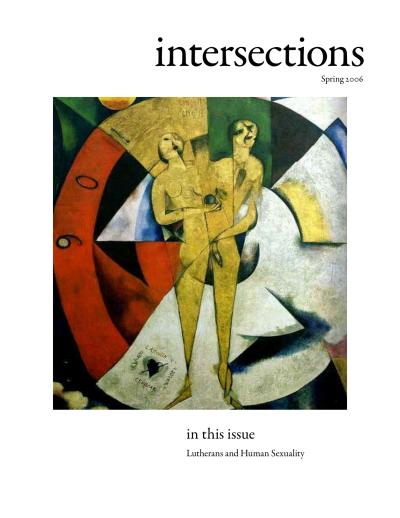 Editorial
From the Publisher
Arne Selbyg
Selbyg notes that both the ELCA and Intersections have undergone major changes this year—the Division for Higher Education and Schools is gone, replaced by the Educational Partnerships and Institutions group within the Vocation and Education unit, and the journal has a new editor (Robert Haak), a new home at Augustana College, a new printer, and a new design. He commends the issue’s focus on human sexuality and points readers to the first draft of Our Calling in Education.
-
Editorial
From the Editor
Robert D. Haak
Haak introduces himself as the new editor inheriting the journal from Tom Christenson and frames the issue around the question of what ELCA colleges might contribute to conversations about human sexuality. He summarizes the contributions of Yeager, Benne, Williams, Bussie, and Nack, and shares previously uncollected National Study of Youth and Religion data on the sexual attitudes and behaviors of Lutheran teens—including that 25% of regularly-attending ELCA teens report the church has done nothing to help them with their sexuality.
-
Article
Sexuality over the Lifespan—Social Trends Pose Moral Dilemmas for Communities of Faith
Adina Nack
Nack, a sociologist who presented to the ELCA Task Force for Studies on Sexuality, surveys empirical research on three life-stages flagged by the Task Force as particularly contested—premarital sexuality among adolescents and young adults, sexuality after divorce and within single parenting, and sexuality in late adulthood. Drawing on the Alan Guttmacher Institute, the Office of the Surgeon General, AARP, National Council on the Aging, and the World Health Organization’s 2002 definition of sexual health, she closes each section with questions about the church’s role in education, blessing of committed nonmarital relationships, and dismantling stereotypes about aging and sexuality.
-
Article
Ethical Deliberation and the Biblical Text—A Lutheran Contribution to Reading the Bible
Ritva Williams
Williams articulates a Lutheran “critical traditionalist hermeneutic”—a phrase borrowed from her Hebrew Bible professor Robert Polzin—that honors Scripture as queen while keeping Christ as its king, and tests it by critiquing Robert Gagnon’s use of Romans 1:18-32 in The Bible and Homosexual Practice. Drawing on Lazareth, Lotz, Philip Esler’s Conflict and Identity in Romans, Stanley Stowers’ Rereading Romans, and Ben Witherington III, she proposes an alternative reading in which Paul recites a Hellenistic-Jewish ethnic caricature in 1:18-32 only to overturn it in 2:1-16, making the passage a critique of self-righteous stereotyping rather than the foundation of a moral doctrine on same-sex intercourse.
-
Article
Scarred Epistemologies: What a Theology of the Cross Has to Say about the Gay Marriage Ban
Jacqueline Bussie
Responding to Robert Benne’s claim (citing Gilbert Meilander and Wolfhart Pannenberg) that one cannot defend gay marriage on biblical or confessional grounds, Bussie reads three theses of Luther’s Heidelberg Disputation alongside Moltmann’s Crucified God and Martin Luther King Jr.’s Letter from Birmingham Jail to argue that the theologia crucis—with its insistence on calling the thing what it is, its acknowledgment of scarred epistemologies and simul justus et peccator, and its refusal to domesticate God—exposes the Ohio Defense of Marriage Act as scapegoating, selective literalism, and an unjust law that the Christian conscience must reject.
-
Article
What Could the Lutheran Colleges and Universities Contribute to the ELCA Discussion of Sexuality—But What Would They Actually Contribute?
Robert Benne
Benne hopes that Lutheran colleges might model fair moral discourse on sexuality by gathering a balanced mix of what James Davison Hunter calls “orthodox” and “progressive” voices from religion and social-science faculties, with the Great Tradition treated as the default position. He doubts this is what would actually happen: citing Klein, Stern, and Western’s research showing a ten-to-one liberal-to-conservative ratio in social-science and humanities associations, he suspects Lutheran faculties skew further left than other private colleges and would simply reinforce the ELCA’s already-progressive seminary and churchwide leadership.
-
 Article
The Vocation of White People in a Racist Society
Caryn Riswold
No. 50 · Fall 2019
Riswold proposes that whiteness is a weakness borne of apathy, atrophy, and ignorance — an atrophied muscle of race-consciousness — and offers concrete practices (reading, adjusting one’s gaze, consuming media differently, drawing on ELCA social statements like the repudiation of the Doctrine of Discovery) for exercising that muscle and naming the vocation of white people in a racist and white supremacist culture.
-
 Book Review
Richard T. Hughes: How Christian Faith Can Sustain the Life of the Mind
Tom Christenson
No. 13 · Winter 2002
Christenson reviews Richard Hughes’s How Christian Faith Can Sustain the Life of the Mind (Eerdmans, 2001), which argues, drawing on Tillich’s notion of “religion breaking through its own particularity,” that faith is a means to the open pursuit of truth rather than its enemy. Christenson reads the argument as a natural fit for a Lutheran tradition of semper reformanda but notes Luther’s own dogmatism toward fellow reformers, and wishes Hughes had drawn a sharper line between an absolute truth that relativizes all human truths and a postmodern abandonment of truth altogether. The book was the most-cited title at the November meeting of North American Lutheran academic officers.
-
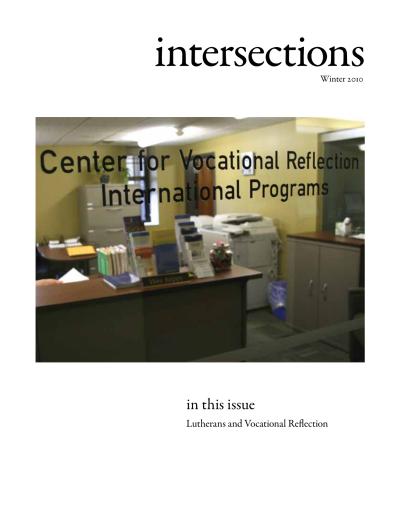 Article
A College with a Calling: Vocation at Augsburg
Mark D. Tranvik
No. 31 · Winter 2010
Tranvik narrates Augsburg’s decade of deep engagement with vocation—from President William Frame’s 1997 visioning process and the 2002 two-million-dollar Lilly grant for Exploring Our Gifts, through five Lutheran theological principles (vocation includes the whole life, lives for the sake of others, ranks all callings equal, cannot be reduced to ethics, and engages public life), to the Wilder Foundation’s Called for Life assessment and the 2008 founding of the Augsburg Center for Faith and Learning under Dr. Tom Morgan and the Bernhard Christensen Chair held by Dr. David Tiede.
-
 Article
The Lutheran Liberal Arts College and Care for the Earth
H. Paul Santmire
No. 3 · Summer 1997
Santmire, author of The Travail of Nature, proposes three mandates for the Lutheran liberal arts college: take responsibility for spiritual particularity by confronting the ambiguities of the classical Christian tradition (Lynn White’s charge against anthropocentric Christianity vs. the Franciscan ecological tradition from Irenaeus through Luther) and of classical Lutheran social ethics (the Two Kingdoms, Romans 13, the Third Reich, Bonhoeffer); promote responsible cultural criticism (against Thoreau’s sociopathic anti-urban suburbanism); and promote a holistic environmental ethos through an interdisciplinary core curriculum with ecology as the queen of the sciences, a community that liberates the social imagination (Mumford, Marcuse), a cosmic Liturgical praxis rooted in the Colossians 1:15–20 hymn to the cosmic Christ, and an academy that models ecological responsibility.
-
 Article
An Ecosystem of Democracy
David Thomason
No. 63 · Spring 2026
6 min audio
Thomason argues that faith-based institutions should equip students not to dominate the public sphere with their convictions but to cultivate an “ecosystem of democracy” — pursuing universal values with virtue and tolerance while acknowledging humanity’s incomplete grasp of truth.
-
 Article
Wilhelm Löhe and Higher Education
David Ratke
No. 30 · Fall 2009
Ratke recovers the educational vision of Wilhelm Löhe (1808–1872), spiritual father of Wartburg College and Wartburg Seminary, drawing on Löhe’s “Aphorismen über Schule und Schulunterricht” and other writings to argue that education is about the formation of whole persons by whole teachers in whole institutions, that all education is religious and never neutral, and that education is for eternity as well as the present — a vision in which the values of Christianity sanctify the so-called worldly means of education.