Robert Benne
Professor of Religion and Director of the Center for Religion and Society
Roanoke College
Published Articles
-
 Article
Point / Counterpoint: What It Means to be a "College of the Church"
Robert Benne, Tom Christenson
No. 28 · Fall 2008
Moderated by Wartburg College pastor Larry Trachte and introduced by Kathryn Kleinhans, this Wartburg campus conversation between Robert Benne (Roanoke College) and Thomas Christenson (Capital University) probes what it means to be a college of the church—Benne emphasizing ethos, vocation, and the Christian intellectual tradition over against secularization and generic education, and Christenson lifting up persistent vocational questions, the gift of difference, and induction into a community of discourse—and finds large common ground around hiring for mission, pedagogy that asks deep questions, and the courage to claim a living religious tradition while inviting everyone to the banquet.
-
 Article
What Could the Lutheran Colleges and Universities Contribute to the ELCA Discussion of Sexuality—But What Would They Actually Contribute?
Robert Benne
No. 22 · Spring 2006
Benne hopes that Lutheran colleges might model fair moral discourse on sexuality by gathering a balanced mix of what James Davison Hunter calls “orthodox” and “progressive” voices from religion and social-science faculties, with the Great Tradition treated as the default position. He doubts this is what would actually happen: citing Klein, Stern, and Western’s research showing a ten-to-one liberal-to-conservative ratio in social-science and humanities associations, he suspects Lutheran faculties skew further left than other private colleges and would simply reinforce the ELCA’s already-progressive seminary and churchwide leadership.
-
 Response
Response to Bishop Olson and President Tipson
Robert Benne
No. 16 · Winter 2003
Benne responds to two articles in the Winter 2002 Intersections: former Bishop Stanley Olson’s “The Marks of an ELCA College,” whose narrow reading of the two kingdoms cedes all epistemological claims to secular knowledge, and President Tipson’s engagement with The Future of Religious Colleges, whose “rather unchastened Enlightenment spirit” underestimates how loaded the social sciences and humanities are with their own philosophical and religious assumptions. Drawing on Reinhold Niebuhr, John Milbank, and William Buckley, Benne defends a “critical mass” of pervasively Lutheran colleges and calls on bishops and pastors to take the schools seriously lest they drift from their religious heritage.
-
 Article
Toward an Adequate Theology of Christian Higher Education
Robert Benne
No. 10 · Fall 2000
Drawing on his forthcoming Eerdmans volume Quality With Soul—Thriving Ventures in Christian Higher Education, which studies St. Olaf, Valparaiso, Notre Dame, Baylor, Wheaton, and Calvin, Benne argues that these schools have kept their souls because a critical mass of boards, administrators, faculty, and students treat the Christian account as comprehensive, unsurpassable, and central. He critiques four inadequate theologies of Christian higher education—pietism, liberal theology (Whitehead, Henry Nelson Weiman, the “values” turn, and accommodation to diversity and multiculturalism), “First Article” approaches (including Merrill Cunninggim’s Methodist version and a Lutheran two-kingdoms quietism), and reactionary/triumphalist theology—and contrasts the Catholic (Notre Dame), Reformed (Calvin, Wheaton, Baylor), and Lutheran (St. Olaf, Valpo) ways of relating faith and learning, calling Lutherans to recover “Christ and culture in paradox” as serious extended conversation rather than as a lazy excuse.
-
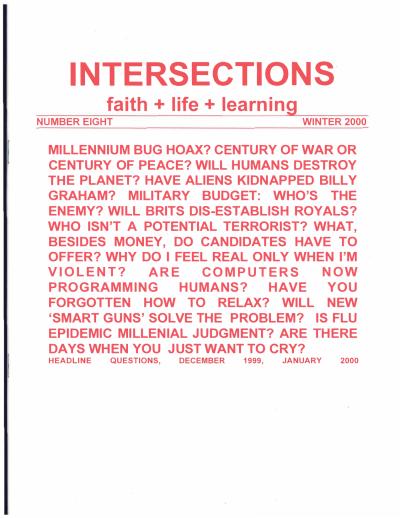 Article
Integrity and Fragmentation: Can the Lutheran Center Hold?
Robert Benne
No. 8 · Winter 2000
Benne answers the conference’s question pessimistically—“the Lutheran center cannot hold in many, if not most of our colleges, because it was never there in an articulated form in the first place”—and distinguishes “Christ of culture” colleges like the Midland Lutheran of his youth (Lutheran by ethno-religious ethos rather than by articulated theology) from James Burtchaell’s “confessional colleges” that operated from a theologically distilled Lutheran humanism. Drawing on Alasdair MacIntyre and Mark Schwehn’s First Things essay on Christian universities, he sketches what a Lutheran center looks like (unity, universality, integrity, a tradition of thought) and how its distortion—reducing the Gospel to justification and ceding everything else to autonomous reason—splits Christ and culture as dangerously as the German church separated Gospel and politics. For colleges that have lost their center, he proposes an “intentional, robust pluralism” that guarantees a Lutheran voice in every department and an “affirmative action for Christians” in hiring.