"The Earth is the Lord's And the Fullness Thereof": Six Theses Regarding Global Education at the Colleges of the Church
Intersections No. 18 · Fall 2003
Prologue
Global education is a significant aspect of the academic programs of the colleges of the ELCA. This has been true for most of our colleges for some time. We all send great numbers of students and faculty overseas for a variety of educational programs. Many of our colleges have specific ties to universities, governmental agencies, and national churches in the countries from which the founding members of our colleges and universities came. These international connections celebrate our immigrant heritage. Many of our colleges and universities work through the vast network of the ELCA and worldwide Lutheranism to develop educational opportunities for our students, faculty, and our alumni/ae. Many of our colleges and universities take part in elaborate consortia that support global education on our campuses through collaboration with other colleges and universities throughout the nation, thereby multiplying the options our students and faculty have to study abroad. Many of our colleges have numerous educational travel seminars run by our faculty for our alumni/ae. I have been a part of three of the colleges of the ELCA, Susquehanna, Bethany, and St. Olaf College. Each of these colleges encourages students, faculty, alumni/ae to study abroad and each invests a good bit of its resources of time, personnel, and capital to support these activities. At St. Olaf, for example, about two-thirds of each graduating class has studied overseas. We spend about four million dollars annually to support these programs.
I have talked thus far about global education in terms of sending students and faculty off campus and overseas. Global education can and does happen in other ways. Many of our colleges actively recruit international students so that a vital international community is nurtured on the campus, in the classroom, on the playing fields, and in the residence halls. I believe that Luther College is a leader in this area. The language villages of Concordia are of national distinction. Many of our colleges have highly developed academic programs that make direct and informed use of cross-cultural learning in many, if not all, classes and majors. Some disciplines, like Political Science, History, and Anthropology have been doing this for years, of course. Other disciplines are reshaping their departmental offerings to be more global in nature. The St. Olaf English Department, for example, has re-formed its curriculum to include not simply the English language and literature of the British Isles and the United States but to require work in English literatures from Canada, East and West Africa, and Asia. The Math Department has developed an extensive program with Hungarian mathematicians and their innovations in problem solving. Also, as new immigrant populations come into our communities, we have opportunities to do global education across the street and not only across the ocean.
Our Lutheran colleges do all of this because we want to nurture a sophisticated appreciation for the great host of men and women whose languages and cultures live in dynamic interaction with the languages and cultures of the United States. We have a demonstrated successful record in these endeavors. We have programs that are recognized nationally as being of the first order. The graduates of our schools make up a considerable proportion of the membership of the Peace Corps, the Lutheran Volunteer Corps, the State Department, and national and international non-governmental organizations involved in works of peace and justice world-wide. Given the radical disproportions of rich and poor, healthy and diseased, well fed and ill nourished, highly educated and illiterate throughout the world, the involvement of our colleges in global education is to be affirmed and strengthened so that our institutions and our students, faculty, staff, and alumni/ae and friends can be intelligent, equipped, active instruments of justice. Our campuses and our academic programs are like antidotes to a great body sick with injustice.
This is a brief description of our circumstance, a circumstance for which we can be grateful and of which we can be proud. It is also a circumstance that puts considerable pressure on the resources of our colleges, resources that already seem so greatly overburdened. In this essay, I would like to explore this pressing question with you: how shall we proceed? Given our rich heritage, the myriad demands for resources, the great shifts in the politics and economics of the nations, the ever-evolving information and communication technology, and new pedagogies, what might the future of global education be on and among our campuses as we collaborate with one another as sister academies? In order to find answers for this question that are appropriate to our individual campuses and helpful to us all, let me raise several theses about global education with you for your consideration. The understandings that arise as a result of our discussion of these theses will shape and inform our ways of proceeding into the future.
Thesis
1. Global education is a theological enterprise. By theology, I do not necessarily mean the study of a certain body of literature written by men and women who are themselves theologians, or becoming conversant with the methodologies and insights which these men and women have passed on to us. Such study is, of course, most helpful in preparing men and women for global education. When I say that global education is a theological enterprise, I mean that global education is about educating our students and faculty in such a way so that they are able to do theology, to be theologians, to think clearly and to speak cogently about God, to reflect analytically upon the human drama in light of the Gospel, and to live in relationship with the earth informed by the notion of creation.
For example, global education has fundamentally to do with learning the meaning of the First Commandment, “Thou shalt have no other gods before me.” Luther, in the Large Catechism, explains this commandment, in part, to mean, “Whatever your heart clings to and confides in, that is really your God.” To encounter other cultures, other languages, and other physical circumstances than the ones with which one is most familiar will be a test of what one’s heart clings to. Global education can be a central element in the movement from clinging to “our god”, through the clinging to many “gods,” to daring to confide in the one God.
This movement can be shaped by dialog with men and women of other cultures and other religious commitments, or with people who have no particular religious commitment at all. Such a dialog involves a conversation based in commitment, engagement with the other, basic skills in the language of the other, and sufficient time. The dynamics entailed in the first commandment can also be facilitated by wonder and awe, being overwhelmed by and drawn into the fascination of that which is beautiful and sacred. Often this happens outside of the confines of one’s own culture. Finally, the doing away with our gods so that we might dare to cling to God must be done through the hard and painful work of disillusionment. Leaving home, in all the rich meanings of that phrase, will be a sure test of one’s god and one will no doubt, if one has honesty and courage enough, become disillusioned with the narrow or petty scope of one’s god or the incapacity of one’s god to save, to inspire, to bring justice, to sustain, or to heal.
Global education can, therefore, equip our students to be able to say “credo” with intelligence and faithfulness. As a result of encountering men and women of other cultures theologically, students can have a more profound sense and greater confidence in that which they understand to be the wellspring of their lives. They can also have a clearer and more compelling sense of that to which they are called to be faithful, that to which they will give their hearts and minds, their strength, and their soul.
If global education in the colleges of the Church is a theological enterprise, as I believe it is, what does this say about the shape of the programs we devise? How do we train men and women in our colleges to be theologians, to do theology? What are the requirements of programs that allow men and women to make the perilous but freeing journey of the first commandment through dialog, through wonder and awe, and through the shattering moments of disillusionment that must precede a more vital faithfulness? Luther’s Large Catechism and the works of H. Richard Niebuhr can inform our thinking about global education as a theological enterprise.
2. Global education necessitates coming to terms with “the stranger” and “hospitality.” A mature understanding of these two terms is central to being able to live in a healthy fashion in the world, at home and abroad. By “stranger,” I mean both the encountering of the other one who is different from me and my kind, and alien to me and my ways. I also mean discovering that I am that one to others. At times, you are the stranger to me and I am the stranger to you. By “hospitality,” I mean the capacity to welcome the stranger into one’s own life, to appreciate his/her gifts, to consider seriously his/her needs, and to consider life’s opportunities and dangers together, in community rather than apart from the one another. Stories about the stranger and hospitality abound in Scripture and can inform this dynamic of global education in the colleges of the church. For example, in the Old Testament, Abraham and Sarah are themselves strangers among alien peoples, and they react to this circumstance in a rich variety of ways. Sarah and Abraham offer hospitality to strangers and are blessed. Other stories in Scripture tell the awful tales of violence toward strangers and the violation of hospitality. When one leaves home, one encounters others who may indeed seem strange or alien, but in this new context, one is always oneself a stranger and alien to those among whom one is now living and working. When one leaves home, one is in need of the hospitality offered by others. When an encounter with another person comes, so too comes the possibility for hospitality.
Coming to terms with what it means to be “the stranger” and what it means to offer “hospitality” helps us to think more clearly about the plethora of words and phrases that are bandied about these days to elucidate attitudes toward difference. Diversity describes the fact that many different kinds of men and women live together and apart in the world. Fear sees the other as a threat to be met with violence. Toleration moves from violence toward the other to allowing the other to be, but to be without respect or appreciation. Respect and appreciation of the other demand more from us than simply the recognition of diversity or toleration. We have to take the other seriously as a full human being if we are to respect and/or appreciate the other. Diana L. Eck, in Encountering God: A Spiritual Journey from Bozeman to Banaras, has thought through some of these dynamics, and her work can be instructive for us. Exclusion, she argues, seeks to protect the truth of one’s own community from others because the other is thought to be dangerous or their ideas and ways to be false. Inclusion allows for one community to live among other communities but it always imagines that one’s own community is superior to and encompasses the other, different community. The pluralist celebrates his/her own community but understands that it is not in sole possession of the truth. Other communities and individuals are therefore not threats or inferiors, but are understood to be men and women who also understand valuable truths about life’s meaning and purpose. They are, therefore, men and women to be engaged in conversation and dialogue so that the whole truth about life might be more fully known and lived.
We struggle on our campus with issues of diversity, fear, violence, toleration, respect, and appreciation. We struggle with issues of exclusion, inclusion, and pluralism. Global education forces us to come to terms with “the stranger” and “hospitality” and therefore can have a salutary influence on our campus debates and our students’ abilities to live out their lives in the increasingly diverse communities of which they will become a part after graduation.
3. Global education is in, for, and against the world. Global education takes the world as its object of study. What do I mean by “world?” World can refer to the globe or the earth, the great blue planet moving through space, the place we inhabit, creation. When we talk about the world in this sense, we are for the world because it is the object of God’s creation and care. Created by God, the earth/world is well worth wondering about and well worth studying. We are called to be for this world as well because we are called to be stewards, caretakers of the world.
“World” can also refer to the world of peoples and nations, languages and cultures, the ebb and flow of history. Certainly this, too, is the object of study for global education. But in this understanding of the “world,” Lutherans can find themselves both for and against the world. Our programs in global education are for the world in the sense that the peoples of the world are the objects of God’s grace and love. God has gifted these men and women with many wonderful and different ways to enliven human existence and to make life in community more secure. The colleges of the Church share in the mission of the church to promote reconciliation, peace, and justice among the peoples of the world. In these ways, and others, global education is for the world.
Yet our programs of study can also be against this world of people and history as well. For it is in this world that evil becomes real. By evil, I mean those forces and realities that crush the capacity for hope in individuals and in communities. Evil is not the devil in red tights, horns, and a pitchfork, prodding us “to bad things.” Nor is evil, necessarily, those acts of anger or violence we see in others and in ourselves. Rather, evil is those individual and collective forces which now make life so excruciatingly painful and confusing that a positive future is unimaginable. From this pool of despair, it seems to me, bad, angry, and violent actions can emerge. Evil is the force that crushes hope, and is not necessarily the inhumane acts themselves. Global education can help students identify, name, and encounter such forces and equip students to resist such forces with faithful intelligence and sagacious direct action. Global education can also help students understand that while evil is real, it is penultimate, and finally subject to God and the power of the Gospel. Hence, hope is possible. In this way, global education is against the world.
This discussion presumes that global education is in the world. The world is the place where one can come to know God and where one encounters evil. The world is the place where one comes to know oneself and one’s neighbor, the stranger and the friend. Global education, and education in general, does not take place, somehow, “out of the world.” The world is the context for learning and acting upon that which one knows to be true and which one believes to be sacred. Global education, in this sense of being in and for the world, is not finally apocalyptic but redemptive. The vision of global education, theologically understood, is not an all-consuming cosmic fire. The vision of global education in and for the world is Isaiah’s great banquet for all the nations (Isaiah 25) or the everlasting city John saw, through which a river passes on whose banks is the Tree of Life whose leaves bring healing to the nations. (Revelations 22)
4. Global education nurtures a sense of vocation in students. The kind of participation in the life of the world that global education can provide, enabling students to do theology, to come to terms with the stranger and with hospitality, to be in, for, and against the world, can also provide the context within which a student hears God’s call and says yes to that call with faithfulness, courage, and true humility. To oversimplify a profound and complex theological insight, the concept of vocation develops in this way. God creates the world in love. All of life is, therefore, a gift to be received with gratitude. God needs men and women to care for creation and calls men and women to use their particular gifts within a particular setting to sustain creation. This gracious intersection of the gifts and circumstances of one’s life provides the best opportunity for one to serve one’s neighbor and to give glory to God. Abraham Heschel wrote extensively about God’s expectation of “man” which is another way of talking about vocation. God, who is love, needs men and women and actively seeks them, pursues them, calls them. Our lives are the response to this loving, this seeking, and this pursuing. The point of the good life, therefore, is not the right job or the right succession of jobs that string together to make a noteworthy career, nor the aggregation of power or possessions or prestige to oneself. A life of worth is a life lived in response to God’s call, in a particular context, making good use of one’s gifts for the sake of others, the good of the earth, and the glory of God.
Another way of thinking about vocation is to think about the end or outcome or benefit of global education for the student. L. DeAne Lagerquist, Associate Professor of Religion at St. Olaf College, has spoken about our students becoming “cosmopolitan citizens.” This is an apt phrase that can describe well the vocational outcome for students of global education. The cosmopolitan citizen, as I understand DeAne, is one who knows how to act with reason and love for the sake of the world, a world that is ordered by One who is trustworthy, and a world with a hopeful future. The formation of such cosmopolitan citizens takes place within the context of the liberal arts, the Gospel, and global education. It requires all three components if a student is to develop a sense of vocation, a life lived worthily, informed by reason, love, the world, and sacred expectations.
5. Global education at the colleges of the church requires the sympathetic engagement of faculty, staff, and administration. I am using “sympathetic” here to mean something like “with the same passion.” The programs of global education at our colleges and many other liberal arts colleges and universities were often started by men and women who themselves had studied and lived overseas and whose lives had been changed in important ways by that experience. Ansgar Sovik, Professor Emeritus of Religion, one of the pioneers of global education at St. Olaf, was born and raised in China. Many of the colleges and universities of the Northeast have global education programs that date back to student missionary activities of the nineteenth century. I myself am the product of just such a program. The originating idea of these programs was to send liberally educated students abroad for extended periods of time, usually two years, to learn the language and culture of the people, and to be of some kind of immediate service to the people with whom one was living. The sojourners would then return to the U.S. with a sense of the world, with an appreciation for the life and culture of one other people, and in league with others who had traveled, studied, and served for the sake of the good of the world. Global education has developed in many new and important ways over the past century but the passion of our programs today, I believe, needs to be in harmony with the passion of the men and women of earlier centuries. The passion was not so much for adventure or having interesting experiences, or having a more interesting resume to help one open life’s doors. The central passion had to do with encountering other men and women on their terms and in their language so that one’s life might be better shaped for the purposes of service, most broadly understood, in any number of jobs and careers. Such a sympathetic understanding on the part of today’s faculty, staff, and administrators can be a counter balance to some trends in global education that trivialize its potency in favor of “having experiences” or “travel abroad” or “recruiting strategies.”
6. ELCA colleges need to exercise the gift of administration to bring greater clarity to the programs being offered by our campuses. Global education is frequently a major component of our academic programs. Many faculty, students, and administrators are involved in the administration of the programs. Considerable amounts of tuition revenue are invested in the programs. This is good and as it should be. We do, however, need to be clearer about the purposes and intentions of our programs. Just what is it that we intend to accomplish? What are the assumptions undergirding our pedagogy? What benefit do we hope students will receive from this kind of education? How are students prepared before leaving and how is their re-entry process designed and monitored? What value do students who have studied abroad or off campus contribute to the life of the campus upon returning? How does global education contribute toward faculty and staff development? What, if any, is the difference between a musical group or an athletic team traveling off campus and an overseas study group of students led by a faculty member? It is important for these questions and others like them to be asked in a systematic way on our campuses so that our programs can be more vital.
I also believe that it could be most helpful for us to consider all of the global education programs collectively being offered by the colleges of the ELCA as a whole. My sense is that, together, we have a portfolio of offerings that, like a portfolio of stock and bonds and real estate, needs to be evaluated and repositioned from time to time for maximum effect. Do we have duplication of effort? Which are the exemplary programs and how can we learn from one another to strengthen the whole? Should/could some agency serve as a kind of broker of programs throughout the ELCA so that all programs are adequately filled and staffed? I believe that our programs are too important and too expensive for each of us to try to offer an exhaustive variety of opportunities for our students and faculty single-handedly. Together, however, we can and do offer a remarkable range of course offerings.
Conclusion
The Psalmist sings out, “The earth is the Lord’s and the fullness thereof, the world and they that dwell therein.” (Psalm 24) A central dynamic of the vocation of the colleges of the ELCA is to inform our various programs of global education with the power and mystery of this verse. Seldom before have we in the colleges of the church needed to embrace the world, its fullness and its peoples, with grace and intelligence and understanding as we need to do so today. Seldom before has it been so absolutely crucial to remember that the earth is the Lord’s, and that it is the Lord who calls us to be agents of justice to the farthest coastlands and to be merciful to those who live next door. Let us pray for wisdom, courage, and freedom so that we might be faithful in the moment.
-
 Editorial
From the Publisher
Arne Selbyg
Selbyg reports that the ELCA Church Council’s new strategic directions include the charge to “assist this church to bring forth and support faithful, wise, and courageous leaders whose vocations serve God’s mission in a pluralistic world,” and assures readers that Intersections, the Vocation of a Lutheran College conferences, and related programs will remain among the tools by which the churchwide organization reaches its strategic goals.
-
Editorial
From the Editor
Tom Christenson
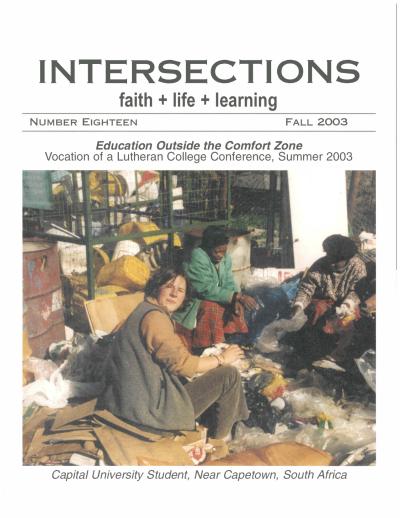
Christenson draws on a ten-year alumni survey at Capital University showing that students most often credit practica, internships, travel-study, and service-learning—not classroom hours—as the places they best learned the university’s stated outcomes, and introduces this issue’s papers from the Summer 2003 Vocation of a Lutheran College Conference on education and global outreach.
-
Article
Service Beyond the Comfort Zone
Kathryn Wolford
Wolford names economic globalization and the growth of civil society as the two issues shaping Lutheran World Relief’s mission, illustrating with the Guatemalan storekeeper undercut by subsidized “gringo” chickens, fair-trade coffee and chocolate campaigns, and Charles Onyango-Obbo’s warning about anti-terrorism laws in fragile African democracies. Drawing on Darrell Jodock, Art Simon, and the Good Samaritan, she frames the global vocation of Lutheran colleges as inviting students past comfort zones of race, class, ethnicity, and ideas through service-learning that links mercy and justice, and closes with a concrete LWR partnership invitation including site visits, internships, fair-trade campus campaigns, and the “A Place for Peace in Colombia” advocacy program.
-
Article
Educating for Peace: 21st Century Models for Thinking Globally and Acting Locally
Janet E. Rasmussen
Rasmussen opens with a rabbinic story about the one-step distance between East and West and describes Pacific Lutheran University’s four-phase “Global Education Continuum”—Introductory, Exploratory, Participatory, Integrative—developed with Teagle Foundation support and grounded in Perry, Bennett, and Musil. She illustrates intentional global/local partnership through three case studies: Barbara Temple-Thurston’s Trinidad-and-Salishan initiative; the China Partners Network with the Amity Foundation, Good Samaritan Hospital, and PLU’s Wang Center; and Ann Kelleher’s three-institution “Norway in Namibia” partnership with Hedmark University College, the University of Namibia, NAMAS, and the Ondao mobile schools for the Himba people. She closes with Daloz, Keen, Keen, and Parks’s Common Fire research and Lee Knefelkamp’s call to be “communities of peace.”
-
Article
The Search for a Just Peace in a Globalized World
Munib A. Younan
Younan, Lutheran Bishop in Jerusalem, grounds Palestinian Christian identity in Incarnation theology and a Lutheran theology of grace and the cross, then surveys the Evangelical movement’s nineteenth-century legacy in the Middle East—the 1864 Arabic Bible, ELCJ schools, women’s ordination, and the Middle East Council of Churches. Engaging Edward Said’s critique of Samuel Huntington, he calls for international and local mutual-recognition agreements (including the Jerusalem Lutheran-Anglican agreement and a Lutheran-Reformed agreement in the Middle East), four marks of interfaith dialogue, and a sharp distinction between Lutheran “Evangelical” identity and the Dispensationalist evangelistic Right whose Israel-Palestine scenarios he names a heresy. He closes by proposing concrete scholarship, faculty exchange, and sabbatical partnerships between U.S. Lutheran colleges and the ELCJ’s churches, schools, and Dar al-Kalima Lutheran Academy.
-
 Editorial
From the Publisher
Mark Wilhelm
No. 43 · Spring 2016
Wilhelm announces the new Network of ELCA Colleges and Universities — established in 2015 and convened for its first Board of Directors meeting in February 2016 — as a missional collaboration between the churchwide organization and the twenty-six ELCA colleges and universities, replacing former churchwide units lost to budget reductions and offering a stronger, more viable vision of Lutheran higher education.
-
 Article
Religion in the Age of Trump
Daniel A. Morris
No. 45 · Spring 2017
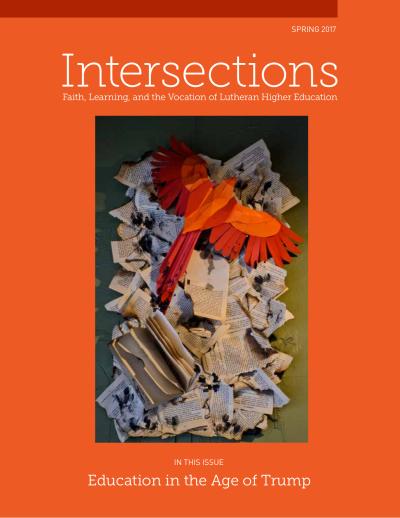
Morris reads the 81% evangelical vote for Donald Trump through two historical theses: that evangelicals’ once-coherent story about Godly participation in political life has fallen apart, and that their long-running tendency to exclude others — once aimed at Black Americans and Catholics — has now turned decisively against Muslims. He argues that scholars of religion and politics have a responsibility to tell these stories well, and that appeals to classroom objectivity can no longer be a luxury.
-
 Article
The Dangers of "Vocation" for Students Thinking about Career
Carl Hughes
No. 41 · Spring 2015
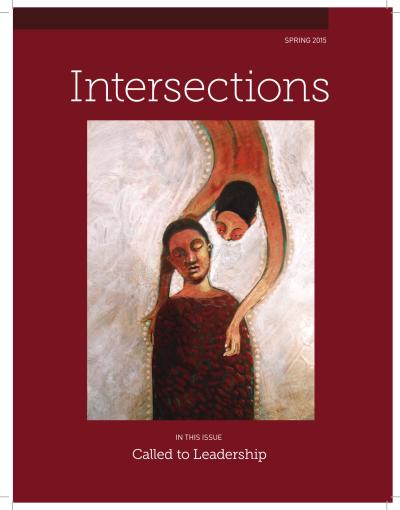
Hughes warns that Lutherans too often use “vocation” as a theologically glorified synonym for a fulfilling career — a misuse that constricts God’s call to our jobs and excludes minimum-wage workers, caregivers, and others from the dignity of calling. Recovering Luther’s expansive understanding, he argues that vocation refers first to people, not professions, and must always be bigger than any one aspect of our lives.
-
 Editorial
From the Publisher: Navigating Affirmative Action, DEI Policies, and Lutheran Vocational Identity
Lamont Anthony Wells
No. 59 · Spring 2024
Wells surveys the converging pressures on NECU institutions — the unsettled landscape of affirmative action, political and academic scrutiny of DEI work, and the preservation of distinctively Lutheran vocational identity — and previews how the issue draws on affirmative practices, sociological viewpoints, and theological responses to navigate a path forward.
-
Article
Women in Leadership: Obstacles, Opportunities, and Entry Points
Susan Hasseler
No. 41 · Spring 2015
Drawing on two focus-group conversations with female faculty and academic administrators at Augustana College (Sioux Falls), Hasseler traces four obstacle/opportunity themes for women in academic leadership — valuing the intellectual work of leadership, religious and cultural interpretations of gender roles, caregiving realities, and embracing a strong voice — and proposes deliberate next steps for cultivating inclusive excellence on ELCA campuses.
-
 Editorial
From the Publisher and Editor
Jason A. Mahn, Mark Wilhelm
No. 44 · Fall 2016
Writing weeks after the 2016 presidential election, Wilhelm and Mahn frame interfaith engagement as the urgent and ongoing work of ELCA colleges and universities, recap NECU’s growing commitments to inter-religious leadership, and introduce essays first delivered at the summer 2016 Vocation of a Lutheran College Conference under the theme “Preparing Global Leaders for a Religiously Diverse Society.”