Originally read as part of a presentation including the St. Olaf Cantorei and Paul Manz, organist
FAITH
It is the celebration of the one-hundred and twenty-fifth anniversary of the founding of Saint Olaf College which provides the context for this concert and the conference which will follow beginning tomorrow.
So in this setting of contemporary music, full of energy, emotion, and precision—let me draw you back to the words and music of an earlier time, the mid-1800’s, in a story told by the late Lutheran educator and theologian T.F. Gullixson. It is the story of an immigrant woman leaving Wisconsin with husband and family for the western frontier. The first day out with team and wagon they crossed the Mississippi River and made evening camp on the Minnesota side. Sitting by the campfire, Gullixson wrote, “her gaze did not waver while night came swiftly on. She held the contour of the eastward bluffs, for they were symbolic of all that had been” of former homes in Norway and Wisconsin, homes with the certainty of family, pastor, church, school, physician, and neighbor. And “sleep would not come; she must look out; she must look east.” Finally sleep came and soon after the dawn, the haze lifted off the river. “Soon the eastward bluffs” stood clearly in view again, but now her back was toward the east—she was looking west and awaited only the road ahead. In her heart was the song “Where God Doth Lead Me I Will Go.” The west wind carried promise—new land, new opportunity, new friends…and it also carried uncertainty. There would be no home, no school, no pastor, no doctor. But there was a song in her heart and so she turned her face to the west wind.
Not many years later five immigrants would gather at the parsonage in Holden: B.J. Muus the pastor, Harold Thorson the business man, and O.K. Finseth, K.P. Haugen, and O.O. Osmondson—all area farmers. They turned their faces to the west wind as they laid plans to begin a school amidst uncertainty about funds, facilities, and faculty. And, born amidst churchly disagreement, there were ecclesiastical uncertainties as well. But there was a song in their hearts, a song of faith and hope. Founder B.J. Muus provided the lyrics, “May the triune God in whose name this cornerstone is laid, be the foundation of this school to all eternity.”
Tonight and tomorrow and all the tomorrows to come, it is our turn to face the west wind and find our song. The west wind favors us in many ways—favors us with prosperity and friends and reputation beyond what Muus and his fellow founders would have ever imagined. And likewise the west wind carries challenge as the prosperity of the day does not extend to all whom we have been called to serve; the pragmatic paradigm of the day calls into question our commitment to matters of the spirit, and the morality of the day challenges our call to love the neighbor, to be reconciled with the enemy, and to care for the homeless.
But we press on in the face of the west wind, for like the pioneer woman at the river’s edge, we sing a song of faith. Tonight that text is supplied by a 13th century monk Venatius Honorius Fortunatas and the music by John Ferguson:
Faithful cross, true sign of triumph,
Be for all the noblest tree;
None in foliage, none in blossom,
None in fruit your equal be;
Symbol of the world’s redemption,
For your burden makes us free.
Yes, and with Paul Manz we will “rise and shine,” for Christ has entered and in Him, we are centered—so we too turn our face to the west wind.
UNDERSTANDING
From the beginning Christians have sought to demonstrate the place of education in the life of the believer. Jesus set the example and his disciples followed his lead. Perhaps the best-known axiom on the subject was rendered by the 11th century monk and bishop St. Anselm when he said, “Faith seeks understanding.” The founders of the Lutheran church, Martin and Phillip, were educators before they were reformers, they simply could not imagine a church without literacy and understanding. And so, when the pioneers who established St. Olaf went about their founding work, it might be described as a congenital condition. And the composers of your college song had it just right when they described St. Olaf as “founded in faith to render light.”
And we might add that, then as now, the college was to render light about both faith and life, for God gave us the gift of curiosity—curiosity about God and creation. Who is this God who expected of us so much, who despaired over us so much and who, ultimately, loved us so much? And we seek light about questions of life, of the earthly kingdom, which is to say questions of vocation. How then shall we live? We believe, confessionally and therefore congenitally again, that all of these things—faith and life, the heavenly and the earthly kingdoms—all of these things hold together.
With such gifts, such commitments, we face the west winds which often produce whirlwinds of conflict over truth and proof, over science and faith, over art and life, over impulse and virtue. While scientific determinism is under siege, pragmatism still has an inordinate power in shaping the agenda of the church, the academy and the culture. And post-modernism has created its own cyclone of confusion.
The challenge of the west wind for St. Olaf college is to live out a conviction expressed in the words of the late Harold H. Ditmanson who wrote “The Christian faith has a universal relevance to every aspect of human life. It is interested in science, history, literature, psychology, art, and politics. It has something to say about all of them, though it does not claim a technical authority within these spheres. It is concerned with every aspect of human relationship, personal and public. It is concerned above all with the interior life of each individual, the deepest level of one’s being.” These are words of understanding which follow naturally for those who believe that “God was in Christ reconciling the world to Himself.”
And a further challenge of the west wind is to do all of this well. Piety is no excuse for incompetence. The founders of St. Olaf and their progeny understood that. Muus put it this way, “I emphasized when I worked for the school that Christianty is honest. It avoids all humbug.” And when Lars Boe started building the great faculty of the ’30’s and ’40’s, he knew what quality required. So did his protege E.O. Ellingsen when he built a chemistry department that would rank among the top 25 in the nation in the production of chemistry majors. John Berntsen embodied the standard in his care for the grounds and facilities and historian Agnes Larson gave voice to the prerequisite of academic excellence when she said, “The only thing that can possibly make St. Olaf what it should be is an able faculty.” And when F. Melius Christiansen was asked how the choir produced such fine music, he replied, “We work! And again we work.”
And, make no mistake, it wasn’t easy. Lars Boe, in a beleaguered moment, said, “Just why the Lord has given us such large opportunities and so little money I cannot understand. I will be very interested in finding out in the hereafter.”
In the face of the west wind, our quest for understanding is an expression of vocation, occasioned by faith. In the composition of John Rutter the musicians voice our petition, “Open my eyes and I shall see! Incline my heart and I shall desire: order my steps and I shall walk in the ways of Thy commandments.” And in our antiphon, with Brokering we celebrate the vocation of this Lutheran college: “Earth and stars, classrooms and labs, loud-sounding wisdom—sing to the Lord a New Song.”
ACTION
Consistent with the fortissimo which we have just expressed, it may be observed that as creatures of the Midwest, this college and most of us have always been interested in where the action is. The woman at the river’s edge a century and a half ago, the founders in the Holden parsonage, the early faculty and their students too—the west wind stirred them to action. “Fram, Fram, Christmenn, Crossmenn”, “Forward, Forward, Men (People) of Christ, Men (People) of (the) Cross.” As Lars Boe put it, “St Olaf is not a college; it’s a crusade.” Faith was the motive, understanding was the modus, and action was the consequence. And not just action anywhere—action in church and culture, in the professions and in politics, in commerce and community. For faith, we know, is not a hothouse enterprise. Christ began by freeing people from their oppression, then taught them through parable and dialectic, and subsequently challenged them to take up their beds, to sell their goods, to care for the poor, to preach to the nations… to save the world!
The founders who established the college exemplified this formula. In the face of their west wind, many had dealt with the issue of slavery in church debates and political campaigns. In addition to building a school in Northfield, they built fine communities throughout the region. They were stalwarts in the political, cultural, and religious life of the day. The made some action calls with which we and they might disagree in hindsight, but they did not shrink from their calling and it was noble work.
And in our time the west wind calls us to action. Still twenty percent of the children in this country live in poverty, still in this new century the United States leads the nations of the world in homicides among children, still in some nations of this world homicidal violence toward women is condoned, still in this century religious wars rage on, still in this century a whole generation of one continent is being decimated by AIDS. And in closer places, still practices of civility are in short supply, virtue is defined individually, the environment is a tertiary issue and the gluttony of our consumption surpasses understanding.
And in the face of these ill winds, where is the faith? Where is the hope? Where is the action? It is the faith of things which are secure but unseen. It is the hope of the resurrection come alive in us. It is the action of redeemed people called to a new life. So, in the text of Ralph Vaughan Williams we bid God:
Come, my Joy, my Love, my Heart:
Such a Joy, as none can move:
Such a Love, as none can part:
Such a Heart, as joys in love.”
And after the crescendo of Vaughan Williams comes the reality of John Tavener, reminding us that we live under the sign of Adam, where our best action and intention may be subverted, where death and despair are partners in dialectic with life and hope. So in many respects, the text and music of Tavener are a dirge. This music, written on the occasion of the death of a 16-year-old girl to cancer, brings us face to face with the realities of a relentless and biting west wind. But then, at last, at the open grave, God bids us, “Come and enjoy the crown I have prepared for you,” and the dialectic is reconciled in both text and harmony. “Where, O death, is your victory? Where, O death, is your sting?”
So in the new millenium as in the old, all in this company are called—one by one and two by two—to be wise as serpents and gentle as doves.
Called to teach and heal and help.
Called to invent and encourage and endure.
Called to pray and proclaim and praise.
Called to mediate and meditate and multiply.
Called to renew, to restore, to reconcile.
In the face of the west wind we stand with Muus and Thorson, with the farmers Finseth, Haugen, and Osmondson, and with their considerable progeny. We sing diffemt music in these days, but we are stirred by the same song of faith. So Fram, Fram, Christmenn, Crossmenn! Forward, Forward, People of Christ, People of the Cross!
-
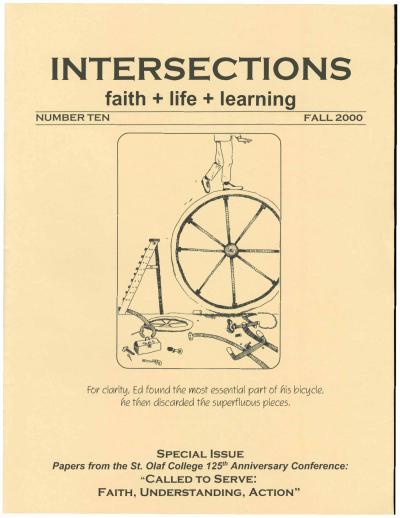 Editorial
From the Publisher
Arne Selbyg
Selbyg explains that, while Intersections usually publishes papers from the annual Vocation of a Lutheran College conferences, this issue gathers presentations from a St. Olaf 125th-anniversary conference—a companion to the volume Called to Serve edited by Pamela Schwandt—because the theology and educational perspectives behind them apply to any Lutheran college and clarify what makes ELCA church-related colleges excellent institutions for students of any faith.
-
Editorial
From the Editor
Tom Christenson
Christenson recommends the St. Olaf 125th-anniversary volume Called to Serve—edited by Pamela Schwandt with Gary de Krey and L. DeAne Lagerquist—particularly Walter Sundberg’s “What Does It Mean To be Lutheran?” and Darrell Jodock’s “The Lutheran Tradition and the Liberal Arts College.” He notes that the volume’s biographical sketches of Lars Boe, F. Melius Christiansen, Ole Rolvaag, Emil Ellingson, Agnes Larson, John Berntsen, Arne Flaten, and Howard and Edna Hong show, against an outsourcing age, that the life of an institution like St. Olaf is the committed life of the people who work there.
-
Article
Toward an Adequate Theology of Christian Higher Education
Robert Benne
Drawing on his forthcoming Eerdmans volume Quality With Soul—Thriving Ventures in Christian Higher Education, which studies St. Olaf, Valparaiso, Notre Dame, Baylor, Wheaton, and Calvin, Benne argues that these schools have kept their souls because a critical mass of boards, administrators, faculty, and students treat the Christian account as comprehensive, unsurpassable, and central. He critiques four inadequate theologies of Christian higher education—pietism, liberal theology (Whitehead, Henry Nelson Weiman, the “values” turn, and accommodation to diversity and multiculturalism), “First Article” approaches (including Merrill Cunninggim’s Methodist version and a Lutheran two-kingdoms quietism), and reactionary/triumphalist theology—and contrasts the Catholic (Notre Dame), Reformed (Calvin, Wheaton, Baylor), and Lutheran (St. Olaf, Valpo) ways of relating faith and learning, calling Lutherans to recover “Christ and culture in paradox” as serious extended conversation rather than as a lazy excuse.
-
Article
Education for Peace and Justice
David J. O'Brien
O’Brien surveys justice and peace education in Catholic higher education from Vatican II through the 1980s pastoral letters on nuclear weapons and the American economy, contrasting evangelical radicals (“what would Jesus do?”) with comfortable accomodationists, and argues that Catholic social teaching remains the church’s “best-kept secret.” Drawing on Bryan Hehir, David Hollenbach, Pope John XXIII, Patricia Hample’s “placing ourselves in the world to be of use,” and Martin Luther King’s last book on the “world house,” he develops pastoral care, solidarity (rooted in the mystical Body of Christ), and a realistic vocation-and-citizenship as the three needed responses for Catholic and Lutheran colleges alike.
-
Article
The Literature of Spiritual Reflection and Social Action
Shirley Hershey Showalter
Showalter, president of Goshen College, opens with Garrison Keillor’s “Singing with the Lutherans” and Walter Sundberg’s account of the Anabaptist “radical reformers” to locate Mennonite identity in a theology of suffering, humility, narrative, and song—tracing it through John S. Coffman’s 1904 “The Spirit of Progress,” Harold S. Bender’s 1944 “Anabaptist Vision,” John Howard Yoder’s The Politics of Jesus, and J. Lawrence Burkholder. She uses her Senior Seminar “Pedagogy of the Holy Spirit” reading of Viktor Frankl’s Man’s Search for Meaning, Madeleine L’Engle’s “Be a namer” and Walter Wink on the angels of institutions, and a Goshen Study-Service Term (SST) journal entry by student David Roth returning from Haiti—closing with two poems by Sarah Klassen—to argue for naming as the redemptive practice of church-related education.
-
Reflection
Vocation
Matt Peterson
In a chapel homily, St. Olaf student Matt Peterson quotes former St. Olaf professor Howard Hong’s 1955 Our Church and the World—“the tragedy is that we seem to have lost the full grasp of the Christian vocation”—to argue that vocation, from the Latin vocare, is centrally a call into daily communion with God and into continually becoming Christian, not the title of a successful career marked by GPA, win-loss records, honorary degrees, or net worth. Drawing on Anthony Bloom on prayer that must be lived, he indicts the dread of Monday, the “come hell or high water” demand for production, and the “faith community” that we take on faith.
-
 Article
A Lutheran Learning Paradigm
Paul J. Dovre
No. 34 · Fall 2011
Drawing on Hughes and Adrian’s Models of Christian Higher Education and on Ernest Simmons, Darrell Jodock, Tom Christenson, Robert Benne, and Richard Hughes, Dovre sketches a Lutheran learning paradigm shaped by four deep narratives—the biblical, the confessional, the theological, and the vocational—and traces their implications for curriculum (the study of scripture, theology, and vocation), for the religion faculty’s college-wide responsibility, and for pedagogy (moral deliberation, dialectic, paradox, the engagement of faith and the secular disciplines).
-
 Article
Lutheran Colleges: Past and Prologue
Paul J. Dovre
No. 30 · Fall 2009
Dovre offers a reminiscence rather than a research paper, drawing on Aristotle’s ethos, logos, and pathos to trace fifty years of change at Midwestern Lutheran colleges through the key issues of survival, respectability, faithfulness, and relationship to the church — from the dependence of the 1950s through the independence of the late twentieth century to the partnership of the 2000s — and identifies key variables (the student marketplace, faculty formation, and the identity/diversity paradox) for shaping the identity and mission of Lutheran colleges into the future.
-
 Article
The Lutheran Calling in Education: Context and Prospect
Paul J. Dovre
No. 23 · Summer 2006
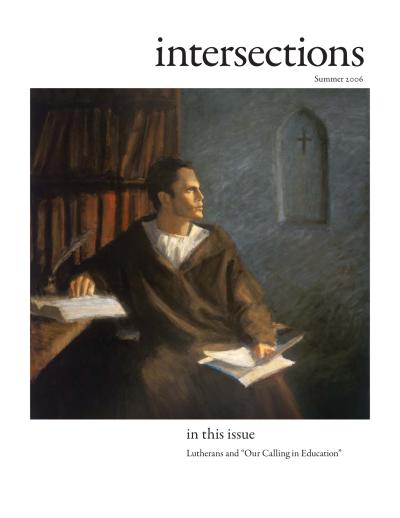
Dovre, President Emeritus of Concordia College and co-chair of the ELCA Task Force on Education, undertakes three tasks: focusing on the current social context (young people’s spiritual lives, the state of mainline denominations, the family map, schools, communities, and higher education); reflecting on why Lutherans care about education (creation in God’s image, vocation, Luther’s legacy, the priesthood of all believers, civic righteousness, and hope); and considering the prospects and possibilities for addressing the calling (biblical, confessional, theological, and pedagogical legacies; the renewal of apostolic ministry, the Christian-college renaissance, K–12 reform, and the congregational education explosion).
-
 Article
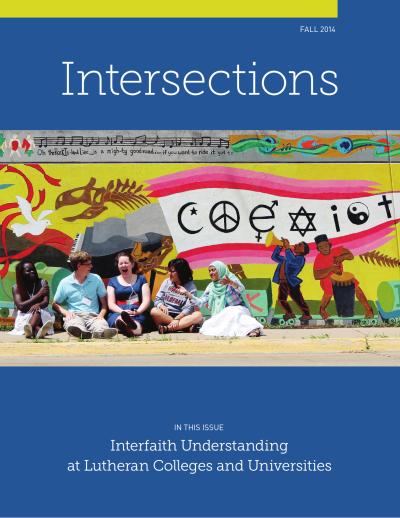
Journey Toward Pluralism: Reimagining Lutheran Identity in a Changing World
Jacqueline Bussie
No. 40 · Fall 2014
Bussie chronicles Concordia College’s Forum on Faith and Life initiative — assessing campus climate, building a President’s Interfaith Advisory Council, and drafting a one-sentence statement that Concordia practices interfaith cooperation “because of” (not “guided by”) its Lutheran identity — to argue that simul justus et peccator thinking equips Lutheran institutions to hold loyalty to tradition and reverence for others together as one piece.
-
 Article
What I Have Learned: Maybe Plato Was Right
Richard Ylvisaker
No. 4 · Winter 1998
Inaugurating the new “What I Have Learned” column, Ylvisaker reflects on a career of teaching philosophy at Luther College and offers four hard-won “preliminary examples” in which Plato turned out to be more right than fashionable criticism allowed: (1) communities are not necessarily better off by becoming more diverse—diversity needs a unity of purpose if it is to enrich rather than fragment; (2) politics, to be more than a struggle for power by competing interests, must rest on a moral basis that transcends those interests; (3) the much-derided body-soul dualism contains a measure of truth about the cognitive and moral limitations of embodied life; and, deepest of all, (4) reason itself depends on a community of discourse in which doctrinaire pronouncement gives way to disciplined inquiry. Athens and Jerusalem, he concludes, should meet at the college of the church.
-
 Article
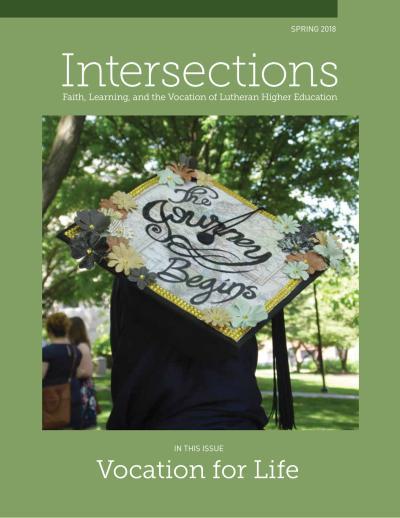
Luther, the Catechisms, and Intellectual Disability
Courtney Wilder
No. 47 · Spring 2018
Wilder confronts Luther’s deeply troubling response to a child with disabilities at Dessau, then mines his Small and Large Catechisms for a Lutheran theology of inclusion — reading the Third Article of the Creed, the petitions of the Lord’s Prayer, and the sacrament of baptism as resources that affirm the full humanity of people with intellectual disabilities as faithful children of God.
-
 Article
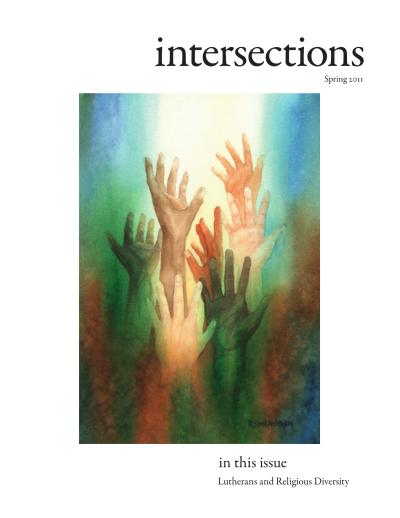
The State of Civil Discourse on Campus and in Society
Terence S. Morrow
No. 33 · Spring 2011
Morrow examines the troubled state of civil discourse in the United States and on college campuses, drawing on three deep traditions — the liberal arts, Lutheranism, and the Anglo-American legal tradition — to argue that Lutheran colleges can serve students and society by acknowledging the tensions inherent in civil discourse and helping students navigate them, and surveys promising campus programs at St. Thomas, Tufts, Loyola, and Harvard.
-
 Article
Hope in a Period of Economic Decline
Rebecca Judge
No. 32 · Spring 2010
Judge reads the 2008-2009 recession against the panic-free 1982 downturn and argues that this panic comes from the genuine surprise of a generation that had been told—by George Will and others—that business cycles had been tamed by deregulation, globalization, and Greenspan. Drawing on Luther’s “Trade and Usury” and Large Catechism, Paul Tillich, Stephen Marglin, Karl Polanyi, and Larry Summers, she critiques the “crude utilitarianism” of Homo economicus and benefit-cost analysis, finding hope in the possibility that this recession will renew a national conversation about moral obligation to neighbor in a market whose “raging bull” has broken out of its squeeze chute.
-
 Institutional Focus
Pivoting to Imaginative Programming in the Midst of the Pandemic at Bethany College
Arminta Fox
No. 55 · Spring 2022
Fox recounts how Bethany College’s NetVUE Program Development Grant — originally designed around service-learning trips — was reimagined under COVID-19 into a guest-speaker model that tripled student participation and opened new vocational possibilities through the close, personal stories of alumni, alums-turned-volunteers, and community partners.