There are two key issues shaping the global context in which Lutheran World Relief (LWR) works. The first is economic globalization; the second relates to civil society and human rights. I would like to offer some thoughts on challenges I believe we share as Lutheran institutions in this society. And I will close with some thoughts on service-learning as it relates to the global vocation of Lutheran colleges and opportunities for collaboration.
The Global Context
Is globalization good or bad? The definitive answer is…yes.
Globalization is a broad term; in fact, it has become something of a catchall for a wide variety of trends that encompass the cross-border flow and exchange of culture, ideas, people, technology, services, and capital and other resources. And infectious disease as well, as we were mostly recently reminded by SARS, which crossed borders with a human and economic impact from Taiwan to Toronto.
In the economic sphere, the flow of trade, investment, and services now far exceeds the impact of international aid flows in all but the very poorest and isolated nations. As we look at how the context for LWR’s mission has changed in recent years, a key factor is the extent to which global economic policies and institutions (both public and private) shape the constraints and opportunities available to impoverished communities, and perhaps, most especially to rural farm populations. People like the Guatemalan storekeeper in a remote village who finds it is cheaper to sell imported “gringo” chickens rather than the “criollo” chickens he used to buy from neighboring farmers to sell in his store. He hears about “free trade” but doesn’t think it is either free or fair when the imported chickens are government-subsidized; meanwhile, his neighboring farmers don’t even qualify for credit from the local banks because they don’t own land to use as collateral.
As LWR carries out our mission, we are in constant dialogue with our local church and non-governmental partner organizations about: 1) how to harness positive contributions, and 2) how to minimize negative consequences of these global economic forces for people living in chronic poverty. For us, this is first and foremost an ethical question, and secondly, one of strategies and tactics; or to put it another way, it is first about how to be faithful in responding to God’s concern for the poor and oppressed—it is about mission; and secondly, about our theory of social change and strategic choices on how to carry out our mission in the most effective way possible with the available (and always limited) resources.
I wish I could say that we have been tremendously successful in helping poor rural farm communities in Asia, Africa and Latin America “compete” in the global market or to find sustainable “opt out” alternatives. We support a number of programs that have successfully placed organic or non-traditional crops with good returns; one example of this is an association of farm cooperatives in Bolivia that sells lima beans in the Brazilian market. However, far too many others are finding their products (for example, traditional crops like corn in Central America or rice in India or cotton in Mali) undercut by subsidized imports or unfavorable tariff barriers.
There are some innovative strategies like fair trade that provide a positive alternative by cutting out the middlemen and guaranteeing a minimum price to producers hard hit by the collapse of global prices for their products. LWR has led the U.S. faith community in mobilizing our Lutheran constituency and recruiting other faith communities to buy fair trade coffee and chocolate as one way to promote greater economic justice for a small, but growing number of producers. Advocacy to influence the major coffee corporations seeks to ‘mainstream’ fair trade principles and practices on a larger scale.
Overall, the playing field is far from level under the international trade regime. To quote the ELCA Social Statement on Economic Life, “Developing countries that have opened their economies to global markets have generally reduced poverty over time more than those that have not, but the terms of trade often work to the disadvantage of developing countries.” More worrying and significant for our work for justice and sustainable development are the increasing gaps in the distribution of income and assets within countries. Whether we are talking about a basic human survival need such as food or a higher-level resource like technology, equitable access and control are at least as important as aggregate quantity and availability of these resources.
Another key factor shaping our work over the past decade is the growth and increasing dynamism of civil society around the world. The most single positive force in our work over the last decade is probably the growing involvement of institutions like churches and non-governmental organizations, as well as the women’s and environmental movements, working for a stronger policy framework, practice, and culture of civic participation. This includes a growing push for more responsive and responsible governance, and for greater transparency and accountability of national and international public institutions, as well as private sector corporations. This is strengthened by a growing awareness among civil society as well as an evolving legal framework for the protection of human rights, including social and economic rights as well as civil and political rights.
There are many exciting cases of citizens using global communication technologies to gain access to information that their own governments have censored or withheld from them. Likewise, global civil society has electronically rallied around causes like the International Campaign to Ban Landmines, a highly successful effort to e-mobilize citizens in far-flung corners of the globe to influence their respective national governments and the UN system toward an international treaty (which, by the way, the U.S. has still not signed so we still have work to do here on the homefront).
For Americans, pre-September 11, 2001, terrorist acts happened in Ireland or Chechnya or some place we couldn’t pronounce. September 11 was yet another expression of globalization—one that graphically brought home the porous nature of national borders. Soon after these attacks, Jessica Matthews, President of the Carnegie Foundation for International Peace wrote, “The most important point is the most obvious: 9/11 changed the United States far more that it did the rest of the world. ‘Homeland security’ is more than a new word in our vocabulary; it is a concern that makes us more like the rest of the world than we have ever been before.” More like the rest of the world, perhaps, yet quite distinct in terms of the predominance of U.S. military, political, and economic power. In response to the attacks on the World Trade Center and the Pentagon, the U.S. and other governments have set in motion a series of policy decisions and actions, whose long-term impact on the global context is still unfolding.
However, in a recent op-ed in the New York Times, African journalist Charles Onyango-Obbo voiced the concerns of many about the impact of the war on terrorism on the yet fragile, emerging culture of human rights, citizen participation and governance in much of the world. He wrote, “In the United States, antiterrorism laws that strip away some civil rights in the name of national security will not roll back human rights significantly—but in Africa they will. Only in the last 10 years have pro-democracy campaigns resulted in constitutions and laws that allow press freedom, fair trials, honest elections and other basic rights. The roots of these laws are so shallow that a single antiterrorism law simply wipes them out.” It will be both ironic and tragic if measures meant to provide security ultimately undermine constructive trends toward more open, participatory and democratic societies.
I have tried in a short—and for that reason oversimplified—manner to highlight two of the major issues and trends impacting the people LWR serves and the context in which we carry forth our mission and ministry. What implications does such a context have for the mission and global vocation of Lutheran colleges?
The Global Vocation of Lutheran Colleges
Business literature points time and again to the increasing value and ‘marketability’ of individuals who develop attitudes, skills and knowledge that enable them to thrive in multicultural and multinational contexts. This is one of many compelling and legitimate arguments that can be made for ‘globalizing’ higher education in general. But, for Lutheran colleges, I think an institutional global vocation goes beyond this type of strategic positioning statement.
It seems to me that an essential aspect of the institutional vocation of Lutheran colleges is to create an academic, social and spiritual environment that encourages students to explore their beliefs, values and personal vocation, one that invites students to live with purpose in all dimensions of our human existence.
Part of a global vocation for Lutheran colleges is shaped by the very global nature of the Christian Church and by our understanding that God’s creative and redemptive work is carried out in every corner of the world—and that no nation has cornered the market on God’s mercy and love.
A significant contribution of the Lutheran theological perspective is to boldly affirm the relational and public nature of faith. Faith is not relegated to the private sphere, nor only to our most closely held relationships of family and kinship.
An anecdote from Lutheran World Relief’s earliest days illustrates this understanding. In 1945, one in seven Lutherans worldwide was a refugee. It would have been easy to say that U.S. Lutheran aid should be directed to our extended family members in Europe; instead, the founders of LWR insisted that aid should be distributed based on need, regardless of religion, national origin or political affiliation. (By the way, today this is a widely accepted core principle of humanitarianism.)
To proclaim the good news of God’s love for the world—for every person and for the whole of creation is by its nature relational and public. Professor Darrell Jodock, professor of religion here at Gustavus Adolpus College, writes, “Luther’s Christianity was anything but privatized. The freedom of the Christian is not just a freedom from self-help plans, but a freedom for service to the neighbor and the larger community.”i
And who is my neighbor? The story of the Good Samaritan ends with a definition of “neighbor” as the person who is in need of our compassion and care. It also ends with the call to be a neighbor—to be the one who reaches out to another in need—even when it takes us beyond our comfort zone. Or the text may be read to assert more boldly, especially when it takes us beyond our own comfort zones.
In speaking of LWR, one of our board members paraphrases our mission as: “to comfort the afflicted and to afflict the comfortable.”
Comforting the afflicted: the grind of poverty and oppression are the challenges facing the people LWR serves. The people we seek to serve, accompany, and empower are challenged by situations of poverty or oppression that most of us have never experienced and sometimes can’t even imagine. Daily bread is a challenge, let alone life in fullness.
And while it is a generalization that may have some significant exceptions on U.S. Lutheran college campuses, our dominant societal context poses a different set of challenges. Challenges like:
- Apathy: it’s not my problem, it doesn’t impact me, so let someone else deal with it—not unlike the Levite or the priest on the road to Jericho in the Good Samaritan story
- Cynicism: The often widespread distrust of government (influence of PACs and special interests), corporations (Enron), non-profits (United Way) and the church (child abuse scandals, internal conflicts)
- Feeling overwhelmed and numbed: When you hear statistics like 1 billion people live on less than $1.00/day or 24 million people in Africa are HIV positive, it is easy to think: I am just one person, what difference can I possibly make? It is easy to become paralyzed by the magnitude of the problems…and retreat to one’s comfort zone.
A relatively high level of material and economic comfort can make us more susceptible to these afflictions; likewise when we take for granted the rights that most (certainly not all) in our society enjoy. Art Simon, a Lutheran and founder of the Christian advocacy network Bread for the World, said, “The problem is not that we’ve tried faith and found it wanting, but that we’ve tried mammon and found it addictive, and as a result find following Christ inconvenient.”ii
I would like to suggest that the global vocation of Lutheran colleges is to engage and equip students to move beyond preferred comfort zones—comfort zones of race, class, ethnicity, nationality, ideas, and more. Lutheran colleges in this time and society are called to help students delve into an exploration of their beliefs and values, and how these relate to the choices they make now and into the future.
- Choices as a neighbor in a global community that each day grows more interdependent, impacting not only people today, but also the environment for future generations
- Choices as a citizen of this nation with incredible freedom to speak, to vote, to participate—here in the most powerful nation on the face of the earth
- Choices as a consumer in a global marketplace of goods and services, produced under widely varying labor and environmental conditions
It is less to afflict than to invite, encourage, nurture, and yes, nudge students to take a leap of faith outside their preferred comfort zones. For a good number of students, college is the first opportunity to take such a leap or even a modest step beyond the boundaries of that is most familiar.
There is an African proverb that says, “You cannot know the bugs of the bed you haven’t slept in, nor where the roof leaks in a house where you have never lived.” In particular, service-learning can provide extraordinary opportunities to check out bugs and roof leaks that we would not otherwise encounter—intimately through contact with people whose lives embody the key issues of our day. Direct assistance through volunteerism and service is important and can enhance dignity and well-being; it can build and sustain relationships.
But, direct service alone is not sufficient for understanding and addressing the underlying causes of poverty and it consequences. It does not necessarily lead to a commitment to justice-oriented change, change that sees the secure shelter of a non-leaky roof as a right. For that, the relationships must be built on a mutual sharing, including our willingness to be transformed by those we too often see only as the beneficiaries of our service and compassion. We need to be open to having our often deeply held assumptions and understandings challenged. In a global context of radical differences in power and resources, this is neither easy nor necessarily comfortable.
Might the global vocation of Lutheran colleges in the 21st century include a conscious effort to link mercy and justice, particularly in the area of service-learning?
To quote Prof. Jodock again, “…mercy is not easily embodied in institutional structures. In order to protect people, institutions and governments need policies that promote justice.”iii He notes that U.S. Lutherans have tended to give far more attention to social service than to political activism, i.e. to addressing policies and structures.
In suggesting that service-learning might be focused on taking students beyond their preferred comfort zones, I know that some Lutheran colleges are already doing innovative programming that exemplifies this approach—bringing to bear experiential, academic, and spiritual dimensions, and making the connection with values and vocation.
In this vein, I would like to close with an invitation to collaboration with LWR.
One of the strategic directions for LWR in our organizational plan for 2003-2007 is “to engage and equip young adults to be catalysts for social and economic justice in the world—helping to create the next generation of leaders for global justice within the church and society.” And, college-age youth were identified as the priority age group for this outreach.
Of all the pieces of our plan, this is one that generates the most excitement from our board. However, it is also the biggest stretch for LWR in determining our specific niche and competencies.
LWR would like to collaborate with institutions that share an understanding of service-learning that includes: experiential learning coupled with critical analysis through reading and through listening to the perspectives of people/communities living in situations of impoverishment or oppression; reflection on values and vocation, and opportunities for sustained follow-up such as advocacy, consumer choices and community-based actions. At LWR, our bias is that the listening, learning and then leading is more important than the direct service rendered in service-learning programs. We are interested in partnerships with institutional backing whereby not only students but also some faculty, administration, and the chaplain’s office could share commitment and ownership.
LWR can bring to the table:
- Locally managed, community empowerment programs in numerous countries in Latin America, Africa, and Asia that could be powerful site visits for college-sponsored service learning trips and study-abroad programs.
- Policy papers and program materials that could be useful as case studies for curriculum development.
- A small number of internships each year. Over 90% of our interns have been women and people of color. Some have joined our professional staff, several have gone on to seminary, and others are working overseas in various capacities. They have been deeply shaped—both ethically and professionally—by their time with us and our organization has gained tremendous passion, expertise and insight from their time with us.
- Social responsibility projects, such as fair trade coffee and chocolate, and education and advocacy campaigns on campus; these could provide useful follow-up engagement for students returning from overseas service-learning programs that introduce them to global economic and policy issues. In this area, I would like to mention a couple of specific opportunities:
- LWR is organizing an immersion trip to Central America for college students and faculty, January 2-10, 2004, focusing on fair trade coffee and its economic and social impact.
- The LWR campaign “A Place for Peace in Colombia” focused on education and advocacy about U.S. policy and aid to the war torn nation of Colombia. Quite a few Lutheran campuses are already involved in this pilot program to link programs and advocacy within Colombia to policy advocacy among U.S. Lutherans. You can check the LWR web site for more information, www.lwr.org.
- Fair trade coffee on your campus; in the cafeteria, and/or coffee shop; you can do this through the LWR Coffee Project; or if you are already hooked on Starbucks or a similar brand, use your purchasing leverage to insist that Starbucks provides your college with fair trade coffee.
- Fair trade chocolate: another winner for campus events. Both chocolate and coffee can provide case studies for classroom research, and links to other areas of student activism, such as child labor issues, and debt.
I will leave you with a quote from the writer E.B. White:
“If the world were merely seductive, that would be easy. If it were merely challenging, that would be no problem. But I arise in the morning, torn between a desire to save the world and a desire to savor the world. That makes it hard to plan the day!”
Endnote
- “A Lutheran Vision of Ministry.” Remarks by Professor Darrell Jodock, Lutheran Services in America Conference, March 2003.
- How Much is Enough? Hungering for God in an Affluent Culture, Arthur Simon (Grand Rapids, MI: Baker Book House, 2003).
- Jodock, op. cit.
-
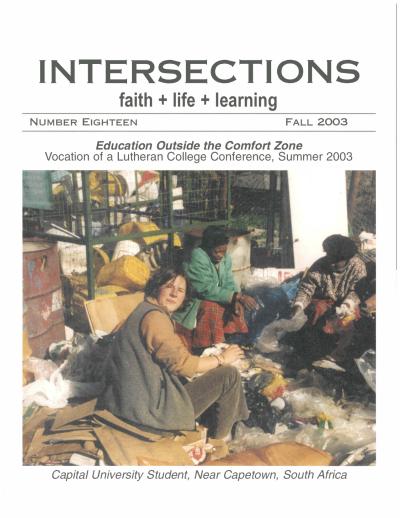 Editorial
From the Publisher
Arne Selbyg
Selbyg reports that the ELCA Church Council’s new strategic directions include the charge to “assist this church to bring forth and support faithful, wise, and courageous leaders whose vocations serve God’s mission in a pluralistic world,” and assures readers that Intersections, the Vocation of a Lutheran College conferences, and related programs will remain among the tools by which the churchwide organization reaches its strategic goals.
-
Editorial
From the Editor
Tom Christenson
Christenson draws on a ten-year alumni survey at Capital University showing that students most often credit practica, internships, travel-study, and service-learning—not classroom hours—as the places they best learned the university’s stated outcomes, and introduces this issue’s papers from the Summer 2003 Vocation of a Lutheran College Conference on education and global outreach.
-
Article
"The Earth is the Lord's And the Fullness Thereof": Six Theses Regarding Global Education at the Colleges of the Church
Christopher M. Thomforde
Thomforde surveys the breadth of global education across ELCA colleges—Susquehanna, Bethany, St. Olaf, Luther’s international students, Concordia’s language villages—and then frames its future around six theses: global education is a theological enterprise that teaches the First Commandment through dialog, wonder, and disillusionment; it necessitates coming to terms with “the stranger” and “hospitality” (drawing on Diana Eck); it is in, for, and against the world; it nurtures vocation and forms L. DeAne Lagerquist’s “cosmopolitan citizens”; it requires sympathetic engagement of faculty, staff, and administration in the spirit of pioneers like Ansgar Sovik; and it calls the ELCA colleges to exercise the gift of administration to bring greater clarity and collective coordination to the portfolio of programs offered across the twenty-eight institutions.
-
Article
Educating for Peace: 21st Century Models for Thinking Globally and Acting Locally
Janet E. Rasmussen
Rasmussen opens with a rabbinic story about the one-step distance between East and West and describes Pacific Lutheran University’s four-phase “Global Education Continuum”—Introductory, Exploratory, Participatory, Integrative—developed with Teagle Foundation support and grounded in Perry, Bennett, and Musil. She illustrates intentional global/local partnership through three case studies: Barbara Temple-Thurston’s Trinidad-and-Salishan initiative; the China Partners Network with the Amity Foundation, Good Samaritan Hospital, and PLU’s Wang Center; and Ann Kelleher’s three-institution “Norway in Namibia” partnership with Hedmark University College, the University of Namibia, NAMAS, and the Ondao mobile schools for the Himba people. She closes with Daloz, Keen, Keen, and Parks’s Common Fire research and Lee Knefelkamp’s call to be “communities of peace.”
-
Article
The Search for a Just Peace in a Globalized World
Munib A. Younan
Younan, Lutheran Bishop in Jerusalem, grounds Palestinian Christian identity in Incarnation theology and a Lutheran theology of grace and the cross, then surveys the Evangelical movement’s nineteenth-century legacy in the Middle East—the 1864 Arabic Bible, ELCJ schools, women’s ordination, and the Middle East Council of Churches. Engaging Edward Said’s critique of Samuel Huntington, he calls for international and local mutual-recognition agreements (including the Jerusalem Lutheran-Anglican agreement and a Lutheran-Reformed agreement in the Middle East), four marks of interfaith dialogue, and a sharp distinction between Lutheran “Evangelical” identity and the Dispensationalist evangelistic Right whose Israel-Palestine scenarios he names a heresy. He closes by proposing concrete scholarship, faculty exchange, and sabbatical partnerships between U.S. Lutheran colleges and the ELCJ’s churches, schools, and Dar al-Kalima Lutheran Academy.
-
 Editorial
From the Publisher
Mark Wilhelm
No. 36 · Fall 2012
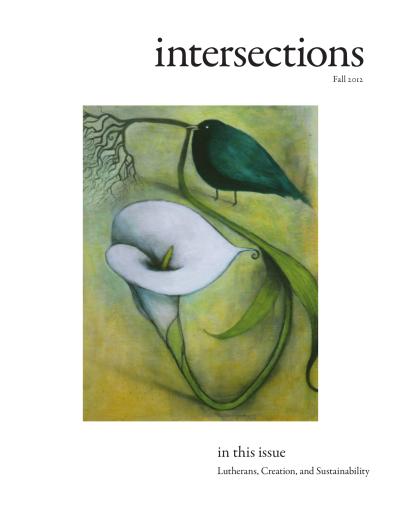
Wilhelm argues that the rhetoric framing ELCA higher education as a binary between “secular” and “religious” is “hokum”: there is a third way of doing higher education from a Christian perspective that is religious in motivation and practice but on the ground looks secular. After more than half a century of debates, he calls on ELCA presidents to “do something” in 2013 to move forward in shared mission and vocation.
-
 Article
Fragmented in Faith: The Concerns and Hopes Found in Student Spirituality and Civic Engagement
Emma Bohmann, Monica Sitachitta
No. 63 · Spring 2026
11 min audio
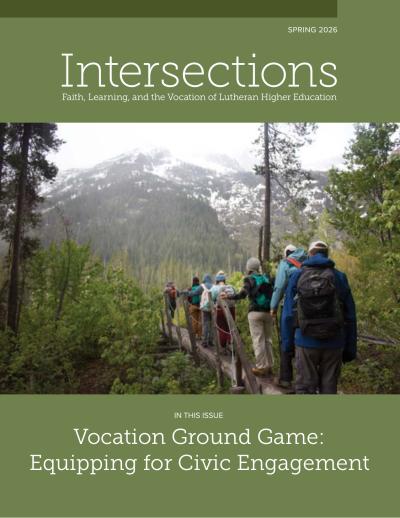
Two Texas Lutheran University students reflect on the cyclical pattern of low spiritual and civic engagement on their campus and argue that distinguishing Lutheran values from Lutheran practice could open space for civic engagement to become a non-optional expression of neighbor-justice for all students.
-
 Article
Hospitality to the Wild
Laura M. Hartman
No. 54 · Fall 2021
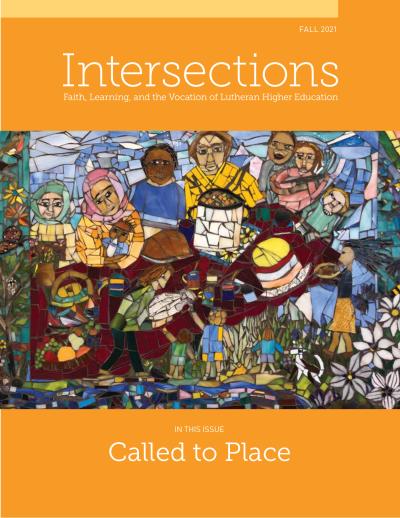
Drawing on research with a Wild Ones Native Landscaping chapter and Marilyn Matevia’s ethic of “creature comfort,” Hartman argues that Christian hospitality must extend to non-human animals and plants — and asks whether college campuses can foster not just human diversity but biodiversity.
-
 Article
Luther's Theology of Learning: Discovering the Vocation of Today's Small Lutheran Liberal Arts College
Eric Childers
No. 20 · Fall 2004
In an excerpt from his Wake Forest University Divinity School senior thesis, Childers profiles six students hand-picked by presidents and chaplains at Concordia College (Moorhead), Lenoir-Rhyne College, and Muhlenberg College—Nathan Gossai, Amy Nelson, Alison Schmidt, Ryan Sigmon, Julie Christianson, and Jeffrey Slotterback—as a living testament to Luther’s theology of learning. He then draws on Solberg, Mark R. Schwehn (in Paul J. Dovre’s The Future of Religious Colleges), Robert Benne, Ernest Simmons, Mark Noll, Richard Hughes, and James Burtchaell to argue that Lutheran colleges have not yet fully articulated their own theology of education and that their vocation is to embrace, engage, and galvanize a Lutheran tradition of learning rooted in the liberal arts, Scripture, the Confessions, and confident ecumenism.
-
 Editorial
From the Publisher
Arne Selbyg
No. 24 · Fall 2006
Selbyg situates this issue in the ongoing ELCA conversation about education that began with the 2005 conference and is feeding into the second draft of the ELCA Social Statement on Education, previews the 2007 conference (“The Vocation of a Lutheran College — Engaging the World”) at Augustana College, Rock Island, and lifts up Luther’s insistence that the church and its members contribute to their wider communities rather than retreat into self-centered enclaves.
-
 Article
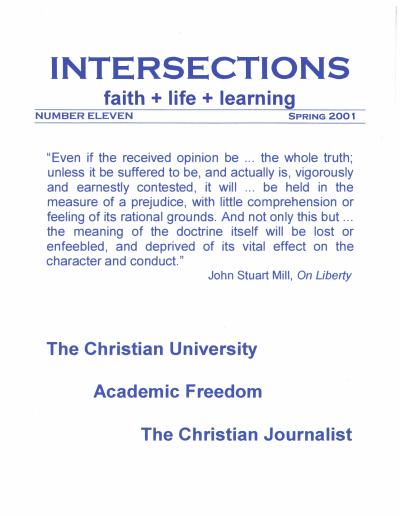
Can a Christian Be a Journalist?
Catherine McMullen
No. 11 · Spring 2001
McMullen recounts how Ernie Mancini’s alumni-program invitation forced her to articulate what a print-journalism major at Concordia might be, then surveys the annus horribilus of 1998—Chiquita and the Cincinnati Enquirer, CNN/Time’s retracted Tailwind story, Patricia Smith and Mike Barnicle fired at the Boston Globe, Stephen Glass at The New Republic, and Matt Drudge and the White House scandal—before contrasting Concordia’s liberal-arts approach with Pat Robertson’s Regent University, whose “Christian journalism” produces one-sided vampire-cult stories and graduates who conclude journalism is no place for a Christian. Drawing on Richard Baker’s The Christian as a Journalist, Tom Christenson on the “law of niceness,” Ernie Simmons, Harmon Smith and Louis Hodges on Christian ethics, Robert Benne’s Lutheran four orders and his “Christian cobbler makes good shoes, not poor shoes with little crosses on them,” Mel Mencher, Robert Bugeja, Walter Cronkite, Pete Hamill, Jeremy Iggers, David Remnick, the Northwestern Death Row exoneration of Dennis Williams, Verneal Jimerson, and William Rainge, and Pulitzer citations for Katherine Boo, Eric Newhouse, George Dohrman, and Mark Schoofs, she argues that journalism is a Lutheran vocation and that Christian cobblers—and Christian journalists—make good shoes.