Luther was a relational thinker. For him one relates to God through faith and to the neighbor through love. This is the inner and the outer person referred to in “The Freedom of a Christian.” The Lutheran sensibility is that life is a paradox, a dialectical tension, in the midst of which one must act and live. Life need not be simple and clear in order to be livable and intelligible. Drawing upon Luther’s model of simultaneity for the Christian life (e.g., simul justus et peccator), such a dialectic, a movement between contrasting positions, can offer both affirmation and critique as it supports dialog involving multiple points of view, contributing to mutual understanding and constructive change. Such a theology can inform a dynamic interaction between Christian freedom and academic freedom and assist in constructively critiquing the emerging global society in which we find ourselves immersed. We must argue neither for a faith so detached from the surrounding culture as to lack intellectual credibility nor for a faith so accommodated to a particular culture as to sanctify its idolatry and hubris.
My thesis is that the Lutheran tradition informs an open and dialectical educational model that encourages the dynamic interaction of faith and learning supporting a vocational understanding of leadership. I will turn first to a brief discussion of legacy and then to leadership, considering particularly the Lutheran dialectical model of higher education and its usefulness for preparing leaders for our time.
Legacy
Valuing the liberal arts, Luther thought the fundamental purpose of Christian education was to preserve the evangelical message and to equip the priesthood of all believers for service in the church and the world. For Luther and his colleague, Philip Melanchthon, one of the direct results of the theological doctrine of justification by grace through faith was public education. In his treatise of 1524, “To the Councilmen of All Cities in Germany That They Establish and Maintain Christian Schools,” Luther states this in a very practical manner:
Now the welfare of a city does not consist solely in accumulating vast treasures, building mighty walls and magnificent buildings, and producing a goodly supply of guns and armor. Indeed, where such things are plentiful, and reckless fools get control of them, it is so much the worse and the city suffers even greater loss. A city’s best and greatest welfare, safety, and strength consist rather in its having many able, learned, wise, honorable, and well-educated citizens. They can then readily gather, protect, and properly use treasure and all manner of property.” (355)
For Lutheran higher education that purpose has not changed but the context has. The task now is to bring into creative interaction relationships of faith and learning in an increasingly global and multicultural society. In her recent book Not for Profit: Why Democracy Needs the Humanities, Martha Nussbaum argues forcefully for the value of liberal arts education to prepare future leaders to think critically and creatively for our time of global transition. She says there is a “silent crisis” at hand in education because so much of the arts and humanities is being dropped in American higher education in favor of emphasizing quantitative and technical skills (Nussbaum 1-12). At a time when critical thinking is needed the most, a time of rapid global change and adaptation, we are deemphasizing it in many of our educational institutions. For Nussbaum, nothing less than the survival of a democratic society is at stake (121-44). Lutheran higher education has retained the arts and humanities, actually relished in them such as in our music programs, while not neglecting the applied sciences and practical skills. Nussbaum’s “manifesto,” as she calls it, would support exactly what we are about at most of our colleges and universities in the United States. But the pressures are upon us as well. The challenge is to preserve this legacy of liberal arts education at our institutions so that it can continue to provide critical thinkers for our time. If liberal arts education is to remain true to its roots it must not lose its originating purpose of cultivating informed, civil leaders but rather find creative ways to express it today. Joseph Sittler put it so well: “The purpose of liberal arts education is to complicate a person open” (Sittler).
Leadership
Dialectic stands at the heart of the Lutheran tradition precisely because Luther refused to separate the life of faith from life in the world. Luther insisted on the Christian life being lived right in the midst of the world so that the resources of faith must be brought to bear on daily work and life, not in some separated, ostensibly more holy or religious sphere such as a monastery. This simultaneity gives rise to two realms in Luther’s thought. The realm of today, the natural world, governed by the civil use of the law in society and guided by reason, and the realm to come, the kingdom of God, governed by grace and guided by faith. The Christian lives in the interface, the overlap, by being in the world but mindful of a world to come. The Christian lives in both worlds simultaneously. Richard Hughes summarizes:
The authentic Lutheran vision, therefore, never calls for Lutherans to superimpose the kingdom of God on the world as the Reformed tradition seeks to do. Nor does it call for Lutherans to separate from the world as the heirs of the Anabaptists often seek to do. Instead, the Christian must reside in two worlds at one and the same time: the world of nature and of grace. The Christian in Luther’s view, therefore, is free to take seriously both the world and the Kingdom of God. (“Mission” 6)
This dynamic “withness” sustains dialogue and does not fear a slippery slope into secularity. Rather, it encompasses all of life, including that which is labeled secular. For the secular, too, is part of God’s creation, which must be brought into dynamic relationship with faith and the potentially transforming grace of God.
“The secular, too, is part of God’s creation, which must be brought into dynamic relationship with faith and the potentially transforming grace of God.”
This very dynamic sustains openness and academic freedom in higher education while at the same time insisting on bringing this world of knowledge into dynamic relationship with the Christian faith and Christian freedom. The result can often be messy, paradoxical, and ambiguous—but that is where faith gives one the strength to continue on. Faith frees the mind for open inquiry and creative reflection, for we are not saved by our own understanding but by the grace of God. Hughes observes, “The task of the Christian scholar, therefore, is not to impose on the world—or on the material that he or she studies—a distinctly ‘Christian worldview.’ Rather, the Christian scholar’s task is to study the world as it is and then to bring that world into dialogue with the Christian vision of redemption and grace” (“Models” 6). To conduct open reflection in dialog with transcendence is clearly one of the most important contributions Lutheran colleges and universities can make to the church’s mission of enlightened understanding of the faith, which empowers educational service to society. In a culture where public discourse, especially about matters of religion, is not encouraged or even welcome, colleges of the church may offer one of the most effective venues for such deliberations. Our students, our society, and our religious institutions need such reflection for we live in a time of significant spiritual searching.
“In a culture where public discourse, especially about matters of religion, is not encouraged or even welcome, colleges of the church may offer one of the most effective venues for such deliberations.”
From the beginning of the Enlightenment through the middle of the twentieth century, it had become common to speak of a separation between fact and value, science and religion, nature and history. Nature, as object, had no intrinsic development but was rather to be understood through scientific analysis in a value free inquiry where both human and religious purposes were considered to be irrelevant. History, on the other hand, was the realm of human purpose and religious value. History was that in which civilizations rose and fell, charting their course in dominating an impersonal world. I have come to understand this split as a false duality. History would not exist without nature and nature itself has a history. I agree with Parker Palmer that epistemologies have moral trajectories; ways of knowing are not morally neutral but morally directive (Schwehn 25). Ways of knowing necessarily include ways of valuing, so a complete separation of fact and value is not possible. All facts are value-laden for it is precisely the values imbedded in interpretive systems that permit the conversion of raw data into meaningful fact. That is the function of theories, models, and paradigms, whether they be in the sciences or the humanities. This condition of the presumed separation of fact and value combined with flux, impermanence, and mass media merchandizing has led to a collapse of traditional, cultural frameworks of meaning. Today this condition is not only local and national; it is increasingly global.
Historically, individuals found personal meaning through the received religious and cultural explanations of their time—but no longer. Renate Schacht, speaking from a German Christian perspective, refers to the formation of what she calls a “collage identity” among many persons, especially the young, today. She observes:
Modern man [sic.] has no fixed roots. Mobility, flexibility, plurality of standpoints, and freedom of opinion development are key characteristics of modern life. These truly positive characteristics, however, bring a dark side of insecurity and disorientation with them, which can retreat behind fundamentally secured walls or vegetate into a “nothing matters” position. The task of education then is to make other paths visible and accessible. (Schacht 68)
It seems to me that the role of a Lutheran college is exactly this—to offer such alternatives to identity formation (see Simmons ch. 1). Identity is a process not a possession and environment forms identity. Lutheran as well as other Christian colleges and universities may assist this meaning-seeking, identity-forming process by cultivating an environment in which faith and learning can be kept in dynamic relationship, which in turn cultivates the possibility of vocation.
“Lutheran as well as other Christian colleges and universities may assist this meaning-seeking, identity-forming process by cultivating an environment in which faith and learning can be kept in dynamic relationship, which in turn cultivates the possibility of vocation.”
The Lutheran tradition’s emphasis upon vocation is one way to give theological grounding for responsible leadership. It centers upon one basic question that has two fundamental dimensions. The question is: Why are you here? The first dimension is the practical, why are you here? Namely, why are you working at the place you are currently employed? What are you doing now and why are you doing it there? This is the realm of practical engagement with life on a daily basis. This first dimension of the question is of the here and now variety. The second dimension cuts more deeply, however: Why are you here? That is, why do you exist? This is the existential dimension of the question, the dimension that focuses on the nature and challenges of human life. Why are you here and not someone else? Why did you come into life or existence at all? Where did you come from and to where are you going? The practical is composed of the necessary factors of place, history, resources (both physical and human), and structure. The existential is composed of the philosophical and theological dimensions of human existence.
In a rather simplified manner, one could say that the practical dimension addresses instrumental questions of value (means), while the existential dimension addresses questions of intrinsic value (ends) for human life. The point is this: Vocation occurs at the intersection of these two dimensions of the why question. Vocation, in the Lutheran understanding, addresses the practical from the context of the existential. It seeks to connect purposes and practices, ends and means, and not allow them to fall apart into separate realms. Why are we here? Luther’s answer was vocation. It is through our work in the world that we incarnate faith and by doing so help sustain the creation. Vocation rejects the separation of the material from the spiritual, of nature from grace. It insists that they be kept together.
“Vocation rejects the separation of the material from the spiritual, of nature from grace. It insists that they be kept together.”
The Lutheran understanding of vocation empowering for public service can serve the common good. Certainly Luther’s proposal of the “common chest” is a clear sixteenth century example of such a pursuit (Lindberg 141). He was concerned to provide for the poor and needy since monasteries and convents, the historic source for such care, were being closed. Not only public education but also social service organizations were a direct result of the Lutheran Reformation. Our educational systems, accordingly, were organized to offer instruction for leadership in such programs and institutions. It is education for the common good. But the common good for any given situation must be discerned through dialog and mutual participation by all parties involved. Vocationally-inspired leadership will seek such dialogue.
Always Reforming
The human question of why always hangs suspended between the finite and the infinite. Juxtaposed between time and eternity, humanity seeks meaning before its own beginnings and after its demise. Part of the grandeur of being created in the image of God, of humus (soil) becoming spirit-breathed and self-conscious, is the ability to ask why. Human beings are meaning-seeking creatures. We are a form of incarnation where the spiritual is made manifest in the material precisely in the transcending of self-interest. Nicholas Berdyaev once observed, “To eat bread is a material act, to break and share it is a spiritual one” (Gilkey 229, Cobb ch. 10). Spirituality is opening up to the needs of the other, to transcendence of the self, and to possibilities of meaning beyond materialistic consumption alone. The study of the liberal arts assists one in opening up to the transcendent dimensions of life and, in so doing, equips faith for meaningful expression in service to the other. That is why there has always been a close connection between liberal arts education and the Christian faith.
“The study of the liberal arts assists one in opening up to the transcendent dimensions of life and, in so doing, equips faith for meaningful expression in service to the other. That is why there has always been a close connection between liberal arts education and the Christian faith.”
The Lutheran model of such an education is particularly helpful here because of its dialectical openness to alternative viewpoints and their dynamic interaction. It critiques contemporary society by bringing it into dialectical engagement with Christ and the Gospel. Such a model avoids what Tom Christenson has termed the “fallacy of exclusive disjunction” (Christenson 12). There are middle positions between exclusion and accommodation in higher education and the Lutheran dialectical model is one. The theology of the cross encourages humility both in terms of one’s own thought and also in the claims of others. Such a theological perspective can and should confront any claim to absoluteness or finality (Tillich’s “Protestant Principle”), especially in its secular expressions.
The great challenge facing mainline religious institutions and faith traditions is to communicate their religious reflection in a way that is accessible to persons living in a technologically socialized, mass media driven, popular culture dominated society. I think the social media that have emerged in the last few years demonstrate how younger people have come to live in the virtual world as authentically as in the so-called “real” world. They move seamlessly and effortlessly between what used to be called “virtual” and “real” reality, a distinction becoming increasingly one without a difference. Work-a-day reality is not going to disappear but the interface between these realms has become diaphanous for the “digital native.” Social organization has undergone a sea change. It has been developing for a long time but we have now reached a tipping point in how social (or political) movements, such as the “Arab spring,” are formed and motivated. We have witnessed Facebook and Twitter revolutions. We are in the beginnings of what can only be called the birth pangs of an emerging new world of global social structures. It is a technologically mediated social revolution but then again, wasn’t the Reformation? Education for leadership today must involve critical and creative thinking as well as dynamic social interaction.
Conclusion
The model of education at a Lutheran institution is ultimately education for self-transcendence, education that draws the student out of her/himself to acknowledge the needs of their neighbor. It is interactive education that always holds in tension academic and Christian freedom, reason, and faith without forcing a premature closure of thought in either direction. It is education for vocational leadership expressed in public life. It is preparation for leadership Soli Deo Gloria.
Works Cited
Christenson, Thomas. The Gift and Task of Lutheran Higher Education. Minneapolis: Fortress, 2004.
Cobb, Jr. John B. The Structure of Christian Existence. Philadelphia: Westminster, 1967.
Gilkey, Langdon. Shantung Compound. New York: Harper & Row, 1966.
Hughes, Richard T. Models for Christian Higher Education. Grand Rapids: Eerdmans, 1997.
_____. “The Mission of Lutheran Colleges and Universities.” 1997 Lina R. Meyer Lecture presented to the Lutheran Educational Conference of North America (LECNA), February 1, 1997, Washington, D.C.
Lindberg, Carter. “Luther on Poverty.” Harvesting Martin Luther’s Reflections on Theology, Ethics and the Church. Ed. Timothy Wingert. Lutheran Quarterly Books. Grand Rapids: Eerdmans, 2004.
Luther, Martin. “The Freedom of a Christian.” Luther’s Works (American Edition), volume 31. Philadelphia: Fortress, 1962.
_____. “To the Councilmen of All Cities in Germany that They Establish and Maintain Christian Schools.” Luther’s Works (American Edition), volume 45. Philadelphia: Fortress, 1962.
Nussbaum, Martha. Not for Profit: Why Democracy Needs the Humanities. Princeton: Princeton University Press, 2010.
Schacht, Renate. “Christian Education in Unstable Times.” Luther and Melanchthon in the Educational Thought in Central and Eastern Europe. Ed. Reinhold Golz and Wolfgang Mayrhofer. Munster: LIT Verlag, 1998.
Schwehn, Mark. Exiles from Eden. New York: Oxford Univ. Press, 1993.
Simmons, Ernest. Lutheran Higher Education: An Introduction. Minneapolis: Augsburg/Fortress, 1998.
Sittler, Joseph. “Church Colleges and the Truth.” Faith, Learning and the Church College: Addresses by Joseph Sittler. Northfield, MN: St. Olaf College, 1989.
-
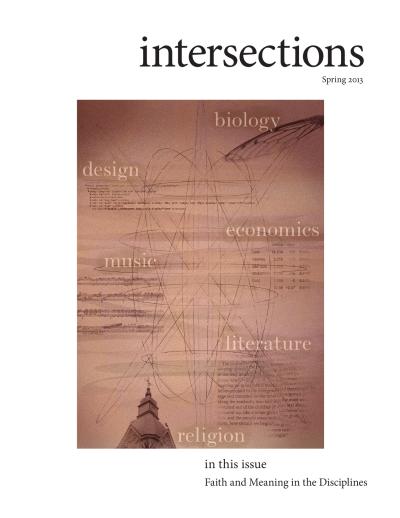 Editorial
From the Publisher
Mark Wilhelm
Wilhelm reports that decisions at the February 2013 LECNA and ELCA presidents’ meetings authorized reviews of funding and organizational practices and appointed a working group to draft a presidential statement on what it means to be a college or university of the ELCA, signaling a more substantive future role for the annual presidents’ gathering in shaping the shared identity and common mission of ELCA schools.
-
Editorial
From the Editor
Jason A. Mahn
Mahn introduces the issue’s six essays as parallel attempts—from poetry, economics, choral music, biology, religion, and Lutheran higher education—to resist our culture’s fact-value split, and uses Augustana’s Fritiof Fryxell, a 1922 biology and English graduate who began teaching just as the Scopes Trial ignited, to illustrate how church-related colleges have long held faith and disciplinary inquiry together.
-
Article
Valuing Poetry
Allison Wee
Writing from California Lutheran University as “value” in higher education collapses into “can it get you a job?”, Wee makes a case for poetry as a life-saving discipline. Drawing on William Carlos Williams, Shakespeare, the Psalms, Wordsworth, Pattiann Rogers, Mary Oliver, and her own Environmental Literature assignment that sends students outside for an hour of attentive stillness, she argues that the poet’s skill of translation cultivates the close attention, fresh perspective, and immaterial dimensions of life her students need most.
-
Article
Calling Economists
Lynn Hunnicutt
Reading Luther’s Whether Soldiers, Too, Can Be Saved alongside Adam Smith’s Theory of Moral Sentiments and Wealth of Nations, Hunnicutt asks whether economists, too, can be saved—and whether economics can host a serious conversation about vocation. She traces her own move from Utah State to Pacific Lutheran University and its Wild Hope Center for Vocation, and turns to Deirdre McCloskey and George DeMartino as economists whose work makes room for vocation and the common good within the discipline.
-
Article
Singing Faith
Adam Luebke
Luebke describes the Waldorf College Choir as a community of faith whose daily devotions, century-long lineage from F. Melius Christiansen, and disciplined wrestling with sacred repertoire—from Fauré’s Requiem to African-American spirituals to Romans 8 sung backstage—form students spiritually as they form them musically, so that fully grasping what they sing becomes a discovery of why they sing.
-
Article
Living Biology
Stephanie Fuhr
Fuhr recounts how a one-credit Becoming Biologists course at Augustana College was rebuilt around the biological worldview after a student flagged John Janovy Jr.’s argument that values are legitimate tools in biology. Drawing also on Stephen Jay Gould’s The Mismeasure of Man, she argues that visions and values—not skills alone—inspire a life’s work in science and provide the foundation for lifetime engagement in the work of biology.
-
Article
Professing Religion
John D. Barbour
Barbour reflects on the vocation of a Professor of Religion at St. Olaf College, asking when and how a teacher should disclose personal faith in the classroom. Drawing on his graduate teachers Anthony C. Yu and Langdon Gilkey, and on Augustine’s Confessions, Dorothy Day, Malcolm X, C. S. Lewis, and Kathleen Norris, he argues that teaching autobiography invites teaching autobiographically—and that professing religion is finally a matter of how one believes, not just what.
-
 Editorial
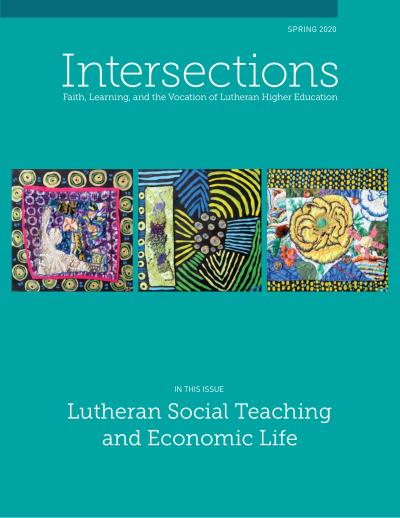
Guest Editorial: Moral Deliberation in NECU Classrooms
Ernest L. Simmons
No. 51 · Spring 2020
Simmons introduces the guiding question of the NECU working group: could the ELCA’s twelve social statements and thirteen social messages — expressions of Lutheran social teaching originally formulated for congregational use — turn campuses into “academic communities of moral deliberation”?
-
 Article
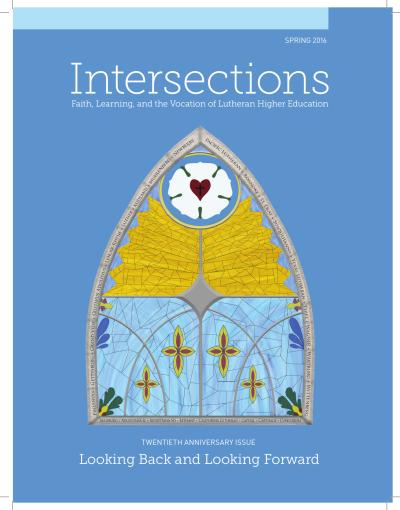
Semper Reformanda: Lutheran Higher Education in the Anthropocene
Ernest L. Simmons
No. 43 · Spring 2016
Simmons enumerates the ELCA initiatives over the past twenty years that have helped Lutheran higher education retrieve a Christian understanding of vocation, then argues that the looming reality of human-caused climate change — the geological epoch of the Anthropocene — now requires Lutheran liberal arts education to prepare students for “planetary citizenship” as sustainability leaders, drawing on the classical Trivium, Luther’s panentheism, and a quantum-physics-inflected theology of divine entanglement and hope.
-
 Article
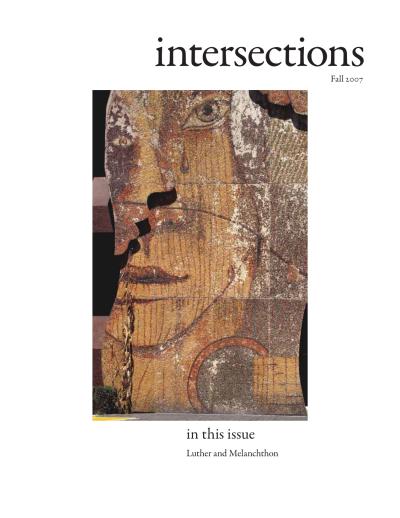
Lutheran Higher Education and the Public Intellectual
Ernest L. Simmons
No. 26 · Fall 2007
Simmons argues that college faculty and administrators are, like it or not, public intellectuals, and that Lutheran higher education’s dialectical understanding of Christ and culture is well suited to support four functions of the public intellectual: articulating constructive critique of received social explanation (especially the “collage identity” described by Renate Schacht); presenting a transcendent theological perspective through the theology of the cross that takes seriously God’s hiddeness, the presence of ambiguity, and the reality of suffering; pursuing the common good amid the demise of the “commons” through H. Richard Niebuhr’s “Christ and Culture in Paradox”; and educating for citizenship through Christian vocation by connecting the practical and existential dimensions of the question “Why are you here?”
-
 Article
The Lutheran Theological Tradition and Recruiting Lutheran Students
Ernest L. Simmons
No. 13 · Winter 2002
Simmons opens with an Abraham-and-Isaac “Windows 98” joke to illustrate the dialectic of faith and learning, then argues that in a new market era of limited religious background, intentional mission and marketing go together. Drawing on Levine and Cureton’s When Hope and Fear Collide for the Millennial Generation born in 1982 and Tom Beaudoin’s Virtual Faith for their GenX parents, he reads “Reclaiming Lutheran Students” survey results showing 86% strong community at ELCA colleges versus 54% at flagship publics and 61% alumni mentoring versus 39%. He then develops three areas where the Lutheran tradition uniquely equips its colleges—community, mentoring and vocation, and the integration of faith and values—using Luther’s “two kingdoms” image of the “Left Hand” (reason) and “Right Hand” (faith) of God, with academic freedom as a product of Ahlstrom’s “Critical Current” in the tradition, and closes with three challenges: recruiting and retaining mentoring faculty, educating church leaders, and reaching potential students and parents.
-
Book Review
Richard T. Hughes: How Christian Faith Can Sustain the Life of the Mind
Tom Christenson
No. 13 · Winter 2002
Christenson reviews Richard Hughes’s How Christian Faith Can Sustain the Life of the Mind (Eerdmans, 2001), which argues, drawing on Tillich’s notion of “religion breaking through its own particularity,” that faith is a means to the open pursuit of truth rather than its enemy. Christenson reads the argument as a natural fit for a Lutheran tradition of semper reformanda but notes Luther’s own dogmatism toward fellow reformers, and wishes Hughes had drawn a sharper line between an absolute truth that relativizes all human truths and a postmodern abandonment of truth altogether. The book was the most-cited title at the November meeting of North American Lutheran academic officers.
-
 Article
Lutheran Higher Education in Global Context: Called to Serve the World
R. Guy Erwin
No. 27 · Spring 2008
Erwin advances three theses on the global vocation of Lutheran higher education: that the vocation of a Lutheran college is to live out its mission in a service-oriented way; that Luther’s definition of vocation as love of neighbor must today have global dimensions; and that a Lutheran college best fulfills its vocation when it fosters a global perspective in its community, curriculum, and ethos. Drawing on Gustav Wingren and Luther’s catechisms, sermons on schooling, and three-realms ethics, he surveys the mission statements and websites of all twenty-eight ELCA colleges and universities for evidence of globalist commitment.
-
 Book Review
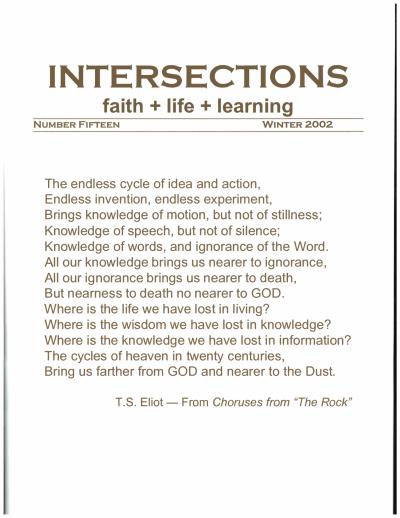
Paul Dovre, ed.: The Future of Religious Colleges
Baird Tipson
No. 15 · Winter 2002
Tipson, president of Wittenberg University, reviews Paul Dovre’s edited proceedings of the October 2000 Harvard Conference on the Future of Religious Colleges (Eerdmans, 2002), summarizing essays by Douglas Sloan on the failure of the “two-realm theory of truth,” George Marsden on faith-shaped scholarship, DeAne Lagerquist, Father David O’Connell, Mark Noll, Robert Benne, Mark Roche on Notre Dame, Joel Carpenter on neo-Calvinist Kuyperianism, and Mark Schwehn on a Lutheran “college-related church” and the centrality of vocation. Against Benne’s suggestion that only two or three robustly Lutheran colleges can be sustained, Tipson defends a less robust but still authentically Lutheran model embodied at places like Wittenberg, Gettysburg, and Roanoke, arguing for the enlightenment commitment to subjecting all truth claims to rigorous criticism and for hiring Marsden-style faith-shaped scholars rather than counting Lutheran heads.
-
 Article
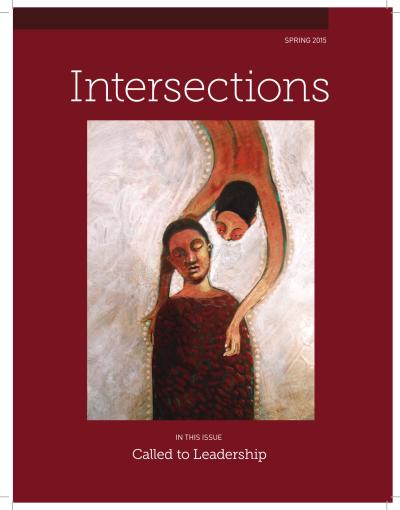
Leading from Within: Peer-Learning Consultations to Explore Our Callings and Campus Capacities for Leadership
Chris Johnson
No. 41 · Spring 2015
Johnson reframes vocational leadership as “soul work” that calls for the deep mind as much as the conscious one, and offers two practices — deep listening and a modified Quaker clearness consultation — as ways for campus colleagues to listen one another into existence. Drawing on Sharon Daloz Parks, Marshall Ganz, Parker Palmer, and Mary Rose O’Reilley, he invites readers to map their stories of self, us, and now.
-
 Editorial
From the Editor
Tom Christenson
No. 18 · Fall 2003
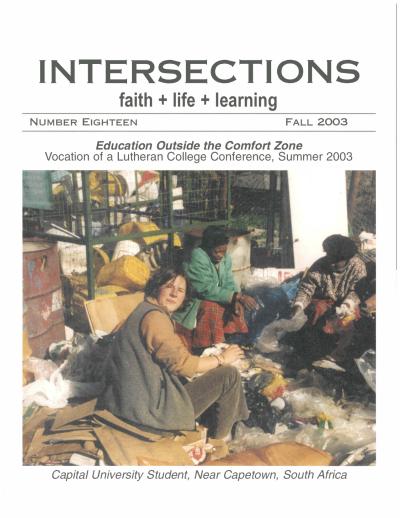
Christenson draws on a ten-year alumni survey at Capital University showing that students most often credit practica, internships, travel-study, and service-learning—not classroom hours—as the places they best learned the university’s stated outcomes, and introduces this issue’s papers from the Summer 2003 Vocation of a Lutheran College Conference on education and global outreach.
-
 Article
Seeking the Common Good: Lutheran Contributions to Global Citizenship
Wanda Deifelt
No. 29 · Spring 2009
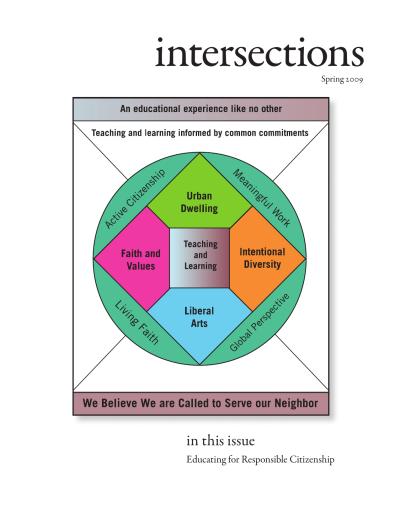
Deifelt draws on Luther’s account of neighborly love in “The Freedom of a Christian” and on his Two Kingdoms theology to argue that a Lutheran ethics of care fosters a sense of responsibility, accountability, and compassion that broadens citizenship beyond rights and virtues. Engaging William Galston’s typology of civic virtues, Sylvia Walby on women’s citizenship, Serene Jones on communitarianism, and Manuel Castells on globalization, she proposes that Lutheran theology equips the church to educate for transformative participation in world affairs.