When Arne Selbyg asked me to speak at this conference, he told me, “The theme for this year’s conference is diversity…,” at which point I thought, “Oh, so that’s why I’ve been called.” But that thought was stopped short by his concluding phrase: “and integrity.” The first definition of integrity that comes to mind for me is “uprightness, adherence to a code of values,” but I realized Arne was using integrity in its other meaning: “soundness, completeness, unity”—as became even clearer when the letter announcing the conference came out and the title had been refined to “Integrity and Fragmentation: Can the Lutheran Center Hold?” Diversity and integrity were here being opposed whereas I had been thinking of diversity and the integrity of church-related colleges, especially Lutheran church-related colleges, as being intimately connected as will become clear later in this talk.
First, a caveat: Maybe this is my literature background coming out, but I cannot help but be struck by how different this issue looks when you are inside or outside the tradition, which also made me think about how different this issue looks when you are at a college with 60% Lutherans or at a college with 4% or 20% Lutherans. I also realize that I am a sort of “inside outsider” at Gustavus and at these gatherings. I have long been interested in religion, and having grown up a sansei (third generation Japanese-American) Buddhist in California, I have spent many years thinking about the similarities between Buddhism and Christianity. One of my most vivid grammar school memories is anxiously worrying about whether I should say “under God” in the Pledge of Allegiance and wondering what would happen to me if I did—or didn’t. In addition, my form of Buddhism, Jodo Shin Shu Buddhism, is often called the most “Protestant” of all the branches of Buddhism and, in fact, as I’ve come to realize, it is very similar to Lutheranism in its theology. Given this background, I am probably more comfortable at daily chapel than our Christian African-American students. Although I have talked to a number of people, Lutheran and non-Lutheran, about these issues over the years, I am well aware that it is my background and my experience at Gustavus Adolphus College that shape my perspective. Still I hope you will find something you can use in these remarks on diversity and integrity.
Actually, Gustavus has not had to think much about “integrity,” if you use integrity to mean holding on to its Lutheran identity. The student body is still close to 60% Lutheran, and situated in rural southern Minnesota, it is still surrounded by a concentration of its historical constituency: Scandinavian, especially Swedish, Lutherans. Every year, one of my colleagues whiles away the time at graduation counting the numbers of Andersons, Johnsons, and Petersons in the program. Three years ago, perhaps inspired by Brian Johnson becoming our co-chaplain and Craig Johnson becoming our Director of Church Relations, to begin the year, we had almost a full month of Johnson faculty and staff giving homilies at daily chapel.
The chapel itself is a big, beautiful building in the center of campus. In addition, campus activity stops from 10 to 10:30 for daily chapel. Chapel attendance regularly reaches 250 while 400 bulletins are printed for Wednesday’s sung morning praise service—and we often run out. The chapel is also the site of many important college functions—convocations, major speakers, Christmas in Christ Chapel, May Day, Honors Day, and Baccalaureate.
The chaplains at Gustavus have made and promise to continue to make Christ Chapel a vibrant, visible, and welcoming place. Richard Elvee, the chaplain of Gustavus for more than 35 years, has been active in making Christ Chapel an inclusive, ecumenical space. He credits the legendary president of Gustavus, Edgar Carlson, with telling him that the chapel program should be modeled on the Swedish folk church tradition, that is, it should be the church of the community; Elvee made it so. His wide-ranging intellectual curiosity about cutting-edge ideas has also made him the ideal organizer and spokesperson for our prestigious Nobel Conference and a visible symbol of the interpenetration of the religious and intellectual life on campus. Brian Johnson, an ’81 Gustavus grad, who returned to campus three years ago as Elvee’s co-chaplain, continues this tradition. A gifted liturgist and musician, he also has a talent for outreach and ministry to the whole college community, but especially to the students. Brian too is interested in ecumenical issues. He spent time teaching in China, participated in an ecumenical dialogue at St. John’s Ecumenical Institute, and is currently helping to edit the collection of personal statements which came out of that three year effort. He has written on apologies for the Holocaust by church bodies and has taught a First-term Seminar on Biblical stories and their contemporary reflections, in his own way, visibly perpetuating the intersection of the academic and religious. The chapel program is in good hands.
Now, you may be having Gustavus-envy, but there is a downside, I think, to all of this good news. And the downside is this: because of our majority population and strong chapel program, I’m not sure Gustavus has had to think seriously about the question Tom Christenson used to start his keynote address at last year’s Vocations Conference on Christian freedom: What is Lutheran about Lutheran higher education? I do not want to minimize the value of having a majority of Lutheran students nor do I want to minimize the importance of having a vibrant, welcoming, and attractive chapel program that makes visible the religious element of the college, thus influencing the ethos and atmosphere of the place. But I agree with Tom that a Lutheran college is on shaky ground if these two elements are the only or essential ways they define their Lutheranness. So if numbers and chapel programs do not make a Lutheran college Lutheran, what does? Christenson argued:
What makes our institutions Lutheran is a vision of the educational task itself that is informed by a tradition of theological themes or principles as well as embodied in practice…. We are Lutheran by means of our educational vision, a theologically informed orientation that manifests itself in what we do as we learn and teach together and our understanding of why we do it…. [But] this common theological orientation may not be so obvious to us, who are part of this tradition. (4)
I think it is precisely the fact that theological foundation is not visible, perhaps not conscious, that people focus on things like percentage of Lutheran students or faculty or the strength or visibility of the chapel program, and why people worry about Lutheran colleges losing their Lutheranness. And well they might. I think this lack of consciousness may be the real threat to Lutheran institutions losing their Lutheranness as they become more diverse. However, like Tom, I would argue that Lutheranism is lucky, that, in fact, diversity and integrity do go together in Lutheran higher education, perhaps in a way unmatched by other church-related colleges. The rest of this talk will be an exploration of the way they do.
Another way to approach the idea of integrity is to ask what our colleges need to do, teach, or embody, to provide a truly excellent education for our students? There are many elements we could point to, including spiritual and moral development, but I think exposure to diversity must also be one of them.
Social psychologists have found that diversity benefits all students, not just minorities. As psychologist Patricia Gurin notes, college is often the student’s “first sustained exposure to an environment other than their home communities” (15). Students learn more and think in deeper, more complex ways in a diverse educational environment because they are confronted by different life experiences, values, and frameworks which not only prompts learning about another’s point of view but also increases awareness of their own and critical thinking about both. This is especially important because as Sylvia Hurtado, associate professor of Education at Michigan noted, segregation in public schools is increasing, and this segregated education means students enter college “with distinct perspectives about the world, hold stereotypical views of different groups, and lack experience interacting with diverse peers” (27). Longitudinal studies have found that encountering diversity in college not only leads to increased cultural awareness, openness to different perspectives and more complex thinking, but is also linked to increased long-term social and civic development (Hurtado 27–28).
As Martha Nussbaum argues in her brilliant Cultivating Humanity: A Classical Defense of Reform in Liberal Education, the purpose of a liberal education is to encourage students to think critically about their lives and society so they can free themselves from traditions to live more thoughtful, conscious, and moral lives.
As Nussbaum points out, authorities and elders since the time of Socrates have always feared that this learning would lead to rejection of one’s tradition (18). But I have found that this is not true. A Jewish colleague noted in a homily last semester that she had never been more Jewish than since she’s come to Gustavus. In fact, she went to Israel this summer. (And, as chance would have it, I also had the opportunity to go to Japan for the first time this summer. With cheap fares to Norway as well, this has been a real “Roots” summer at Gustavus.) I have never been more Buddhist. Being at Gustavus has prompted me to become more knowledgeable and articulate about my own religion. Ironically, going to daily chapel allows me to practice my religion—with its lack of emphasis on liturgical practice and its emphasis on gratitude, faith, and mindfulness—in a regular way which I had not done since leaving for college. Discussions with Christian friends have deepened my knowledge of their religion, my own religion, and their many similarities, and they have prompted some thinking about the significance of some of the differences. I know they have done the same for my Christian friends. The “mature Christian understanding” and commitment many of our colleges articulate as a goal in their mission statements are more likely to come, I think, not only in an environment where religious matters are discussed and taken seriously, but also where different systems can prompt broader, deeper, and more complex thought about faith, God, and the purpose of life.
If we want to advertise that we prepare students to take their place in our society and the world, again integrity dictates we pay attention to diversity. Economics and communications systems as well as politics—perhaps even more than politics—have made us very much part of an interconnected global village. But “the global marketplace isn’t just ‘over there.’ It’s right here,” notes Anthony P. Carnevale, in “Diversity in Higher Education Why Corporate American Cares.” He goes on to note that “by 2025, the additional 72 million members of the US population will include 32 million Latinos, 12 million African-Americans, and 7 million Asians” (1).
Carnevale argues that corporate America cares because diversity is good for business. Diversity is especially important for companies that do business overseas. Obviously some minorities are multilingual and many understand their heritage culture. Less obviously, Carnevale notes, “Employees with different values, cultures, and religious beliefs are more likely to appreciate the need to tailor products or sales approaches to foreign customers” (6). Even less obviously but more importantly, Carnevale points to research that shows that “organizations employing diverse work groups tend to be more innovative and flexible by nature,” that diversity “stimulated creativity among all the members [of a workteam] by forcing reexamination of basic assumptions and encouraging more open and frank dialogue,” and “prevented companies from sliding into ‘group think’ and from unwittingly offending potential customers or overlooking market opportunities” (6).
Carnevale ends his article by arguing: “So… improving diversity on campus and in the workforce is not just a ‘nice’ social and political goal. It is a necessity—for both social and economic reasons—that must be conveyed to elected leaders and the general public. In the twenty-first century, the United States is well positioned to continue as the world’s preeminent economy, with diversity giving us a unique advantage. To maintain our competitive edge, corporate America needs employees that are increasingly creative and agile. To meet the need, we require a pool of diverse workers with college educations to match” (6).
That last line arises from his observation that although minority enrollment in colleges has increased, it is still not proportionate to the population. America is still not the land of equal opportunity. Although Carnevale focuses on the business world, I agree that improving diversity on campus is a necessity for social as well as economic reasons. W. E. B. DuBois argued at the beginning of the twentieth century that “the problem of the color line would be the problem of the twentieth century.” As the deaths of Matthew Shepherd and Isaiah Shoels make clear, discrimination still mars our landscape. Carnevale notes, like Gurin, that “students that are taught in schools with diverse faculties and with diverse students bodies become better critical thinkers, better problem solvers, better communicators, and better team players” (6), qualities he sees as making them more employable and valuable workers. But I would argue that these qualities also potentially make them better citizens, better contributors to a democracy, especially when those qualities are married to what I call an ethical imagination.
This points to what I think makes church-related colleges especially important for the twenty-first century. Many of the problems facing this country and the world—race relations, institutional racism, the environment, the widening gap between haves and have nots both here and abroad—are ethical or moral problems. Even science and technology which we have relied on for so long to provide solutions now raise ethical questions of their own. Where is a student more likely to be encouraged to see and think about the ethical dimensions of their personal, career, and civic choices than at a church-related college?
And among all the major Christian denominations, Lutheranism, I think, is particularly well placed not only to embrace the cultural pluralism that is so characteristic of our nation and important for our future, but also to put its support of pluralism in a theological frame. As Richard Hughes explains in his introduction to Models for Christian Higher Education: Strategies for Success in the Twenty-first Century:
Lutherans insist that the Christian lives simultaneously and inevitably in two kingdoms—the kingdom of this world (nature) and the kingdom of God (grace)…. Lutheranism acknowledges the world as it is—deformed and estranged from God—is nonetheless God’s creation and therefore worthy of study and understanding on its own terms…. The task of the Christian scholar… is not to impose on the world—or on the material he or she studies—a distinctly “Christian worldview.” Rather, the Christian scholar’s task is to study the world as it is and then to bring that world into dialogue with the Christian vision of redemption and grace. This theological vision is the great strength of Lutheran higher education for it enables Lutherans to take religious and cultural pluralism with a seriousness that often escapes other Christian traditions. (7)
The reason Luther’s paradox of the two kingdoms is so supportive of pluralism (and the life of the mind), Hughes explains in more detail in “Our Place in Church-related Higher Education in the United States,” an expanded version of a talk he gave at the 1997 Vocations conference (and elsewhere including Gustavus), is not only that we live in both kingdoms simultaneously but God lives in both. To quote Hughes, “In Luther’s vision, God employs the finite dimensions of the natural world as vehicles which convey his grace to human beings. As Luther often affirmed finitum capax infiniti or, the finite is the bearer of the infinite” (8). But this fosters genuine conversation because of Luther’s insistence on human finitude. The understanding that one’s knowledge is always fragmentary and incomplete leads to the impossibility of Lutherans absolutizing their perspectives and the need for constant critical rethinking of their own ideas—and to be in dialogue with others. As Richard Solberg in his article in Hughes’ Models notes:
All people, both believers and unbelievers, are members of God’s secular kingdom and serve as His agents in ordering and governing it…. In the fulfillment of their roles as citizens and servants, entrepreneurs, professionals, or peasants, [Christians] are free to join hands with anyone, Christian or not, who desires to improve and enrich the human condition…. [Education’s] purpose, grounded in the Creed’s first article, is to foster the capacity to learn, to enhance and enrich people’s lives, and to equip students to make human society what God intends it to be. (76)
Academic freedom, intellectual inquiry into all areas, the welcoming of all in this task of studying the world and improving the human condition—all of this has a base in Lutheran theology. In fact, Hughes ends this article asserting his view that Lutheran colleges and universities occupy a special niche in the world of Christian higher education in the United States because they can claim:
To offer a first class education where the life of the mind is nurtured, where all questions are taken seriously, where critical thinking is encouraged, and where a diversity of cultures are valued, and that these virtues all grow from deep and profound commitments to the Christian faith. (9)
However, as both Hughes and Solberg point out, none of this is automatic. Hughes points out the twin pitfalls of rigid codification of Lutheran thought as a result of accentuating Lutheran interpretations of the kingdom of God, on one hand, and rampant relativism and secularism, as a result of accentuating the world at the expense of the Kingdom of God, on the other (“Our Place” 9). Solberg asserts that “the most serious critique one could level at Lutheran higher education in America is that it has failed to fulfill the educational challenges implicit in its own theology,” resulting in “quietism with respect to social action” and limitations on free inquiry and critical judgment (80).
At Gustavus the combination of free critical intellectual inquiry, religious welcome, and service and its foundation in Lutheranism has been reinforced by the leadership of key Swedish Lutheran figures in our history like Eric Norelius, our founder; Edgar Carlson, legendary president; and Herbert Chilstrom, trustee as well as first bishop of the then newly formed ELCA. Learning more about Lutheranism in general and Gustavus’s history in particular has helped me feel at home there, to identify and love it in ever deepening and informed ways as I could see that my belief in ideals of critical inquiry, diversity, and service were supported both by Lutheranism and Gustavus’s heritage, at least as I understood them. And it has allowed me to be more articulate about what Gustavus is and its value to prospective students and their parents to be able to talk about what makes Gustavus distinctive, including its Lutheranism.
But the learning process has been piecemeal, a result of a bit of luck and my own interest. I was a representative to the first of these ELCA Vocations conferences. I can’t tell you how relieved I was to learn more about Lutheran theology and to see how much it supported my own beliefs, values, and educational goals. This Conference has been very effective in generating a group of faculty and administrators, Lutheran and non-Lutheran, who are better informed and excited about working on church-relatedness on campus. My learning about Gustavus’s Swedish Lutheran heritage had been even more fragmentary, which is one reason I asked Brian Johnson to make a presentation on it as part of the series I set up as a participant in the Rhodes Regional Consultation on the Future of Church-related Colleges this past year. Not surprisingly, it was the best attended session, drawing twice as many students, faculty, and administrators as the other two presentations. This phenomenon was repeated throughout the Rhodes Consultation. People want to know what makes their institution what it is.
I am trying to get Religion professor Garrett Paul who gave a wonderful presentation on Lutheran concepts and higher education and Brian Johnson to write up their Rhodes talks because I feel it is important for new and prospective faculty to get this information—especially because if there is anywhere where diversity is growing quickly at all of our institutions, I suspect it is in the faculty. Certainly at Gustavus, THIS is the place where Gustavus is in danger of losing its “Lutheranness,” at least in numbers. I suspect that most of the new faculty who are not Lutheran come, as I did, with little knowledge of Lutheranism. They are more likely to be familiar with the Puritans if they remember their American history, or Catholicism or Fundamentalism if they watch the news. So religious means restrictive. No wonder they are a little apprehensive about teaching at a church-related college and don’t think of going to chapel. I believe that an introduction to Lutheranism and the history of the college and what that means for the life and values of the college can do much to allay new faculty’s fears and integrate them into the college community.
This education and integration is important not just for the new faculty but for the college. Although the regular “chapel crowd” at Gustavus includes a group of Lutheran faculty, administration, and staff, half the core comes from other religious traditions—Catholic, Episcopalian, Moravian—and this Buddhist. The homilists come from an even wider range. This diversity keeps the chapel program vital and stimulating; it contributes to the on-going pursuit of truth and spiritual development on campus. The real enemy is less diversity than indifference. Perhaps church-related colleges, as was suggested at the Rhodes Regional Consultation’s final meeting, need to be less apologetic about their church-relatedness in hiring. I don’t think this necessarily means hiring Lutherans, but I do think it is important for retaining the institution’s Lutheranness to have a core of people who are interested in the college’s church-relatedness and who can articulate their understanding of its Lutheran heritage.
The Lutheran understanding of the importance of conversation in intellectual and spiritual development not only supports the mission of our colleges but breaks down the problem I had been having with a hospitality model which was prominently mentioned at the Rhodes Consultation’s final meeting. Perhaps I should not have been surprised that it was Mark Schwehn who defined hospitality in a way that emphasized the equality and importance of both host and guest, suggesting that it is possible at times for host and guest to exchange places and that certainly host and guest are equally apt to learn from each other. That equality of host and guest, the blurring of the dichotomy, the belief that both host and guest have something important to say and that conversation and sharing of views is central are particularly Lutheran and not necessarily shared by other Christian denominations, as I know from experience.
This understanding of Lutheran education and the role of diversity in it and its articulation may be particularly important for those colleges where Lutheran students and faculty are a minority and where the chapel program has been weakened—because the danger of fragmentation and the loss of Lutheran identity is very real in such places. This understanding can place diversity in a context that can build community and create more vital, dynamic educational and spiritual development opportunities by actively encouraging dialogue. However, this understanding of Lutheranism, Lutheran education, and educational excellence also challenges schools like Gustavus, where the percentage of minorities is still low, to make diversity a higher priority.
Can a Lutheran center hold at our colleges as the faculty, student body, and society become increasingly diverse? I hope so—it is certainly something worth working for. Increased diversity does create the risk of fragmentation and loss of Lutheran identity. I think it is important to hold on to that Lutheran identity because too often loss of that identity leads to a loss of the spiritual and moral realm which is part of the “value added” of church-related schools. But the Lutheran theology (in addition to educational excellence) that calls us to value diversity also gives us the theological basis to keep diversity and identity in creative tension—and conversation. I have always felt that comparison was an especially good teaching tool. It not only helps us expand our horizons but also sharpens and deepens our understanding of ourselves by making visible what was invisible through familiarity. I realize that this issue of diversity and identity looks different depending on the historical and theological background of the college and the personal background of the person viewing. But whatever the situation, the issue of identity and diversity raises the possibility for campus discussions that can revitalize, sharpen, and deepen the vision of our identities and missions as Lutheran colleges.
It is my belief that Lutheran colleges have a special contribution to make to the twenty-first century, producing citizens and leaders with the critical understanding of the complexities and paradoxes of life, with a well developed spiritual and moral dimension, and with an appreciation of the limits of any individual’s understanding and the value of different points of view. It is often said that schools reflect the society around them. I think the tension created by diversity and church-relatedness in Lutheran colleges has the potential to stimulate the conversations that will help mold the leaders society will need to create a better tomorrow.
Works Cited
Carnevale, Anthony P. “Diversity in Higher Education: Why Corporate America Cares,” Diversity Digest, 3.3 (Spring 1999): 1, 6.
Christenson, Tom. “Learning and Teaching as an Exercise in Freedom.” Intersections, No. 6 (Winter 1999): 3–11.
Gurin, Patricia. “New Research on the Benefits of Diversity in College and Beyond: An Empirical Analysis.” Diversity Digest, 3.3 (Spring 1999): 5, 15.
Hughes, Richard T. “Introduction.” Models for Christian Higher Education: Strategies for Success in the Twenty-first Century. Eds. Richard T. Hughes and William B. Adrian. Grand Rapids, MI: William B. Eerdmans Publishing Company, 1997: 1–9.
____. “Our Place in Church-related Higher Education in the United States.” Intersections, No. 4 (Winter 1998): 3–10.
Hurtado, Sylvia. “Reaffirming Educators’ Judgment: Educational Value of Diversity.” Liberal Education 85.2 (Spring 1999): 24–31.
Nussbaum, Martha. Cultivating Humanity: A Classical Defense of Reform in Liberal Education. Cambridge, MA: Harvard UP, 1997.
Solberg, Richard W. “What Can the Lutheran Tradition Contribute to Christian Higher Education?” Models for Christian Higher Education. Eds. Richard T. Hughes and William B. Adrian. Grand Rapids, MI: William B. Eerdmans Publishing Company, 1997: 71–81.
-
 Editorial
From the Publisher
Arne Selbyg
Selbyg reflects on the origins of Intersections—begun out of concern that the philosophy and theology behind Lutheran higher education could be lost to retirements and other preoccupations—and credits Paul Dovre of Concordia and Robert Sorensen of the ELCA Division for Higher Education and Schools as key figures behind the resumption of the debate. He points to three recent books (Ernest Simmons’s Lutheran Higher Education, Paul Contino and David Morgan’s The Lutheran Reader, and Pamela Schwandt’s Called to Serve) and to the new Lutheran Academy for Scholars in Higher Education, and previews the next “Vocation of a Lutheran College” conference at Dana College in August on what differentiates Lutheran colleges within American higher education.
-
Editorial
From the Editor
Tom Christenson
Christenson marks the eighth edition of Intersections, expresses gratitude to the ELCA Division for Higher Education and Schools and especially to the soon-retiring Bob Sorenson for backing the journal, the Vocation of a Lutheran College Conferences, and the Lutheran Academy of Scholars, and introduces an issue that gathers analyses and arguments from both insiders to Lutheran theology and outsiders, from veterans of the institutions and recent arrivals—voices that together remind us that what is and what ought to be need to inform each other.
-
Article
Integrity and Fragmentation: Can the Lutheran Center Hold?
Robert Benne
Benne answers the conference’s question pessimistically—“the Lutheran center cannot hold in many, if not most of our colleges, because it was never there in an articulated form in the first place”—and distinguishes “Christ of culture” colleges like the Midland Lutheran of his youth (Lutheran by ethno-religious ethos rather than by articulated theology) from James Burtchaell’s “confessional colleges” that operated from a theologically distilled Lutheran humanism. Drawing on Alasdair MacIntyre and Mark Schwehn’s First Things essay on Christian universities, he sketches what a Lutheran center looks like (unity, universality, integrity, a tradition of thought) and how its distortion—reducing the Gospel to justification and ceding everything else to autonomous reason—splits Christ and culture as dangerously as the German church separated Gospel and politics. For colleges that have lost their center, he proposes an “intentional, robust pluralism” that guarantees a Lutheran voice in every department and an “affirmative action for Christians” in hiring.
-
Article
From Pietism to Paradox: The Development of a Lutheran Philosophy of Education
Philip Nordquist
Nordquist traces a four-decade personal and institutional journey from the “Protestant triumphalism” and aggressive moralism of S. C. Eastvold’s 1950s Pacific Lutheran through the 1960 Ditmanson–Hong–Quanbeck volume The Christian Faith and the Liberal Arts, Gordon Lathrop’s 1972 PLU donor address grounding the university in two-kingdoms theology, the ALC’s 1975 Concordia workshop with Bill Narum, Bob Bertram, Harris Kaasa, and Sydney Ahlstrom’s case for the “critical” tradition over the scholastic and pietistic, the 1976 LCA statement distinguishing “Christian” from “church-related” education, and Richard Hughes’s 1997 Carthage address. He concludes that dialectical (two kingdoms) theology, Christian humanism alongside professional studies (the New American College model), Luther’s commitment to universal compulsory education, environmental and civic responsibility, and academic freedom together constitute the bequest of the Reformation—“Christ and culture in paradox” remains the best approach to education he knows.
-
Poem
Things That Renew Hope
Sig Royspern
Inspired by Andrew Greeley’s Religion as Poetry, which defines religion as hope-renewing experiences and the stories, symbols, rituals, and images that preserve them, Rauspern offers a list-poem of small renewals of hope: lovers kissing in the street, the first snowfall of each year, compost and spring sprouts and Jewish humor, kids’ summer mischief, a mother nursing her baby on the bus, small jazz ensembles, two old men reconciling without remembering why, an unscheduled gift, the blues, a child taking him by the hand, and a gray-haired man who threw his cellular phone in the river.
-
Article
The Diversity Dilemma: Dealing With Difference
Kathy Fritz
Fritz reports from Newberry College—83% Caucasian, 16% African-American, 22% Lutheran, the smallest college in NCAA football—on a 1998–1999 year of crisis in which the Board of Trustees Executive Committee asked the president to resign over financial issues, the president fired three vice presidents, four trustees including the chair and treasurer resigned, and the controversial “veterinary technology” major became a flashpoint between the president’s recruitment-driven vision and the faculty’s commitment to “preparation for LIFE.” Turning to ethnic diversity, she frames three sociological approaches—“feed them all” to reduce conflict, the “3 A’s” (academics, athletics, arts) to create common identity, and Aguirre and Turner’s case for “weak ethnic identification” against the post-Yugoslavia failures of strong pluralism—and grounds the search for institutional unity in St. Paul’s body-of-Christ imagery from 1 Corinthians 12 and Ernest Simmons’s claim that diversity yields “creative adaptations that assist mutual survival.”
-
Reflection
A View From the Other Side
Daisybelle Thomas-Quinney
Thomas-Quinney—an ordained Church of God minister and adjunct in Religion at Thiel College—offers “a view from the other side” as a non-Lutheran African American “outsider and novice”: her bittersweet 1995 arrival at Thiel, her swift discovery (alongside one African American secretary, one Hispanic professor, and thirty-eight African American students recruited largely as athletes) of a “chilly” campus unprepared to nurture the very minority students it had recruited, her examination of Thiel’s 1875 founding and the Augsburg Confession Article IV right-hand/left-hand kingdoms, the parables of mustard seed and yeast from Matthew 13, and Bishop James Crumbly’s 1985 LCA manual Inclusiveness and Diversity: Gifts of God. Drawing on Bruce Reichenbach, Samuel Hazo, and Josephine D. Davis’s Coloring the Halls of Ivy, she concludes that the Lutheran center cannot hold “as is” but has “great possibility” when the mission statement is actually followed.
-
 Article
Called to Compassion over the Course of a Life: A Buddhist Perspective
Florence D. Amamoto
No. 47 · Spring 2018
Amamoto, an associate professor at Gustavus Adolphus shaped by Jodo Shin Shu Buddhism, argues that although Buddhism has no “caller” God, it has a strong sense of calling — we are called by the world to respond to the suffering around us with mindfulness, egolessness, and compassion — and that this lifelong journey is enriched by encounter with the Lutheran vocational tradition.
-
 Article
Diversity and Dialogue: Twenty Years and Counting
Florence D. Amamoto
No. 43 · Spring 2016
Twenty years after her essay “Diversity and Dialogue” in the first issue of Intersections, Amamoto returns to Gustavus Adolphus College to reflect on what has changed and what has not: rising numbers of students of color and international students, faculty turnover and increased publication pressures, the disappearance of the Center for Vocational Reflection, and the renewed importance of articulating Gustavus’s Swedish Lutheran heritage and inclusive sense of community in a tuition-dependent, cost-cutting environment.
-
 Institutional Focus
Diversity and Dialogue: Gustavus Adolphus College
Florence D. Amamoto
No. 1 · Summer 1996
Amamoto, a third-generation Japanese-American Buddhist who teaches American literature at Gustavus Adolphus and regularly attends daily chapel, writes as an “inside outsider.” Engaging Schwehn’s closing call to refurbish the Lutheran college, she argues that church-related colleges are vitally important to society, that “refurbishing” must take up diversity, and describes how Lutheranism is manifest at Gustavus: Christ Chapel as the highest point on campus, the ecumenical chapel program led for thirty years by Chaplain Richard Elvee, the Nobel Conferences that pair scientists with philosophers and theologians, the First-term Seminar and Tuesday Conversations, the India study-abroad program organized by Deane Curtin, and the Sponberg Chair in Ethics. She names the pressures of money, secularization, and the publications-driven push for “excellence” that threaten this creative tension.
-
 Reflection
Annie Schone
Annie Schone
No. 40 · Fall 2014
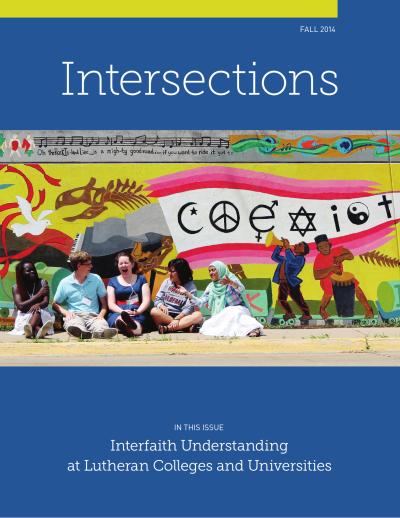
Schone, raised in a small conservative Central Illinois congregation, recounts how Augustana’s Interfaith Understanding group and Interfaith Youth Core gave her the first chance to befriend Muslim, Unitarian Universalist, and atheist peers, and how she hopes to bring the joy of those friendships back to her home church through the power of storytelling.
-
 Editorial
From the Publisher
Arne Selbyg
No. 27 · Spring 2008
Selbyg, retiring this summer as Director for ELCA Colleges and Universities, reflects on his decade serving as spokesperson between the church and its twenty-eight colleges and universities, and argues that the link between the colleges and the church has grown stronger over the last ten years — sustained by supportive church leaders like Presiding Bishop Mark Hanson, the annual Vocation of a Lutheran College conference, and a Lutheran theology of higher education whose principles (questioning authority, returning to the sources, including the excluded, serving the neighbor) remain a strong basis for operating colleges and universities in the twenty-first century.
-
 Editorial
From the Publisher: Staying Connected
Mark Wilhelm
No. 38 · Fall 2013
Wilhelm frames Intersections as a tool for maintaining relationships among leaders in ELCA higher education, welcomes the journal’s new editorial advisory board, and points readers toward the 2014 Vocation of a Lutheran College conference at Augsburg and a special interfaith understanding conference at Augustana with Eboo Patel and Presiding Bishop Elizabeth Eaton.
-
 Article
A Response to Paul Santmire: The Lutheran Liberal Arts College and Care for the Earth
Arthur A. Preisinger
No. 4 · Winter 1998
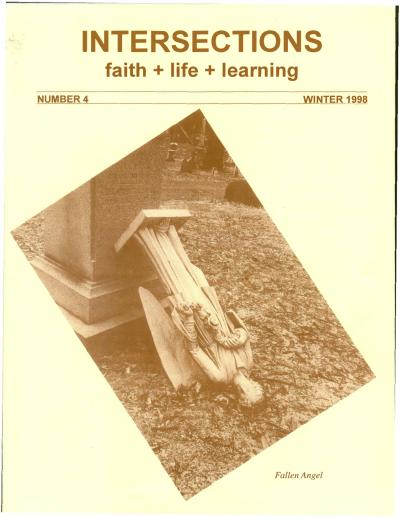
Preisinger commends much of Paul Santmire’s earlier essay—the critique of the “back-to-nature” cult, the call for a holistic environmental ethos, the suggestion of a cosmic liturgical praxis—but takes issue with Santmire’s reading of classical Lutheran social ethics. He argues that the two kingdoms doctrine was not a systematic Lutheran treatise (the term itself became common only in the 1930s), that the doctrine’s misuse by some twentieth-century German theologians does not condemn its proper use, and that the South African Council of Churches actually deployed the doctrine (correctly interpreted) against apartheid. Drawing on Karl Hertz, Ulrich Duchrow, Tom Strieter, and F. Edward Cranz, Preisinger defends the doctrine as complementary duality—left hand and right hand of God, governances to be distinguished but never separated—and concludes with Bill Lazareth that the skeletons in the Lutheran closet are not Luther but departures from Luther.
-
 Institutional Focus
Serving and Building Community at Concordia College
Larry Papenfuss
No. 55 · Spring 2022
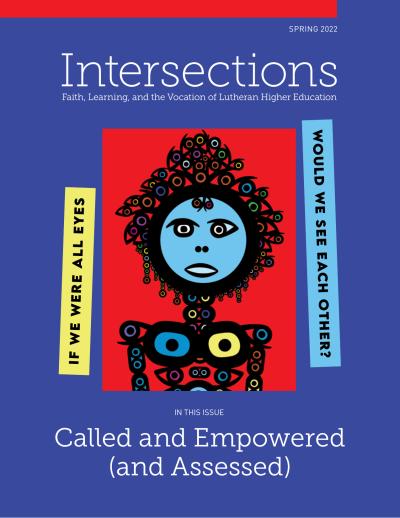
Papenfuss, director of the Dovre Center for Faith and Learning, frames eight ways Concordia College serves the world by building community — from quality teaching and liberating liberal learning to interfaith cooperation and modeling “diversity with particularity” as a Lutheran “third path” institution.
-
Editorial
From the Editor
Tom Christenson
No. 1 · Summer 1996
Christenson, feeling like a proud parent, welcomes readers to the inaugural issue and acknowledges three people without whom the publication would still be just an idea: Naomi Linnel of the ELCA office for Higher Education and Schools, publisher Jim Unglaube, and Capital University president Josiah Blackmore. He invites readers’ reactions, suggestions, and active involvement as editors, reviewers, authors, artists, and critics in shaping the dialogue across the ELCA college and university family.