Last fall, I taught a section of Valparaiso University’s first-year experience course. My course theme was “Re-Thinking Citizenship.” During one session, I asked my students to consider the different communities to which they belong — families, schools, even online — and to write about a specific action they had taken that demonstrated their “citizenship” within that community.
When I read their responses, I was surprised to find that many of them thought of citizenship in terms of random gestures of kindness toward strangers. Many students talked about service projects like showing up at food banks with boxes of canned goods. One described drawing smiley faces on customers’ cups at Starbucks. But few students described actions that contributed to genuine communities built on enduring and reciprocal relationships. They gave, others received. End of story. These responses reflect a common model of “service” that is well-meaning and charitable, but also transactional and simplistic. While this approach may lead to many worthy actions, genuine civic engagement requires more.
It is hardly a surprise that growing up with few compelling examples of citizenship, our students’ understanding of the concept is limited.
In its mission statement, Valparaiso University states an intention to “prepare students to lead and serve in both church and society.” The first step in fostering this kind of civic engagement is to nurture connections between students and communities. We must do so at a time where the students’ own communities are increasingly fractured and fragile due to political, economic, and social polarization. It is hardly a surprise that growing up with few compelling examples of citizenship, our students’ understanding of the concept is limited.
How can we counter this? Community engagement is central to a Valpo education. In the first-year program, students participate in “Field Work” projects that connect them to the broader community and build civic skills. Valpo students commit hundreds of thousands of hours each year to community outreach and service learning. One project that I have been involved with is the Community Research and Service Center (CRSC). In this office, Political Science students conduct research projects for local governments and non-profit organizations. Over thirty years, CRSC students have completed dozens of projects, from surveying community members about their perceptions of local needs to evaluating the effectiveness of after-school programming.
This kind of community-based research teaches students that genuine community engagement depends on building long-term relationships. These projects require sustained collaboration in which research is only the beginning of a process of discerning and responding to community needs. We draw on our partners’ local knowledge and expertise, while they count on us to gather data, analyze it carefully, and communicate findings in ways that are useful to them. This work demands patience, communication, and accountability over time.
One challenge for community-engaged education is that it is resource intensive, demanding significant faculty time and sustained institutional funding. During periods of enrollment decline and financial pressure, these programs become difficult to sustain. At Valpo, this has meant significantly scaling back CRSC operations to reflect this reality. We are exploring partnerships with other campus units and new funding sources to expand our capacity, but that remains a work in progress. Community outreach may be central to our mission, but that does not mean it is easy — or inexpensive — to sustain.
If institutions are to be true to their missions, they must invest in these programs. The CRSC enables students to apply their research skills and intellectual training to benefit communities while learning the discipline of building genuine partnerships. My hope is they come to see their Social Sciences education as the foundation for a life vocation. In these kinds of experiences, our students can begin to transform from well-intentioned individuals into, engaged, and generous citizens of their communities and the world.
-
 Editorial
From the Publisher & Editor
Colleen Windham-Hughes, Lamont Anthony Wells
6 min audio
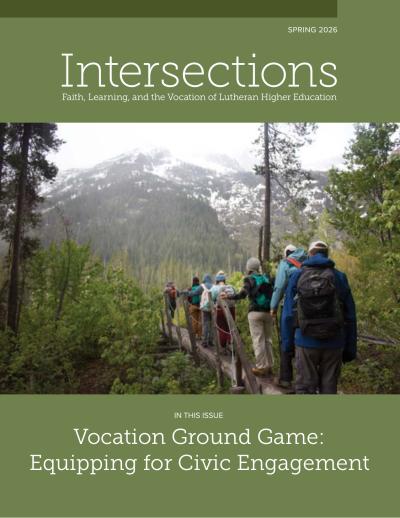
Wells and Windham-Hughes frame vocation as “ground game” — the practical, public living-out of faith through civic engagement — and introduce the issue’s focus on how Lutheran higher education equips students to repair the world.
-
Reflection
I am a Treaty Partner
Kyrie Fairbairn
7 min audio
A recent California Lutheran graduate reflects on how a course on Indigenous Rights and Practices, and a conversation with a former Chairman of the Lummi Nation, led her to claim a “treaty partner” identity and to challenge readers to learn the treaties that shape the lands they call home.
-
Article
Civic Engagement and Faith Perspectives
William O'Brochta
15 min audio
Guest editor William O’Brochta introduces the section by overviewing the ELCA’s call to civic engagement, recapping the Fall 2025 Civic Engagement and Faith Perspectives conference at Texas Lutheran University, and previewing the participant essays that follow.
-
Article
Leaning-In to the Civic Lessons of Our Namesakes
A. Lanethea Mathews-Schultz
6 min audio
Mathews-Schultz uses the civic legacy of the Muhlenberg family — from General Pete’s Revolutionary call to action to President Muhlenberg’s inaugural address on the “education of conscience” — to invite students at Muhlenberg College into a shared civic inheritance.
-
Article
Teaching and Mentoring in Service of Civic Engagement
Haco Hoang
6 min audio
Hoang describes how her teaching, mentoring, and research at California Lutheran University — including a multi-year collaboration with the Lutheran Office of Public Policy on Lutheran Lobby Day — cultivate civic skills grounded in ELCA social statements and the Lutheran tradition of faith and reason.
-
Article
An Ecosystem of Democracy
David Thomason
6 min audio
Thomason argues that faith-based institutions should equip students not to dominate the public sphere with their convictions but to cultivate an “ecosystem of democracy” — pursuing universal values with virtue and tolerance while acknowledging humanity’s incomplete grasp of truth.
-
Article
Bringing Core Values to Life through Civic Engagement
Austin Trantham
5 min audio
Trantham shows how Saint Leo University’s Benedictine Core Values shape his civic engagement work — from advising a “Why Vote?” campaign and Constitution Day panels to engaging students in the Unify Challenge for respectful cross-institutional discourse.
-
Article
Civic Engagement, "Baylor In Deeds," and Engaged Learning
Rebecca Flavin
6 min audio
Flavin describes how Baylor’s strategic plan “Baylor in Deeds” and its Office of Engaged Learning are building civic engagement into the Arts & Sciences core curriculum, with early Global Engagement Survey data showing gains in civic efficacy and global civic responsibility.
-
Article
Fragmented in Faith: The Concerns and Hopes Found in Student Spirituality and Civic Engagement
Emma Bohmann, Monica Sitachitta
11 min audio
Two Texas Lutheran University students reflect on the cyclical pattern of low spiritual and civic engagement on their campus and argue that distinguishing Lutheran values from Lutheran practice could open space for civic engagement to become a non-optional expression of neighbor-justice for all students.
-
 Article
The Vocation of White People in a Racist Society
Caryn Riswold
No. 50 · Fall 2019
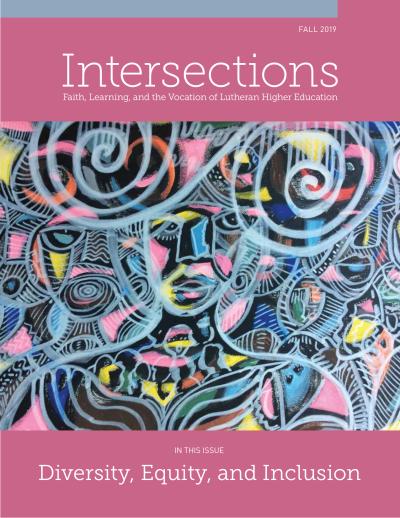
Riswold proposes that whiteness is a weakness borne of apathy, atrophy, and ignorance — an atrophied muscle of race-consciousness — and offers concrete practices (reading, adjusting one’s gaze, consuming media differently, drawing on ELCA social statements like the repudiation of the Doctrine of Discovery) for exercising that muscle and naming the vocation of white people in a racist and white supremacist culture.
-
 Article
A New Image for an Ancient Call: Lutheran Higher Education Amidst Pandemics Today
Caryn Riswold
No. 52 · Fall 2020
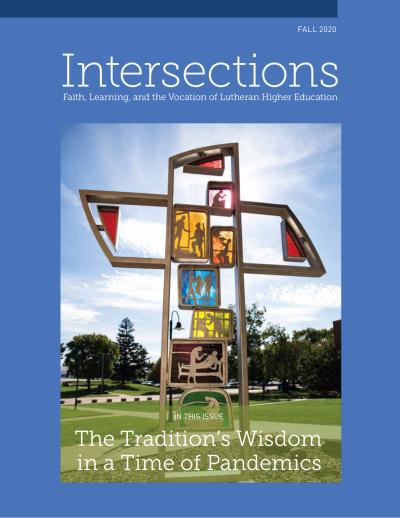
Pairing Wartburg’s Lebenskreuz sculpture with the Matthew 25 acts of mercy and the commitments of Rooted and Open, Riswold reads the calls to feed the hungry, welcome the stranger, and care for the sick as urgent summons for Lutheran higher education in a year of overlapping pandemics — and as a call to dismantle the structures that produced them.
-
 Article
A Reconsideration of the Political Approach to Abortion
Sophia Cruz Ponce
No. 57 · Spring 2023
Cruz Ponce argues that the pro-life versus pro-choice binary distracts from the underlying social factors that lead to unwanted pregnancies, and proposes a reframed political approach focused on mandated sex education, free contraception, and crisis pregnancy centers that address the social, political, and economic barriers women face.
-
 Editorial
From the Editor
Tom Christenson
No. 2 · Winter 1997
Christenson opens with an invitation for reader submissions to balance the conference-paper format of the first two issues, then asks how college and universities can turn students positively toward learning. Drawing on Aristotle’s claim that study is loved for its own sake (which students greet with disbelieving laughter) and Neil Postman’s The End of Education, he argues that students lack narratives within which learning makes sense and proposes four Lutheran mega-narratives—stewardship of creation, the freedom of the Christian, the sacramental presence of the transcendent in the concrete and ordinary, and vocation—that could inspire learning at the 28 ELCA colleges and universities.
-
 Article
The Responsible Professional: Vocation and Economic Life
Martha E. Stortz, Tom Morgan
No. 51 · Spring 2020
Stortz and Morgan argue that the “value-added” of Lutheran higher education is a responsibility ethic — one that frames the professional as a first responder “called and empowered to serve the neighbor so that all may flourish” — and unpack the four criteria of the 1999 ELCA social statement Sufficient, Sustainable Livelihood for All as a framework for economic deliberation.
-
 Editorial
From the Publisher
Arne Selbyg
No. 20 · Fall 2004
Selbyg reports that during 2004 a task force appointed by the ELCA Division for Church in Society has been laying the groundwork for a Social Statement on Education, with a draft to be debated in congregations and educational forums in 2006 and considered for adoption at the 2007 Churchwide Assembly. He urges Lutheran educators to obtain and study the new Task Force study document from the Division for Church in Society and submit their reactions so that the drafters know what those with ties to Lutheran educational institutions think is important.