“Institutions in the Network of ELCA Colleges and Universities (NECU) share a common calling that is deeply rooted in the Lutheran intellectual tradition and boldly open to insights from other religious and secular traditions.” NECU, Rooted and Open
The Question
These opening lines from Rooted and Open posits a common calling rooted in the Lutheran intellectual tradition for the 27 signatory NECU institutions. The statement explicitly unpacks several Lutheran theological values to ground and support educational priorities such as excellence, freedom of inquiry, vocation, and others. But it is fair to wonder whether other aspects of the Lutheran intellectual tradition besides those unpacked could also benefit institutions of the Network of ELCA Colleges and Universities (NECU). To focus on one specific question, could Lutheran social teaching add value to NECU classrooms as a resource in academic inquiry?
Such a question probably has not occurred to most NECU faculty or, likewise, to Lutherans who teach in non-Lutheran institutions. For some it may even bring immediate apprehensions about academic freedom. Yet, the constructive use of Lutheran social reflection would not impinge on academic freedom if that body of thought could demonstrate a legitimate claim as an academic resource itself, one “deeply rooted in the Lutheran intellectual tradition and boldly open to insights from other religious and secular traditions.” It is a legitimate question, then, to ask what role Lutheran ethical material—as part of the intellectual tradition claimed in the NECU statement—might play in the classroom.
This essay is initially descriptive; it seeks to share something about the character and content of recent Lutheran social reflection in order to invite faculty and others to consider whether ELCA social teaching could be used as academic resources. Integral to the descriptive task, however, I also argue that the body of ELCA social teaching provides an actual social ethic. That is, one finds there a relatively comprehensive, remarkably cogent, and responsibly consistent ethic from the viewpoint of ethical theory.1 Through description and attention to this claim, this essay probes how the content of ELCA social teaching is a legitimate resource for classrooms. It concludes by pointing to the results of a pilot project testing these ideas in summer of 2019 run by a NECU steering committee.
“Could Lutheran social teaching add value to NECU classrooms as a resource in academic inquiry?”
Academic Inquiry and a Lutheran Social Ethic
The existence of a Lutheran tradition is widely recognized as an unintended outcome of a religious, political, economic, and social dispute of sixteenth-century Europe. The reform movement originating first in, but not confined to, Wittenberg, Germany, sought reform in the church catholic. It never intend to form an independent, even if temporary, church of its own or to intellectually fund a distinctive tradition. Regardless, human beings inherently live and think out of traditions (Macintyre) and after 500 years Lutheran has become the adjective to designate a sociological and intellectual tradition within the church catholic.
Lutheran moral and social reflection, consistent with claims in the NECU statement, sees itself as both rooted in an intellectual heritage while yet necessarily open to other sources, religious and non-religious. While the tradition’s moral content is not wholly unique among Christian stances, it is possible to distinguish a collection of perennial themes, emphases, and characteristics of Lutheran social reflection that constitute an identifiable tradition. Moreover, this tradition, at its best, sees its efforts as a contribution to the interpretation of human life, including moral life, in all its height, depth, and complexity.
The term social teaching in one sense may be applied to the entire body of historical reflection. This body draws from the perennial themes on social and ethical life forged in the source writings of the sixteenth century, e.g. the Book of Concord, as they sought to interpret the meaning of the Holy Scriptures for their day. However, it is more appropriate to distinguish that body as historical Lutheran social reflection over against contemporary Lutheran social teaching. Social teaching seems to suggest a church’s body of official documents that has been consciously developed for that purpose. Social teaching in this essay, then, designates a collection of documents developed within the ELCA that officially addresses social questions. (See page 15 for a complete list.)
“While the tradition’s moral content is not wholly unique among Christian stances, it is possible to distinguish a collection of perennial themes, emphases, and characteristics of Lutheran social reflection that constitute an identifiable tradition.”
This teaching certainly is rooted in, nourished by, and accountable to the history of Lutheran social reflection. However, it is composed of a particular body of statements, messages, and policy resolutions adopted legislatively on behalf of the ELCA. In most United States denominations, official addresses to social questions, when it actually exists, is a collection of policy and moral directives adopted ad hoc by governing bodies. However, the ELCA’s teaching joins just a couple of other denominations which work out their social teaching as sustained arguments drawing upon extensive theological and social analysis. Certainly the best-known social teaching is from the Roman Catholic tradition, illustrated most recently by Pope Francis’ Laudato Si. While clearly less extensive than the Roman Catholic social ethic developed over some 150 years, the ELCA has produced a body of moral articulation that also can be claimed as a social ethic in itself.
Two questions immediately seem obvious. The first asks: what justifies a claim to be a social ethic? A social ethic, over against a collection of ethical materials, is recognized when it can be shown to be comprehensive, cogent, and consistent as a body across the five dimensions of ethics. Taken together, ELCA social teaching is not propositional in the sense that an overarching set of principles deductively determine its content. Yet, this essay sketches how the ELCA’s social teaching satisfies the three criteria with a coherence comparable to that of a tapestry. To speak analogically, this essay argues that as a tapestry this evangelical Lutheran social ethic could legitimately be a source of academic inquiry in classrooms across any number of disciplines when moral questions are, or ought to be, addressed.
“What commends ELCA social teaching for a classroom in which many students are not religious, let alone Lutheran?”
The second question asks: even if it meets the criteria, what commends ELCA social teaching for a classroom in which many students are not religious, let alone Lutheran? Why should anyone besides a Lutheran pay attention? The content and character of ELCA social teaching as a coherent tapestry is part of the answer. However, I want to lift up its character as a responsibility ethic, an ethical mode that lends itself to use in settings like classrooms. Responsibility ethics conceives of human beings first and foremost as essentially dialogical; that is, the human self comes into being through interaction. Rather than attention to right rules, consequentialist goals, or good virtues, this mode emphasizes a fitting response to moral quandaries. Classrooms are a natural setting to exercise this qualitatively rich moral wrestling, what has been called elsewhere “transformative responsible dialog” (Anderson). The description and the warrant for these claims are sketched in the remainder of this essay.
Relatively Comprehensive
ELCA social teaching represents some 30 years of moral deliberation addressing the great social institutions and issues of contemporary life. While the address has occurred in a series of documents, they provide extensive material on a surprisingly comprehensive series of ethical questions relevant to most academic disciplines. (This comprehensive address is a claim that not every social ethic can make!) The scope of attention to both large-scale social systems and to applied topics is evident in the titles of ELCA social teaching (see page 15 for a complete list). There are 13 social statements (heftier documents that address the overarching social institutions of contemporary life such as sexuality, health care, economics) and 14 social messages (topical considerations on narrower social questions).
The claim to comprehensiveness depends not just on the titles but on the fact that each statement or message speaks to related questions. The statement about genetics, for instance, attends to the fundamental question of unprecedented human power in science and technology as well as to the calling of scientists. This is necessary in order to provide rationale for how the statement speaks to the use of genetic science and technology. The statement on sexuality speaks to the nature of marriage and family, same-sex relations, internet sex, pornography, etc. The statement on peace ranges on topics from the military-industrial complex to international development to just war and pacifism. While a couple broad social systems have not yet been treated,2 the body of documents taken together suggests the overall warp and woof of the ethic in much the way that a tapestry suggests the contour of yet to be woven sections.
The purpose for ELCA teaching documents also matches the comprehensive goals of any genuine social ethic (ELCA, “Policies” 10). Several of these commend themselves directly to the world of higher education. ELCA social teaching:
- presents an overall moral vision of the good through repeated moral articulation on specific questions of contemporary life;
- funds moral formation as part of the church’s teaching function exercised within congregations, colleges, seminaries, and other venues;
- provides frameworks for dialog, discernment, judgment, and action;
- offers vocational reflection on many everyday callings; and
- provides the basis for advocacy on social, economic, and political questions, both for the corporate witness and for the exercise of citizenship.
Responsibly Consistent
The title of this section, “responsibly consistent,” is a wordplay to underscore the conceptual and operational consistency of this social ethic in the mode of responsibility ethics. This mode of doing ethics stands over against the other fundamental ethical modes: duty-oriented (deontological), goal-oriented (teleological), or virtue-oriented (areteological) ethics.3 The mode of rule-oriented ethics (associated with Kant, for instance) views human beings primarily as “citizens” under obligation with an emphasis upon determining what is right as derived deductively from absolute norms. The mode of goal-oriented, consequentialist ethics (associated with Mills and Bentham, for instance) perceives human beings primarily as “makers” with a focus on their actions that bring about certain ends. The mode of virtue ethics (associated with Aristotle or Thomas Aquinas, for instance) also perceives human beings primarily as “makers,” but with a primary focus on concern for character-formation through the excellences of the virtues.
“The human being most fundamentally must determine what is fitting in the face of a plurality of demands, forces, and goods.”
In contrast, the mode of responsibility ethics (technically called cathekontic ethics) considers human beings fundamentally as dialogical creatures. This mode of ethics only appeared in the last hundred years and includes both religious thinkers (H. Richard Niebuhr and Dietrich Bonhoeffer, for instance) and philosophers (Emmanuel Levinas, for instance). It takes its descriptive title from the idea and metaphor of humans as interactive answerers. The Latin root of responsibility, respondere, means one who answers or gives account to another. In other words, there is a fundamentally different conception of what is at the heart of being moral. While rules and duties, consequences and virtues, are significant to the moral life, it argues that the human being most fundamentally must determine what is fitting in the face of a plurality of demands, forces, and goods. The decisive metaphor in this mode is about what or who makes a rightful claim on human lives. The first moral question asks: what is going on? There are obvious distinctions among those who write in this mode. However, it is generally agreed that this approach provides a mode that “is not reducible to an ethics of virtue or duty” (Schweiker, “Disputes” 18).
The first indication that responsibility operates as the dominant mode in the body of ELCA teaching appears in the fifth paragraph of the foundational ELCA social statement. The 1991 statement Church in Society: A Lutheran Perspective reads: “The witness of this church in society flows from its identity as a community that lives from and for the Gospel...It is in grateful response to God’s grace in Jesus Christ that this church carries out its responsibility for the well-being of society and the environment” (ELCA, Church 1). The primary theme here is responsiveness, albeit directed at differing “whoms.” The Christian and the Christian church respond to God’s grace in Jesus Christ but simultaneously carry out responsibility to the created world. The moral origin is response to God but significantly there also is an operational responsibility that is oriented to neighbors. The content of moral action is discerned by what serves the flourishing of the neighbor who needs care and justice.
ELCA social statements demonstrate this consistency repeatedly. The 2009 statement, Human Sexuality: Gift and Trust, observes: “Our vocation of service leads us to live out our responsibilities primarily in light of and in response to the neighbor’s needs, often in complex and sometimes tragic situations” (ELCA, Human 4). The text then turns to fundamental themes and to normative sources such as the Ten Commandments in responding to the neighbor’s needs. One finds parallel moves in virtually every social statement.
Certainly, no group of thinkers or leaders sat down in 1987 (the “birth year” of the ELCA) and decided that the ELCA will be doing responsibility ethics. That point is, however, crucial to the claim! Responsibility ethics is widely regarded as emerging in the twentieth century because of the drastically altered global context of unprecedented human powers, pluralism, social complexities, and the pervasive questioning of authority. These factors do not dictate a responsibility mode, but they are conditions that favor its emergence. This mode, then, was not pre-established; yet concepts and commitments of responsibility found natural expression, a synergy if you will, with both historic Lutheran themes and contemporary practices.
“Responsibility ethics is widely regarded as emerging in the twentieth century because of the drastically altered global context of unprecedented human powers, pluralism, social complexities, and the pervasive questioning of authority.”
The distinctiveness of this responsibility ethic becomes clearer through comparison with Roman Catholic social teaching. Catholic social teaching has a historical pedigree and richness, but it is the work of an educated and illustrious magisterium, a relatively small group of individuals. Further, it carries a hierarchical authority as absolutely binding on the conscience of members when delivered ex Cathedra. ELCA pronouncements, by contrast, are developed by a taskforce of clergy and lay specialists through a broad participatory process including three major feedback loops. Ultimately, ELCA teaching documents must be adopted by a democratically elected body (called the Churchwide Assembly) composed of two-thirds of lay members and one-third of rostered leaders.
This democratic component matches the emphasis in responsibility ethics upon dialog and interaction within a community of moral deliberation. It does not seem like a stretch then to suggest that such an approach lines up with what many faculty hope to accomplish in the classroom when the material begins to border on moral questions. Whether that be economics, social science, artistic meaning, the inherent moral character of technology, the use of scientific knowledge, or others, the subject matter at some point crosses into the moral. When that is the case, the object for inquiry depends a great deal upon the understanding of what it means to make moral judgments. Classroom dialogue could move toward determining the right rules or duties, best consequences, or virtues. Yet, it seems a smoother fit to invite dialog toward what is fitting. The classroom so conceived would be an exercise in responsibility ethics.
Remarkably Cogent
Besides being comprehensive and consistent, a genuine social ethic must address all the dimensions of ethics and provide an identifiable and cogent core. In common usage the term “ethics” is often confined erroneously to matters of moral norms and practical reasoning. However, moral theory demonstrates that ethical reflection entails five dimensions and a thoroughgoing ethic must address each (Schweiker, Responsibility 35). In greatly simplified terms, these dimensions are:
- The fundamental dimension, which asks: what is the basic character of reality and, in specific, what is the basic character and meaning of being a human agent or a society? When asked in religious terms, these same questions are addressed in light of claims about the divine.
- The hermeneutical or interpretive dimension, which asks: what and how do we interpret the context of any moral situation? In short, how does the ethic interpret what is going on in a given context?
- The normative dimension, which asks: what is good, right, or fitting? That is, it asks about the correct norms for human being and doing.
- The practical dimension, which asks: how does this get implemented? What is good applied reasoning?
- The meta-ethical dimension, which asks: how is it we know something is true and, specifically, how does one justify moral claims?
I have demonstrated elsewhere how ELCA social teaching operates in all five dimensions (Willer, “Emerging.”). For two reasons it is relevant to illustrate the normative dimension in the current essay: (1) it will suggest several moral questions that could be addressed in the classroom; and (2) it segues into the essential characteristics of the social ethic—its axiology and principle of choice.
Normatively speaking, ELCA social teaching documents mediate between grand ethical affirmations and detailed application in particular situations (ELCA, “Policies” 11). That is, while they may name highly abstract principles and occasionally commend specific decisions, they devote major attention to “middle principles” as frameworks for mediating between the abstract and decisions about particular situations. Several of these principles are identifiable across the body of teaching statements and would serve well as starting points in the classroom for moral dialogue. ELCA statements represent a communitarian ethic focused on question of the common good, for instance. However, they do not argue in terms of seeking the greatest good for the greatest number, and consistently hold that special priority be given to the voices and needs of those who are most vulnerable. (The most vulnerable often are left out of calculations solely dependent on the greatest good for the greatest number.)
Likewise, the meaning of justice is specified as identifying four principles—participation, solidarity, sufficiency, and sustainability. These four appear first in the statement on ecology (1993) but also are addressed in the statement on economics (1999) and again on genetics (2011); they also shape several social messages. This continuity is not sketched out systematically from one document to the other, but the overlapping and complementary attention to the meaning of justice creates a remarkably cogent demarcation. Likewise, across the documents there is attention to wise practical reasoning, a congruence that develops cumulatively into a useful conceptual apparatus.
“There is an identifiable moral imperative across ELCA teaching documents.”
This coherence in the demarcation of justice and practical wisdom segues into the most substantive claim about the ethic’s cogency: there is an identifiable moral imperative across ELCA teaching documents. The clearest articulation of such an operational imperative is found in the statement on genetics: “Accordingly, responsible people are called to practice the imperative to respect and promote the community of life with justice and wisdom” (ELCA, Genetics 15). In this formulation, the statement provides the sine qua non of an ethic. That is, it provides both the core value and the directive for choice. This imperative provides the conceptual means to evaluate policy and direct action on questions regarding the use of genetic knowledge. As the statement says: “With this imperative, the ELCA articulates an ethic of universal human obligation to serve the flourishing of the created order” (16).
This imperative can be identified as operative across the body of ELCA social teaching. In one sense, of course, the overarching moral imperative of most Christian ethics is the golden rule—to do unto others as you would have them do unto you (Matt. 7:12, Luke 6:31). In one sense, then, that could be said to underlie every social statement, but such a broad imperative does not provide an identifiable core value or directive for choices. While still overarching there is sufficient specificity in a moral imperative regarding the health care system that states: “respect and promote the flourishing of the common good of health with justice and wisdom in all social relations and actions.” While the particular content of any given social statement is ecology, education, criminal justice, or others, each operates with this mixed moral imperative, theoretically speaking. That is, each spell out the meaning of right choice (respect and promote) and the core value (flourishing of the common good).
Significantly, such a moral imperative bears deep resemblance to that which is found in early Lutheran social reflection. Those who know Martin Luther’s Small Catechism will recognize, for instance, the resemblance between such an imperative and his pithy instruction regarding the Fifth Commandment. He writes: “We are to fear and love God, so that we neither endanger nor harm the lives of our neighbors, but instead help and support them in all of life’s needs” (352). Note how Luther’s reasoning founds Christian moral concern in response to God. It also gives first priority to the “do not” of the commandments. That is, he gives priority first to respect, to the “do no harm” principle for the neighbor’s good. But then Luther turns, in every commandment, to the “do” meaning of the commandment, i.e., to promoting the good of neighbor. Framed by such Lutheran Christian commitments, then, one can say that ELCA social teaching coheres around the central imperative: In response to God’s love, respect and promote the flourishing of the common good with justice and wisdom in all social relations and actions.
“ELCA social teaching coheres around the central imperative: In response to God’s love, respect and promote the flourishing of the common good with justice and wisdom in all social relations and actions.”
But can such an imperative be useful in a classroom for individuals whose conception of God is not Christian or who doubt or deny the existence of God? It is here that the mode used by the ELCA social teaching reaches beyond explicit Christian reflection. It is here that using the mode of responsibility ethics contributes to the analysis and understanding of moral existence per se, regardless of religious commitments. One may not call upon God, but the point of responsibility ethics is that the human being wrestling with moral quandaries is set upon by demands and forces and must give account. The French philosopher Emmanuel Levinas, in fact, develops a responsibility ethic not based in a religious tradition but argues that it is in response to the face of the other that an imperative of responsibility appears (Levinas, Totality and Otherwise). Thus, while certainly located in an ELCA teaching document, the moral approach and content can assist anyone who believes that moral questions require a fitting response, whether that response is understood as to God’s action, to a spiritual force, or to a naturalistic field. The ELCA social ethic enables and prompts moral grappling with or without the stamp of religious tradition.
Conclusion
Assessing the criteria of comprehensiveness, consistency, and cogency, this article has argued that the body of ELCA social teaching provides an actual social ethic, one usable as a resource for classrooms. But, is there any evidence that this teaching resource actually can work? Yes. The Network of ELCA Colleges and Universities (NECU) brought together a pilot project in July of 2019 for a small group of business, finance, and economic faculty from four ELCA-related institutions. The two-day project at Augsburg University included discussion such as that above regarding ELCA social teaching, but the heart of the pilot was quite practical. The focus, an obvious choice, was on Sufficient, Sustainable Livelihood for All (1999) as the test for the classroom.
Participants were invited to imagine using the statement in class in three ways: (1) to prompt discussion by using segments, (2) to develop a case study to hold up to the statement as mirror, and (3) to think about how their syllabuses might integrate the statement as a resource. The discussion was candid and rich, noting the urgent need for tools in the classroom to enable civil and engaged dialog at this time of growing cultural polarization. There are no magic solutions, but participants evaluated the statement’s content and approach as significantly worthwhile, even while critiquing its age and expressing the wish it had covered some topics more thoroughly. Most significantly for this article, there was a general affirmation about its value in the classroom, summarized by one participant as, “[this] document gives me language and tools to articulate, dig deeper, ask better questions, and enable students to think a little better for and about themselves” (Willer, “NECU”).
Endnote
1. Elements of this essay were first published as “Emerging Tapestry” (see works cited), and are used here with permission.
2. For example, ELCA social teaching to date does not address the digital revolution or a thorough theological address to government. The latter is now underway, due in 2025.
3. There are disagreements whether consequentialist and virtue ethics should be folded together under teleology since both are oriented to ends. It seems easier for non-theorists to distinguish the fundamental categories as threefold. See Robin Lovin in works cited below, as well as the essay by Martha Stortz and Tom Morgan in the present issue if Intersections.
Works Cited
Anderson, Per. “Cultivating Transformative Responsible Dialogue: Community of Moral Deliberation and Lutheran Higher Education.” Intersections 35 (Spring 2012): 10-16.
ELCA (Evangelical Lutheran Church in America). The Church in Society: A Lutheran Perspective, 1991. Accessed 1 March 2020, https://elca.org/Faith/Faith-and-Society/Social-Statements/Church-in-Society
———. Genetics, Faith and Responsibility, 2011. Accessed 1 March, 2020, https://www.elca.org/Faith/Faith-and-Society/Social-Statements/Genetics
———. Human Sexuality: Gift and Trust, 2009. Accessed 1 March 2020, https://www.elca.org/Faith/Faith-and-Society/Social-Statements/Human-Sexuality
———. “Policies and Procedures of the Evangelical Lutheran Church in America for Addressing Social Concerns,” 2018. Accessed 1 March 2020, http://download.elca.org/ELCA%20Resource%20Repository/Policies_and_Procedures.pdf
Levinas, Emmanuel. Totality and Infinity: An Essay on Exteriority. Trans. Alphonso Lingis. Duquesne UP, 1969.
———. Otherwise than Being, or Beyond Essence. Trans. Alphonso Lingis. Duquesne UP, 1999.
Lovin, Robin W. An Introduction to Christian Ethics: Goals, Duties, and Virtues. Abingdon, 2011.
Luther, Martin. “The Small Catechism.” The Book of Concord: The Confessions of the Evangelical Lutheran Church, 345-75. Edited by Robert Kolb and Timothy J. Wengert. Translated by Eric W. Gritsch, et al. Fortress, 2000.
MacIntyre, Alasdair. After Virtue: A Study in Moral Theory. Second ed. University of Notre Dame Press, 1984.
NECU (Network of ELCA Colleges and Universities). “Rooted and Open: The Common Calling of the Network of ELCA Colleges and Universities.” Accessed 1 March 2020, http://download.elca.org/ELCA%20Resource%20Repository/Rooted_and_Open.pdf
Schweiker, William. Responsibility and Christian Ethics. Cambridge UP, 1995.
———. “Disputes and Trajectories in Responsibility Ethics.” Religious Studies Review 27.1 (Jan. 2001): 18-24.
Willer, Roger A. “An Emerging Tapestry: An Evangelical Lutheran Social Ethical.” Dialog 56.3 (Fall 2017): 298-309.
———. “NECU Social Teaching Pilot Project” July 18-19, 2019, personal notes.
-
 Editorial
From the Publisher
Mark Wilhelm
Wilhelm frames the issue by tracing how Lutheran educational ideals — once a primary source of contemporary higher education — were masked in the United States, and introduces a NECU initiative that uses the case of business ethics to explore Lutheran social teaching as an academic resource.
-
Editorial
Guest Editorial: Moral Deliberation in NECU Classrooms
Ernest L. Simmons
Simmons introduces the guiding question of the NECU working group: could the ELCA’s twelve social statements and thirteen social messages — expressions of Lutheran social teaching originally formulated for congregational use — turn campuses into “academic communities of moral deliberation”?
-
Article
The Responsible Professional: Vocation and Economic Life
Martha E. Stortz, Tom Morgan
Stortz and Morgan argue that the “value-added” of Lutheran higher education is a responsibility ethic — one that frames the professional as a first responder “called and empowered to serve the neighbor so that all may flourish” — and unpack the four criteria of the 1999 ELCA social statement Sufficient, Sustainable Livelihood for All as a framework for economic deliberation.
-
Institutional Focus
A List of ELCA Social Teaching and Policy Documents
A reference list, as of September 2019, of the ELCA’s twelve social statements, fourteen social messages, and over 150 social policy resolutions — with Spanish translations where available.
-
Article
The Challenge of Inclusion in the Ethics Classroom
Faith Wambura Ngunjiri
Ngunjiri, the only Black woman tenured faculty member at Concordia College, reflects on her students’ resistant and resonant responses to MLK Day programming on “Not Racist: A White Moderate Myth” — and on what it takes to make the ethics classroom a place where students can “BREW”: Becoming Responsibly Engaged in the World.
-
Article
Business as Usual? Marketing, God, and the Limits of Christian Callings
Emily Beth Hill
Hill, a former corporate marketing consultant turned theologian, returns to Luther’s claim that no vocation is more holy than another — and uses Luther’s Large Catechism definition of God to argue that the modern practice of branding intentionally redirects the love and worship of human beings toward capital, raising the question of whether Christian neighbor-love places limits on what professions Christians should pursue.
-
Article
Responding to Student Hunger at NECU Institutions
Kristen Glass Perez
Glass Perez recounts how her work as college chaplain at Augustana and Muhlenberg evolved after a student offhandedly declared, “I am always so hungry at this school,” and shares five lessons learned from launching campus pantries, emergency grant programs, and the HOPE Survey to address food insecurity as a defining calling of NECU institutions.
-
Article
Gen Z is Made for Lutheran Higher Education
W. Kent Barnds
Barnds argues that Generation Z’s defining traits — socially responsible, purpose-driven, cost-conscious, culturally open, and tech-expectant — align almost perfectly with the missions of NECU institutions, and offers concrete suggestions (from replacing “vocation” with “purpose” to embracing Gen X parents as co-pilots) for Lutheran colleges seeking to attract and serve this generation.
-
 Institutional Focus
So That All May Belong: Lutheran Roots for Diversity, Equity, Inclusion, and Justice
Altheia Richardson, Angie Hambrick, Caryn Riswold, Colleen Windham-Hughes, Deanna Thompson, Marcia Bunge, Robert Clay
No. 61 · Spring 2025
22 min audio
The full NECU statement grounds DEIJ work in Luther’s 16th-century reforms and Lutheran theological claims about the image of God, equal dignity, and the limits of human knowing — offering definitions, Lutheran roots, and calls to action for diversity, equity, inclusion, and justice, with belonging as the outcome of DEIJ at work.
-
 Article
Reconciled Diversity: Reflections on our Calling to Embrace our Religious Neighbors
Jacqueline Bussie
No. 33 · Spring 2011
Bussie offers three concrete recommendations for cultivating reconciled religious diversity on Lutheran campuses — Lutheran listening and the telling of stories, engendering encounters with religious neighbors through curriculum and bridge-building events, and choosing empathy and collaboration over evangelism and creed — arguing that what students fear most in encounters with the religious “other” is the loss of their own identity and distinctiveness, and that we can show them how loyalty to one’s own tradition and reverence for different traditions can coexist.
-
 Reflection
A View From the Other Side
Daisybelle Thomas-Quinney
No. 8 · Winter 2000
Thomas-Quinney—an ordained Church of God minister and adjunct in Religion at Thiel College—offers “a view from the other side” as a non-Lutheran African American “outsider and novice”: her bittersweet 1995 arrival at Thiel, her swift discovery (alongside one African American secretary, one Hispanic professor, and thirty-eight African American students recruited largely as athletes) of a “chilly” campus unprepared to nurture the very minority students it had recruited, her examination of Thiel’s 1875 founding and the Augsburg Confession Article IV right-hand/left-hand kingdoms, the parables of mustard seed and yeast from Matthew 13, and Bishop James Crumbly’s 1985 LCA manual Inclusiveness and Diversity: Gifts of God. Drawing on Bruce Reichenbach, Samuel Hazo, and Josephine D. Davis’s Coloring the Halls of Ivy, she concludes that the Lutheran center cannot hold “as is” but has “great possibility” when the mission statement is actually followed.
-
 Article
Impelled to Pluralism: Thoughts About Teaching in a Lutheran University
Jim Huffman
No. 17 · Summer 2003
Huffman traces his personal journey through three stages of faith—the “comfortable Christ” of his Midwestern Christian childhood, Clark Pinnock’s “faith principle” of accessible salvation, and finally Christ as the “humble teacher”—to a pluralism that rejects religious triumphalism without abandoning Christian commitment. Drawing on Diana Eck, Wesley Ariarajah, John Cobb, the Catholic novelist Endo Shusaku, and the histories of Confucian China and imperial Japan, he then describes how this commitment shapes his teaching of East Asian religion and nationalism at Wittenberg University: insisting on respectful language, working sympathetically through doctrines like Buddhist non-attachment, and helping students see the pernicious effects of triumphalism in both religious and political life.
-
 Reflection
Keeping Close from a Distance: Pandemic Reflections of a Library Coordinator
Carla Flengeris
No. 53 · Spring 2021
Flengeris reflects on a year of running Luther College’s library at the University of Regina from her basement and mourns the loss of the hourly walks through the stacks—the “roving reference” that, she realizes, were never disruptions to her work but were the work itself.
-
 Article
Seeking the Common Good: Lutheran Contributions to Global Citizenship
Wanda Deifelt
No. 29 · Spring 2009
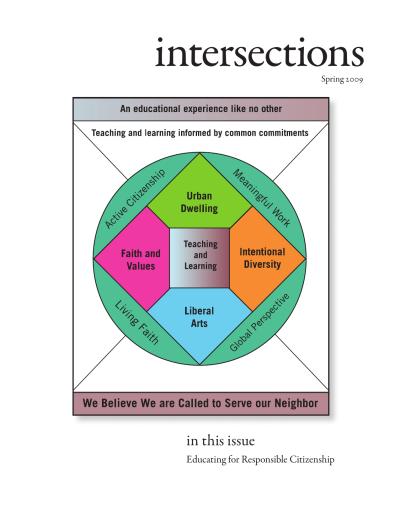
Deifelt draws on Luther’s account of neighborly love in “The Freedom of a Christian” and on his Two Kingdoms theology to argue that a Lutheran ethics of care fosters a sense of responsibility, accountability, and compassion that broadens citizenship beyond rights and virtues. Engaging William Galston’s typology of civic virtues, Sylvia Walby on women’s citizenship, Serene Jones on communitarianism, and Manuel Castells on globalization, she proposes that Lutheran theology equips the church to educate for transformative participation in world affairs.