I must start off by saying that I am not Indigenous and living in the U.S. I experience privilege from being white. I am from Ferndale, Washington, and grew up on unceded land that has been the Lummi Nation’s since time immemorial.
I had long prioritized social justice in my life, from advocacy for local education initiatives to leading young voter sign ups to promoting resources for women’s reproductive health — long before Lutheran higher Ed took me into its (loving) grasp. That being said, growing up the granddaughter of a Lutheran pastor, I’m sure the tenets of Lutheranism played a role from the start.
When I took a class called “Indigenous Rights and Practices” during my junior year at California Lutheran University, I anticipated interest in the subject but did not predict the profound impact it would have on me. The class allowed me to have conversations that changed my world view and shifted how I perceived my obligation towards the land I grew up on. I gained knowledge about the political landscape surrounding tribes in the U.S. in a way I had not previously experienced. Most importantly, I took away an identity as a “treaty partner.”
My work in the class focused on the Treaty of Point Elliott of 1855. The Treaty of Point Elliott was signed by numerous Coast Salish tribes, as well as the future first governor of the Washington territory, Isaac Stevens. The Treaty made many promises — guaranteeing healthcare, opportunities for education, and the maintenance of tribes’ traditional fishing rights. However, not unlike every other treaty the U.S. has signed with a tribe, this treaty has been broken time and time again. Let me repeat that so it sticks with you — every treaty a tribe has signed with the U.S. has been broken. 368 broken promises.
As a part of the project, I interviewed a former Chairman of the Lummi Nation, and we had a conversation about the inextricable nature of the Treaty: salmon, land, orcas, and people. During the conversation about the Treaty, the Chairman emphasized repeatedly that I am a treaty partner. He said too often treaties are thought of as just “Indigenous things” and “relics of the past.” He underscored the constitutional obligation to understand treaties as the supreme law of the land. The Chairman urged me to understand that the Treaty of Point Elliott is just as much my treaty, as it is his.
The U.S. Government has broken their promises, and many of us have looked the other direction while they have done so.
The U.S. government, largely comprised of white, protestant, heterosexual, wealthy men, have incessantly put the full onus on tribes to uphold and fight for what was promised in jointly signed treaties. A treaty at its core is a promise; it is a partnership. Promises require commitment to be upheld from all sides, and when a party is not a good-faith partner, treaties do not function, and one of the partners loses recognition in the process. The U.S. Government has broken their promises, and many of us have looked the other direction while they have done so. They have stolen land, killed animals, kidnapped children, and purposefully eradicated the languages and cultures that have sustained Indigenous people since time immemorial in immeasurable ways, an unquantifiable number of times.
As a country, our conversations with Indigenous nations, our government-to-government partners, have long been riddled with white people speaking over Indigenous voices and failing to honor formal treaties. These conversations have come with a disregard for differing opinions, and ears shut to cries that demand access to land, clean water, and healthcare. We have a duty to uphold our treaties — that in and of itself is public interest and civic engagement. When we do not do so, we disregard our government partners, our neighbors, and our friends.
My understanding of myself as a treaty partner has led to me sharing this perspective. While I fully accredit the language and knowledge of being a treaty partner to the Chairman, I have California Lutheran to thank for giving me the steppingstone to uncover this identity that should have been there all along.
I have pursued opportunities to delve further into the idea of being a treaty partner, focusing my undergraduate philosophy capstone on Indigenous sovereignty and U.S. treaty breaches, by comparing arguments made by John Locke and Vine Deloria Jr., a Standing Rock Sioux theologian, author, and Indigenous activist. I have used my position as a U.S. Senate staffer to advocate on behalf of tribes. I am now applying to law school to continue to grow in this treaty partner identity in a new way.
I challenge you to identify and understand the treaties that affect the land of your home. I aim to stir a curiosity in you to learn about the promises that impact places and living things dear to you.
I am a treaty partner because my ancestors signed the Treaty of Point Elliott and I have benefited immeasurably from it. The treaty is full of flaws and problematic promises, items that scream colonization and assumptions of misplaced authority and superiority. But it also reserves rights and guarantees vaccines and education. I have a responsibility to uphold the treaty and respect it as the supreme law of the land. I challenge you to identify and understand the treaties that affect the land of your home. I aim to stir a curiosity in you to learn about the promises that impact places and living things dear to you.
I know I have failed and will continue to fail in upholding my treaty. However, a much more significant failure would be declining to acknowledge, share, and fight for the promises stated in the Treaty of Point Elliott altogether. Sharing the verbiage of being a treaty partner, is a step I am taking as I walk on, practicing ownership and responsibility.
-
 Editorial
From the Publisher & Editor
Colleen Windham-Hughes, Lamont Anthony Wells
6 min audio
Wells and Windham-Hughes frame vocation as “ground game” — the practical, public living-out of faith through civic engagement — and introduce the issue’s focus on how Lutheran higher education equips students to repair the world.
-
Article
Civic Engagement and Faith Perspectives
William O'Brochta
15 min audio
Guest editor William O’Brochta introduces the section by overviewing the ELCA’s call to civic engagement, recapping the Fall 2025 Civic Engagement and Faith Perspectives conference at Texas Lutheran University, and previewing the participant essays that follow.
-
Article
Leaning-In to the Civic Lessons of Our Namesakes
A. Lanethea Mathews-Schultz
6 min audio
Mathews-Schultz uses the civic legacy of the Muhlenberg family — from General Pete’s Revolutionary call to action to President Muhlenberg’s inaugural address on the “education of conscience” — to invite students at Muhlenberg College into a shared civic inheritance.
-
Article
Teaching and Mentoring in Service of Civic Engagement
Haco Hoang
6 min audio
Hoang describes how her teaching, mentoring, and research at California Lutheran University — including a multi-year collaboration with the Lutheran Office of Public Policy on Lutheran Lobby Day — cultivate civic skills grounded in ELCA social statements and the Lutheran tradition of faith and reason.
-
Article
Community-Based Research as Engaged Citizenship
James Paul Old
6 min audio
Old argues that genuine citizenship requires more than charitable gestures — it demands long-term, reciprocal community partnerships — and describes how Valparaiso’s Community Research and Service Center embodies that vision even amid the financial pressures threatening such programs.
-
Article
An Ecosystem of Democracy
David Thomason
6 min audio
Thomason argues that faith-based institutions should equip students not to dominate the public sphere with their convictions but to cultivate an “ecosystem of democracy” — pursuing universal values with virtue and tolerance while acknowledging humanity’s incomplete grasp of truth.
-
Article
Bringing Core Values to Life through Civic Engagement
Austin Trantham
5 min audio
Trantham shows how Saint Leo University’s Benedictine Core Values shape his civic engagement work — from advising a “Why Vote?” campaign and Constitution Day panels to engaging students in the Unify Challenge for respectful cross-institutional discourse.
-
Article
Civic Engagement, "Baylor In Deeds," and Engaged Learning
Rebecca Flavin
6 min audio
Flavin describes how Baylor’s strategic plan “Baylor in Deeds” and its Office of Engaged Learning are building civic engagement into the Arts & Sciences core curriculum, with early Global Engagement Survey data showing gains in civic efficacy and global civic responsibility.
-
Article
Fragmented in Faith: The Concerns and Hopes Found in Student Spirituality and Civic Engagement
Emma Bohmann, Monica Sitachitta
11 min audio
Two Texas Lutheran University students reflect on the cyclical pattern of low spiritual and civic engagement on their campus and argue that distinguishing Lutheran values from Lutheran practice could open space for civic engagement to become a non-optional expression of neighbor-justice for all students.
-
 Article
The Identity, Mission, Vision, and Goals of a Lutheran College vis a vis Bacon's "Of Studies" and Newman's "The Idea of a University"
Cora Lazor, Mary Theresa Hall
No. 15 · Winter 2002
Hall, an Associate Professor of English at Thiel, and Lazor, a Thiel junior and 2002 ELCA Division for Higher Education summer intern, read Thiel College’s Statements of Identity, Mission, Vision, and Goals alongside Sir Francis Bacon’s “Of Studies” (1625) and John Henry Cardinal Newman’s The Idea of a University (engaging Azade Seyhan’s May 2002 PMLA essay along the way). They argue that Bacon’s “Read…to weigh and consider” and Newman’s defense of liberal over technical training underwrite Thiel’s new Writing-Intensive Course requirement, its ten institutional objectives, and its commitment to “service to society” in the Judeo-Christian tradition.
-
 Article
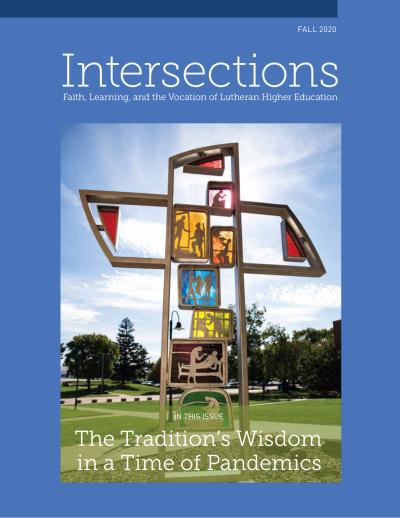
Through Truth to Freedom—by Way of Reconciliation
Paul C. Pribbenow
No. 52 · Fall 2020
Reflecting on Augsburg’s 150th-anniversary motto “Through truth to freedom,” Pribbenow argues that in a season of three pandemics — pandemic illness, economic collapse, and the racial sin laid bare by the murder of George Floyd — higher education’s most authentic work is to educate for truth and freedom by way of confession and reconciliation.
-
 Article
Work Works
Julius Crump
No. 56 · Fall 2022
Crump argues that in an era of class-stratified careerism and the “ruins of neoliberalism,” commencement-speech rhetoric about heroic vocation will not resuscitate vocation — instead, professors embodying vulnerability, extemporaneity, and contemporaneity in the classroom can show students that consistent work, embodied as service to others, is itself worthy.
-
 Institutional Focus
Building a Developmental Framework for Vocational Reflection at Thiel College
Brian Riddle, Greg Q. Butcher, Liza Anne Schaef
No. 55 · Spring 2022
Riddle, Schaef, and Butcher describe how a NetVUE Program Development Grant enabled Thiel College to build “the Tomcat Way” — a four-year developmental framework with personal, social, academic, and professional domains and four phases (Explore, Envision, Belong and Lead, Launch) — that now guides every aspect of the student experience.
-
 Article
Where Disruption and Vocation Meet: One Path Toward Teaching Reproductive Justice in Challenging Times
Lena R. Hann
No. 57 · Spring 2023
Hann recounts how a missed math class in her first college term led her into volunteer work at a feminist abortion clinic and ultimately a career in public health, and describes how she designed and taught a Reproductive Justice immersive term course at Augustana College through the disruptions of COVID-19, George Floyd’s murder, and the Dobbs decision.
-
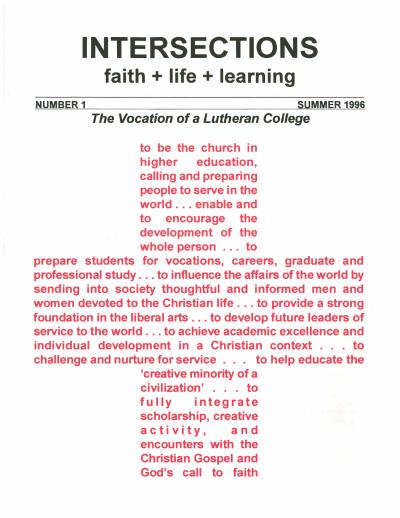 Response
"Whose Future?" or "Social Justice and the Lutheran Academy?"
Marsha Heck
No. 1 · Summer 1996
Heck argues that the future of Lutheran higher education lies less in defining Lutheran distinctiveness than in moral action grounded in face-to-face relationships with others. Drawing on David Lotz’s two-kingdoms theology of citizenship, Ernest Simmons’s relational reading of Luther, Arthur Preisinger’s indictment of the German Lutheran misreading of two kingdoms during the Third Reich, Starla Stensaas of Dana College, and Paulo Freire’s dialectic of empowerment, she calls Lutheran colleges to integrate moral reflection with moral action—to move students’ muscles against what is not true as well as to feel truths in their bones.