I sit here in my office alone (as I ought) writing my confession. The Deans and the faculty have asked me to write; expect me to confess. I confess that I am a collaborator.
I confess that I have always collaborated. In elementary school I talked with my friends and my parents about my report on dinosaurs. In junior high I read Cliff notes on William Faulkner. In my weakness, I sought help. I perverted my individuality. I failed. Collaborator. Cripple. Cheat.
In high school I showed my poems to others and asked for help on algebra. To teach me independence my teachers and friends gave me no help. They accused me (rightly, it is true, but I confess to hating them for it) of cheating.
In college I continued to rail the American ideal by working with a classmate on a project. My instructors showed me my error. They exclaimed that my work could not be judged, and that they would not know how to grade me, but I persisted.
I confess: I collaborate with my colleagues. I ask their opinion. I borrow their syllabi. The work I now publish in my own name I have done with help. No matter that some have given me this help freely. I stole it. The fault is mine. I should not have asked. No matter that I thanked them in acknowledgments. I sullied my work with the thoughts of others. I used their ideas. Miscreant. Malefactor. Miscegenist.
I confess that I collaborate in my classroom. I invite suggestions from my students. Yes, I confess to enticing my students to collaborate. I have required them to work in groups, though they rightly despise it. They yearn to do their own work. To stand on their own. They are independent, but I have tempted, even compelled, them to go astray. I have lured my students into collaboration. Piper. Pusher. Pederast.
I confess that I have attempted, in the safety of my office, to collaborate with my students in tutorials. In their independent studies I have collaborated with them. They study selfhood, self-reliance, self-esteem, self-righteousness, self-fulfillment, self-flattery, self-employment, self-deception, self-assertion, self-adjusting-self-feeding-self-congratulation. But, I confess to helping them, even to forcing my opinions and help on them.
It is true. I fear to stand alone. My mother and my father, my classmates, my colleagues and my students influence me. But this is not their confession, it is mine. I cannot think alone. I circulate drafts. I ask for comments. I have even borrowed my bootstraps. Thief. Thespian. Fool.
And if all this were not shame enough, I confess that my colleagues and students have helped me to write this confession. I confess that I hoped for their praise and their criticism. I confess I changed my words and writing because of their help. I could not even confess alone, but collaborated in my confession. And, I confess: I enjoyed it.
-
 Editorial
From the Publisher
James M. Unglaube
Unglaube opens the journal’s second year by previewing the 1997 Vocation of a Lutheran College conference at Carthage, which will examine the Lutheran tradition from outside (Richard Hughes of Pepperdine on the Lilly Endowment’s Models for Christian Higher Education; David Johnson, President of the University of Minnesota at Morris and Luther College graduate, on the tradition from the public sector) and inside (Ann Pederson of Augustana in Sioux Falls; Timothy Lull of Pacific Lutheran Theological Seminary), and previews Eric Eliason’s emerging proposal for an Academy of Scholars in Lutheran Higher Education modeled on NEH/NSF-style summer seminars.
-
Editorial
From the Editor
Tom Christenson
Christenson explains that this issue breaks from the first two issues’ single-focus pattern to feature three principal papers on the environment, the education of desire, and hiring and personnel policies, plus two poems and a piece of reflective bemusement. He then commends George Marsden’s The Outrageous Idea of Christian Scholarship (Oxford, 1997) and challenges Lutheran scholars to articulate how the particulars of their faith inform their scholarship—in conversation with Calvinist work like Nicholas Wolterstorff’s Reason Within the Bounds of Religion and Art in Action—rather than remaining silently complicit in the view that faith has no place in the academy.
-
Article
The Lutheran Liberal Arts College and Care for the Earth
H. Paul Santmire
Santmire, author of The Travail of Nature, proposes three mandates for the Lutheran liberal arts college: take responsibility for spiritual particularity by confronting the ambiguities of the classical Christian tradition (Lynn White’s charge against anthropocentric Christianity vs. the Franciscan ecological tradition from Irenaeus through Luther) and of classical Lutheran social ethics (the Two Kingdoms, Romans 13, the Third Reich, Bonhoeffer); promote responsible cultural criticism (against Thoreau’s sociopathic anti-urban suburbanism); and promote a holistic environmental ethos through an interdisciplinary core curriculum with ecology as the queen of the sciences, a community that liberates the social imagination (Mumford, Marcuse), a cosmic Liturgical praxis rooted in the Colossians 1:15–20 hymn to the cosmic Christ, and an academy that models ecological responsibility.
-
Article
An Aristotelian Twist to Faith and Learning
Gregg Muilenberg
Muilenburg, chair of Philosophy at Concordia, surveys the four traditional models for faith and reason—conflict, independence, dialogue, and integration—and argues that the Lutheran dialogical model is insufficient for wholeness. Drawing on the post-foundationalist epistemology of perspective and Aristotle’s account of knowing as desire-driven action, he proposes that faith is an ultimate value (an assessment belief of the form ‘x is better than y’), that learning is desire-directed action, and that the core of Christian education is the education of Christian desire—requiring both reflection and commitment, both integration and diversity.
-
Poem
Two Poems: The Dark Angels / Decorative Cooking
Gary Fincke
Two poems by Gary Fincke of Susquehanna University: “The Dark Angels,” a return to the sidewalk in front of the father’s razed bakery in Etna, the soot-pocked windows, the Saturday trash fire, the last eclair on the work room’s folding chair; and “Decorative Cooking,” the mother’s story of St. Julitta, Betty Crocker’s “New Design for Happiness,” the Sunday dinners of shaped Jellos and anise Magi cookies, the visit of the former pastor returned to Pittsburgh to declaim the death of God, and the father who lays evergreen crosses by the mother’s headstone in the Garden of Dreams.
-
Article
Mission and Hiring in the Christian College
Bruce Reichenbach
Reichenbach of Augsburg argues that the Christian or Church-related college’s mission to educate the whole person from a perspective of Christian faith and values can only succeed through intentional hiring of a “critical mass” of faculty, administrators, and staff committed to that mission (following George Marsden and the 1960s Danforth Commission), supplemented by on-going faculty development. He defends an inclusive community-with-diversity, a freedom-and-commitment tension grounded in Alasdair MacIntyre’s account of tradition, and the legality of preferential religious hiring under Title VII of the Civil Rights Act and the relevant case law (Tilton, Hunt, Roemer, Blanton, Grove City, Amos).
-
Response
A Call for Creative Education
Wendy McCredie
McCredie of Texas Lutheran responds to Reichenbach by reframing the four ideas embedded in his claim that “the entire college community should be knowledgeably committed to the college’s mission”—community, knowledge, commitment, mission—and argues that the Lutheran tradition’s unwillingness to be separate from the world should lead us to educate the public about the Lutheran tradition rather than interrogate prospective employees about their faith. She questions whether agreement on “Christian values” is possible (or even Lutheran), and reads Reichenbach’s “creative education” as the dialectical tension between gospel and law, God’s love and our human limits, that members of communities related to the Lutheran church are uniquely positioned to inhabit.
-
Response
Hitting a Moving Target
Harry Jebsen
Jebsen, former Provost of Capital University, responds to Reichenbach by arguing that the institutions, the ELCA, congregations and pastors, students, and curriculum are all moving targets. Drawing on Alvin Toffler’s Future Shock and his own fifteen years of hiring as Dean and Provost (a candidate who hoped the cross out front didn’t mean anything), he traces the drift from the “Mr. Chips” faculty who personified Dana and Midland Lutheran to a campus culture where “everybody is nice to each other” has replaced theological substance, and where MBA programs, conservatories, law schools, and adult-education programs further dilute the focus of the residential Lutheran college.
-
 Article
Modeling Virtue: In Which a Social Psychologist Decides He Can Do Good Without Freely Choosing It
Chuck Huff
No. 9 · Summer 2000
Huff, recalling his 1975 sophomore disillusionment with a sterile introductory psychology in South Georgia (and Danny Saunders’s question from The Chosen), defends a scientific psychology as model-making rather than meaning-finding, traces the collapse of Lawrence Kohlberg’s totalizing theory of moral development into chastened mini-theories, and presents William Damon and Anne Colby’s interview study of twenty-three “moral exemplars” whose lives were marked by self-good unity, constant self-examination in community, a felt inability to have done otherwise, religious grounding, and genuine happiness. Following Aristotle on virtue as learned habit and the Christian tradition of the “slave for Christ,” he concludes that goodness flows from the choice of constraints rather than from the lone free-will hero of fairy tales, complicating C. P. Snow’s two-cultures divide. Originally the 1998 Mellby Lecture at St. Olaf.
-
 Response
On the Outside Looking Out: A Personal and Social Psychological Response
Chuck Huff
No. 2 · Winter 1997
Huff of St. Olaf—a self-described “Metho-Bap-terian” from the South educated at Bob Jones University—offers a personal response to Bouman’s themes (welcoming the rejection of biblical inerrancy, the distinction between gospel and scripture in the homosexuality debate, the gospel-in-the-creeds reading that releases him from Hellenistic conundrums, and the recasting of justification by faith as meaning rather than insurance policy) and a social-psychological response in which a planned study of campus social networks at St. Olaf was discontinued when preliminary interviews revealed that everyone—storied Lutherans, secular faculty, feminists, fundamentalists—felt like outsiders. Continuing the tradition requires constructing a conversation that is thoughtful, fair, inclusive, charitable, focussed, and still true to the tradition.
-
 Editorial
From the Publisher
Mark Wilhelm
No. 31 · Winter 2010
Wilhelm traces his decades-long enthusiasm for the Lutheran doctrine of vocation from his St. Olaf days reading Luther’s Open Letter to the German Nobility, notes Parker Palmer’s lecture-circuit ministry and Mark C. Taylor’s reflections on calling, and argues that ELCA colleges should claim vocation as the defining mark of Lutheran higher education—yet warns that vocation risks becoming “the program du jour” rather than a permanent hallmark.
-
 Article
Point / Counterpoint: What It Means to be a "College of the Church"
Robert Benne, Tom Christenson
No. 28 · Fall 2008
Moderated by Wartburg College pastor Larry Trachte and introduced by Kathryn Kleinhans, this Wartburg campus conversation between Robert Benne (Roanoke College) and Thomas Christenson (Capital University) probes what it means to be a college of the church—Benne emphasizing ethos, vocation, and the Christian intellectual tradition over against secularization and generic education, and Christenson lifting up persistent vocational questions, the gift of difference, and induction into a community of discourse—and finds large common ground around hiring for mission, pedagogy that asks deep questions, and the courage to claim a living religious tradition while inviting everyone to the banquet.
-
 Article
Marked by Lutheran Higher Education
Martha E. Stortz
No. 49 · Spring 2019
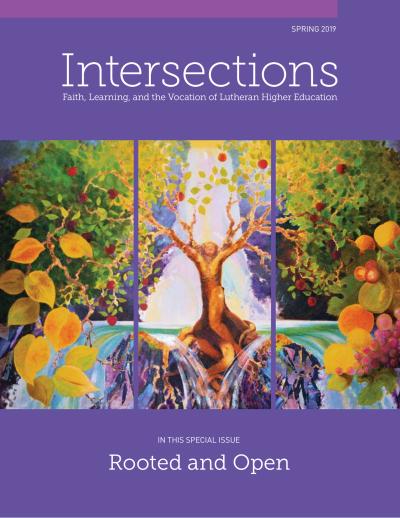
Stortz offers an “operating manual” to Rooted and Open by tracing how the writing team moved from descriptive marks of the institutions to aspirational verbs that mark people — “called and empowered, to serve the neighbor, so that all may flourish” — and shows how each mark generates educational priorities theologically grounded in the radical mystery of God, the wild generosity of God, and the God who became one of us.
-
 Editorial
From the Publisher
Arne Selbyg
No. 8 · Winter 2000
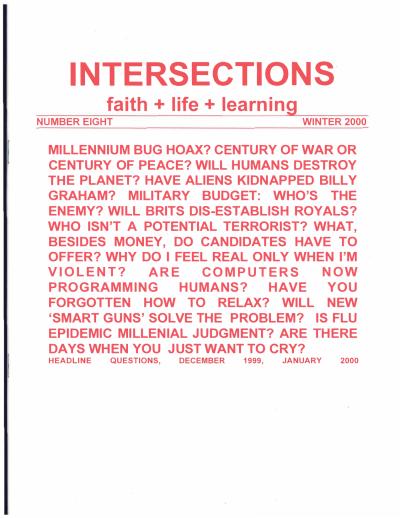
Selbyg reflects on the origins of Intersections—begun out of concern that the philosophy and theology behind Lutheran higher education could be lost to retirements and other preoccupations—and credits Paul Dovre of Concordia and Robert Sorensen of the ELCA Division for Higher Education and Schools as key figures behind the resumption of the debate. He points to three recent books (Ernest Simmons’s Lutheran Higher Education, Paul Contino and David Morgan’s The Lutheran Reader, and Pamela Schwandt’s Called to Serve) and to the new Lutheran Academy for Scholars in Higher Education, and previews the next “Vocation of a Lutheran College” conference at Dana College in August on what differentiates Lutheran colleges within American higher education.
-
 Article
Dual Citizenship: Reflections on Educating Citizens at Augsburg College
Paul C. Pribbenow
No. 29 · Spring 2009
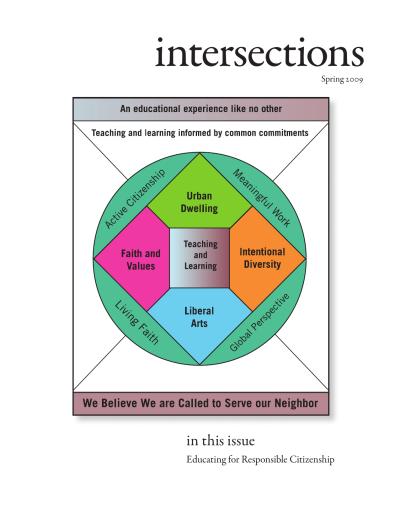
Pribbenow argues that the vocation of Augsburg College is to educate “dual citizens”—those able to live within the messiness of common work rather than resolve every tension once and for all. Drawing on John Courtney Murray on democracy as “the intersection of conspiracies,” Bill Moyers, Jean Bethke Elshtain, Stephen Carter, and the Augsburg vision statement “We believe we are called to serve our neighbor,” he names four common commitments and five principles of civic education that ground Augsburg’s incarnational mission in its city neighborhood.
-
 Book Review
The Religious Genealogy of College: Interrogating the Ambivalence of Delbanco's College
George Connell
No. 39 · Spring 2014
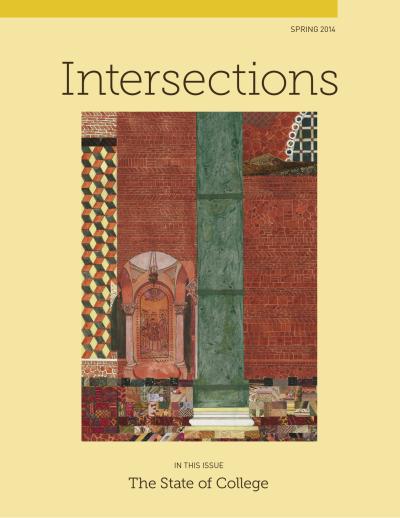
Connell reads Andrew Delbanco’s College: What It Was, Is, and Should Be alongside Concordia’s Vision Statement for the Humanities and Martha Nussbaum’s Not for Profit, tracing Delbanco’s ambivalent engagement with the religious origins of American college. He asks whether Delbanco’s “college idea” can survive cut off from the religious rootstock that nourished it, and proposes that church-related colleges may serve best not as a “usable past” but as a “usable present.”