At the end of the first season of the hit Netflix comedy series, Master of None, the two young adult main characters’ relationship is on thin ice. Dev (played by Aziz Ansari) and Rachel (played by Noël Wells) have been dating for several months, and the initial joy of dating has begun to dwindle. They are getting on each other’s nerves. Their sex life has become blasé. Rachel is angry Dev failed to tell his parents they were even dating.
In the season finale, Dev and Rachel attend a friend’s wedding. During the reading of the vows, which are over-the-top in their lovey effusiveness, Dev and Rachel are transported into an alternate reality in which they imagine what their vows might look like:
Dev: “Rachel, I’m… not 100 percent sure about this. Are you the one person I’m supposed to be with forever? I don’t know. And what’s the other option? We break up? …I don’t know I guess…gettin’ married is just the safer bet at this point. [Pause as Dev stares off into the distance.] Sorry, I was just thinking about all the paths my life could have taken.”
Rachel: “Dev, you’re a great guy. You really are. But you’re right…are we supposed to be together forever? I don’t know. And it just sucks because I mean it feels like everything is laid out now. There are no more surprises. We get married, have kids, get old, and then we die. And I’ve basically invested two of my prime years with you so I should just go all in. That’s just math. So, let’s do this. Quickly.”
Minister: “Do you, Dev, take Rachel to be your partner in a possibly outdated institution in order to have a quote-unquote normal life? Are you ready to give up an idealistic search for a soulmate and try to make it work with Rachel so you can move forward with your life?”
Dev (grimacing): “I do.”
Minister: “And do you, Rachel, promise to make a crazy eternal bond with this gentleman who you happen to be dating at this stage in your life where people normally get married?”
Rachel (nonchalantly): “Yep. I do.”
Minister: “I now pronounce you two people who might realize they’ve made an…unfortunate mistake in about three years.”
After the wedding, Dev confesses to being “freaked out” by their friends’ marriage vows. Sitting across from Rachel at their kitchen table, Dev admits, “I feel like when you’re younger and in your twenties your life is not as clear. You don’t know where it’s going. It takes turns you don’t expect. There’s surprises. And then as you get older it becomes a little clearer and you just know where you’re going to go. There’s less surprise and less excitement and you see what’s ahead. I’m just saying that whatever you’re doing at this age, it’s intense. Whatever you’re doing, whoever you’re with, that’s maybe it, you know? And it’s a lot of pressure.”
Master of None brilliantly tackles the realities of life for American young adults today with humor, authentic language, and an appreciation of the tension many twentysomethings feel between longing to “settle down,” and avoiding just “settling.”
While some seek to blame young adults for their “extended adolescence,” others appreciate their bind. New York Times columnist David Brooks devoted a 2017 column to the topic. Brooks tells the story of how one of his former students was forced to think differently after graduating from college. In college, this student succeeded by taking on small tasks, step by step. Assignments built up into course credits which eventually resulted in a college degree. But young adulthood, Brooks argues, is quite different. “This gets at one of the oddest phenomena in modern life,” Brooks explains. “Childhood is more structured than it has even been. But the great engine of the meritocracy spits people out into a young adulthood that is less structured than it has ever been” (Brooks).
“Twentysomethings are delaying leaving their parents’ homes, delaying marriage and having children, delaying home ownership, delaying financial independence, and—not usually on such lists, but certainly true—delaying (or avoiding) membership in churches or other faith communities.”
Brooks is certainly right that young adulthood has changed significantly over the past twenty years or so. Compared to previous generations, twentysomethings are delaying leaving their parents’ homes, delaying marriage and having children, delaying home ownership, delaying financial independence, and—not usually on such lists, but certainly true—delaying (or avoiding) membership in churches or other faith communities.
Brooks eventually draws from author Meg Jay, explaining, “I used to think that the answer to the traumas of the twenties was patience. Life is long. Wait until they’re 30. They’ll figure it out. Now I think that laissez-faire attitude trivializes the experiences of young adulthood and condescends to the people going through them” (Brooks).
And then, as if anticipating this very topic, David Brooks ends with a call to action for colleges and universities. Given the uncertainty around us, Brooks essentially poses a set of vocational questions that students should take up in college, supported by savvy faculty and administrators:
What does it mean to be an adult today? What are seven or 10 ways people have found purpose in life? How big should I dream or how realistic should I be? …What do I want and what is truly worth wanting? (Brooks)
While I might quibble with some of Brooks’ inferences, I appreciate his tone. It avoids the valence of blame that poisons so much writing and conversation by older adults about twentysomethings. The factors that have brought about such shifts in twentysomethings’ behavior are many, and if anyone or anything is “to blame” it is broader social and economic realities that have brought such shifts. Consider, for a start, student debt rates, changes in the housing market, availability of birth control, proliferation of unpaid internships, or shifts in entry-level salaries. It is too easy to complain that things are different than they used to be, and in the process blame college students for the behavior of their helicopter parents, or for accepting the $50,000+ loan packages that adults offered them.
In the rest of this essay, I raise up the experiences and stories of young adults as they wrestle with questions of vocation that twentysomethings face today. Along the way, I draw from various conversation partners including theologians, cultural critics, psychologists, and young adults themselves. My hope is that readers will develop empathy for the experiences of twentysomethings today. Through their stories and literature on vocation literature, we find several shifts in practices for colleges and universities to consider.
Emerging Adulthood
When I taught at Concordia College, an article appeared in the campus newspaper profiling two students in their early twenties who were in love. That wouldn’t be so unusual, except that these students became engaged in college, and then married the summer before their senior year. In my informal conversations with students after the article came out, many expressed shock at how weird it would be to be married while still in college. Fair enough, I thought, until the article came up in a conversation with a senior colleague. He recalled that, back when he was a student, marriage before graduation was quite common. In fact, I believe he even described a residence hall assigned for married couples. That a college would have enough married students to develop a policy had never crossed my mind. But, then again, I was only ten years older than my students and shared a fair number of cultural connections with them.
To describe what many scholars now call “emerging adulthood” requires a bit of historical context. In the recent past, traditional life events that have characterized young adulthood included marriage, starting a family, and full-time employment. However, scholars have now largely accepted that these life passages no longer best define what it means to be a young adult. Consider, for instance, that in the past few decades the average marriage age has shifted for women from 22 to around 27, and to 29 for men (“For Single Women”). And once young adults do get married, the options for exploration are endless—whether to have kids; whether to rent, buy, or share a home; whether to stay in a soul-sucking job or pursue a poorly-paying dream; whether to pay off student loans or merely enjoy avocado toast.1
How are young adults approaching these shifts? Aaron David Fuller argues that, for many twentysomethings:
Marriage and having children are delayed because it closes off opportunity and exploration in other spheres, such as work or romantic relationships… This is not to say that young adults don’t honor commitment in any form or never adopt distinct beliefs or values. Young adults think deeply about such things, but look to many different spheres of experiences and life to form them because of their preference for independence and unbounded personal choice and exploration. (8)
“Not surprisingly, the emotional lives of twentysomethings are quite complex.”
Not surprisingly, the emotional lives of twentysomethings are quite complex. In her fine book, The Defining Decade: Why Your Twenties Matter—And How to Make the Most of Them Now, clinical psychologist and professor Meg Jay reports on the emotional struggles many twentysomethings reveal to her:
- “I feel like I’m in the middle of the ocean. Like I could swim in any direction but I can’t see land on any side so I don’t know which way to go.”
- “I feel like I just have to keep hooking up and see what sticks.”
- “I didn’t know I’d be crying in the bathroom at work every day.”
- “The twentysomething years are a whole new way of thinking about time. There’s this big chunk of time and a whole bunch of stuff needs to happen somehow.”
- “My sister is thirty-five and single. I’m terrified that’s going to happen to me.”
- “I can’t wait to be liberated from my twenties.”
- “Last night I prayed for just one thing in my life to be certain.” (Jay xxiv–xxv)
Twentysomething life can be a trial; the choices, limits, and possibilities of contemporary life, a struggle.
Stories from the Front Lines
I now move from describing the situation more generally, to sharing three stories of twentysomethings specifically.
“The Abandonment Temptation”
In my book, Kissing in the Chapel, Praying in the Frat House, twentysomethings reflect on their experiences with faith and college. I recently reached out to one of the essayists, Johnna Purchase, for an update on how she’s encountering life after graduating from an ELCA college.
In her original essay, Johnna struggles with the question of whether God has a plan for her life. Particularly, the questions that most concern Johnna relate to dating, and whether there is one right man for her. More broadly, though, Johnna’s piece considers how she might rest in and trust God’s providence, even while she does not know God’s plan for her. She concludes that, vocationally, she must “relax, trust, and let it be” (Copeland 178).
Well, it turns out that Johnna is still working to live into this wise advice several years later. After college, she taught English overseas. She then moved back to the states, landing in Texas where she got a teaching job. Her professional goals are to become a librarian, and to succeed she will need to obtain a master’s degree. However, Johnna took the teaching job first to aggressively pay off her undergraduate student loans. She recently turned 25 and appreciated this birthday as a milestone of sorts. She reflected, “Although I’m not concerned with staying young forever like so much of our society is, [that birthday] has spurred me to be more intentional about going after my professional goals and feeling out how vocation ties into this” (Purchase).
Johnna reports that her time in Texas has presented plenty of challenges vocationally. On the dating scene, she says that since pursuing a notion of holistic vocation is important to her, she’s found—through trial and error—that it can be hard to find a partner with a compatible appreciation. She’s also struggled to find a church community where she feels at home. Interestingly, Johnna writes:
I’ve found actively pursuing the idea of vocation is challenging because many of the people around me don’t have a concept of vocation. I’ve also found that by looking at my life in terms of vocation, I’m isolated from my peers…Finding [typically older] mentors to discuss vocation with has been a struggle too, but I think they could be a great resource because, unlike work peers, true mentors are open to the idea that you want to pursue other degrees and other professional experiences or that you may make choices that prioritize other parts of your vocation instead of being a slave to your job.
Later, Johnna summarizes that she has found the notion of vocation, instilled in her by her ELCA college and faith experiences, difficult to sustain given competing secular values. She concludes:
I’ve found that discovering vocation is a messy, recursive process often without immediately obvious answers and therefore hard. Despite a genuine longing for living my vocation, external pressures—worldly success, financial insecurity, a lack of support of like-minded peers—can sometimes cause me to put off exploring vocation, even as I’ve seen some peers abandon the pursuit altogether (Purchase).
Balancing Acts
Alexandra Benson graduated from an ELCA college three years ago and is pursuing a seminary degree. In college, Alexandra came to appreciate the ways the curriculum and other mission connections encouraged exploration beyond the traditional classroom. As a psychology major, Alexandra explains she never developed a concrete idea of what to do post-graduation, and the search for the “right answer” became, she admits, a sort of obsession. She went after her vocational search with the same diligence she applied to her studies. Alexandra notes, “I was sure there must be one right vocational answer, which at the time I associated almost entirely with finding the perfect career. Surely God was calling me to a specific career in a specific location; my job was to play the part of vocational detective and discover that call” (Benson).
After college, Alexandra spent a year as a full-time volunteer with the Urban Servant Corps program. There she engaged new questions such as:
What does it mean to live out one’s vocation within societal webs of injustice in which I am simultaneously oppressed and oppressor? What does it mean to live deeply in intentional community, to be a steward of the environment? What is the role of my own Christian faith in an increasingly pluralistic and global society? How do my gifts best match up with the needs of this world—and what happens when there isn’t one right answer? (Benson)
Alexandra concluded our correspondence with two particular insights. First, she noted how she wrestles with the current step (graduate school) on her journey, feeling a tension between earning a degree to prepare for her future, while also finding firm roots in the present—as a friend, roommate, sister, and more. That balance between day-to-day living and preparing for future opportunities is particularly challenging.
“That balance between day-to-day living and preparing for future opportunities is particularly challenging.”
Second, reflecting on her college experience, Alexandra remembers feeling “stretched to the breaking point with classes, extracurricular activities, and work study hours.” Looking back, she wonders whether it would have been possible, as she puts it, to “faithfully say ‘no’ to some opportunities in order to actually foster [her] own vocational wellness and exploration” (Benson).
Minimalism
My third example comes from the blog and published memoir by Joshua Fields Millburn and Ryan Nicodemus, who serves as exemplars of extreme vocational shifts in emerging adulthood. Millburn and Nicodemus are practitioners of and advocates for “minimalism.” Also called voluntary simplicity, Samuel Alexander defines the movement as, “cultures and affirms what is often called the ‘simple life’ or ‘downshifting’” (Alexander 7). Minimalism emphasizes restraint in purchasing decisions, moderation, and a search for what is truly personally fulfilling.
Millburn’s and Nicodemus’s discovery of minimalism came after successful careers rising fast in the telecommunications industry. Millburn explains in his book that while his life was full of material wealth including a six-figure salary, luxury car, oversized house, and hundreds of clothes, “There was a gaping void, and working 70–80 hours a week just to buy more stuff didn’t fill the void” (“About Joshua & Ryan”). After meeting another minimalist evangelist, they embraced the movement, moved to Montana, started a blog, and eventually produced an award-winning documentary, The Minimalists.
In their writings, Millburn and Nicodemus advocate a clear philosophy of vocation. They tell readers to ask, “What is my mission?” and to make sure their personal missions are deeply connected to their passions. “People who do what they love for a living,” he writes, “tend to refer to their work as their mission. Not their job, not their career—their mission” (Everything That Remains 117). For Millburn, mission is individual to each person, something people must discover uniquely. Interestingly, The Minimalists exhibit a strong sense of calling to their work. Their story is made even more powerful by its drastic shifts from a corporate life consumed with accumulating goods, to one advocating for the exact opposite. They emphasize that freedom from consumerism allows them to more fully enjoy relationships and experiences.
“Freedom from consumerism allows them to more fully enjoy relationships and experiences.”
Takeaways for Colleges and Universities
There are several lessons that Lutheran colleges and universities can learn from the above. I concentrate on three.
Call Out Lies
Much of what we experience in the cultural conversation about work, professional life, and livelihoods raise up paid work as a be-all-end-all. We glamorize work itself without appreciating the difficulties and complexities it raises.2
Take, for example, how work featured in the last presidential election. Gallons of ink were devoted to Donald Trump’s concern for the laid-off coal miner and factory workers whose jobs were displaced by automation. Discussion of blue collar workers usually reflects America’s founding myths around work: with work comes dignity, we like to tell ourselves. Indeed, the welfare reform bill of the mid-90s enshrined a work requirement, so even our social benefits imply that one’s relationship to others is contingent on their job (and not their human dignity).
As Hillary Clinton put it in debate, responding to a question about Islamophobia, of all things: “My vision of America is an America where everyone has a place, if you are willing to work hard, do your part, [and] contribute to the community. That’s what America is. That’s what we want America to be for our children and our grandchildren” (“Transcript”). And yet, as Jonathan Malesic has pointed out, much of our vocational language and resources fall short when faced with contemporary work realities. What is dignified about working 10 hour shifts for minimum wage scalding headless chickens in a dangerous poultry plant (Grabell)? When in the United States more workers are employed by the fast-food chain Arby’s than those who work as coal miners, why do our politicians give such weight to the plight of the miners (Ingraham)? If we value choice and parenting, why are we the only industrialized nation without federal parental leave policies? Might it be that our reverence for work—any work—outweighs our concern for human dignity and community?
Malesic suggests these issues are both cultural and theological. He writes:
The common theological terms used to describe work are not much help in navigating questions that workers face today. How do you recognize, for example, if your work is harming you? How much attention should you give it? How hard should you work? Is it “time theft” to take a mental break from work, given that work is itself a source of stress? What if you are not paid a living wage? Should you remain in a job even if you are burned out because you need the salary and benefits? To answer these questions, the church’s theology of work must be portable and subjective rather than objective and tied to a single “state.” It must not overvalue work or drive the overworked even harder. (Malesic)
Indeed, and further, I argue: colleges and universities’ posture towards work must be portable and subjective enough not to be tied to a single job, economic system, or cultural era. Our colleges and universities must be willing to challenge the prevailing culture around work. Emerging adults already are. Plus, they can smell inauthenticity a mile away. If we somehow suggest that a magical dignity and happy, easy life comes with employment, we will only appeal to the most gullible of students. The others know—or at least sense—the tough truth around work. It sometimes sucks. It is (too often) dehumanizing. In many segments of our society, the model is in dire need of an overhaul.
“If we somehow suggest that a magical dignity and happy, easy life comes with employment, we will only appeal to the most gullible of students. The others know—or at least sense—the tough truth around work. It sometimes sucks. It is (too often) dehumanizing. In many segments of our society, the model is in dire need of an overhaul.”
I once taught a course entitled, “Vocation and the Quest for Life’s Purpose.” In it, we read Anne-Marie Slaughter’s 2012 cover story in The Atlantic titled, “Why Women Still Can’t Have It All.” The piece reflects on Slaughter’s own story of vocational wrestling. In 2009, she was dean at Princeton University when she was invited by Secretary of State Hilary Clinton to serve as the first female director of policy planning at the State Department. Two years later, Slaughter found herself resigning for a myriad of vocational reasons, and the article puts her wrestling in the context of America’s struggle with work, gender, and parenting. Slaughter’s essay describes her transition from a time in her career when she told young women, “that you can have it all and do it all, regardless of what field you are in” to a more nuanced, less rosy reality that appreciates our complex realities of work, partners, family, caring for parents, the economy, and so on. Slaughter writes, “I’d been part, albeit unwittingly, of making millions of women feel that they are to blame if they cannot manage to rise up the ladder as fast as men and also have a family and an active home life (and be thin and beautiful to boot)” (Slaughter).
“Our colleges and universities must embrace the tough, difficult truth about work these days.”
Students in my vocation course had much to say about Slaughter’s argument. Two schools of thought persisted. Some students wrote-off Slaughter’s gendered analysis, suggesting that their experiences reflected something like actual equality. Other students, however, admitted the article described some of their anxieties about their plans for work, marriage, children, and travel. Many expressed a desire for balance, but a healthy skepticism about whether it would ever be possible.
Such struggles are real. Our colleges and universities must embrace the tough, difficult truth about work these days. So, for public events, invite to campus emerging adults who can tell their struggle to find life-giving employment—not just the shining stars, but grads who will be honest about the challenges of work. Read Malesic, Slaughter, and others, who call into question cultural stories that say things are all right with work. It is time to be real, admitting to students that they can’t have it all, at least not all at the same time. In time, I believe our students will come to thank us for our honesty.
Discovering How to Explore Life
Too often, the word “vocation” becomes a stand-in for “job” or “career.” Instead of colleges and universities approaching vocation, primarily, with career in mind, I suggest that framing vocation through the lens of meaning-making as more appropriate for emerging adults today.
Put another way, vocation is not about finding a job; it’s about discovering how to explore life well. It’s about making meaning of the disparate aspects of life, including, but not limited to, work.
This vocation as meaning-making emphasizes the Christian foundations of vocation, but it’s also more expansive. First, theologically speaking, Kathleen Cahalan writes, in a chapter addressing how vocational searching occurs at all stages in life:
Vocation, then, is Christian meaning-making. It refers to the ways we “take in,” construct, reconstruct, critique, and identify what is significant in relationship to God and others. God’s call comes to us from birth till the end of our days in multiple and varied ways. You experience God’s call anew through particular developmental tasks that emerge in each part of the life span. (36)
Cahalan draws from Sharan Daloz Parks’ work, emphasizing how the twenties is a time for ongoing searches, dialogues toward truth. So too, Luther Seminary graduate student Allison Siburg, in her thesis on young adult women and vocation, builds from Parks to argue for an understanding of vocation that focuses on verbs not events. Rather than preparing emerging adults for marriage, kids, and a job, Siburg argues a modern understanding of vocation should focus on verbs like “becoming,” “participating,” and “cultivating” (10). Siburg’s work connects such ongoing work to Lutheran baptismal liturgy (“live,” “hear,” “serve,” “proclaim” and “strive”) but, as shown below, such leanings flourish beyond the church as well.
Employing this meaning-making approach at colleges might emphasize the search rather than the job. When it comes to arguing for the return on investment of a private ELCA education, I admit this approach may make the marketing and communication team nervous. But, given the reality of emerging adulthood, I do think it is worth framing the value of college as the ability to make meaning (and make a living) in our complex world. For a time, one college’s tagline was, “lives of worth and service” which does lean towards process and not just outcomes. Similarly, Concordia College’s theme of the core curriculum, “becoming responsibly engaged in the world” affirms the always ongoing nature of learning (see Connell).
At the risk of exaggerating to make the point, in the perfect ELCA college of my imagination, I would make a promise to prospective students and parents that went something like this:
We promise not to prepare you for a single career.
We promise not to answer life’s big questions for you.
We promise not to allow you ever to focus on a job over holistic living.
We promise not to relieve you of pain over the world’s injustice.
We promise not to exempt you from a life of deep searching, meaning-making, and commitment to a horizon beyond your own.
Ultimately, if college is about so much more than getting a job, what if college “deliverables” focused on the emerging, changeable nature of young adulthood more than the job market itself?
Vocationally Engaging Your Twenties
Meg Jay’s book, The Defining Decade: Why Your Twenties Matter takes a helpful approach to emerging adulthood, one that I hope our colleges might embrace. Rather than shaming twentysomethings for not getting their lives together, Jay suggests a series of ways emerging adults might approach their twenties by engaging their vocational potential.
“What if, then, colleges helped graduates approach their twenties as a time to take small, wise steps forward—and not figure it all out?”
The mistake many young adults make—certainly influenced by parents and teachers—is aiming to reach their final job/career goals in their twenties. Very few people will land their dream job in their twenties. Perhaps there was a time when that first job or internship out of college led to a 35-year career in a single company, but for the majority of us, those days have passed.
What if, then, colleges helped graduates approach their twenties as a time to take small, wise steps forward—and not figure it all out? Jay’s approach to the issue is helpful because she does not write-off the fact that many young adults will want to travel, date around, have flexible lives, and so on. Jay suggests, though, that even in the midst of such twentysomething experiences, emerging adults can still position themselves towards a profitable path. Jay gives plenty of examples: for a future law student, working as an assistant in a law firm rather than taking a job bartending. For many, volunteering or gaining non-profit experience that builds resumes even while they offer opportunities for adventure. Jay provides dozens of illustrations of emerging adults searching for ways to “grow up” but hesitant to do so due to the enormous range of options before them. Jay’s read of the research finds that if “feeling better doesn’t come from avoiding adulthood, it comes from investing in adulthood” (170). Aligning with Jay’s approach, colleges and universities should clarify reasonable expectations of twentysomething life, emphasizing that it might be used wisely as a time for taking appropriate steps towards long-term vocational goals.
Conclusion
As emerging adulthood becomes cemented into most twentysomethings’ experiences, colleges and universities must shift their practices accordingly. We should prepare graduates to enter an ongoing period of thoughtfulness, vocational reflection, and wrestling with difficult life choices. We must admit the fact that twentysomething life has changed, and develop practices that allow for these new realities. At their best, these practices will call out falsehoods about work and the modern economy, focus on ongoing meaning-making throughout one’s twenties, and prepare students to engage their twenties in ways that lead to long-term benefits. As the meme goes, “adulting is hard,” and that’s okay. Let us—students, culture, and colleges together—therefore embrace the vocational challenge.
End Notes
1. Of course, I merely jest that an affection for avocado toast is on par with such financial goals as buying a home or paying off student loans. But others seem to take such a claim seriously. See Cummings, “Millionaire to Millennials.”
2. My thoughts here are particularly influenced by the Catholic thinker, and former college professor, Jonathan Malesic whose writings—from books, magazine articles, to tweets—I highly recommend. Formal citations follow, but additionally, I note how thoroughly my argument in this section relies on Malesic’s scholarship, including several illustrations that appear in his work (e.g. coal miners).
Works Cited
Alexander, Samuel. “The Voluntary Simplicity Movement: Reimagining the Good Life beyond Consumer Culture.” The International Journal of Environmental, Cultural, Economic and Social Sustainability 7 (2011). Accessed 1 May 2018, https://papers.ssrn.com/sol3/papers.cfm?abstract_id=1970056
Benson, Alexandra. Email correspondence. 8 July 2017.
Brooks, David. “Mis-Educating the Young.” New York Times. Opinion. June 23, 2017. Accessed 1 May 2018, https://www.nytimes.com/2017/06/23/opinion/mis-educating-the-young.html
Cahalan, Kathleen A. The Stories We Live: Finding God’s Calling All around Us. Grand Rapids, MI: Eerdmans, 2017.
Connell, George. “The Religious Genealogy of College: Interrogating the Ambivalence of Delbanco’s College.” Intersections 39 (Spring 2014): 6-9.
Copeland, Adam J., ed. Kissing in the Chapel, Praying in the Frat House: Wrestling with Faith and College. Lanham: Rowman & Littlefield, 2014.
Cummings, William. “Millionaire to Millennials: Your Avocado Toast Addiction Is Costing You a House.” USA Today. May 16, 2018. Accessed 1 May 2017, https://www.usatoday.com/story/money/2017/05/16/millionaire-tells-millennials-your-avocado-addiction-costing-you-house/101727712/
“For Single Women, An ‘Infinite Variety Of Paths.’” National Public Radio. September 30, 2014. Accessed 1 May, 2018 https://www.npr.org/2014/09/30/352661280/marriage-pattern-shifts-seen-by-some-as-destabilizing-society
Fuller, Aaron David. Bridging the Disconnect: Reframing Vocation for the Sake of Young Adults, the Church, and its Leaders. MDIV Thesis. Luther Seminary, 2013.
Grabell, Michael. “Exploitation and Abuse at the Chicken Plant.” The New Yorker. May 8, 2017. Accessed 1 May 2018, https://www.newyorker.com/magazine/2017/05/08/exploitation-and-abuse-at-the-chicken-plant
Ingraham, Christopher. “The Entire Coal Industry Employs Fewer People than Arby’s” The Washington Post. Wonkblog. March 31, 2017. Accessed 1 May 2018, https://www.washingtonpost.com/news/wonk/wp/2017/03/31/8-surprisingly-small-industries-that-employ-more-people-than-coal/?noredirect=on&utm_term=.e2bdd1136a38
Jay, Meg. The Defining Decade: Why Your Twenties Matter and How to Make the Most of Them Now. New York: Twelve, 2012.
Malesic, Jonathan. “Why We Need a New Theology of Work.” America Magazine. September 12, 2016. Accessed 1 May 2018, https://www.americamagazine.org/issue/labor-todays-vineyard
Millburn, Joshua Fields, and Ryan Nicodemus. “About Joshua & Ryan.” The Minimalists. Accessed 1 May 2018, https://www.theminimalists.com/about/
———. Everything That Remains: A Memoir by The Minimalists. Asymmetrical, 2014.
Purchase, Johnna. Email correspondence. 11 July 2017.
Siburg, Allison Mabel Parks. “Trust and Relationship, Voice and Power, and Embodying Baptismal Call: The ELCA’s Role in Empowering Young Women in Vocational Discernment.” Luther Seminary, 2012.
Slaughter, Anne-Marie. “Why Women Still Can’t Have It All.” The Atlantic. August, 2012. Accessed 1 May 2018, https://www.theatlantic.com/magazine/archive/2012/07/why-women-still-cant-have-it-all/309020/
“Transcript of the Second Debate.” The New York Times. October 10, 2016. Accessed 1 May 2018, https://www.nytimes.com/2016/10/10/us/politics/transcript-second-debate.html
-
 Editorial
From the Publisher
Mark Wilhelm
Wilhelm celebrates that NECU schools continue to educate for vocation but warns that the culture of Lutheran higher education is at risk — sustained largely by informal cadres of individuals — and introduces NECU’s Rooted and Open statement as a first institutional step toward reclaiming the 500-year-old Lutheran intellectual and educational tradition.
-
Editorial
Guest Editorial
Lynn Hunnicutt
Hunnicutt traces the etymology of vocation through its cognates — evoke, provoke, convocation — to argue that vocation presumes a relationship between caller and called, that callings are often grounded in ordinary words and humble lives, and that recognizing vocation as plural and lifelong relieves colleges of the pressure to help students find a single calling while on campus.
-
Article
One Life, Many Callings: Vocation Across the Lifespan
Katherine Turpin
Turpin, drawing on the collaborative research behind Calling All Years Good, traces how vocational discernment shifts through adolescence, younger adulthood, middle adulthood, late adulthood, and older adulthood — arguing that focusing vocation on entry into the workforce limits the capacity of intergenerational college communities to wrestle with calling throughout life.
-
Article
Called to Compassion over the Course of a Life: A Buddhist Perspective
Florence D. Amamoto
Amamoto, an associate professor at Gustavus Adolphus shaped by Jodo Shin Shu Buddhism, argues that although Buddhism has no “caller” God, it has a strong sense of calling — we are called by the world to respond to the suffering around us with mindfulness, egolessness, and compassion — and that this lifelong journey is enriched by encounter with the Lutheran vocational tradition.
-
Article
Vocation and Dharma throughout Life's Stages: A Hindu Perspective
Vidya Thirumurthy
Thirumurthy traces her own attempt as a Hindu faculty member at Pacific Lutheran University to grasp the Lutheran concept of vocation, finding in the Bhagavad Gita’s teaching on dharma — duty fulfilled without expectation of reward — an equivalent that, like vocation, varies across the four stages of life and calls individuals to transform others through selfless service.
-
Book Review
Vocation on Campus: Reading Mark Tranvik's Martin Luther and the Called Life at Pacific Lutheran University
Alex Lund, Michael Halvorson
Halvorson and Lund — faculty member and student — review Mark Tranvik’s Martin Luther and the Called Life alongside PLU’s Wild Hope Center for Vocation, weighing the book’s warning against “vocation lite” against the challenge of speaking of God’s call to students in the Pacific Northwest’s “None Zone,” where most students have little exposure to Lutheranism.
-
Article
Luther, the Catechisms, and Intellectual Disability
Courtney Wilder
Wilder confronts Luther’s deeply troubling response to a child with disabilities at Dessau, then mines his Small and Large Catechisms for a Lutheran theology of inclusion — reading the Third Article of the Creed, the petitions of the Lord’s Prayer, and the sacrament of baptism as resources that affirm the full humanity of people with intellectual disabilities as faithful children of God.
-
Article
Lutheran Higher Education in the Land of Anxiety
Jon Micheels Leiseth
Leiseth, returning to Concordia from work with the ELCA’s Young Adults in Global Mission in Southern Africa, draws on Bessel van der Kolk and Babette Rothschild to argue that pervasive student anxiety functions as low-grade trauma that hijacks the storytelling at the heart of vocational discernment — and explores embodied, breath-based practices that might help students reclaim their stories.
-
 Article
Superheroes and Origin Stories: Tools to Discover and Claim One's Callings
TJ Warren
No. 41 · Spring 2015
Warren argues that the “Hero’s Journey” — Joseph Campbell’s monomyth with its ordinary world, call to adventure, mentors, and return with the elixir — offers a powerful pedagogical tool for helping college students discover their origin stories and claim their callings. Drawing on Superman, Wonder Woman, and Rosa Parks alike, he invites educators to mentor students into becoming the heroes of their own lives.
-
Article
Sharing Leadership within Colleges and Universities
Leanne Neilson
No. 41 · Spring 2015
Building on Jodock’s framework, Neilson applies vocational leadership to the unique work environment of higher education — mission statements, faculty governance, the slow pace of consensus, and the sometimes uneasy relationships between faculty and staff — and asks how leaders, followers, and team players can create an atmosphere of mutual empowerment on Lutheran college campuses.
-
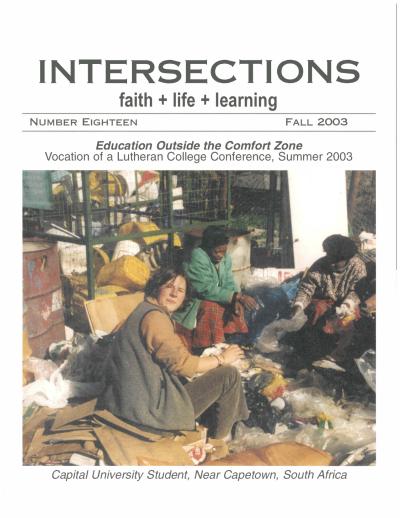 Editorial
From the Editor
Tom Christenson
No. 18 · Fall 2003
Christenson draws on a ten-year alumni survey at Capital University showing that students most often credit practica, internships, travel-study, and service-learning—not classroom hours—as the places they best learned the university’s stated outcomes, and introduces this issue’s papers from the Summer 2003 Vocation of a Lutheran College Conference on education and global outreach.
-
 Article
Freedom of a Christian-College: Looking through the Lens of Vocation
Kathryn L. Johnson
No. 24 · Fall 2006
Johnson, Paul Tudor Jones Professor of Church History at Louisville Presbyterian Theological Seminary, re-reads Luther’s 1520 treatise The Freedom of a Christian as a paradigm for the “freedom of a Christian college” amid the pressures of professional preparation. She traces Luther’s paradoxical claim that a Christian is “a perfectly free lord of all, subject to none” and at the same time “a perfectly dutiful servant of all, subject to all,” and argues that the same dialectic frees a Lutheran college to engage the professions without being captured by them.
-
 Editorial
From the Editor
Colleen Windham-Hughes
No. 62 · Fall 2025
5 min audio
Windham-Hughes plays on the shared Latin root of “education” and “seduction” (ducere, to lead) to warn against the No-saying seductions of giving up or condemnation, and to call educators to the riskier Yes of showing up to build third-space communities of truth-telling and hope.
-
 Reflection
The Neglected Miracle of Pentecost
Susan M. O'Shaughnessy
No. 32 · Spring 2010
O’Shaughnessy, in a homily delivered at Concordia College in 2008, reads the Pentecost narrative of Acts 2 through Maria Lugones and Elizabeth Spelman’s 1983 critique of white feminism’s cultural imperialism. She argues that the miracle is not the disciples’ speaking but the immigrant Jews’ hearing—and that the writer of Acts withholds the content of what was said precisely to teach disciples that people of privilege know less than the foreigner, the immigrant, the oppressed, the woman, the child, and must learn to listen in new languages before they can speak.