Americans stand a chance of hearing about vocation when class-conscious twenty-year-olds commence with life as young adults. Commencement speeches frequently include explicit or implicit references about the worthiness of one or another professional pursuit. Graduates aspire to a class-status that likely delimited their options for a major and, upon beginning college, effectively predetermined their career path. In an economy with strident class-stratification, incoming freshmen are encouraged to “follow the money”. Commencement speeches rarely remind graduates about that pursuit. Invariably, commencement speech themes accent vocation. Professional pursuits are deemed worthy when graduates exercise transformative agency. Graduates are tasked with shouldering the burden of engaging in transformative heroic acts. It’s highly unlikely, however, that a profession, institution or industry will be transformed. In fact, there are no guarantees that either the profession or the person will be transformed. Graduates may experience the journey as worthy and transformative in retrospect. Journeys, to be sure, are replete with risks. Consistent heroic actions are worthy because transformation is possible and, perhaps, preferable. Who wouldn’t prefer to be transformed? Those who are unbothered and apathetic. In increasingly technocratic, career-conscious academic contexts, apathy abounds. Given the kind and quantity of America’s societal problems, the mismatch is confounding. Why such apathy when social pathologies abound? How can the worthiness of pursuing unscripted journeys be redeemed? When worth emanates from consistent work. Work is worthy. Work translates. Work works.
Educators in humanities who profess to students a few times a week at small liberal arts colleges would likely agree that the number of the unbothered is growing. The number of the unbothered are increasing on both sides of the desk. Professors and students languish. What, of worthiness and work, remains?
Educators can cultivate classroom experiences that devalue heroic ideologies, eschew expressly religious heroes and embrace anti-heroines. By emphasizing just one option, professors alienate self and students. Educational endeavors should be fraught and forgiving. The joys of educational endeavors obtain when the complexity of a religious anti-heroine, like Toni Morrison’s Sethe, surfaces. Such joy is manifest when, in the context of a seminar, sojourners realize that humanist groups like the Coalition of Black Trade Unionists deideologize difference.
The risk of being employed in quasi-elite academic institutions is acute, not least because apathy abounds. The journey may not justify the risks. Interest groups deploy decadent economic imperatives among what Wendy Brown calls the “ruins of neoliberalism.” Vocation is among the ruins. The ruins help explain apathy as well as the annual calls to render heroic pursuits vocational. In the academy, explanations are necessary but insufficient. Professors and students need more. Perennial commencement speeches, intentional though they may very well be, will not resuscitate vocation. Parishioners from wisdom traditions in prior American eras commend work. When embodied as a form of service to others, work is worthy.
Post-War and post-Civil Rights churches in impoverished communities often displayed admonitions prominently in vestibules that encouraged its members as follows: “Enter to Worship, Depart to Serve” and “God first, others second, me last.” How can such deference address apathy if vocation redounds to God-talk that warrants serving elites, be they students or professionals? Many activists, Afro-pessimists and post-Socratic scholars view such religiously inspired deference as self-abnegation. Colonized Christian God-talk is antiquated. Respectability politics disrespects the impoverished. These critics make valid points. The journeys of impoverished Christians from previous generations was a risk. Merely talking about God and vocation, though a necessity for some, will not suffice. The wisdom of elders commends the kind of work such that an educators walk matches their talk. If an educator’s work is consistent and co-creative, transformative moral agency will commence.
Professors embody such work when their teaching and research consistently exudes vulnerability, extemporaneity and contemporaneity. Professors must resist the urge to model the banking theory of knowledge. Graduate school is over. Impressing intellectual elders is no longer the goal, as if it ever was. Undoubtedly, professors are the smartest in the room. If, by chance, a professor is not the expert, students are blameless. Proving one’s intellectual bona-fides is counter-productive. Assuredly, in some courses, lectures are apropos. Make them interactive. Over the course of a semester, professors should, both through in-class dialogue and paper feedback, convince students that their ideas and arguments matter. Centering student learning requires vulnerability.
Professors must also exhibit the joys of learning, in class. If proverbial light bulbs do not “go off” in class, during a session, America’s post-literature, algorithmic culture will not aid this process. This applies to professors, too. When this occurs, professors should state as much, in the moment. Learning, moreover, is a process. Students who seem to have more “light bulbs moments” need not be catered to. Attend to deliberate thinkers who might need several weeks to process ideas. Professors should structure classes so that students are encouraged to think “out loud” and explore arguments that lead to unjustifiable, even undesirable, conclusions. Over the course of a semester, professors should talk less. They should feel out-numbered. Such a state of affairs is far more likely to obtain when professors are extemporaneous.
Lastly, professors should be conversant with current events. Examples are most illustrative when students know the person or event being referenced. Professors need not necessarily be culture vultures. Pop culture is transient and, at times, distasteful. That is what makes recent examples so interesting. Positioning a fashionable contemporary cultural event or person against the backdrop of a wisdom, literary or philosophical tradition is generative. Traditions perdure because they are selective. Professors should not predetermine what could be selected. Such determinations are journeys that require the kind of co-creative—student-teacher—transformative work that occurs in the classroom for the purpose of empowering those who do not attend college, especially the impoverished.
-
 Editorial
From the Editor: Why All This Talk About Vocation?
Colleen Windham-Hughes
Windham-Hughes introduces the Fall 2022 issue built around Mark Wilhelm’s keynote “Why all this talk about vocation?” and previews five panel responses, two first-time conference reflections, and companion pieces on Womanist theology — framing vocation as a call not to privilege but to constructive and corrective work that undoes unjust systems.
-
Article
Why All This Talk About Understanding the Mission of NECU Member Institutions as a Vocation?
Mark Wilhelm
In his valedictory keynote, retiring NECU Executive Director Mark Wilhelm argues that Lutheran higher education is, properly understood, vocation-based education — outlining four core practices recovered over the past fifty years and naming the constructive and corrective work still to be done, including a fuller embrace of DEIJ and of the diverse vocations of NECU’s 27 institutions.
-
Response
Response to Mark Wilhelm: Vocation, Mission and Privilege
Marit Trelstad
Trelstad affirms Wilhelm’s claim that vocation is the foundational shared mission of Lutheran higher education rather than one program among many, and presses the critique that calls to “vocational reflection” can mask privilege — arguing that an intersectional lens shows vocational discernment is in fact a matter of survival and flourishing for students from marginalized communities.
-
Response
Response to Mark Wilhelm: DEI, Great; DWS (Dismantling White Supremacy), Even Better
Vic Thasiah
Thasiah argues that if Lutheran colleges and universities want to live out their commitment to the flourishing of all, DEI is good but DWS — dismantling white supremacy — is even better, and offers three Lutheran sensibilities (suspicion of self-righteousness, the decolonial shockwave of the cross, and critical thinking that can still register awe) that can make DWS a core practice of higher education.
-
Response
Response to Mark Wilhelm: Distinguishing Between Identity and Vocation
Andrew Tucker
Tucker proposes that NECU’s next most faithful step is to faithfully and effectively differentiate vocations and identities — arguing that identity is who you are, vocation is what you do, and that recognizing the plurality of both helps Lutheran institutions name which work is theirs to take up and which is good work that belongs to someone else.
-
Response
Response to Mark Wilhelm: Vocation—Wide Perspective Questions
Mary-Paula Cancienne
Cancienne, drawing on Iain McGilchrist, asks whether higher education has prioritized micro lenses at the expense of the macro view, and invites educators to hold the drama of individual vocation stories within a wider plot that includes James Webb Telescope wonder, climate grief, the long shadow of enslavement, and the resilience of native populations.
-
Response
Response to Mark Wilhelm: Adopting the Framework of ‘Because’ and ‘Therefore’
Paul C. Pribbenow
Pribbenow describes how Augsburg University responded to its dramatic demographic transformation (from 18% to nearly 70% BIPOC entering students over sixteen years) by adopting an institutional vocational statement and a simple “because/therefore” framework for translating particular Lutheran theological convictions into institutional programs, policies, and practices.
-
Reflection
Why All This Talk About Vocation?
Madyson Ray
Ray, a junior at Midland University and the only student attendee at the 2022 conference, reflects on four workshops — on teaching womanist thought, on supporting student-athletes, on resistance to the word “vocation,” and on vocational reflection — and brings home concrete ideas including a women’s-history scavenger hunt and semester-long vocational reflections.
-
Institutional Focus
LibGuide: Introduction to Womanist Theology
Elli Cucksey
Cucksey, the head librarian at Trinity Lutheran Seminary, recounts how Beverly Wallace’s Introduction to Womanist Theology class — the first offering of the ELCA Seminaries’ Womanist Theology Initiative — led her to build a publicly available LibGuide that amplifies Black women’s voices and gathers the resources of the course for future students.
-
Article
Doing the Work One’s Soul Must Have
Beverly Wallace, Yolanda M. Norton
Norton and Wallace describe the Womanist Experiential Learning Initiative — including the Beyoncé Mass, study-abroad partnerships in Portugal, Brazil, and Ghana, and the Black Girl Magic Academy for teenage girls — as a way of centering Black women’s voices in theological education and doing, as Katie Geneva Cannon put it, “the work…that one’s soul must have.”
-
 Editorial
From the Publisher
Mark Wilhelm
No. 43 · Spring 2016
Wilhelm announces the new Network of ELCA Colleges and Universities — established in 2015 and convened for its first Board of Directors meeting in February 2016 — as a missional collaboration between the churchwide organization and the twenty-six ELCA colleges and universities, replacing former churchwide units lost to budget reductions and offering a stronger, more viable vision of Lutheran higher education.
-
 Article
From Pietism to Paradox: The Development of a Lutheran Philosophy of Education
Philip Nordquist
No. 8 · Winter 2000
Nordquist traces a four-decade personal and institutional journey from the “Protestant triumphalism” and aggressive moralism of S. C. Eastvold’s 1950s Pacific Lutheran through the 1960 Ditmanson–Hong–Quanbeck volume The Christian Faith and the Liberal Arts, Gordon Lathrop’s 1972 PLU donor address grounding the university in two-kingdoms theology, the ALC’s 1975 Concordia workshop with Bill Narum, Bob Bertram, Harris Kaasa, and Sydney Ahlstrom’s case for the “critical” tradition over the scholastic and pietistic, the 1976 LCA statement distinguishing “Christian” from “church-related” education, and Richard Hughes’s 1997 Carthage address. He concludes that dialectical (two kingdoms) theology, Christian humanism alongside professional studies (the New American College model), Luther’s commitment to universal compulsory education, environmental and civic responsibility, and academic freedom together constitute the bequest of the Reformation—“Christ and culture in paradox” remains the best approach to education he knows.
-
 Article
The Musician's Vocation
Jeffrey Bell-Hanson
No. 48 · Fall 2018
Bell-Hanson argues that musicians, who exercise profound influence over the emotional flavor of a moment, are called not merely to technical proficiency but to a sense of vocation: understanding their art well enough to use it responsibly, to intend truthfulness rather than manipulation, and to articulate its significance in dialog with other disciplines.
-
 Article
A Lutheran Dialectical Model for Higher Education
Ernest L. Simmons
No. 37 · Spring 2013
Drawing on “The Freedom of a Christian,” simul justus et peccator, Richard Hughes, Joseph Sittler, Martha Nussbaum, and Tom Christenson, Simmons argues that the Lutheran tradition informs an open, dialectical educational model that holds Christian and academic freedom together. He locates vocation at the intersection of the practical (why are you here?) and the existential (why are you here?) and proposes Lutheran higher education as education for self-transcendence and leadership Soli Deo Gloria.
-
 Reflection
Truth, Reconciliation, and Redemption in South Africa
Brian Forry Wallace
No. 13 · Winter 2002
Wallace, a 24-year veteran political science professor at Capital University, recounts five weeks of post-apartheid peace-building travel-study with students living south of Cape Town—visiting townships, schools, day-care centers, a children’s AIDS hospital, Robben Island, and Nelson Mandela’s cell—and offers vivid sketches of his student companions Amy, Brian, Meghan, Karrie, Patrick, Meredith, Cheryl, Corin, Debbie, April, and Audra. He concludes that these students—atheists and agnostics and Buddhists and Methodists and Baptists, headed for social work, nursing, teaching, ministry, and parenthood—embody vocation by responding to a voice that calls them out of themselves to be present and to heal in this world, and that they are his link to the redemption of a lost and broken soul.
-
 Institutional Focus
Interfaith Campus Organizing at California Lutheran University
Allison Bermann, Mehak Sachdev
No. 44 · Fall 2016
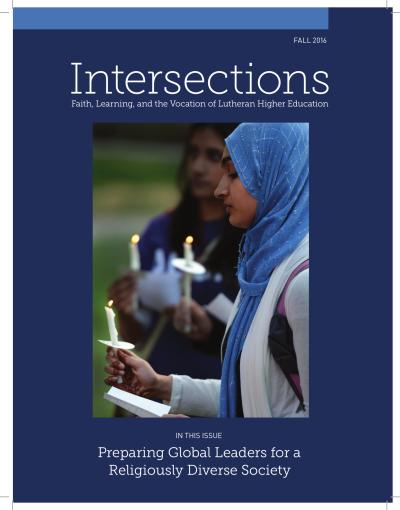
California Lutheran University students Allison Bermann and Mehak Sachdev describe how interfaith participation at CLU grew from a grassroots movement into a sustained, integrated part of campus identity — with an intern program, Interfaith Allies, co-curricular events from Diwali dinners to Hunger Banquets, and a classroom practice of storytelling that opens the required Introduction to Christianity course to students of every faith and none.