Business as Usual? Marketing, God, and the Limits of Christian Callings
Intersections No. 51 · Spring 2020
Among the reforms Martin Luther desired for the church, he sought to break down the walls between the holy vocations and everyone else. He argued that all people could serve God and love their neighbors, no matter their job, and that those who worked in the church as priests or monks, for example, were not more holy or perfect than others.
In one example, writing on whether Christians can bear the sword on behalf of “temporal authority” (secular government), he argues first that temporal authority exists not for Christians who ought naturally to follow the will of God, but “for the sake of others, that they may be protected and that the wicked may not become worse” (Luther, “Temporal Authority” 94). Thus, Christians can freely participate in this secular government and bear the sword—not for their own advantage, but out of love for their neighbor and to restrain evil and protect the vulnerable. “Therefore,” he writes, “if you see that there is a lack of hangmen, constables, judges, lords, or princes, and you find that you are qualified, you should offer your services and seek the position” (95).
Many might respond with a cry of disbelief: “Hangmen? Is it really appropriate for Christians to be in the business of killing people?”
The hangmen example is a famous and hotly debated one—perhaps by Luther’s design. He is most concerned to probe the limits of what can count as a legitimate Christian calling. He thus sets up various criteria that need to be in place for the inclusion of hangmen. First and foremost, the temporal authority (political leader) must recognizes his or her work to be the rightful promotion of the common good or restraint of evil in service of the neighbor. Luther recognizes that many princes claiming to be acting “Christianly” were simply amassing their own power (“Temporal Authority” 84). In our decidedly post-Christian era, such an argument is further complicated. And given all the injustices present within our contemporary judicial system, the question is pressed further: Can Christians, constrained by love of neighbor, be executioners?
Not all questions of Christian vocation are quite so controversial. The contemporary faith and work movement exists today in the wake of Luther’s claim that no vocation is more holy than another. Yet it too must wrestle with what exactly a “Christian business,” for example, means and how to live it out. Some see the workplace as a place to evangelize, but emerging organizations are trying to more closely align “Christian” work with work for justice and the flourishing of all (Worthen).
As the movement develops a more critical edge and is willing to question business as usual, I would suggest we need to return to the question of whether there are certain professions Christians shouldn’t do. While I don’t wish to reconstruct a wall between secular and sacred vocations, my contention is that the command to love our neighbor requires us to look deeply at how our work affects our neighbors.
Depending on our religious traditions and social locations, the answer to the question of whether certain professions may be off limits may appear self-evident; some jobs may seem obviously wrong to one person, while completely fine to another. But we are formed by many things that teach us those perspectives. For example, James K.A. Smith has identified secular liturgies in spaces such as the shopping mall, sports arenas—and yes, universities—that can idolatrously shape our ideas of “the good life” (121). As our participation in these and other practices in culture shape our social imaginations, they provide ethical frameworks by which we make decisions. This formation is often implicit and occurs without our knowledge, hence our decisions according to this “common sense” appear self-evident and not necessarily in conflict with our faith.
The Business of the Neighbor
I write as a theologian and ethicist who sees the question of vocation as an important ethical question. But I also write as someone who spent ten years working in corporate marketing consulting before going back to university and studying theology. In the process I realized just how much I had been shaped by capitalism, the American Dream, and my own business education.
I also write with several caveats. My goal in asking the question is not to come up with a concrete list of professions Christians must avoid. The answers are rarely so black and white, and if we did come up with such a list we would inevitably domesticate it in order to be able to live according to it. In making such a list we would simply have to avoid that list of professions in order to justify ourselves and then judge ourselves more righteous than those who were in those jobs. I also want to acknowledge that our options are always limited and imperfect; there is no “innocent” job untainted by structural injustices. We cannot entirely extract ourselves from consumer capitalism, just as we cannot extract ourselves from the fallen world in which we live.
Luther famously advocated that Christians cannot be justified by any works—by obeying any set of laws—but that salvation was given as a gift through faith in Christ’s work on our behalf. The law, he argued, causes humans to constantly look inward to ask whether they are good enough. In doing so, they can never really love their neighbor because they are preoccupied with their own works and salvation. However, in Christ, one can be assured and secure in their salvation and are thus able to look outward to Christ and their neighbor.
Dead to sin and alive in Christ, one is able to focus on loving the concrete neighbor that God places before one. This is our broadest vocation as a Christian. In that sense, the first theological question we may ask about professions is how does this help or hinder my love for my neighbor? Because our social imagination is so powerfully shaped by the systems and institutions in which we live, we must critically examine what is happening in the places where we work, what might be getting in the way of loving our neighbor, or problematically redefining what loving our neighbor means. I hope that the questions examined here open us up to how Christ transforms the way we understand what it means to love our neighbor in our work contexts.
“The first theological question we may ask about professions is how does this help or hinder my love for my neighbor?”
With this goal in mind, I here scrutinize one particular profession: marketing. Marketing serves as a useful example for several reasons. First, it is mundane and ubiquitous. Virtually every type of organization from churches to non-profits and corporations have marketing positions. Second, it is either praised as empowering consumers and meeting their needs, or demonized as manipulating desires. So which is it? Or can we evaluate its compatibility with Christian neighbor love without either praising or demonizing?
How we narrate the practices of marketing dictates the ethical questions raised and frames the set of reasonable answers about whether Christians should participate. Marketing is useful, then, as a case study to theologically narrate what is going on and to do so in a way that gets underneath textbook definitions and polarizing options, while allowing for critical questions and discernment.
Who is Marketing For?
Marketing positions itself as a neutral set of tools, as a process that facilitates the mutually beneficial exchange of products and services of value. This formal positioning takes on a positive tone via one of marketing’s prominent framing ideas: the marketing concept. According to the marketing concept, the firm exists for customers to know their needs and satisfy their needs.
“According to the marketing concept, the firm exists for customers to know their needs and satisfy their needs.”
This positive positioning is emphasized as texts rhetorically portray the marketing concept as a progression from other possible business orientations—namely a focus on production or selling. In the production concept, a firm focuses on selling mass-produced goods at a low cost, while under the selling concept, firms undertake aggressive selling campaign so that consumers will buy enough of their products, that perhaps they otherwise would not. With these other concepts as a foil, the portrayal of an enlightened turn from a selling orientation to the customer orientation makes the marketing concept appear as a win-win strategy, one that focuses on the interests of the consumer to meet business objectives and therefore facilitating valuable and mutual economic exchange. Firms oriented in this way create our treasured social goods: wealth and economic growth, ever improving lifestyles, and the ability to freely express ourselves personally by what we consume.
“The consumer is now in total control,” Kevin Roberts, former CEO of advertising agency Saatchi & Saatchi, proudly exclaims. “She’s going to decide when she buys, what she buys, where she buys, how she buys…All the fear’s gone and all the control is passed over to the consumer” (qtd. in Goodman and Dretzin).
However, the pure customer orientation of marketing can be questioned by digging further into the discipline’s stated objectives. Philip Kotler, an influential popularizer of the marketing concept writes that “Marketing management is essentially demand management” (Marketing Management 15). This aspect of marketing has been present from its earliest roots in economic theory. No matter how a firm frames its purpose one must keep in view the desire to manage customers in order to manage product demand. Further, one can see the fundamental force and purpose of the customer orientation of a business in light of a further conversation in Kotler’s marketing textbook. He argues that the main purpose of orienting a firm to satisfy the needs of the target customer is because it is cheaper to retain an existing customer than to attract a new customer (22).
Therefore, we can see that the primary goal of the marketing concept is to increase customer loyalty (customer retention) for the sake of company profit. My point so far is simply that marketing cannot be both empowering to the consumer, striving to “sensitively [serve] and [satisfy] human needs” as Kotler advocates (Kotler and Levy 13), and be a system of tools that desires to manage demand and create customer loyalty for the sake of customer profit. We must acknowledge that it is not a neutral set of techniques.
“Marketing cannot be both empowering to the consumer, striving to ‘sensitively [serve] and [satisfy] human needs,’ and be a system of tools that desires to manage demand and create customer loyalty for the sake of customer profit.”
The marketing concept masks the vast network of activities and systems that exist in order to know consumers, and then to generate a situation in which they are satisfied by a given product or service. Management guru Peter Drucker writes: “The aim of marketing is to know and understand the customer so well that the product or service fits him and sells itself. Ideally, marketing should result in a customer who is ready to buy. All that should be needed then is to make the product or service available” (64-65).
This description reveals the sweeping aspirations of marketing to know customers in order to influence them—to make it appear that they are satisfying their needs and desires without needing to be convinced. A detailed analysis of the practices and systems in place from marketing research to advertising to big data reveal this desire and the increasing capacity to carry this out in personalized ways. A study of each practice in its context reveals its own set of theological and ethical questions. Here I will focus on branding as a significant tactic used to generate consumer loyalty for the sake of profit and then reflect theologically on that practice.
Branding: A Quest for Loyalty
Modern branding originated in the early twentieth century as the output of industrialized goods increased and markings became prevalent to help consumers distinguish between mass-produced items. The world of branding has changed significantly since then to the point where Naomi Klein now argues that industrial economies are no longer about making and selling things, but buying products and then branding them (5).
This shift has been driven by the continuing need to create customer loyalty. Multiple things can create customer retention; one, of course, is that the product actually satisfies the needs of consumers. A company cannot generate loyalty if it offers something that no one is interested it, or promises something it does not deliver—however fleeting satisfaction may be. However, as the number of products available has proliferated, as quality and pricing have converged, and as most physical and functional needs have been met, more is needed to generate loyalty. This is the role of the modern brand.
Brand loyalty develops as firms successfully meet functional needs with the product itself, but it must progress from there. Strong brands must be able to associate their brand with more “expressive” and “central” values, thus endeavoring to meet more emotional and spiritual needs. In this way consumers are encouraged to link questions such as, “What kind of person do I want to be?,” with the brand, so that the brand is seen to “say” something about the consumer and consumers and brands can “share” values. As brands create this linkage, customers will be increasingly loyal to them (Andrew 191).
Douglas Aitkin, a branding expert, describes the experience of hearing consumers in a focus group “expressing cult-like devotion” to gym shoes. He decided to study cults to apply that knowledge to brands. Aitkin concluded that people join brands for the same reason people join cults: “to belong and to make meaning.” Thus, in addition to managing product quality, advertising and promotions, packaging design, and pricing decisions, brand managers now have to “create and maintain a whole meaning system for people, through which they get identity and understanding of the world. Their job now is to be a community leader” (qtd. in Goodman and Dretzin). Brands are providing communities for people to self-actualize and consumers are using brands to help navigate life experiences, to construct their identities, and to express their values.
“All these elements are designed to generate love and loyalty among the target audience by glorifying the brand and creating visceral associations.”
In another take, Kevin Roberts argues that brands should aim to generate love for their brand. He insists that stand-out brands must “tap into dreams,” utilize “myths and icons”, and generate “passion” in order to create “loyalty beyond reason” (77, 66). Roberts’s comments point to the range of activities that go on to animate brands in order to generate love and loyalty. Putting a Nike swoosh on a T-shirt means something now, but that meaning was created and is continually sustained. Brand personalities are created by a variety of elements from their name, logo, shapes, and colors, to slogans, spokespeople, stories, event sponsorships and product placements in the media. All these elements are designed to generate love and loyalty among the target audience by glorifying the brand and creating visceral associations.
So far I haven’t mentioned theology, but other words for the loyalty brands seek might be faithfulness or worship.
Luther on What a God is
The theological contours of branding can be illuminated by looking at Luther’s definition of God from The Large Catechism:
What does it mean to have a god? or, what is God? Answer: A ”god” is the term for that to which we are to look for all good and in which we are to find refuge in all need. Therefore, to have a god is nothing else than to trust and believe that one with your whole heart. As I have often said, it is the trust and faith of the heart alone that make both God and an idol. If your faith and trust are right, then your God is the true one. Conversely, where your trust is false and wrong, there you do not have the true God. For these two belong together, faith and God. Anything on which your heart relies and depends, I say, that is really your God. (386)
For Luther, our trust and faith define both God and idols—“anything on which your heart relies and depends.” This does not mean that God is only a projection of ourselves, our fears and desires, but that human beings are wholly determined by their relationship with God. God is not just someone we acknowledge with our lips or our minds. Rather, our lives are oriented by hope and trust in God’s goodness, promises, and provision.
All our faith and trust is in the true God or it’s not. There is no in between—that’s idolatry, according to Luther. God is the one eternal good, the giver of all good things and the one who provides by grace and gift alone. And so, “[God] wishes to turn us away from everything else apart from him, and to draw us to himself, because he is the one, eternal good” (Luther, Large Catechism 388). Luther acknowledges that many of the good things we receive come through other humans, yet “anything received according to his command and ordinance in fact comes from God...Creatures are only the hands, channels, and means through which God bestows all blessings” (389). So as brands attempt establish themselves as a source of life, identity, and meaning for the sake of their own profit, they are redirecting the hopes and trust that are meant to placed in God.
And brands do not just help increase firm profits by selling their products and services; they are also financial assets for the firm that appear on company balance sheets. This quantity represents the value of a brand that could potentially be transferred to another company in the event of a sale, separate from expected sales revenue (Batchelor 102). The brand is something over and above the product or service itself; it is created and sustained by the work of professionals who attempt to imbue the brand with spiritual values and meaning that ultimately only exist to the extent that customers believe they exist and are willing to value them—who look to them to help as a source of identity and meaning in the world.
Here we might ask about the actual difference, for example, between a functional car and a BMW. In some ways a BMW may actually be of higher quality—more comfortable or more efficient than a lower-priced car. But we would be hard pressed to equate the price difference and brand power entirely to quality or other real differences in the cars.
“Brands have captured the love and worship of human beings and have turned them into capital.”
In a very real way, then, brands have captured the love and worship of human beings and have turned them into capital. Neuroscience also reveals the successful effects of branding. When individuals are exposed to the logos and imagery of powerful brands their neural activity is identical to the patterns of brain activity produced when they view religious symbols (Lindström 124-25).
Questions Christians Should Consider
For Luther, an economic system, the market, or even a brand can be the means by which God provides genuinely good things to human beings. But that system or brand becomes idolatrous when it points human beings away from God as the provider and endeavors to secure worship and trust in itself instead.
Though what I have just described is a dominant theoretical approach to branding and true for most large brands, not all branding operates as I described. My friend does branding for small, local businesses and focuses on helping them clearly communicate their main message. But as a Christian, he understands the potential impacts of branding in our contemporary environment. He is willing to ask the tough questions about his own business practices in light of his faith, and pass on projects that don’t fit his ethical considerations.
Christians working in marketing or branding, or those considering going into the profession, should consider the following:
- What does the brand or advertisement promise? Is it directly related to the product or service or is it something above and beyond what we can realistically promise?
- What is the genuinely good thing we are providing to customers? And how are we defining what is genuinely good? Does it increase or diminish service to the neighbor?
- Are our marketing efforts directing the hopes or trust of human beings away from God and toward our company or brand? Though Luther noted that its possible to recognize God’s provision coming from the hands of human beings, it is clearly a problem if our marketing efforts intentionally obscure such provision and idolatrously redirect human identity and faith away from God.
As we consider broadly the question of whether there are some professions Christians shouldn’t do, my intention is to press us to ask questions of our work that go beyond how we can be “good Christians” at work and to ask what is going on in our work itself, and how it affects others. Luther’s definition of God, and the corollary, of an idol, is a useful lens to examine many practices and aspects of life because it reveals that faith is always enacted. All actions spring from some hope and are expressions of praise and expectation of what one can count on from some power. And so, we must question whether and how our own work creates idols or plays on fears instead of trust in God.
But Christians must also examine their own hope and faith, and be continually reminded of who they are in Christ. That God through Christ is for them reveals a God who provides everything human communities need to flourish. Only as human lives are confident and radically oriented by trust in God’s promise will they be freed to follow God, including in their paid vocations. The business of Christianity—centrally focused on worship of God and love for the neighbor—will always run counter to idolatrous visions of “the good life.”
Works Cited
Andrew, David. “Brand Revitalization and Extension.” Brands: The New Wealth Creators, 184-95. Edited by Susannah Hart. Macmillan, 1998.
Batchelor, Alex. “Brands as Financial Assets.” Brands: The New Wealth Creators, 95-104. Edited by Susannah Hart. Macmillan, 1998.
Goodman, Barak, and Rachel Dretzin. “The Persuaders.” Frontline. PBS, 2004. Accessed 1 March 2020, www.pbs.org/wgbh/pages/frontline/shows/persuaders/etc/script.html
Kotler, Philip. Marketing Management: Analysis, Planning, Implementation, and Control. Ninth, International ed., Prentice-Hall, 1997.
Kotler, Philip, and Sidney Levy. “Broadening the Concept of Marketing.” Journal of Marketing 33 (1969): 10–15.
Lindström, Martin. Buyology: Truth and Lies about Why We Buy. Broadway, 2010.
Luther, Martin. “Temporal Authority: To What Extent it Should be Obeyed.” Luther’s Works (American Edition), volume 45. Muhlenberg, 1962.
———. The Large Catechism. The Book of Concord: The Confessions of the Evangelical Lutheran Church. Edited by Robert Kolb, Timothy J. Wengert, and Charles P. Arand. Fortress, 2000.
Roberts, Kevin. Lovemarks: The Future Beyond Brands. Second ed., PowerHouse, 2005.
Smith, James K. A. Desiring the Kingdom: Worship, Worldview, and Cultural Formation. Vol. 1. Cultural Liturgies. Baker Academic, 2009.
Worthen, Molly. “What Would Jesus Do About Inequality?” The New York Times, December 13, 2019. Accessed 1 March 2020, www.nytimes.com/2019/12/13/opinion/sunday/christianity-inequality.html
-
 Editorial
From the Publisher
Mark Wilhelm
Wilhelm frames the issue by tracing how Lutheran educational ideals — once a primary source of contemporary higher education — were masked in the United States, and introduces a NECU initiative that uses the case of business ethics to explore Lutheran social teaching as an academic resource.
-
Editorial
Guest Editorial: Moral Deliberation in NECU Classrooms
Ernest L. Simmons
Simmons introduces the guiding question of the NECU working group: could the ELCA’s twelve social statements and thirteen social messages — expressions of Lutheran social teaching originally formulated for congregational use — turn campuses into “academic communities of moral deliberation”?
-
Article
The Responsible Professional: Vocation and Economic Life
Martha E. Stortz, Tom Morgan
Stortz and Morgan argue that the “value-added” of Lutheran higher education is a responsibility ethic — one that frames the professional as a first responder “called and empowered to serve the neighbor so that all may flourish” — and unpack the four criteria of the 1999 ELCA social statement Sufficient, Sustainable Livelihood for All as a framework for economic deliberation.
-
Institutional Focus
A List of ELCA Social Teaching and Policy Documents
A reference list, as of September 2019, of the ELCA’s twelve social statements, fourteen social messages, and over 150 social policy resolutions — with Spanish translations where available.
-
Article
ELCA Social Teaching for the Classroom?
Roger A. Willer
Willer argues that the body of ELCA social teaching, taken as a whole, constitutes an actual social ethic — relatively comprehensive, responsibly consistent, and remarkably cogent — whose mode of responsibility ethics commends it as a classroom resource for any discipline that wrestles with moral questions.
-
Article
The Challenge of Inclusion in the Ethics Classroom
Faith Wambura Ngunjiri
Ngunjiri, the only Black woman tenured faculty member at Concordia College, reflects on her students’ resistant and resonant responses to MLK Day programming on “Not Racist: A White Moderate Myth” — and on what it takes to make the ethics classroom a place where students can “BREW”: Becoming Responsibly Engaged in the World.
-
Article
Responding to Student Hunger at NECU Institutions
Kristen Glass Perez
Glass Perez recounts how her work as college chaplain at Augustana and Muhlenberg evolved after a student offhandedly declared, “I am always so hungry at this school,” and shares five lessons learned from launching campus pantries, emergency grant programs, and the HOPE Survey to address food insecurity as a defining calling of NECU institutions.
-
Article
Gen Z is Made for Lutheran Higher Education
W. Kent Barnds
Barnds argues that Generation Z’s defining traits — socially responsible, purpose-driven, cost-conscious, culturally open, and tech-expectant — align almost perfectly with the missions of NECU institutions, and offers concrete suggestions (from replacing “vocation” with “purpose” to embracing Gen X parents as co-pilots) for Lutheran colleges seeking to attract and serve this generation.
-
 Article
Renewing a Sense of Vocation at Lutheran Colleges and Universities: Insights from a Project at Valparaiso University
Marcia Bunge
No. 14 · Summer 2002
Bunge, director of the process for writing Valparaiso’s nearly two-million-dollar Lilly grant on the Theological Exploration of Vocation, argues that contemporary culture’s reduction of vocation to either paid work or self-fulfillment requires Lutheran institutions to renew attention to a rich theological concept rooted in Luther’s expansion of vocation beyond the priesthood. She outlines eight low-cost “doorways”—caring adults, prayer, worship leadership, music and the arts, service, cross-cultural experience, church camps and wilderness, study and reflection—and describes Valparaiso’s two-program structure: a Campus-Wide Program weaving vocation into Freshman Core Courses and chapel life, and a Church Vocations Program for students considering full-time ministry. She closes with four troubling questions for any institution carrying out such a grant: what faith traditions can learn from one another, how to involve parents, whether faculty and staff have space to reflect on their own vocations, and whether daily institutional practices—family policies, treatment of low-paid staff, environmental responsibility, obligations to the wider community—actually reflect a commitment to love of neighbor.
-
 Article
The Church in Education? Education in the Church? Ten Theses on Why These Questions Matter
Leonard G. Schulze
No. 21 · Summer 2005
Writing in the months before the August 2005 Churchwide Assembly that will decommission DHES, Schulze frames his vision for the division as ten Lutheran-style theses, each followed by Luther’s catechetical question “What does this mean?” He argues that critical thinking and moral deliberation are in the Lutheran gene pool; that Luther’s devotion to learning was an expression of Christian vocation; that the rise of the research university and the binary public meaning of “evangelical” have marginalized church-related colleges; that DHES has been wrongly perceived as marginal; and that the reformed concept of vocation must drive the soon-to-be-created program unit for Vocation and Education. An appendix reproduces the 2005 DHES strategic planning overview.
-
 Reflection
Vocation
Matt Peterson
No. 10 · Fall 2000
In a chapel homily, St. Olaf student Matt Peterson quotes former St. Olaf professor Howard Hong’s 1955 Our Church and the World—“the tragedy is that we seem to have lost the full grasp of the Christian vocation”—to argue that vocation, from the Latin vocare, is centrally a call into daily communion with God and into continually becoming Christian, not the title of a successful career marked by GPA, win-loss records, honorary degrees, or net worth. Drawing on Anthony Bloom on prayer that must be lived, he indicts the dread of Monday, the “come hell or high water” demand for production, and the “faith community” that we take on faith.
-
 Reflection
Some Personal Reflections on the ELCA Vocation of a Lutheran College Conference, 1998
Jennifer Sacher Wiley
No. 7 · Summer 1999
Sacher Wiley, a Unitarian Universalist with one Jewish parent and a first-year music faculty member at Susquehanna, reflects on common-ness and other-ness at the 1998 conference—Tom Christenson’s weaver’s warp and Charles Ives’s essay on American music—and proposes four markers of group identity. Against the fear of secularization expressed by some attendees, she suggests that “Christian” might be defined less by belief in Christ as Savior than by living a vocation as Jesus lived, with Cheryl Ney offered as an example of a “working prophet,” or “little Christ,” regardless of specific belief in the Trinity.
-
 Article
The Divide Within (Not Between) Liberal Arts and Professional Education
Lake Lambert
No. 24 · Fall 2006
Lambert, then Board of Regents Chair in Ethics at Wartburg College and Project Director for the “Discovering and Claiming our Callings Initiative,” argues that the real divide in higher education runs not between the liberal arts and the professions but within each — between teaching that forms students for callings and teaching that merely transmits content or credential. He calls Lutheran colleges to recover, across both liberal arts and professional disciplines, a shared commitment to vocational formation grounded in the Lutheran tradition.
-
 Article
Called to Serve
Robert D. Haak
No. 31 · Winter 2010
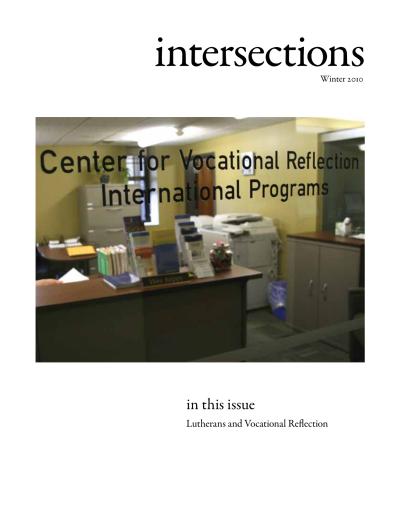
Haak describes Augustana’s Center for Vocational Reflection (CVR) and its threefold framework of skills/gifts/talents, passions/values, and needs of the community. He surveys the CVR’s Working with Faith group, seminary visits, spiritual companioning, Servant Leader Internships, international travel reflection, and the major Senior Inquiry curriculum revision—then reports the lessons learned at Augustana: that multiple exposures matter more than any single program, that the language of vocation works even for non-religious students, that student-initiated ideas (like Erin Blecha’s Athletes Giving Back) often succeed most, and that the CVR will soon merge into a new Community Engagement Center.