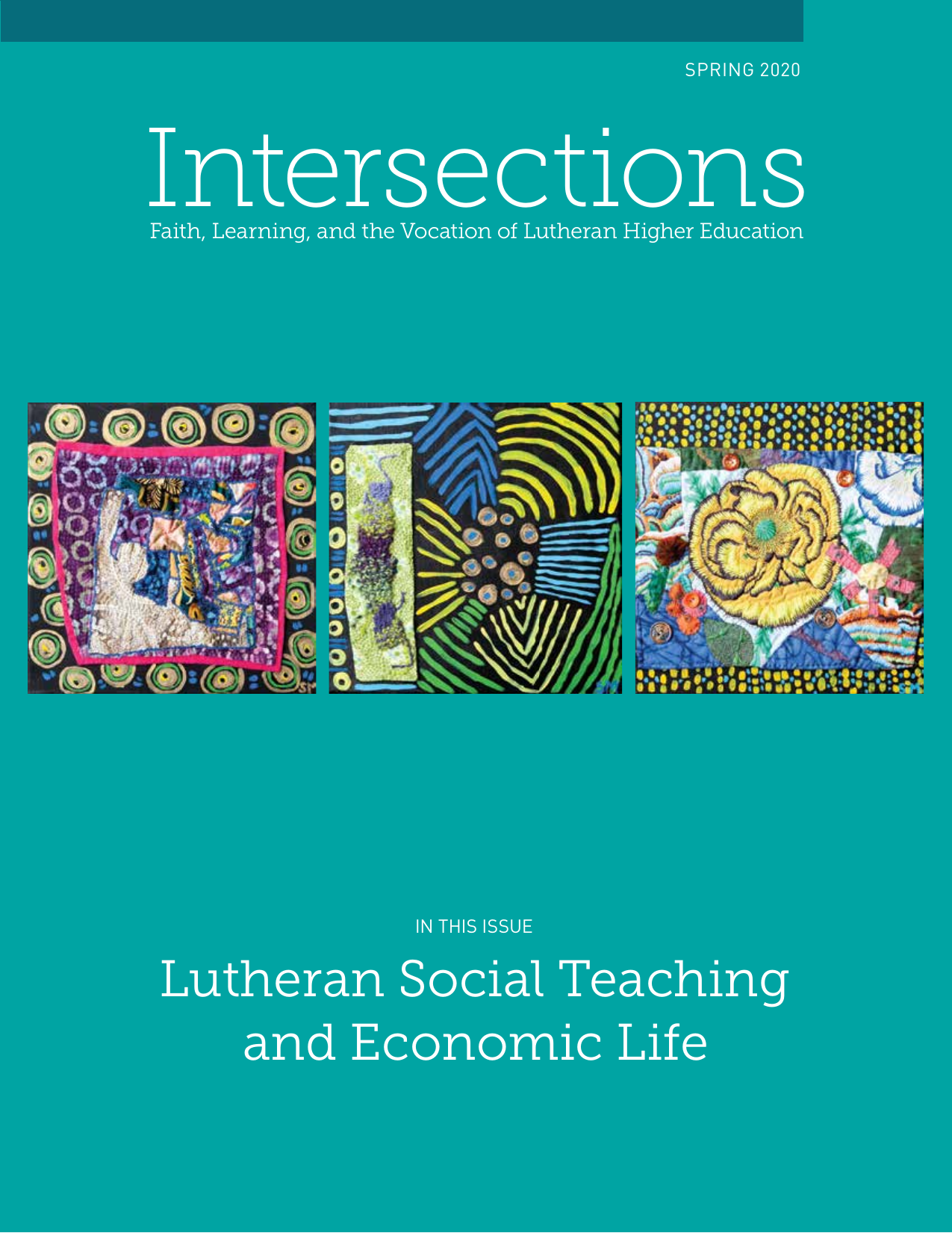
Lutheran Social Teaching and Economic Life
The Spring 2020 issue gathers writings from a NECU initiative to reclaim the Lutheran intellectual tradition as a resource for academic mission. A July 2019 Augsburg consultation asked whether ELCA social teaching — especially the 1999 statement Sufficient, Sustainable Livelihood for All — could serve as a classroom resource for business ethics. Essays explore moral deliberation, responsibility ethics, the challenge of inclusion, the theology of marketing and branding, student food insecurity, and how Generation Z’s defining traits align with Lutheran higher education.
Editors
Articles in this Issue
-
 Editorial
From the Publisher
Mark Wilhelm
Wilhelm frames the issue by tracing how Lutheran educational ideals — once a primary source of contemporary higher education — were masked in the United States, and introduces a NECU initiative that uses the case of business ethics to explore Lutheran social teaching as an academic resource.
-
Editorial
Guest Editorial: Moral Deliberation in NECU Classrooms
Ernest L. Simmons
Simmons introduces the guiding question of the NECU working group: could the ELCA’s twelve social statements and thirteen social messages — expressions of Lutheran social teaching originally formulated for congregational use — turn campuses into “academic communities of moral deliberation”?
-
Article
The Responsible Professional: Vocation and Economic Life
Martha E. Stortz, Tom Morgan
Stortz and Morgan argue that the “value-added” of Lutheran higher education is a responsibility ethic — one that frames the professional as a first responder “called and empowered to serve the neighbor so that all may flourish” — and unpack the four criteria of the 1999 ELCA social statement Sufficient, Sustainable Livelihood for All as a framework for economic deliberation.
-
Institutional Focus
A List of ELCA Social Teaching and Policy Documents
A reference list, as of September 2019, of the ELCA’s twelve social statements, fourteen social messages, and over 150 social policy resolutions — with Spanish translations where available.
-
Article
ELCA Social Teaching for the Classroom?
Roger A. Willer
Willer argues that the body of ELCA social teaching, taken as a whole, constitutes an actual social ethic — relatively comprehensive, responsibly consistent, and remarkably cogent — whose mode of responsibility ethics commends it as a classroom resource for any discipline that wrestles with moral questions.
-
Article
The Challenge of Inclusion in the Ethics Classroom
Faith Wambura Ngunjiri
Ngunjiri, the only Black woman tenured faculty member at Concordia College, reflects on her students’ resistant and resonant responses to MLK Day programming on “Not Racist: A White Moderate Myth” — and on what it takes to make the ethics classroom a place where students can “BREW”: Becoming Responsibly Engaged in the World.
-
Article
Business as Usual? Marketing, God, and the Limits of Christian Callings
Emily Beth Hill
Hill, a former corporate marketing consultant turned theologian, returns to Luther’s claim that no vocation is more holy than another — and uses Luther’s Large Catechism definition of God to argue that the modern practice of branding intentionally redirects the love and worship of human beings toward capital, raising the question of whether Christian neighbor-love places limits on what professions Christians should pursue.
-
Article
Responding to Student Hunger at NECU Institutions
Kristen Glass Perez
Glass Perez recounts how her work as college chaplain at Augustana and Muhlenberg evolved after a student offhandedly declared, “I am always so hungry at this school,” and shares five lessons learned from launching campus pantries, emergency grant programs, and the HOPE Survey to address food insecurity as a defining calling of NECU institutions.
-
Article
Gen Z is Made for Lutheran Higher Education
W. Kent Barnds
Barnds argues that Generation Z’s defining traits — socially responsible, purpose-driven, cost-conscious, culturally open, and tech-expectant — align almost perfectly with the missions of NECU institutions, and offers concrete suggestions (from replacing “vocation” with “purpose” to embracing Gen X parents as co-pilots) for Lutheran colleges seeking to attract and serve this generation.