As of September 2019
More information available at www.elca.org/socialstatements
Social Statements (address social institutions, provide frameworks)
The Church in Society: A Lutheran Perspective (1991)
Abortion (1991) — Aborto
The Death Penalty (1991) — Pena de Muerta
Caring for Creation: Vision, Hope, and Justice (1993) — Medio ambiente
Freed in Christ: Race, Ethnicity, and Culture (1993) — Raza, Etnicidad y Cultura
For Peace in God’s World (1995) — Por la paz
Sufficient, Sustainable Livelihood for All (1999) — Vida Economica
Caring for Health: Our Shared Endeavor (2003) — Salud y asistencia sanitaria
Our Calling in Education (2007) — Educación
Human Sexuality: Gift and Trust (2009) — La sexualidad humana
Genetics, Faith and Responsibility (2011)
The Church and Criminal Justice: Hearing the Cries (2013) — La Iglesia y la justicia penal
Faith, Sexism, and Justice: A Call to Action (2019) — (Translation in process)
Social Messages (briefer, topically focus, dependent on statements)
“AIDS/HIV” (1988) — El SIDA
“Israeli/Palestinian Conflict” (1989)
“Homelessness: A Renewal of Commitment” (1990) — Gente sin Vivienda
“End of Life Decisions” (1992) — Final de la Vida
“Community Violence” (1994) — Violencia Comunidad
“Sexuality: Some Common Convictions” (1996) — La Sexualidad
“Immigration” (1998) — Inmigración
“Suicide Prevention” (1999) — Suicido
“Commercial Sexual Exploitation” (2001) — Explotaćion Sexual
“Terrorism” (2004) — Terrorismo
“People Living with Disabilities” (2010) — Personas Discapacidades
“The Body of Christ and Mental Illness” (2012) — Las enfermedades mentales
“Gender-based Violence” (2015) — (Translation in process)
“Human Rights” (2017) — (Translation in process)
150+ Social Policy Resolutions (policy specific)
Examples of two different kinds:
a) Adopted by Church Council (include theological and analytical background)
“The Sponsorship of Legal Gaming by American Indian Tribes” (2007)
“Toward Compassionate, Just, and Wise Immigration Reform” (2008)
b) Adopted by Churchwide Assembly (little background, very brief)
“Rural Economic Crisis” (1999)
“Opposition to the War in Iraq” (2005)
-
 Editorial
From the Publisher
Mark Wilhelm
Wilhelm frames the issue by tracing how Lutheran educational ideals — once a primary source of contemporary higher education — were masked in the United States, and introduces a NECU initiative that uses the case of business ethics to explore Lutheran social teaching as an academic resource.
-
Editorial
Guest Editorial: Moral Deliberation in NECU Classrooms
Ernest L. Simmons
Simmons introduces the guiding question of the NECU working group: could the ELCA’s twelve social statements and thirteen social messages — expressions of Lutheran social teaching originally formulated for congregational use — turn campuses into “academic communities of moral deliberation”?
-
Article
The Responsible Professional: Vocation and Economic Life
Martha E. Stortz, Tom Morgan
Stortz and Morgan argue that the “value-added” of Lutheran higher education is a responsibility ethic — one that frames the professional as a first responder “called and empowered to serve the neighbor so that all may flourish” — and unpack the four criteria of the 1999 ELCA social statement Sufficient, Sustainable Livelihood for All as a framework for economic deliberation.
-
Article
ELCA Social Teaching for the Classroom?
Roger A. Willer
Willer argues that the body of ELCA social teaching, taken as a whole, constitutes an actual social ethic — relatively comprehensive, responsibly consistent, and remarkably cogent — whose mode of responsibility ethics commends it as a classroom resource for any discipline that wrestles with moral questions.
-
Article
The Challenge of Inclusion in the Ethics Classroom
Faith Wambura Ngunjiri
Ngunjiri, the only Black woman tenured faculty member at Concordia College, reflects on her students’ resistant and resonant responses to MLK Day programming on “Not Racist: A White Moderate Myth” — and on what it takes to make the ethics classroom a place where students can “BREW”: Becoming Responsibly Engaged in the World.
-
Article
Business as Usual? Marketing, God, and the Limits of Christian Callings
Emily Beth Hill
Hill, a former corporate marketing consultant turned theologian, returns to Luther’s claim that no vocation is more holy than another — and uses Luther’s Large Catechism definition of God to argue that the modern practice of branding intentionally redirects the love and worship of human beings toward capital, raising the question of whether Christian neighbor-love places limits on what professions Christians should pursue.
-
Article
Responding to Student Hunger at NECU Institutions
Kristen Glass Perez
Glass Perez recounts how her work as college chaplain at Augustana and Muhlenberg evolved after a student offhandedly declared, “I am always so hungry at this school,” and shares five lessons learned from launching campus pantries, emergency grant programs, and the HOPE Survey to address food insecurity as a defining calling of NECU institutions.
-
Article
Gen Z is Made for Lutheran Higher Education
W. Kent Barnds
Barnds argues that Generation Z’s defining traits — socially responsible, purpose-driven, cost-conscious, culturally open, and tech-expectant — align almost perfectly with the missions of NECU institutions, and offers concrete suggestions (from replacing “vocation” with “purpose” to embracing Gen X parents as co-pilots) for Lutheran colleges seeking to attract and serve this generation.
-
 Response
Response to Mark Wilhelm: Adopting the Framework of ‘Because’ and ‘Therefore’
Paul C. Pribbenow
No. 56 · Fall 2022
Pribbenow describes how Augsburg University responded to its dramatic demographic transformation (from 18% to nearly 70% BIPOC entering students over sixteen years) by adopting an institutional vocational statement and a simple “because/therefore” framework for translating particular Lutheran theological convictions into institutional programs, policies, and practices.
-
 Editorial
From the Editor
Tom Christenson
No. 21 · Summer 2005
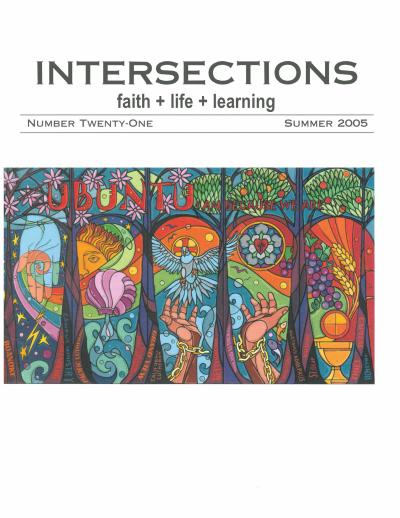
In his valedictory letter as outgoing editor, Christenson recounts the 1994 origins of Intersections, when he took the idea to Naomi Linnell and Jim Unglaube at DHES and persuaded the council of presidents to launch the journal on a shoestring with printing paid by DHES and everything else by Capital University. He summarizes the issue’s contents—papers from the 2004 Vocation of a Lutheran College Conference plus two commissioned pieces from former DHES directors Bob Sorensen and Leonard Schulze—and thanks the student copy editors and Capital’s presidents and provosts who sustained the publication.
-
 Article
A Reconsideration of the Political Approach to Abortion
Sophia Cruz Ponce
No. 57 · Spring 2023
Cruz Ponce argues that the pro-life versus pro-choice binary distracts from the underlying social factors that lead to unwanted pregnancies, and proposes a reframed political approach focused on mandated sex education, free contraception, and crisis pregnancy centers that address the social, political, and economic barriers women face.
-
 Article
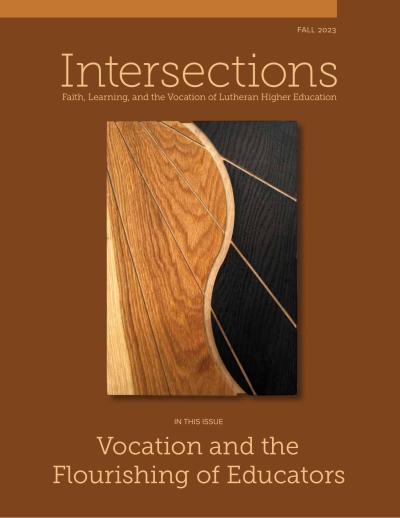
Vocare: A Spiritual Practice for the Spaces Between
Charlene Rachuy Cox
No. 58 · Fall 2023
Cox introduces Vocare, a six-word spiritual practice developed through the Nourishing Vocation Project at St. Olaf, that uses the acronym V-O-C-A-R-E to help individuals and communities honor the spaces “between no longer and not yet” and discern their callings for the common good.
-
Article
Changes
W. Robert Sorensen
No. 21 · Summer 2005
Writing as former executive director of the Division for Higher Education and Schools, Sorensen places the DHES within the threefold movement of Luther’s Reformation—university, church, and individual piety—and recounts how the Division cohered its work with colleges, universities, campus ministries, and schools around Joseph Sittler’s definition of education as “movement into a larger world.” Drawing on Huston Smith’s “primordial tradition,” the Namibian student program, work in India and Palestine, and the Bergendoff series of publications, he raises a twofold concern about the proposed merger of DHES into a Division for Vocation and Education: whether the new structure will signal the core significance of education in the heritage and life of the church, and whether it can carry forward the effectiveness and scope of DHES’ work.
-
 Article
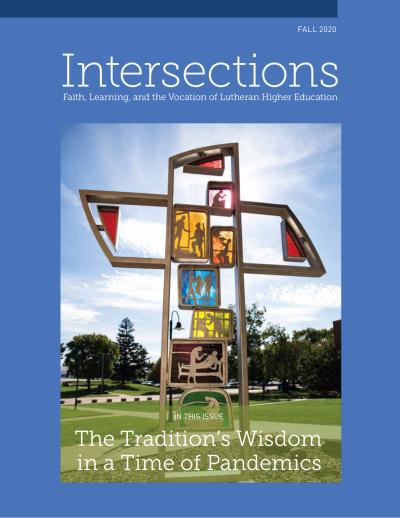
A New Image for an Ancient Call: Lutheran Higher Education Amidst Pandemics Today
Caryn Riswold
No. 52 · Fall 2020
Pairing Wartburg’s Lebenskreuz sculpture with the Matthew 25 acts of mercy and the commitments of Rooted and Open, Riswold reads the calls to feed the hungry, welcome the stranger, and care for the sick as urgent summons for Lutheran higher education in a year of overlapping pandemics — and as a call to dismantle the structures that produced them.