Do You Teach in a Different Manner at a Lutheran College? Unraveling the Lutheran Knot and Highlighting the Glory in the Theology of the Cross
Intersections No. 16 · Winter 2003
The question I was given to reflect on during this session is: Do you teach in a different manner at a Lutheran college? That’s a tough question, so I think I want to use one of my lifelines and poll the audience. How do you respond when I ask you that question? Yes or no, do you teach in a different manner at a Lutheran college? Some of you respond “Yes” and some of you respond “No.” But if you were given the choice, I bet some and maybe many of you would prefer to respond “Yes and No.” To most questions, the Lutheran response is typically neither “Yes” nor “No,” but rather “Yes and No.” It’s dialectical. Dialectic is the classical art or practice of examining logically, as by a method of question and answer. Dialectic is a form of discourse in which the issue under consideration is examined from different perspectives. From one perspective one might answer a question in the affirmative, but from another perspective one might feel the need to answer negatively. Thus, the “Yes and No” response. At the heart of Lutheran reflection lies a commitment to dialectal thinking. That’s why our question, Do you teach in a different manner at a Lutheran college? requires a “Yes and No” answer.
I. The Difference of the Lutheran Knot
Being Lutheran means having a knot in your stomach. The Lutheran dialectic puts a knot in your stomach, a tension that keeps life from becoming too easy. That knot has been there in my stomach more or less all my life. In my early years growing up I felt it more strongly during family devotions and Sunday School classes and confirmation classes, but it was always there. At Concordia College in Moorhead it was more keenly present during chapel and in some religion classes, but it was always there. During my years at Luther Seminary it was always pretty potent, and during my years in the parish ministry with the people of St. Paul American Lutheran Church by the Dairy Queen in “Nordeast” Minneapolis it was always there. During my time at the University of Chicago Divinity School it was not imposed on me from without in the same way as at the seminary; but by that time it had become so internalized that I still felt the need for making sure the knot or tension was there. I wasn’t comfortable without it. And I think that’s a universal feature of Lutherans. If the knot or the tension isn’t there, then the concern quickly surfaces that maybe the Lutheran identity isn’t as present as it should be. This is the eighth summer conference in a row on the “Vocation of a Lutheran College.” That’s incredible. The Methodists or the Presbyterians or the Roman Catholic colleges don’t have that kind of obsession with their identity. It’s clearly an indication of our need for the knot or the tension of the Lutheran dialectic.
And this knot becomes a part of who we are. I teach at Thiel College in western Pennsylvania, an ELCA college that was founded in 1866 by the churchperson William Passavant. My wife and I headed out to Thiel precisely because it was an institution of higher learning of the Evangelical Lutheran Church in America. It was an academic place marked by the Lutheran knot. And we have stayed there because it is one of the ELCA colleges. The Lutheran knot has tied us to that spot. This year I’ll be heading into my 20th season of teaching in the Religion department at Thiel.
Thiel is out east. It’s not on the East Coast, but it’s east compared to midwestern schools. The tendency in recent decades has been for the eastern ELCA colleges to loosen the Lutheran knot a bit. That was the case at Thiel, especially in the decade before I arrived, or during the 70s. The thought was, I guess, that if the Lutheran knot is too tight, it might kill an educational institution by making it too parochial and thereby unattractive to non-Lutheran folks. By the time I showed up at Thiel, a concerted effort was being made to tighten that Lutheran knot again and to re-establish relations with the various Lutheran synods. And that effort has continued right up to the present. There is now general agreement that the Lutheran identity of Thiel should be lifted up, not just because this strengthens our recruiting of Lutheran students but because our Lutheran tradition is an important part of our identity and a visible Lutheran knot also works to our advantage in recruiting a broad range of students.
But wherein, we ask, lies the origin of the Lutheran knot? What’s the character of the tension that seems to necessarily accompany the Lutheran faith? It has been talked about in a lot of different ways: the law/gospel distinction, the two kingdoms, the tension between the first article of creation and the second article of redemption, the difference between Word and world. My research over the years has not been in the area of Luther or Lutheranism, but recently I have started doing some work on the theology of Luther. Since Arne Selbyg has reminded us that these vocation conferences are intended to be sort of “Lutheranism 101” for college faculty and staff, I am not going to avoid sharing some of my thoughts on Lutheran theology.
II. The Difference of the Theology of the Cross/Glory
I would like to speak of the Lutheran knot in terms of the theology of the cross. Martin Luther’s religious reflection was centered in what he called the theology of the cross, the theologia crucis. During the sixteenth century Martin Luther articulated the theme of the theology of the cross that served as the center of his whole theology. Over against that theology Luther set the theology of glory. The theology of the cross served as the basis for criticizing the theology of glory. The theologians of glory, in Luther’s eyes, were too speculative, relying too heavily on human reason to probe the divine mysteries. They were too presumptuous, trusting too confidently in the visible splendors of life as a direct indication of the invisible operations of God. And they were too prideful, thinking that noble achievements in the world came about on the strength of human ingenuity and effort alone. The theology of glory concentrated on the notion of merit and on the idea that humans are able to earn righteousness by means of good works. Luther’s theology of the cross undercut the presumptuous speculations of the theologians of glory by singlemindedly insisting on the cross as the clue for understanding the true character of both God and the Christian’s life in the world.
It should be underscored, I suppose, that Luther did openly criticize the theology of glory. However, this was not long lived. Only at five different points did Luther mention the theology of the cross and the theology of glory, and these were all between the years 1518 and 1521. Luther likely discontinued his use of the phrase “the theology of glory” because he realized that it is a bit misleading. There surely are inauthentic forms of the theology of glory, i.e., when theology assumes one or another triumphalistic shape, from consumerism to militarism to ecclesiasticism. But so too is there an authentic form of the theology of glory. Martin Luther affirms glory as the teleological principle of the human creature. That is, creation’s goal is for the human to become glorious. One can find a theology of glory in Luther’s theological anthropology, and this theology of glory stands behind and sustains his theology of the cross. The tension between this theology of glory and the theology of the cross is fundamental and this tension, I would suggest, lies behind the various other Lutheran dialectics.
Luther’s theologia crucis has inspired theological followers to continue his polemic against the theologia gloriae. On the scene today there are not many self-appointed Lutheran defenders of the faith who feel the need to search out and destroy any and every theology of glory. But there are plenty of Lutheran theologians who, armed with their fighting doctrine of justification by grace through faith and their dialectic of law and gospel, stand ready as theologians of the cross to chastise theologians who focus on glory and freedom and human creativity; the critics regard that whole approach as basically an effort to run away from the cross, contrition, and confession. The Lutheran knot is defended by way of the theology of the cross. In Lutheran circles today, therefore, commitment to the theology of the cross often carries with it suspicion of and contempt for theological perspectives leaning toward or resembling a theology of glory. The climate within the Lutheran ranks is currently such that most would consider it theologically stupid if not suicidal to advocate a theology of glory.
I want to do precisely that, however, to advocate a theology of glory. Much has been lost in the broadside attack on the theology of glory. The creation, the natural, reason, and the human are concepts that generally have not been given their due in Lutheran theology because of the widespread antipathy toward the theology of glory that has created an atmosphere in which it is imprudent to sing the praises of glory in any form other than a narrowly understood Gloria Dei. There needs to be developed, I think, a renewed appreciation for the notion of glory that is both central to the biblical story and relevant to contemporary theological thinking. I define glory as the sparkling presence of God shining through human beings and the world of creation. It should not be blasphemous or pretentious for Christians, even Lutheran Christians, to claim that God is “really present” in, with, and under the creatures and events of the world. The theology of the cross needs to be complemented by a version of the theology of the glory that bears resemblance to thinking encountered in the distinguished tradition of Christian humanism.
The theology of the cross points to the dialectic or tension that is the source of the Lutheran knot. But sometimes that theology becomes so onesidely negative that it loses its tensive quality. We need a theology of glory to balance out the theology of the cross. The Lutheran knot requires it. On the whole I believe our Lutheran colleges have been places where the glorious side of the human has been remembered and appreciated. As we proceed today in considering what is different about teaching at a Lutheran college, I want to be highlighting the glory that is implicitly affirmed in Luther’s theology of the cross. And this should be able to happen somewhat organically, because this lifting up of glory is one of the things that the Lutheran colleges have done rather well over the years in their teaching, especially in comparison with the Lutheran seminaries. There is it seems a little different manner of teaching at a Lutheran college as compared to that at a Lutheran seminary, maybe because seminaries sense more of a charge to protect the faith.
The tension between cross and glory can be developed in terms of Word and world. A little over a year ago I was asked to speak at a Men’s Breakfast Group sponsored by a Christian denomination. The group meets twice a year at The Brass Lantern, a restaurant located a few miles out of Greenville. As a personal aside I can say that vocationally, I operate in my life as a theologian. That means that my job is to formulate discourse about God, so that the reality of God might be understood and appreciated and experienced more fully by people in our time. I’ve come to realize as I’ve tried to carry out this theological task that the whole relationship with God takes place within the context of the world. The world requires attention theologically. So for this men’s group meeting I decided to lead them through some reflections on loving the world, to underscore that, for Christians, loving the world can’t be separated from loving God nor can it be separated from the whole God-world relationship. Therefore, after settling on this theme for the talk, I telephoned the organizer and gave him the title “On Loving the World.” So I chose that title very intentionally, in order to counteract the tendency of Christians to overemphasize the Word and underplay the world. Well, when I arrived at the breakfast a few months later, I was glad to see a very good turnout. The organizer said they had advertised the event quite a bit and he was pleased with the number of men that had shown up. Then he introduced me and said, as advertised, I would be speaking on that all-important theme of “On Loving the Word.” So I had to explain that my actual topic was “On Loving the World,” which maybe wouldn’t have brought out as many men if it had been the publicized topic but which I felt was equally important.
III. The General Differences of Church-Relatedness
At a general level, one can identify reasons why one might find a different manner of teaching at a Lutheran college. Being an ELCA college means that the education process is granted its own integrity, its own arena. A Lutheran college differs from a Christian college in its self-understanding. The Lutheran knot, whether manifesting itself as the distinction between the two kingdoms, the kingdom on the left and the kingdom on the right, or the distinction between the law and the gospel, or the distinction between Word and world—means that academics are taken seriously in their own right. ELCA colleges do not affirm such things as Christian geology or Christian economics or Christian sociology. At our colleges professors and students are free to inquire without censure from some big brother type of religious authority. Luther valued education; he said according to some accounts, “Better a smart Turk than a dumb Christian.” Gratefully, our Lutheran church expects us to strive for academic excellence; and when we do that, when we are a strong educational institution, then we are fulfilling one of our major roles as a college of the church. No matter how much we affirm postmodern cultural currents that embrace all the differences of pluralism, Lutherans still also finally affirm a unity or singularity of truth, even if we are deprived of any absolute knowledge of that truth. But God is one and so, ultimately, is God’s truth. In fact, I like to think of truth as one of God’s great nicknames, along with Beauty, Justice, and Love. If Truth is God, then knowledge is not to be feared; rather, we can expect knowledge to lead us to Truth or God. So holders of or those held by the Lutheran knot fully endorse that beautiful aphorism of Sir Francis Bacon: “With the first sip of the cup of knowledge one loses God; but at the bottom of the cup one finds God in all God’s glory.”
Having mentioned postmodern cultural currents, let me add a word on how the Lutheran knot influences my evaluation of contemporary cultural configurations. Cultural evaluating is critical if one sees the theological task as requiring an understanding of the world no less than of the Word. Discerning cultural forces is part of doing theology. We note, then, that our Lutheran colleges are situated within that important trajectory of Western culture flowing from the Enlightenment, which is the fountainhead of the modern world. The postmodern begins at different points in time depending on one’s analysis, from early figures such as Nietzsche, Marx and Kierkegaard of the nineteenth century to later twentieth century figures situated between the two world wars. But the postmodern generally is depicted as a protest movement against the sameness of the modern. The postmodern hails difference over against modernity’s preference for unity of worldview that gushes forth from steadfast devotion to rationality and autonomy. My commitment to the Lutheran knot nudges me to maintain the dialectic between the modern and the postmodern; it enables me to recognize that postmodernity has suffered from some excesses while making a legitimate critique of the modern, and that modernity surely deserves postmodernism’s criticism but also possesses some features worth preserving. So the knot leads me to affirm a late modern form of culture that wishes to level the postmodern critique against the modern but strives all the while to preserve worthy elements of the modern. The early modern can be cleansed of its abuses and be reshaped as a late modern form of culture that appreciates the postmodern emphasis on difference but does not give up altogether on the modern quest for rational, autonomous life.
One teaches in a different manner at a Lutheran college because it is a church-related institution of higher learning. The importance of a church-related college lies in this, that it is a place where a special variety of discourse is created and embodied. There is the church with its Word on the one hand and the world with its words on the other. Each has its discourse. But the church-related college is situated in-between these two. It takes both the church and the cosmos seriously, but its discourse is not merely that of either Christ or culture. Rather, it brings these two together and a new level of discourse is the result. A distinctive type of discourse is born in the mutually critical correlation of Word and world. This mutually critical correlation means that the message of the church and attending spiritual values of humankind are brought critically to bear on the situation of the world in all its scientific, socio-political, economic, psychological complexity, and likewise the rigorous, down-to-earth, hard-nosed cognizing of the world is brought critically to bear on cultural meanings and values including the kerygma or message of the church. Created is a fresh discourse which is the air the church-related college breathes, the food it eats, the blood it pumps, and the artistic expression it contributes. Our Lutheran colleges are houses of hermeneutics and rhetoric. They develop interpretations and they engage in arguing their interpretations. State universities do this too, for interpreting and arguing interpretations are the tasks of academic institutions. And yet, there is a difference. For the church-related college is a half-way house. By design, that is, by mission, it stands “in” the world but is not “of” the world. The Lutheran knot ties us to “in but not of” language. That is why its discourse is special. That discourse, which welcomes warm-temperature experiences of faith no less than cool-temperature experiments of science, bridges the gap that exists between the two other discourses of church and world. As students learn that synthesizing discourse, they experience what our academic catalogues call “an integrative worldview,” which is a prime goal of the education process at our church-related colleges.
While this discourse-creating quality has been the most important feature of Lutheran church-related colleges all through their history in this country, there is a significant sense in which this intrinsically important feature is gaining greater extrinsic importance as we move ahead into the twenty-first century. It seems to many that we are currently in the middle of a paradigm shift. As I have indicated, some analysts of culture are still pushing for a further advance of the modern, others believe the modern has to be buried and replaced by the anti-modern values of the postmodern, still others are calling for a return to the pre-modern, and a few of us are advocating instead a late modern form of culture in continuity with and yet significantly different from the early modernity of the Enlightenment. This whole confusion over where we are culturally is a sign of the transition that we are in. Coming, it seems, is a new global paradigm which is leading to a restructuring of knowledge within the academy. The move toward the global is forcing disciplines together; the result is the creation of whole new levels of knowledge bridging disciplines. Interdisciplinary and multidisciplinary teaching and research is becoming the order of the day. Graduate schools are being transformed, begrudgingly, to be more in tune with the new times. Specialization is not being done away with, but the trading of specialized knowledge, which was the original intent of specializing anyway, is becoming expected. The humanities are being driven to mix it up with one another and also with the sciences. Because of global crises, the sciences are being forced to take seriously questions of values and ethics and other humanities’ types of concerns. The Lutheran knot helps to open us to this new paradigm.
We can see, then, why the church-related college will gain greater extrinsic importance in the future. We can envision a time when the academy as a whole will be creating new discourses. It will be needing to do out of dire need what the church-related colleges have been doing all along out of faithful commitment, namely, bringing together different discourses and in the process creating a new one. The long tradition of the church-related college should leave it poised to lead the way through the confusion and disorientation of dealing with the new paradigm that is upon us. If the church-related college is to do this, it must not forget either of its two foci, either the church with its Word or the world with its words, nor can it lose the mutually critical correlation of these two.
Being an ELCA college means that issues of faith are understood as being an important part of life. In searches for presidents of our Lutheran institutions there are often impressive Lutheran candidates with terrific jobs in state schools who are asked why they would consider a change. One might hear said, as I have, from a candidate for a presidency of a Lutheran college, that as an ELCA clergyperson he had always wanted the opportunity to be in a leadership position in an ELCA college. For this person, it was absolutely no contest: he would leave his current position in a second, for he would love to come and be engaged with those at the Lutheran college in making it an even stronger and better educational institution of the church. This person was convinced that at that Lutheran college there is agreement that issues of faith are a critical part of understanding human development. The Lutheran knot ties us to that expanded understanding of the world that faith is always seeking. It brings into our conversations the reality of a God who is committed to the creation, loving it with a love that will never let it go.
Being an ELCA college means that Christian values are lifted up within the community’s life. We can’t overestimate the impact that is made by opportunities to participate in serious discussion of contemporary issues of faith and life. Of course, this happens all the time in the classroom; but it also takes place in other settings. Our Lutheran colleges do manage to create special times when faculty, students, administration, and staff are together reflecting and sharing ideas on ways in which holding a Christian stance implicates one to respond in this way or move toward this affirmation or be engaged in this action. The pattern of life of our brother Jesus and the community of freedom and love that he inaugurated (i.e., the kingdom of God) offer much to current contemplation of vexing ethical questions. The Lutheran knot prevents us from forgetting about and fleeing from our particular Christian resources when dealing with thorny questions.
IV. The Specific Differences at Thiel
At a more specific level, I should repeat that I teach in the Religion department at Thiel. We make an effort to respect the Lutheran knot. We try to keep a balance between Word and world, cross and glory within the department. We keep the tension by respecting the two sides of our discipline. In the field of religion there’s currently a tension between religious studies and theological studies. That tension has been around for about forty years. Religious studies is a more worldly approach to religion. It employs various methodologies in exploring the subject matter of religion, from psychological to sociological, historical, phenomenological, gender and class considerations, and many other approaches. Religious studies is less quick to assume the religious stance, and when it does it is sure to keep alive the critical spirit of doubt as the indispensable other side of faith. Theological study on the other hand is more eager to hold up the Word of God as key for understanding what religion is all about. Theology as discourse about God, especially of the Jewish and Christian variety, receives a special place in the theological study of religion. Doctrinal ideas and liturgical rituals of the Jewish-Christian tradition are deemed worthy of study in their historical context and in terms of their systematic coherence. The theological approach to religion presumes that the most insightful way to learn about religion is by functioning in religion. The Lutheran knot is present within our department in that we want to do our educating with the tension that comes in affirming both of these approaches, both the religious studies approach and the theological approach. Some religion departments around the country have insisted on the need to choose one or the other, so one can find theology departments that aren’t interested in hiring religious studies scholars and religious studies departments that wouldn’t consider hiring a theologian. In our little department we have attempted to keep a balance between these two and to hire people who are open to incorporating insights and approaches from “the other side.”
At Thiel all students are required to take the religion course entitled “Interpreting the Jewish and Christian Scriptures.” That’s clearly an indication of respect for the Word. Theologians of the cross wouldn’t ask for more. But within that course students are exposed to all the worldly considerations of what is entailed in arriving at a meaningful interpretation of the Bible in our contemporary world. Students learn that the Word can’t mean without the world and that the world shapes the meaning of the Word. They learn the historical-critical method. And yet, they learn also that that rather critical or negative method does not provide the last word on the meaning of a biblical text, but that there is a need to discern via the productive imagination new meanings in keeping with the overall biblical message of liberating transformation. We like to think that this Scriptures course gets our students to explore the deeper meanings of life in the twenty-first century and that the new meanings they settle on are in fact what is meant by God’s Word.
I teach and hope our students learn that Word and world belong together. God, according to traditional Christian formulation does not need the world in order to exist, but the ultimate reality of life does need the world in the project of creation. For at the heart of divine creating is the bestowing of freedom upon creatures. The Creator desires to create a world that opens up space for self-determining, and through cosmic evolution and biological evolution and cultural evolution that desire has been met. The long evolutionary process has resulted in us, human beings who are little less than the angels, amazingly glorious creatures who possess the power of self-determination. God has a purpose for the world, but that purpose is for the world to participate in bringing about the divine purpose. Therefore, the Creator God needs the world, and the world is thus rendered glorious as the divine helpmate.
I teach that the Word is the source of the world’s transformation. The Almighty Lover is the source of creative transformation, the cause of the effectiveness of new possibilities and thus the ground of freedom. The Word creates human freedom and calls humans to use their freedom to the fullest, that is, to enhance their own freedom and the freedom of others. When we heed that call to use our freedom for the enhancement of freedom, we are loving. When we feel the urging and luring of new possibilities, when we hear the call not to give in to the easy decisions to go with the old, safe ways of past habits, but to actualize ourselves by way of those tough decisions that lead us in new directions—then in that hallowed, sacred experience of struggling with possibilities we become aware of God’s presence within our lives. We are again encountering the Lutheran knot. The divine reality needs us because we are created co-creators. God needs the world in the sense of needing to recruit partners, needing to enlist conspirators to knock down the walls that separate people, to challenge the prejudices and biases that people hold, to smash the exclusivity of clubs, clans, and cliques, of closed communities and congregations. God needs us to be agents of creative transformation, agents of reconciliation, co-creators with God in making all things new. The Word needs us, needs the world, because the creation has been designed in such a way that the creative transformation of the world will be accomplished in and through our partnership. The Lutheran knot ties Word to world while ever distinguishing the two.
At Thiel all students take a first-year, two-semester, team-taught interdisciplinary course in “The History of Western Humanities.” This course covers the disciplines of history, literature, art, music, philosophy, and religion. Here the investigation of religion is a part of the study of the development of the Western world. While there is an effort to offer a coherent word on the place of religion, the focus is clearly on the world. The same can be said about the second-year, two-semester, team-taught interdisciplinary course on “Science and Our Global Heritage.” That course includes the natural sciences, the social sciences, and the humanities and centers on the theme of sustainability as four units are covered, namely, “Brazil and Biodiversity,” “India and Food (Population),” “Nigeria and Natural Resources,” and “China and Industrialization.” Here the focus is truly global in scope. Covering the religions of those geographical locales means that at least introductory consideration is given to Hinduism, Buddhism, Confucianism, Taoism, Islam, African indigenous religious traditions, and Christian Liberation Theology. World religions are tended to in that course, and students are exposed to questions raised by cultural and religious pluralism. So here again it is the world side of the world and Word dialectic that receives the emphasis, but the concern for the Word is present in the rational quest for genuinely seeking to understand the “other” that is a central objective of the course.
I teach that world and Word belong together. The world needs the Word for a sense of purpose and the God of the Lutheran knot provides that. Our students need to ask the big questions about the purpose of life. As humans, we ask the meaning question and the answer doesn’t come apart from some over-arching sense of the purpose of things. What is of ultimate significance? What is it that is of primary importance in life? Where have I come from and where am I going, ultimately? Those are all at heart religious questions and in the answer we give we identify our Good. Martin Luther has said, “Find your Good and you will have found your God.” Luther loved the name for God, as deriving from the word ‘good,’ because as he put it, “God is an eternal fountain which overflows with sheer goodness and pours forth all that is good in name and fact.”
I teach that the world needs the Word because it needs a good. We need the Good as the ground for our values and the goal for our striving. Directionless, we meander aimlessly; with direction, we can flourish. We need a Word about a God who is our Good so that we have an orientation for our living. We need a source of self-transcendence, so that we, individually and communally, don’t become complacent but remain self-critical and open to fresh novelties that challenge us and enliven us. The Lutheran knot bears witness to the God of creative transformation who, making all things new, gives us an orientation for our living and a transcendent reference point for opening up the future and calling us away from the status quo in our individual and corporate journeys.
I also teach that the Word calls us to criticize the world. Our students are fascinated and too often captivated by the prevailing religion of our culture. Consumeristic economics in which the individual is understood as a freely acting, insatiably acquisitive agent whose fulfillment is found in continual monetary gain to enable continual buying of things—that’s the most popular form of religion in the contemporary world. The individualistic attainment of material goods is finally, though, anemic because it doesn’t deliver what it promises, the abundant life. It delivers instead the insufficient life, the skimpy life, the form of life that leads to what prophetic songwriter and artist Tracy Chapman sings about as “The Rape of the World.” The consumeristic quest for things is never brought to closure, as long as one stays captivated by that worldview. Once we’re in the race to collect things, it’s a never-ending race that requires bigger and better things but which never brings satisfaction or fulfillment. What that prevailing consumeristic model of the good life lacks is a real God, a God of creative transformation making all things new, one who lets us know who we really are, one who reminds us of our limits by saying “Enough is enough,” one who entices us to think about living sustainably and enables us to move more fully into a sustainable lifestyle, one who makes us realize that envisioning alternative economic models to the one that prevails is a very important religious item on the planetary agenda for the coming century.
So my teaching is different at a Lutheran college because I teach the Scriptures course, the Western Humanities course, and the Global Heritage course. But it is also different in that I have invested a good deal of time as Co-Director of what we call Thiel’s Global Institute. The Institute began about five years ago as the Institute for Science and Religion in a Global Context. A couple of years ago we decided we needed to deal with issues of society and values as well as science and religion, so we changed the name to simply the Global Institute. The Institute primarily sponsors two conferences every year. We sponsor an Earth Week Celebration during the spring semester. As part of that annual April celebration hundreds of elementary school kids come to the college for workshops on that year’s theme. Three or four national speakers for our particular topic are brought in and other fun events take place. As one studies the global situation it does not take long to learn that economics stands at the heart of the global community’s life. We all need to be learning more about economics if we are going to be able to function as responsible citizens in the global arena. So more recently the Institute has begun sponsoring a shorter conference in the fall semester on global economics. This past fall, after September 11, the symposium topic was “Religion, Economics, and Violence: Promise and Peril of the New Millennium.” Lectures for that event included “The Moslem World, Globalization, and Violence” by a leading Islamist, “The Economics of Violence” by a trade policy expert, and “A Rational and Effective Response to Terrorism” by a State Department official from the Office of the Coordinator of Counter-Terrorism. The Lutheran knot ties me to the work of the Global Institute and encourages my institution to support its work.
One final point should be mentioned. Another way in which I teach in a different manner at our Lutheran college is that I participate when I can in the worship life of the campus. When there are campus-wide worship events at Thiel, I try to attend. This has nothing directly to do with my teaching. In my teaching in the Religion department and in the interdisciplinary courses, I attempt to maintain the distinction between teaching and preaching and try not to cross the line. But I also know that I am called to be a professor, that is, to profess to the students what is most important in my life. So I hope that my profession of faith shines through all that I do. But I don’t typically talk about my religious faith, even if it informs all my thinking and lecturing and discussing in class. So an important statement is made through my participation in Christian religious functions on campus. It discloses that, while I stand in a thinking relation to the world as that which exists for me to know, I also stand in a thanking relation to the world as that which is donated to me as gift. By worshiping I profess publicly my commitment to ultimacy as imaged by Christian symbols, myths, and narratives, and that commitment makes all the difference in my teaching.
So, do I teach in a different manner at a Lutheran college? From one perspective I have to answer, “No, because I am called to incorporate students into an earthy, all-too-human process of interpreting the world. This tough secular work is most mundane and shares much with teaching that goes on at other institutions.” From another perspective, however, I must answer, “Yes, because this mundane secular work of incorporating students into an earthy, all-too-human process of interpreting the world is a vocatio or calling from the God of life who desires the creation to flourish in glorious fullness of life.” For me, only such dialectical doublespeak leaves me content, with that unmistakable feeling in my stomach that is distinctly the at-once dreaded and delightful dis-ease of the Lutheran knot.
-
 Editorial
From the Publisher
Arne Selbyg
Selbyg reports that “vocation” is surely among the top three words in Intersections’s history and congratulates nine ELCA institutions—Augsburg, Augustana (Rock Island), Concordia (Moorhead), Gustavus Adolphus, Luther, Pacific Lutheran, St. Olaf, Valparaiso, and Wartburg—on receiving roughly two-million-dollar Lilly Endowment grants for the “Programs for the Theological Exploration of Vocation,” while reminding readers that for Lutherans the priesthood of all believers means callings to be accountants, nurses, police officers, and home makers count as fully as callings into ministry.
-
Editorial
From the Editor
Tom Christenson
Christenson previews this issue’s papers from the Vocation of a Lutheran College Conference—Curt Thompson on “the Lutheran knot,” Carol Gilbertson on the creative dimensions of language, Bruce Heggen on theological vocabulary in the state university, Susan Poppe on the boundaries of campus freedom, and Sig Royspern’s oracular gems—welcomes Robert Benne’s response to the previous issue as a sign that Intersections is becoming a locus of continuing conversation, and confesses his reluctant consent to appear on the cover.
-
Article
Honoring the Word: Lutherans and Creative Writing
Carol Gilbertson
Gilbertson argues that “honoring the Word” in Lutheran colleges means cherishing the sacred power of human language as God’s gift across three sites—the chapel talk, the classroom of wonder, and the poem—and illustrates her argument by reading aloud her own poems: “The Refiner’s Fire and Leaping Calves,” “Late June,” “Early June,” “Sweet July,” “Good Friday,” “Pondering These Things,” “The Limbs of Words,” and “Night Rising,” drawing on Darrell Jodock, John Updike, Martha Nussbaum, George Steiner, and T. S. Eliot’s “The Dry Salvages” to claim writing as a Christian vocation that “incarnate[s] the unseen sacred.”
-
Article
Writing Toward the Night Complete: Teaching and Working at the Public, Secular Institution
Bruce Allen Heggen
Heggen, Lutheran Campus Ministry pastor and adjunct English professor at the University of Delaware, builds on a freshman’s essay closing line—“All in all our night was complete”—to argue that even in the secular public university one can “teach hope” as a critical principle by drawing on Douglas John Hall’s Heideggerian distinction between calculative and meditative thought, the Frankfurt School’s instrumental versus substantialist reason, Luther’s theology of the cross, Parker Palmer’s “obedience to truth,” bell hooks, Lionel Basney, Shelley Shaver, and Donald Sheehan’s Frost Place “principle of compassion.” The classroom and Lutheran campus ministry together can become “communities of memory and hope” that, like the artist student’s Fourth of July, hold together danger, people getting together, explosions, and lots of fun.
-
Article
The Impropriety of Jesus' Teaching: The Woman at the Well and The Vagina Monologues
Susan M. O'Shaughnessy
O’Shaughnessy Poppe dedicates her message to those who worked to put on Eve Ensler’s The Vagina Monologues against administrative resistance and reads the Samaritan woman at Jacob’s well alongside the testimony of a Bosnian rape survivor whose story Ensler asked to tell, arguing that the “impropriety” of Jesus—his scandalous recognition of those silenced by sexism, racism, war, custom, and the church—is the model for the mission of a college of the church to defend academic freedom and to break the chains of oppression by inflicting discomfort on the proper and pure.
-
Poem
A Rainfall of Questions Collected in the Form of a Poem
Sig Royspern
Royspern offers fourteen oracular questions on aging, addiction to possessions, water striders, magnolias, slippery fish, moths and the moon, priests and leaf-rakers, weeds and flowers, the price of education, abandoned groceries, spiritual pilgrimage, melons and oats, similes, and the impossibility of finding a store that sells a spring wind.
-
Response
Response to Bishop Olson and President Tipson
Robert Benne
Benne responds to two articles in the Winter 2002 Intersections: former Bishop Stanley Olson’s “The Marks of an ELCA College,” whose narrow reading of the two kingdoms cedes all epistemological claims to secular knowledge, and President Tipson’s engagement with The Future of Religious Colleges, whose “rather unchastened Enlightenment spirit” underestimates how loaded the social sciences and humanities are with their own philosophical and religious assumptions. Drawing on Reinhold Niebuhr, John Milbank, and William Buckley, Benne defends a “critical mass” of pervasively Lutheran colleges and calls on bishops and pastors to take the schools seriously lest they drift from their religious heritage.
-
 Article
Teaching and Mentoring in Service of Civic Engagement
Haco Hoang
No. 63 · Spring 2026
6 min audio
Hoang describes how her teaching, mentoring, and research at California Lutheran University — including a multi-year collaboration with the Lutheran Office of Public Policy on Lutheran Lobby Day — cultivate civic skills grounded in ELCA social statements and the Lutheran tradition of faith and reason.
-
 Article
An Apostolate of Hope
David L. Tiede
No. 32 · Spring 2010
Tiede argues that the vocation of a Lutheran college is to be “an apostolate of hope” oriented by three metrics of our time: 12,000 (the Dow), 350 (parts per million of CO2), and $1.25 (the daily income of 1.4 billion people in extreme poverty). Drawing on Darrell Jodock’s “third path” for church-related colleges, Larry Rasmussen’s Batalden lectures, Mark Tranvik, Douglas John Hall, Bill McKibben, Stephen Privett, Peter Singer, and Augsburg’s Center for Global Education, he proposes that justification by faith, critical pluralism, stewardship of God’s earth, and love and justice for our students together prepare wise leaders to renew the future.
-
 Article
The Vocation of Intersections on its Twentieth Birthday
Jason A. Mahn, Robert D. Haak, Tom Christenson
No. 43 · Spring 2016
The three editors of Intersections — Bob Haak, Jason Mahn, and Tom Christenson (in spirit, following his death in 2013) — trace the twenty-year vocation of the journal itself: its 1996 birth at Capital University; its coming-of-age years of debate over institutional markers, two-kingdoms theology, and Lutheran identity; the ascendancy of “education for vocation” as the central marker of Lutheran higher education; and its ongoing identity in relation to a changing ELCA and to the broader cultural conversation about purpose, wholeness, and the vocation of higher education.
-
 Article
Why Did the Chicken Cross the Road? A Homily on Liminality and Vocation
Lori Brandt Hale
No. 45 · Spring 2017
Drawing on Wes Moore’s The Other Wes Moore, Warren St. John’s Outcasts United, Victor Turner’s anthropology of liminality, and Dietrich Bonhoeffer’s poem “Who Am I?”, Hale considers how Hmong, Muslim, Latinx, LGBTQ+, non-traditional, and other students live in “double liminal” spaces — and asks whether liminality might itself be a place of transformation in conversations about vocation.
-
 Article
Even Lutheranism Can Be Cool Now: Changes in Religion and American Culture
Mark Wilhelm
No. 28 · Fall 2008
Wilhelm names two major changes in the role of religion in American culture—the rise of a rhetoric of religious individualism, exemplified by “Sheilaism” in Robert Bellah’s Habits of the Heart, and a proliferation of religious options driven by the democratization of authority, the end and beginning of ethnicity, the success of ecumenism, and the information revolution—and draws implications for Lutheran-related higher education, including support for Stephen Prothero’s call for core religious literacy and a confident reclaiming of each college’s religious heritage as a platform for engaging the religious diversity of America.
-
 Book Review
Paul Dovre, ed.: The Future of Religious Colleges
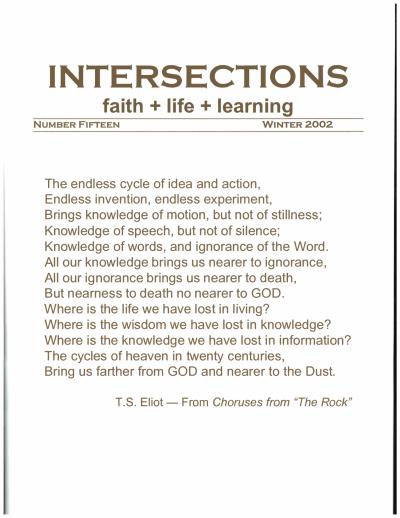
Baird Tipson
No. 15 · Winter 2002
Tipson, president of Wittenberg University, reviews Paul Dovre’s edited proceedings of the October 2000 Harvard Conference on the Future of Religious Colleges (Eerdmans, 2002), summarizing essays by Douglas Sloan on the failure of the “two-realm theory of truth,” George Marsden on faith-shaped scholarship, DeAne Lagerquist, Father David O’Connell, Mark Noll, Robert Benne, Mark Roche on Notre Dame, Joel Carpenter on neo-Calvinist Kuyperianism, and Mark Schwehn on a Lutheran “college-related church” and the centrality of vocation. Against Benne’s suggestion that only two or three robustly Lutheran colleges can be sustained, Tipson defends a less robust but still authentically Lutheran model embodied at places like Wittenberg, Gettysburg, and Roanoke, arguing for the enlightenment commitment to subjecting all truth claims to rigorous criticism and for hiring Marsden-style faith-shaped scholars rather than counting Lutheran heads.