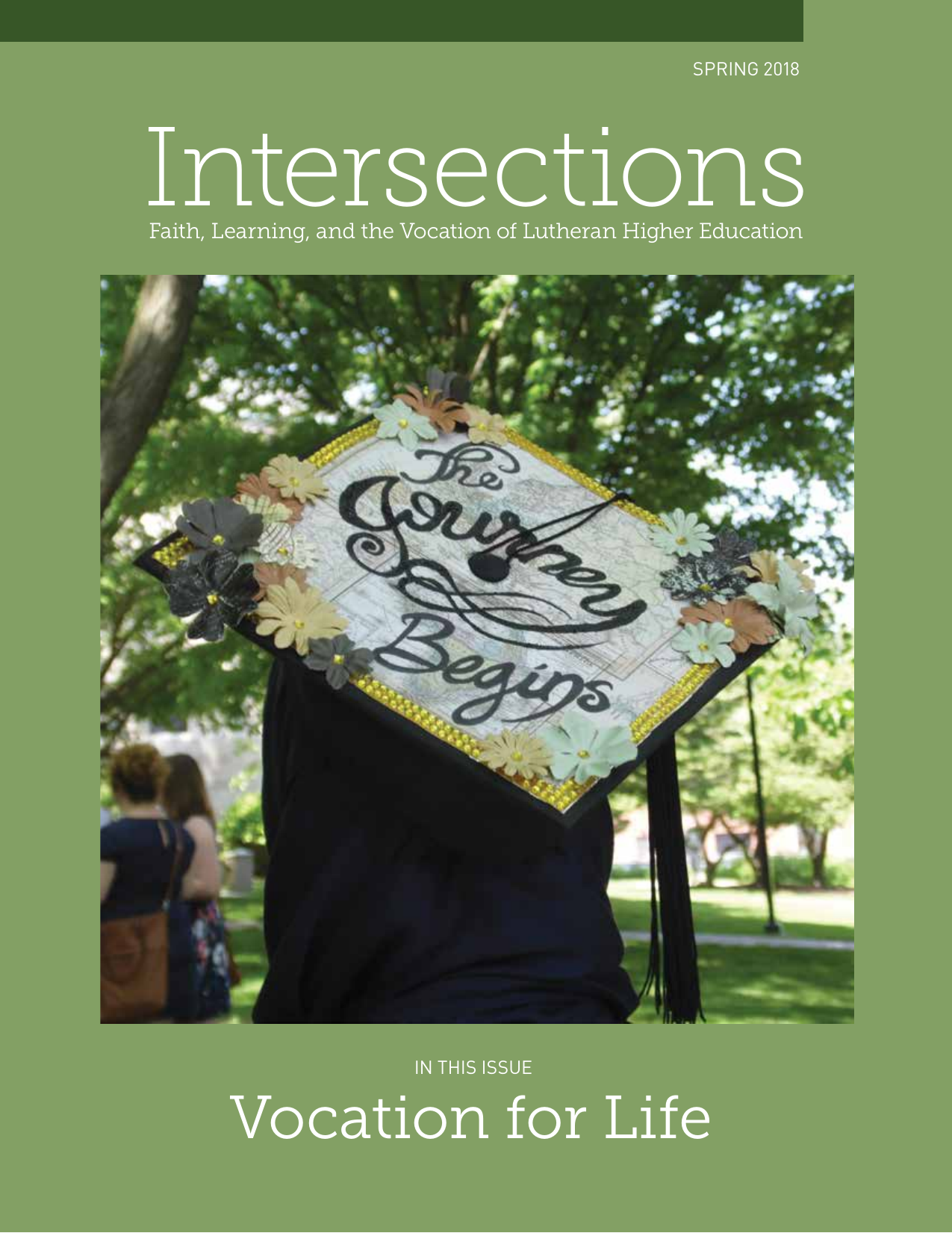
Vocation for Life
The Spring 2018 “Vocation for Life” issue, drawn from the 2017 Vocation of a Lutheran College Conference, gathers essays on vocational reflection as a lifelong journey — how Lutheran colleges can educate students for the many callings they will hear and heed. Essays explore vocation across the lifespan, the experience of emerging adulthood, vocation from Buddhist and Hindu perspectives, a reading of Tranvik’s Martin Luther and the Called Life, Luther’s catechisms as a resource for a theology of intellectual disability, and Lutheran higher education in a campus culture of pervasive anxiety.
Editors
Articles in this Issue
-
 Editorial
From the Publisher
Mark Wilhelm
Wilhelm celebrates that NECU schools continue to educate for vocation but warns that the culture of Lutheran higher education is at risk — sustained largely by informal cadres of individuals — and introduces NECU’s Rooted and Open statement as a first institutional step toward reclaiming the 500-year-old Lutheran intellectual and educational tradition.
-
Editorial
Guest Editorial
Lynn Hunnicutt
Hunnicutt traces the etymology of vocation through its cognates — evoke, provoke, convocation — to argue that vocation presumes a relationship between caller and called, that callings are often grounded in ordinary words and humble lives, and that recognizing vocation as plural and lifelong relieves colleges of the pressure to help students find a single calling while on campus.
-
Article
One Life, Many Callings: Vocation Across the Lifespan
Katherine Turpin
Turpin, drawing on the collaborative research behind Calling All Years Good, traces how vocational discernment shifts through adolescence, younger adulthood, middle adulthood, late adulthood, and older adulthood — arguing that focusing vocation on entry into the workforce limits the capacity of intergenerational college communities to wrestle with calling throughout life.
-
Article
Vocation for Emerging Adulthood: Within and Beyond College
Adam Copeland
Copeland uses scenes from Master of None, David Brooks’ columns, Meg Jay’s The Defining Decade, and the stories of two ELCA college graduates to argue that emerging adulthood has fundamentally changed — and that Lutheran colleges should call out cultural lies about work, reframe vocation as meaning-making, and help graduates take small, wise steps into their twenties.
-
Article
Called to Compassion over the Course of a Life: A Buddhist Perspective
Florence D. Amamoto
Amamoto, an associate professor at Gustavus Adolphus shaped by Jodo Shin Shu Buddhism, argues that although Buddhism has no “caller” God, it has a strong sense of calling — we are called by the world to respond to the suffering around us with mindfulness, egolessness, and compassion — and that this lifelong journey is enriched by encounter with the Lutheran vocational tradition.
-
Article
Vocation and Dharma throughout Life's Stages: A Hindu Perspective
Vidya Thirumurthy
Thirumurthy traces her own attempt as a Hindu faculty member at Pacific Lutheran University to grasp the Lutheran concept of vocation, finding in the Bhagavad Gita’s teaching on dharma — duty fulfilled without expectation of reward — an equivalent that, like vocation, varies across the four stages of life and calls individuals to transform others through selfless service.
-
Book Review
Vocation on Campus: Reading Mark Tranvik's Martin Luther and the Called Life at Pacific Lutheran University
Alex Lund, Michael Halvorson
Halvorson and Lund — faculty member and student — review Mark Tranvik’s Martin Luther and the Called Life alongside PLU’s Wild Hope Center for Vocation, weighing the book’s warning against “vocation lite” against the challenge of speaking of God’s call to students in the Pacific Northwest’s “None Zone,” where most students have little exposure to Lutheranism.
-
Article
Luther, the Catechisms, and Intellectual Disability
Courtney Wilder
Wilder confronts Luther’s deeply troubling response to a child with disabilities at Dessau, then mines his Small and Large Catechisms for a Lutheran theology of inclusion — reading the Third Article of the Creed, the petitions of the Lord’s Prayer, and the sacrament of baptism as resources that affirm the full humanity of people with intellectual disabilities as faithful children of God.
-
Article
Lutheran Higher Education in the Land of Anxiety
Jon Micheels Leiseth
Leiseth, returning to Concordia from work with the ELCA’s Young Adults in Global Mission in Southern Africa, draws on Bessel van der Kolk and Babette Rothschild to argue that pervasive student anxiety functions as low-grade trauma that hijacks the storytelling at the heart of vocational discernment — and explores embodied, breath-based practices that might help students reclaim their stories.