Vocation and Dharma throughout Life's Stages: A Hindu Perspective
Intersections No. 47 · Spring 2018
This essay is an attempt to unpack the meaning of the Lutheran concept of vocation in the context of Hinduism. Not an easy task, and an arduous journey! Anyone coming to the term vocation from a different religious tradition could have trouble grasping its deeper meaning—just as I did, and still do. Still, I think that Hinduism has ways of making sense of vocation and calling—and may prove especially helpful for considering how vocation (or one’s duty) changes over the course of an individual’s life.
My interpretations and reflections of Hinduism are based on my experiences and are modeled to me by my parents, extended family members, and elders of my Indian community. There are wide variations in how individuals practice the religion—some very religious and ritualistic, others more philosophical, still others characterized as atheists and agnostics. This essay is my take on my religious experiences with and philosophic understandings of Hinduism over the years.
I joined Pacific Lutheran University (PLU) in 2005. Even before I officially began my tenure as a faculty member in the education program, I was asked if I would be willing to attend a Vocation of a Lutheran College Conference in Columbus, Ohio. There I was introduced to the concept of vocation within the Lutheran context. For a Hindu, this concept was quite foreign. At PLU, often the conversations on vocation are orchestrated by the Wild Hope Project. The question, “What will you do with your one wild and precious life?” (from Mary Oliver’s poem, “The Summer Day”), is used to facilitate a dialog between faculty members so they can, in turn, guide their students in identifying their vocations. The first step is for faculty members to illustrate how they chose their vocations. Since this concept puzzled me, it became one of the main themes of inquiry during my entire term at PLU.
The only definition I had of “vocation” was nonreligious, and in terms of “vocational programs.” Eventually, I understood that vocation was complex, but I could not wrap my mind around it because I had no reference point within my religion or experiences. This led me to wonder how PLU’s non-Lutheran or non-religious constituents—and especially our international students—could engage in a conversation on vocation. Does one need a cultural context or a Lutheran upbringing to grapple with the term? How then are we to help our students? How might I participate in the process?
I came to interpret vocation as “calling,” and could connect this to an earlier experience. In the early 1980s, I had the privilege of meeting Mother Theresa in India. I was lucky to talk to her in person. That incident helped me anchor the concept of calling to her, a religious leader. Calling was something that true spiritual leaders, such as Mother Theresa, had in their own encounters with God. I have also read that Mother Theresa had a decisive, special calling, a moment of epiphany, where God called on her to serve the poor when she was travelling from Darjeeling to Calcutta on a train. Serving the poor became her divine calling. This raises the question that if religious gurus have such callings, can a common person also have one? Could the term vocation then simply mean service?
As I attended conferences and meetings on vocation at PLU and in other sister institutions, no one could really assist in clarifying and relating this concept to other religious contexts. There was an assumption that everyone understood what vocation meant. It therefore became my own journey, and it was important for me to grapple with it so I could have a deeper understanding.
Doing One’s Dharma
I began to think that, even if vocation’s first home is within Christianity, there must be some equivalent terms in Hinduism. This is because I am a firm believer that all religions share some core, common tenets, even if the road we each take may differ. As I ponder it over now, there may be some bridges between finding one’s vocation and doing one’s dharma.
“In Hinduism, one’s dharma varies with age, gender, and occupation.”
Dharma, meaning duty (or living the right way), is one of the fundamental concepts in Hinduism or Hindu philosophy. The dictionary defines the Hindu notion of dharma as an “individual’s duty fulfilled with observance of custom or law.” The right way of living is to do one’s duty; every individual has to do his/her duty as laid down by the religious scriptures. The key to doing one’s duty is to do it without expecting any rewards (duty for the sake of duty), even if one has to make sacrifices in order to fulfill it.
Related to the theme of this particular issue of Intersections is the fact that, in Hinduism, one’s dharma varies with age, gender, and occupation. India, like other patriarchal societies, still remains divided by gender. (They have made some strides in breaking the gender divide over the centuries, but with limited success.) Similarly, respect is duly given to people who are older than you, like family elders, older siblings, and so on. Elders, in turn, have particular duties to their progeny. All of this provides something of the unsaid norms of the society.
If a Hindu were to explain the essence of duty/dharma to a child, odds are she or he would reference the Bhagavad Gita. Indeed, many believe the essence of Hinduism can be found in the Bhagavad Gita, also called The Song of the Lord or the Divine Song. Often referred to as Gita, it is written in Sanskrit language, and is part of the Hindu Epic Mahabharata (“Big Battle of Good over Evil”). The Gita is in the form of a dialog between the Pandava prince Arjuna, a warrior, and his chariot driver, Lord Krishna. On the battle field, Lord Krishna explains to Arjuna why it is important to carry out one’s duties.
The Bhagavad Gita calls for one to do one’s duties without looking for returns, emphasizing detachment from selfish gains. This conflicts considerably with the motives of a careerist, one who works hard to achieve a goal with a reward and an ulterior motive. The careerist seeks advancement, promotions, and raises. Such ambition conflicts with dharma as described in the Gita. Again, there, the fulfilling of one’s duty should be without expecting any reward. There is total surrender to fulfilling one’s duties—duty to oneself (body, mind, and soul), and duty to others (society and environment). Duty calls for selflessness or sacrifice. So what are the duties of an individual, and what guidelines are provided in the scriptures?
Different Duties over the Course of Life
Here we return to the theme of different vocations—that is, different duties—over the course of a lifetime. For the sake of everyday practices, dharma is commonly divided into four main stages. First there is the duty of children, students, and “bachelors” (or of Brahmacharya, typically one to 25 years of age), where one must focus on educating one’s mind, respecting and being obedient to elders, and practicing self-discipline. Next, there is the duty of a family person (Grihastha, ages 26 to 50), when one has duty to one’s spouse, to children and elders in the family, to fellow human beings, and to nature. Next, there is the duty of grandparents or elders (Vanaprastha, 51 to 75 years of age), where one takes on more of a supporting and advisory role for one’s family, but also slowly relinquishes responsibilities to the next generation. The fourth and final stage is that of an ascetic or renunciate (Sanyasa, 76+ years of age), when individuals are free from all worldly or material desires and prejudices. While Sanyasa traditionally refers to a hermit or recluse, most people in this stage today continue to live with their children. Thus, one’s duty changes quite dramatically as one moves through life’s stages. Still, it is believed that doing one’s duty consistently demands selflessness and sacrifice over the whole of a life.
Of course, the division of duty into these stages gets complicated as Hinduism migrates and changes. Economic opportunities have compelled families to move to different parts of India or the world. I know of many families where siblings are scattered between, for example, the United States, Canada, and Australia. Still, when duty calls, many siblings take turns caring for their elderly parents. Often times, instead of having the elderly parents move from one place to another, each family may move temporarily back to the parents’ home and provide the necessary care. In these cases, status and wealth have not prevented them from taking care of their elderly parents. Fulfilling their duty is given higher priority. No sacrifice is too big!
Concluding Thoughts
I hope to have given the reader some understanding of the types of duties one has to fulfill throughout one’s life according to Hinduism. Dharma seems to be the driving force in Hinduism, just as vocation is the driver in Lutheranism.
When we interlace the concepts of vocation with duty or dharma, shared components come to surface. Both concepts focus on service to others, being selfless in this service, and the importance of sacrifice. One is called on to fulfill one’s duty. Perhaps the biggest difference is that, in one religious context, one is largely introspective to find vocation, and in the other, it is assigned to you “from without” by society and by scripture. Still in both cases, duty and/or vocation is discerned first and foremost by considering oneself as nestled within a network of relationships—those between the young and the old, between me and what the Lutheran tradition calls “the neighbor.” One could say that both contexts—Lutheranism and Hinduism—call on individuals to transform the lives of others while allowing such experiences to transform them. By working between and through religious differences, it is certainly possible for us to develop a more inclusive language and to promote the concept of vocation to a wider audience.
“Both contexts—Lutheranism and Hinduism—call on individuals to transform the lives of others while allowing such experiences to transform them.”
-
 Editorial
From the Publisher
Mark Wilhelm
Wilhelm celebrates that NECU schools continue to educate for vocation but warns that the culture of Lutheran higher education is at risk — sustained largely by informal cadres of individuals — and introduces NECU’s Rooted and Open statement as a first institutional step toward reclaiming the 500-year-old Lutheran intellectual and educational tradition.
-
Editorial
Guest Editorial
Lynn Hunnicutt
Hunnicutt traces the etymology of vocation through its cognates — evoke, provoke, convocation — to argue that vocation presumes a relationship between caller and called, that callings are often grounded in ordinary words and humble lives, and that recognizing vocation as plural and lifelong relieves colleges of the pressure to help students find a single calling while on campus.
-
Article
One Life, Many Callings: Vocation Across the Lifespan
Katherine Turpin
Turpin, drawing on the collaborative research behind Calling All Years Good, traces how vocational discernment shifts through adolescence, younger adulthood, middle adulthood, late adulthood, and older adulthood — arguing that focusing vocation on entry into the workforce limits the capacity of intergenerational college communities to wrestle with calling throughout life.
-
Article
Vocation for Emerging Adulthood: Within and Beyond College
Adam Copeland
Copeland uses scenes from Master of None, David Brooks’ columns, Meg Jay’s The Defining Decade, and the stories of two ELCA college graduates to argue that emerging adulthood has fundamentally changed — and that Lutheran colleges should call out cultural lies about work, reframe vocation as meaning-making, and help graduates take small, wise steps into their twenties.
-
Article
Called to Compassion over the Course of a Life: A Buddhist Perspective
Florence D. Amamoto
Amamoto, an associate professor at Gustavus Adolphus shaped by Jodo Shin Shu Buddhism, argues that although Buddhism has no “caller” God, it has a strong sense of calling — we are called by the world to respond to the suffering around us with mindfulness, egolessness, and compassion — and that this lifelong journey is enriched by encounter with the Lutheran vocational tradition.
-
Book Review
Vocation on Campus: Reading Mark Tranvik's Martin Luther and the Called Life at Pacific Lutheran University
Alex Lund, Michael Halvorson
Halvorson and Lund — faculty member and student — review Mark Tranvik’s Martin Luther and the Called Life alongside PLU’s Wild Hope Center for Vocation, weighing the book’s warning against “vocation lite” against the challenge of speaking of God’s call to students in the Pacific Northwest’s “None Zone,” where most students have little exposure to Lutheranism.
-
Article
Luther, the Catechisms, and Intellectual Disability
Courtney Wilder
Wilder confronts Luther’s deeply troubling response to a child with disabilities at Dessau, then mines his Small and Large Catechisms for a Lutheran theology of inclusion — reading the Third Article of the Creed, the petitions of the Lord’s Prayer, and the sacrament of baptism as resources that affirm the full humanity of people with intellectual disabilities as faithful children of God.
-
Article
Lutheran Higher Education in the Land of Anxiety
Jon Micheels Leiseth
Leiseth, returning to Concordia from work with the ELCA’s Young Adults in Global Mission in Southern Africa, draws on Bessel van der Kolk and Babette Rothschild to argue that pervasive student anxiety functions as low-grade trauma that hijacks the storytelling at the heart of vocational discernment — and explores embodied, breath-based practices that might help students reclaim their stories.
-
 Response
A Call for Creative Education
Wendy McCredie
No. 3 · Summer 1997
McCredie of Texas Lutheran responds to Reichenbach by reframing the four ideas embedded in his claim that “the entire college community should be knowledgeably committed to the college’s mission”—community, knowledge, commitment, mission—and argues that the Lutheran tradition’s unwillingness to be separate from the world should lead us to educate the public about the Lutheran tradition rather than interrogate prospective employees about their faith. She questions whether agreement on “Christian values” is possible (or even Lutheran), and reads Reichenbach’s “creative education” as the dialectical tension between gospel and law, God’s love and our human limits, that members of communities related to the Lutheran church are uniquely positioned to inhabit.
-
 Article
Laboratories for Living in a Diverse World
Elizabeth Eaton
No. 44 · Fall 2016
Presiding Bishop Elizabeth Eaton argues that ELCA colleges and universities are called to be laboratories for living in a religiously diverse world. Reflecting on the decline of Christian privilege, the ELCA’s ecumenical and inter-religious work, and her own experience addressing the Islamic Society of North America, she offers three questions about partnerships, formation, and institutions as platforms for new collaborations.
-
 Book Review
Reviews
Matthew J. Marohl
No. 26 · Fall 2007
Marohl reviews two 2006 Lutheran University Press volumes from Grand View College (Des Moines, IA). Mark C. Mattes and Ronald R. Darge’s Imaging the Journey … of Contemplation, Meditation, Reflection, and Adventure pairs Mattes’s Lutheran meditations on seven themes (from a spirituality of communication to Alpha and Omega) with Darge’s photographs and Ronald Taylor’s short prayers, with Mattes’s writing on vocation singled out as the volume’s finest. The Grand View College Reader, edited by Mattes, Evan A. Thomas, Kathryn Pohlman Duffy, and Ronald Taylor, surveys the college’s Foundations, Creativity, and Vocation through chapters by Thorvald Hanson, Kenneth Sundet Jones, Kevin Gannon, Ammertte C. Deibert, Steven Snyder, and President Kent Henning, tracing Grand View’s Grundtvigian and Danish Lutheran roots.
-
 Reflection
A View From the Other Side
Daisybelle Thomas-Quinney
No. 8 · Winter 2000
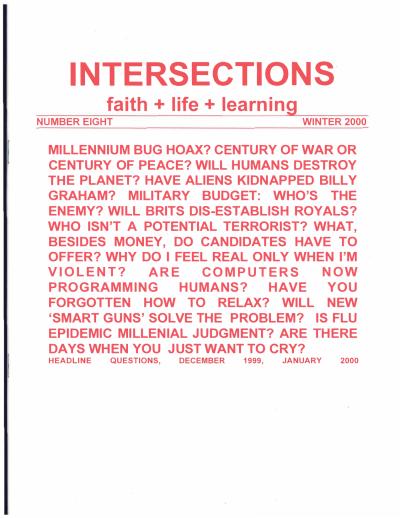
Thomas-Quinney—an ordained Church of God minister and adjunct in Religion at Thiel College—offers “a view from the other side” as a non-Lutheran African American “outsider and novice”: her bittersweet 1995 arrival at Thiel, her swift discovery (alongside one African American secretary, one Hispanic professor, and thirty-eight African American students recruited largely as athletes) of a “chilly” campus unprepared to nurture the very minority students it had recruited, her examination of Thiel’s 1875 founding and the Augsburg Confession Article IV right-hand/left-hand kingdoms, the parables of mustard seed and yeast from Matthew 13, and Bishop James Crumbly’s 1985 LCA manual Inclusiveness and Diversity: Gifts of God. Drawing on Bruce Reichenbach, Samuel Hazo, and Josephine D. Davis’s Coloring the Halls of Ivy, she concludes that the Lutheran center cannot hold “as is” but has “great possibility” when the mission statement is actually followed.
-
 Editorial
From the Publisher
Mark Wilhelm
No. 51 · Spring 2020
Wilhelm frames the issue by tracing how Lutheran educational ideals — once a primary source of contemporary higher education — were masked in the United States, and introduces a NECU initiative that uses the case of business ethics to explore Lutheran social teaching as an academic resource.
-
 Article
Lutheran Colleges: Past and Prologue
Paul J. Dovre
No. 30 · Fall 2009
Dovre offers a reminiscence rather than a research paper, drawing on Aristotle’s ethos, logos, and pathos to trace fifty years of change at Midwestern Lutheran colleges through the key issues of survival, respectability, faithfulness, and relationship to the church — from the dependence of the 1950s through the independence of the late twentieth century to the partnership of the 2000s — and identifies key variables (the student marketplace, faculty formation, and the identity/diversity paradox) for shaping the identity and mission of Lutheran colleges into the future.