Resistance in the Age of Trump: An Interview with Ivonne Wallace Fuentes
Intersections No. 45 · Spring 2017
Jason Mahn, editor of Intersections, came to know of Ivonne Wallace Fuentes’s work with Indivisible after reading an article in In These Times, an independent, nonprofit magazine.1 In the following interview with Ivonne, he asks about her work with the progressivist political action group, how it connects with her teaching and research, and how such advocacy (advocare) work informs her sense of vocation (vocare).
What does your work at Roanoke College entail?
As an Associate Professor of History at Roanoke College, I usually teach three courses a semester, mostly on Latin American history. I also teach our Methodology class, and teach on Latin America and Spanish history for our general education curriculum. I also currently chair our Faculty Personnel Committee, help coordinate the Latin American and Caribbean Studies Concentration, and am involved in ongoing conversations about pedagogy and digital humanities initiatives. My research agenda is at a point of transition: my book, Most Scandalous Woman: Magda Portal and the Dream of Revolution in Peru, is forthcoming this October from Oklahoma University Press. I will start working on a couple of new projects, including one on revolutionary internationalism in Central America in the 1960s-1980s.
When and how did you first get involved with political movements/protests?
I was completely shocked by the election results in November. I had been following the polls and other analysis, and did not believe Clinton would lose. After that loss, I was in school and despondent. A week after the election, Our Revolution in the Blue Ridge, a local Sanders group, called a meeting for all progressives to gather and plan next steps. At that large meeting, I organized a breakout group into a rapid action task force meant to come to the aid of our local communities who would, if the Republican campaign promises were honored, bear the brunt of the new administration: our Muslim and Latin@ neighbors, refugees, women, people who depend on Medicare/Medicaid/Social Security, and the LGTBQ+ community.
When and how did your work with Indivisible start?
During winter break, I read some of the analysis that I had collected since November and saved for after I finished grading. One of those links was the Indivisible Guide. It really resonated with me. It offered a concrete, almost recipe-like roadmap to do exactly what our task force wished to do: local, defensive action to protect our communities and progressive values. I registered our group that very night, on January 2. The next day, the first day of Congress, my House Representative, Bob Goodlatte, made the news when he proposed an amendment that would have gutted independent ethics review in Congress. We organized our first action within 48 hours: a visit to his district office to deliver New Year’s cards. Our group, which at that point may have been about 20 people and email addresses, now has nearly 1000 members.
For those who may not have heard of it, would you describe the philosophy of Indivisible and why you were attracted to it?
The Indivisible Guide distills the best practices of constituent advocacy into a concrete, easy to use 25 page handbook. It stresses that influencing your three (for most, sorry DC) members of Congress is the most effective way to get your voice heard as a citizen at the federal level. It explains that all members are always thinking about re-election, no matter how “safe” their seats may appear. As such, if enough constituents raise their concerns about an issue, they pay attention—as demonstrated by the calamitous roll out of the Republicans’ American Health Care Act and their attempts to repeal the Affordable Care Act. The Guide stresses that the most effective advocacy focuses on issues currently under consideration for a vote and comes from constituents, not just concerned people from other states or districts. It also highlights how the amount of effort any action takes matters: members of Congress and their staff pay more attention to correspondence and phone calls than signatures on a petition, and an in-person visit to a district office or town hall ranks even higher. I was attracted to it because it was such a clearly detailed plan, and because these tactics of civic engagement have a proven track record.
Are there ways in which your paid work as a professor of history and your work in political organizing inform or bear on one another?
Yes! I tell people all the time that the skills that I am using as a leader and coordinator of Roanoke Indivisible are those that I have honed in the classroom. Preparing actions is like preparing assignments. I ask myself the same things; What do I want to communicate? How can I make a complicated issue clear and accessible? How can I make this fun, active, and participatory? My own training as a historian also means I think a lot about texts—how to write documents and explanations, sure, but also how to craft messages, how to craft digital communications, how to translate press releases into language that moves people. My own research interests are on revolutionary movements, so I analyze how societies mobilize in other contexts, asking what strategies proved effective.
What “mobilization” have you seen that has related to your research?
I am particularly interested in how this moment of mobilization here in Southwest Virginia is led by women who would not have identified as political leaders or agents before; that suggests to me that this is a new fount of energy, a new cohort of leaders activated by the misogynistic tenor of the campaign. We have seen similar moments in Latin American history before, and such women-led activism has profoundly changed the lived politics of places like, for instance, Argentina.
What do your students think about your work outside the classroom? Do they know of it? Engage it? Critique it? How do you connect with students who have very different political persuasions than you?
I think this is a very important question, and one that I have dealt with as long as I have been in the classroom in part because I teach courses that have a high political component. I am currently teaching Latin American Revolutions, for instance. My position has always been to be direct about my personal political opinions if students ask me a direct question, but I explicitly explain at the start of the semester that all my courses are spaces of inquiry where our communal learning is most enhanced if we allow and engage with all positions, as long as they are respectfully proposed, and let the evidence and the strength of logic and argument decide which position makes most sense to any individual. Here at Roanoke, some students have found some of the media coverage Roanoke Indivisible has garnered and have spoken to me about it, all in support. But I know that there are many students who do not share my political positions. With students of all persuasions right now in this particular historical moment, I try to be the kind of mentor and teacher I would have wanted if such momentous political earthquakes had happened when I was at their life stage.
How can students learn to think critically about the current political state?
I counsel students that in times of upheaval, there is wisdom in not jumping to conclusions from any side, and that often the media and politicians are working hard to generate a gut response for their own reasons, not for our benefit as citizens or humans. I counsel them to focus not on personalities but on institutions, and to ground themselves in the most stable political foundations we have: the Constitution and other founding documents. It is likely that political labels are currently in a transition phase, a phase of realignment. I counsel students that they need not let partisan labels define them. Instead, they can first decide what principles and values they want to see in the world, and find the political persuasion that comes closest to that moral compass.
What gives you the most hope about resistance and grassroots political organizing? What are the biggest challenges that progressive community organizers presently face?
Honestly, what gives me most hope is seeing people like me, fellow travelers, become activists. I talk to people who tell me they had no idea who their representative or state delegate was a few months ago, but now they have those phone numbers in their “favorites” and have set a daily alarm to remind them to call. I deeply believe that this is not a far-right country; it’s not even a far-right electorate. The current monopoly on federal power that the Republicans enjoy is not a popular mandate as much as a carefully engineered and incredibly well-funded tapestry of gerrymandered districts, voter suppression laws, and exquisitely calibrated agitation propaganda.
The current president would never have won if he had openly campaigned on the extreme agenda he is now proposing—an Ayn Rand budget proposal, attacks on health care, and so forth. These are significant political obstacles, no doubt, but they are not insurmountable. And if we work towards a more authentic democratic society, one where all votes are welcomed and courted, one where citizens and not just giant donors have influence in the halls of power, I have faith that our society will then better reflect what I see to be our shared values of community, opportunity, and care.
You work at one of our 26 ELCA-related schools. Are there any ways in which the institutional identity or church-affiliation of Roanoke College supports, runs against, or otherwise bears on your advocacy and resistance work?
I think it supports it, absolutely. While I do not ground my own activism in the Lutheran heritage, I draw my own moral compass from a broadly New Testament injunction to take care of the least among us—to care for the weak, the orphan, the widow, the stranger, the prisoner. And here at Roanoke, we ground our educational philosophy and mission statement in care for the whole person, which we argue can then prepare students to be active, engaged agents in their world. And of course, one of the ways that we are active is as citizens in our participatory democracy.
Marty Stortz from Augsburg College had been reminding many of us that vocation (vocare) and advocacy (advocare) can and should be intimately linked. Would you describe how your own sense of vocation is influenced by your advocacy work, and vice-versa?
In part because this is a new facet of my own life that has emerged in reaction to what seems like a blitzkrieg assault in the last few months, I am not sure I have given this the careful thought it requires. But on first appraisal it rings true to me. I have always thought of my vocation to be a teacher and a scholar, but being a scholar of Latin American history by definition entails advocating for peoples either long-forgotten (who was that indigenous tribe, anyway?) or dismissed as a “dead end” of history. I am guided by the belief that every human story, no matter who, when, or where, is worthy of consideration and has much to teach us about our shared lived experience of being human. I am also guided by the belief that such consideration must entail a clear-eyed analysis of the structures of power that define, constrain, or empower individuals in their time and place. This approach emerged in the biographical approach I took in the book I just finished, a gendered analysis of Magda Portal, the only female national leader in Peru’s most important twentieth-century opposition party. And it guides my advocacy now—we are nowhere near as disempowered as some of the historic agents I study and teach. There are billions of other humans on this planet right now who have less influence on the structures of power in the United States, which, given geopolitical realities, affect them—especially now in an area of accelerating climate change. Let’s use that voice. We must use that voice.
Endnotes
1. Kate Aronoff, “The Left Group Shaking Up Congress from the Grassroots.” In These Times. February 13, 2017. Accessed 1 May, 2017, http://inthesetimes.com/article/19871/indivisible-trump-resistance-left-tea-party
-
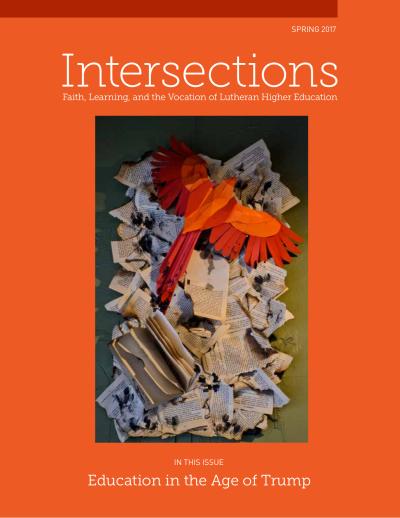 Editorial
From the Publisher
Mark Wilhelm
Wilhelm describes how ELCA colleges and universities have shifted the definition of Lutheran higher education away from institutional markers toward alignment with educational values drawn from the Lutheran intellectual tradition — and previews a NECU-convened faculty working group whose recommendations will go to the ELCA college presidents at their June 2017 conference on Lutheran identity.
-
Editorial
From the Editor
Jason A. Mahn
Mahn introduces “Education in the Age of Trump” by recounting a difficult academic year on his own campus — the Augustana “chalking” incident, a Latinx Unidos rally, and post-election conversations with marginalized students and quietly conservative Trump supporters alike — and frames the issue’s essays as careful (re)imaginings of the vocation of Lutheran higher education in an anxious political climate.
-
Article
Higher Education in the Age of Trump
Daniel B. Braaten
Braaten surveys what the Trump administration has and has not done on higher education — from the selection of Betsy DeVos and a rumored Falwell-led task force to the travel ban and expanded deportation priorities — and argues that Lutheran colleges, guided by the ELCA’s social message on immigration, have a special obligation to consider what they will do to protect their most vulnerable students.
-
Article
Religion in the Age of Trump
Daniel A. Morris
Morris reads the 81% evangelical vote for Donald Trump through two historical theses: that evangelicals’ once-coherent story about Godly participation in political life has fallen apart, and that their long-running tendency to exclude others — once aimed at Black Americans and Catholics — has now turned decisively against Muslims. He argues that scholars of religion and politics have a responsibility to tell these stories well, and that appeals to classroom objectivity can no longer be a luxury.
-
Article
Room at the Table: Reflections on Identity and Inclusion from a Lutheran-Friendly Muslim
Rose Aslan
Aslan reflects on her experience as a Muslim professor of Islamic studies at California Lutheran University — teaching “Introduction to Christianity” from her strengths in the Abrahamic religions, preaching an Eid khutba in a Lutheran chapel, and conversing with the university’s convocators — and proposes “Lutheran-friendly Muslim” as a way of being host and guest at once in a pluralistic Lutheran institution.
-
Article
Jonah: The Anti-Hero of Vocation
Martha E. Stortz
In a chapel talk first given at Augsburg College’s Vocation 2.0 series in September 2016, Stortz reads the prophet Jonah as the great anti-hero of vocation — one who tries to outrun God’s call to the great city of Nineveh — and argues that, in a season of urban violence and divisive election-year rhetoric, the story is less about public calling than about being called by the publics in our midst.
-
Article
Why Did the Chicken Cross the Road? A Homily on Liminality and Vocation
Lori Brandt Hale
Drawing on Wes Moore’s The Other Wes Moore, Warren St. John’s Outcasts United, Victor Turner’s anthropology of liminality, and Dietrich Bonhoeffer’s poem “Who Am I?”, Hale considers how Hmong, Muslim, Latinx, LGBTQ+, non-traditional, and other students live in “double liminal” spaces — and asks whether liminality might itself be a place of transformation in conversations about vocation.
-
Poem
Poetry: After Months of Clouds, the Sun; First Bird
Farah Marklevits
Two poems by Augustana writing instructor Farah Marklevits: “After Months of Clouds, the Sun” calls the reader up from a desk of doom-scrolling addiction and into breeze and light, while “First Bird,” epigraphed by Emily Dickinson, watches a robin flit through mid-January Midwestern loam as a phenological fairy tale of dread and the urge to live.
-
 Article
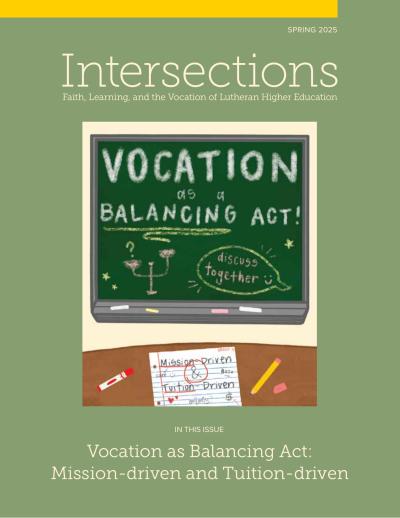
Vocation at Full Stretch: Reflections on Follow Your Bliss and Other Lies about Calling and its Use among College Students
Jason A. Mahn
No. 61 · Spring 2025
43 min audio
Mahn engages Bonnie Miller-McLemore’s Follow Your Bliss and Other Lies about Calling as required reading in a sophomore religion course, showing how her categories of missed, blocked, conflicted, fractured, unexpected, and relinquished callings empower young adults to perceive embodied, unplanned, and often painful dimensions of life as essential parts of vocation — and help close the gap between mission-driven and tuition-driven realities.
-
 Article
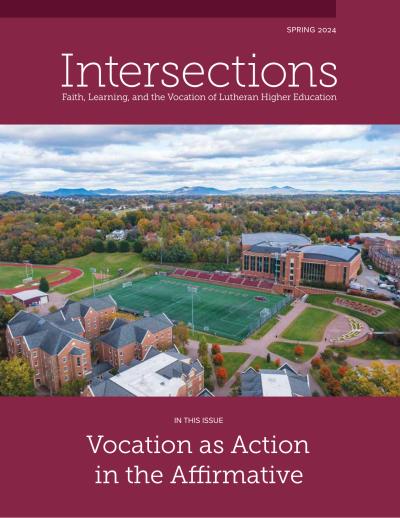
On Recruiting Diverse Students, Rooted in Mission
Eric Rowell, Jason A. Mahn
No. 59 · Spring 2024
Jason Mahn interviews Eric Rowell, Assistant Director of Admissions and Diversity Outreach at Augustana College, about how recruiting students from a wide variety of backgrounds — rooted in Augustana’s Lutheran commitment to vocation and educating across difference — remains essentially unchanged in the wake of the Supreme Court’s 2023 decisions on affirmative action.
-
 Editorial
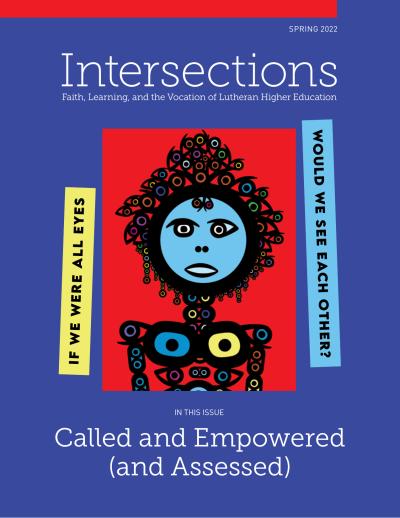
From the Outgoing Editor
Jason A. Mahn
No. 55 · Spring 2022
Mahn closes out a decade of editing Intersections, passes the duties to Colleen Windham-Hughes, gives thanks to Mark Wilhelm and Augustana College, and introduces an issue largely drawn from comments by Lutheran faculty, staff, and administrators at the 2022 NetVUE national gathering.
-
 Editorial
From the Editor
Jason A. Mahn
No. 54 · Fall 2021
Mahn introduces the “Called to Place” theme of the 2021 VLHE Conference, arguing that Lutheran higher education’s emphasis on vocation must be grounded in particular geographies and embodied communities — for, as Wallace Stegner put it, “If you don’t know where you are, you don’t know who you are.”
-
 Reflection
Shelter in Place: Reflections from March 22, 2020
Jason A. Mahn
No. 53 · Spring 2021
On the fourth Sunday of Lent in 2020, Mahn meditates on the etymology of “shelter” (from shield) and on an email from a former student in Boston whose mutual-aid organizing models a Lutheran understanding of vocation: the upending of ego by divine love that frees us, finally, to see and serve the neighbor.
-
 Editorial
From the Editor
Jason A. Mahn
No. 52 · Fall 2020
Mahn narrates a year of crisscrossing pandemics — Covid-19, economic collapse, partisan politics, and the long pandemic of white supremacy revealed anew by the murder of George Floyd — and argues that Lutheran liberal arts schools, by educating for vocation, are uniquely poised to help students respond with character and capable callings.
-
 Article
Lutheran Education in the None Zone
Samuel Torvend
No. 23 · Summer 2006
Torvend, Associate Professor of Religion at Pacific Lutheran University, argues that any ELCA social statement on education must speak not only to those raised within the cultural and theological traditions of ELCA Lutheranism but also to the diverse communities of the “none zone” — the Pacific Northwest and other regions where religious affiliation is increasingly unaffiliated. The statement must therefore equip Lutheran colleges, congregations, and schools for engagement with religious pluralism and cultural diversity rather than presuming a Lutheran cultural baseline.
-
 Reflection
Sweet on My Lips
Corin Wesner
No. 13 · Winter 2002
A passage from Wesner’s travel journal during the same South Africa workshop. Walking into a wood-and-tin shack church where raindrops fall on already-soaked carpet and the service is in Xhosa, she remembers her painted, carpeted home church and her adolescent argument with her mother about wearing a dress to worship, and finds herself engulfed in warmth as the few women sing—welcomed by a stranger’s smile and opened up.
-
Editorial
From the Publisher
Mark Wilhelm
No. 55 · Spring 2022
Wilhelm announces his planned retirement on January 31, 2023, after serving as the founding executive director of the Network of ELCA Colleges and Universities, and gives thanks for the privilege of helping NECU articulate a shared vision for Lutheran higher education in twenty-first-century North America.
-
 Reflection
Dreaming God's Dream: A Sermon on Isaiah 56:1-2, 6-8
Stephan K. Turnbull
No. 34 · Fall 2011
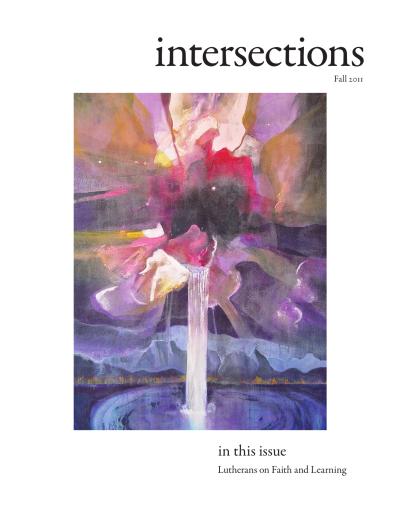
Preached at the 2008 “Savvy with Substance” Convocation of the ELCA at Central Lutheran Church, Minneapolis, this sermon by parish pastor Stephan K. Turnbull (First Lutheran Church, White Bear Lake) sets the small dreams of pastors and academics—balanced budgets, peaceful congregations, coherent midterm papers—over against the prophet’s dream in Isaiah 56 of a God who gathers all nations to a house of prayer for all peoples. Turnbull calls educators, preachers, and church leaders to articulate God’s dream of getting the world back through the dying of Jesus the Messiah and the resurrection’s first fruits of new creation.
-
 Article
Of Fathers and Feminism: How One Lutheran Woman Came to a Vocation
Karla G. Bohmbach
No. 14 · Summer 2002
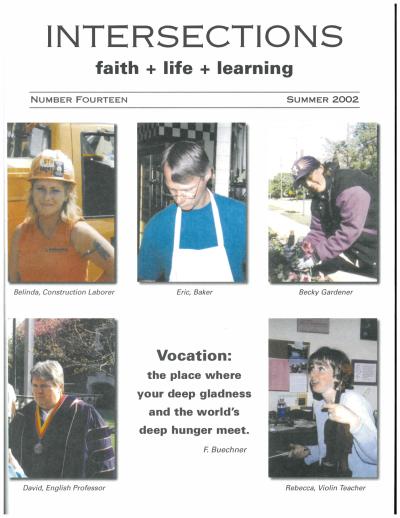
Bohmbach, a recently tenured Susquehanna University feminist biblical scholar one month shy of forty, traces her vocation back through a Vacation Bible School injury, an LCMS upbringing in which only men could preach or preside, her father’s contradictory message that she could do anything while modeling a church that limited women, St. Olaf’s revelation of a Lutheran female face, and a Duke graduate seminar on the History of Feminist Thought with Carol Meyers. Her published feminist work on biblical daughters and on the concubine of Judges 19 is read alongside Kathleen Norris’s account of word-bombardment in church, Michel Tournier on childhood as “ardent confusion,” and her own recent participation as both student and teacher in an Authorized Lay Worship Leaders Program.
-
 Article
Practicing Hope: The Charisms of Lutheran Higher Education
Martha E. Stortz
No. 32 · Spring 2010
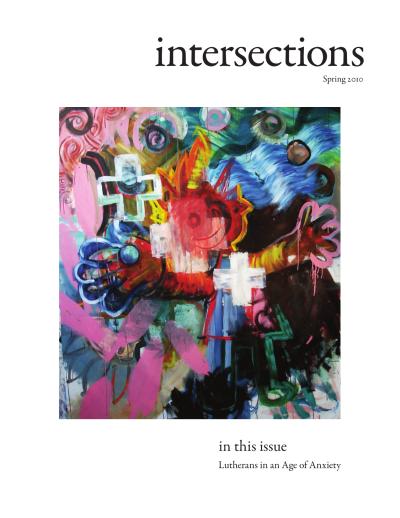
Stortz names four charisms—theological gifts of identity rather than commodities—that Lutheran higher education brings to a culture of fear: semper reformanda as flexible, responsive institutions; the freedom of a Christian as simul justus et peccator critical inquiry that holds opposites in creative tension; regard for the other as “neighbor” rather than friend or alien; and the priesthood of all believers as a public, civic calling to know the poor. Drawing on Augustine, George Lindbeck, Patricia Killen, James Clifford, Earl Shorris, Carter Lindberg, and Augsburg’s Center for Global Education, she argues that immersion trips, neighbor-regard, and welfare reform witness that the gift Lutherans bring is hope grounded in Christ in you, the hope of glory.