Dual Citizenship in Athens and Jerusalem: Ricoeur's Hermeneutics and the Promise of Lutheran Higher Education
Intersections No. 19 · Summer 2004
Beyond the desert of criticism we seek to be called again. —Paul Ricoeur, The Symbolism of Evil.
In contrast with other Christian approaches to the question of the relationship between faith and learning, which tend either to isolate faith from learning or to over-accentuate a continuum between them, the Lutheran approach to Christian higher education seeks to develop a conversation between faith and learning that preserves the integrity of each and can address current secularistic biases that would inhibit the attempt to establish a dialogue between faith and learning. In an attempt to flesh out a model of dialogue that can help us better understand how to model a faith-based approach to higher education, one can look to the work of the contemporary French philosopher and theorist of language and interpretation, Paul Ricoeur. Ricoeur’s work can provide a model for discerning various phenomenological elements of dialogue (such as listening, risk, open-endedness, and mutuality), offer a framework from within a “neutral” or non-faith perspective for making the dialogue between faith and learning a plausible and worthwhile endeavor, and show how education as a process is a profoundly hermeneutical task. His understanding of myth as an indispensable category for interpreting human behavior, truth primarily as manifestation and not correspondence, and secularism’s ability to dehumanize people calls for a retrieval of a faith-based approach to education congenial to the Lutheran tradition. Himself a layman of the French Reformed Church, Ricoeur offers work that should help us clarify the educational dynamics that can be operative at Lutheran-related schools.
In response to the dynamics of disengagement outlined by Marsden and Burtchaell, we need to maintain that Christian higher education should indeed attempt in a specifiable way to integrate faith and learning across the curriculum and in various facets of student life. Admittedly, a school is not a church—nor should it be. A school is a community of scholars seeking to further the life of the mind. However, the unique heritage and calling of church-related institutions of higher learning is to attempt to find ways for faith and learning to connect. This is a task unique to the church-related school, since it is not promoted by secular institutions or by other agencies of the church. If we conceive of this integration as a conversation between faith and learning, we can recognize that both questions addressed to the faith from outside of faith and questions arising from the faith to that which is outside of faith are permitted and encouraged as essential components in the development of the life of the mind. In other words, unlike much secular-based education, Lutheran higher education proposes that questions of faith are worthy of one’s reflection; and, in contrast to many sectarian Christian institutions, at Lutheran colleges and universities it is permissible—indeed sometimes necessary—to criticize our presuppositions of faith in the hope of refining our faith-inspired perspectives. Admittedly, this task is risky for faith. We might lose our faith in the process of self-criticism. Nevertheless, as it will be seen, if we follow Luther’s and/or Ricoeur’s thinking, a faith that insists on security of whatever sort proves not to be genuine faith at all.1
In some perspectives in higher education, faith issues and questions are thought to be solely a private matter. In this view, scholars want to preserve human autonomy from the threat of authoritarianism and defend scientific research from the challenge of “obscuritanism.” Hence, in their view, faith is an irrational disposition or blind acceptance of the religious legitimization of social institutions. By contrast, for church-related higher education, faith issues are thought to engage the life of the mind and even challenge our assumptions about social legitimization. Faith issues are permitted to be public, even though these issues will not receive univocal answers from church-related faculties, whose views often reflect the pluralism of the wider academy. Hence, church-related colleges should seek to foster both academic excellence and spiritual growth, and not just provide opportunities for spiritual growth. How might this be possible in an academic environment? Issues of faith are nurtured as much, if not more so, by the questions that faith raises, and not merely by the historic creedal or confessional answers that faith has traditionally given. Indeed, the very transmission of faith has been sustained by the questions generated by the faithful. Hence, one should agree with former St. Olaf College president Mark Edwards that “there should be in most cases no substantive difference between scholarship by Christians and by non-Christians.” However, one can assume that the pedagogy at church-related campuses at times might be markedly different from that at secular campuses, since the church-related community of scholars will expect and encourage questions about various disciplines, methods, and subject matters that might address faith or be addressed by faith. In church-related colleges, a confessional tradition meets the wider world of scholarship: this encounter mixes not the ingredients of oppression or repression, but of lively debate. Of course, one should not assume that religion courses required for the baccalaureate degree by many Evangelical Lutheran Church in America (ELCA) schools will guarantee that faith and learning will be cross-fertilized. As an academic discipline, the study of religion in a church-related school may be done, indeed perhaps often ought to be done, from a vantage point of critical distance from faith, a “second order” reflection on “first order” faith propositions. However, such critical distance should never quiet questions of faith for the very sake of achieving an alleged “academic freedom” in the classroom. There is no wholly neutral stance in which scholars do their work. Scholars are always framed by traditions or perspectives. In a church-related environment, questions and issues of faith are, ironically, a guarantee of the pursuit of academic freedom across the curriculum, since they are not dismissed out of hand due to secularistic bias.
The integration of faith and learning can happen and often occurs in the outreach programs of campus ministry centers at state and/or secular universities and colleges or by various groups within currently demarcated research arms of the academy. However, church-related colleges ought to endeavor to bring faith and learning into conversation in an intentional way in their many endeavors and venues. From the perspective of democratic ideals and free inquiry, such a goal in no way jeopardizes the autonomy or academic freedom of faculty or students, since all members of a church-related academic community have freely consented to the value of this endeavor by their joining this particular community of scholars. Hence, as suggested by Ricoeur’s thinking, the atmosphere that ought to be fostered on church-related campuses would avoid, on the one hand, a skepticism that thinks that it is pointless to seek truth or, in this case, the integration of faith and learning, and, on the other hand, a dogmatism in which one presumes to have discovered the definitive truth so that no further questions need be asked.2 Rather, church-related higher education can foster an attitude of hopefulness that faith can provide a vision of meaning, meaningfulness, and even truth in and for the academy as it inspires students to consider lives of dedicated service to the world. Church-related higher education ought to produce graduates who understand the responsibilities of dual citizenship in both Athens and Jerusalem. The skeptic needs to take the risk of questing for meaning in inherited symbols, despite these symbol’s limitations, while the dogmatist needs to see his or her symbols appropriately critiqued.
The Lutheran Approach to Christian Higher Education
As several scholars have argued, different Christian traditions have tended to construe the relationship between faith and learning in different ways.3 The Reformed tradition has tended to integrate faith and learning by subordinating learning to faith in order to construct a unified and coherent single understanding of reality, a purported “Christian worldview” since, after all, all truth is God’s truth. A consistent Reformed position tends to be alarmed by the threat of secularization, since it will attribute secularization as resistance to the distinctive Christian perspective.4 The Roman Catholic perspective tends to emphasize continuity between faith and reason since it is apt to construe the material world in virtually a “sacramental” way as a vehicle of God’s grace and presence. The Mennonite and/or “free church” traditions emphasize not so much a distinctive Christian understanding of the world as distinctive Christian behavior—radical discipleship—a personal, practical, and unique discipline as over against the world. While appreciating the desire to relate faith and learning found in all these approaches and, in fact, sensing a core of truth in all of them, Lutheran higher education resists the attempt to impose a “Christian worldview” on the world, or the desire to insulate itself from the world, or the supposition that there is an uncontested continuum between faith and learning. Perhaps less confident in our ability to interpret either our world or God’s truth for the world than these other perspectives, Lutheran higher education tends to see its mission as establishing a dialogue between faith and learning for the sake of mentoring citizens who will serve both church and society. The integration of faith and learning in a Lutheran perspective, then, suggests thematizing a conversation between the implications of faith for learning and the implications of the various disciplines in the arts and sciences for faith, when and where it is appropriate.
A conversation between faith and learning should not be misconstrued as one between public (learning) and private matters (faith issues). It is not an exercise in “values clarification.” Rather, it involves the “to and fro” or “give and take” movement in a dialogue generated by two sets of possibilities: those of new life granted by the gospel as they bear upon the life of the mind, and those of the life of the mind as they bear upon our comprehension of the gospel. A Lutheran approach to higher education is guided by an affirmation that the world is properly God’s, not our own, and that this truth liberates us from any pretentiousness towards divinity that we might foster. As people of faith, we can be free to accept our creatureliness, our ultimate dependence upon God as a loving creator. As people of faith, we can be free from the anxiety that can cause humans to be “curved in” upon themselves, as Luther put it. Indeed, we can be liberated from our own quest for self-security and in this way we are available to consider the needs of our neighbors and the earth. Hence, people ought not to insulate their faith from the challenges and prospects of the world, since the gospel frees them to accept their creatureliness in and for the world. We also ought to be suspicious of any attempts to impose a “Christian worldview” on the world since we can never assume, this side of the eschaton, that our faith can somehow become sight. We walk, as St. Paul puts it, “by faith, not by sight” (2 Cor. 5:7). Faith indeed should seek to understand everything it is capable of understanding. Faith is seeking understanding, as St. Augustine taught us. Indeed, St. Augustine is right to note that far from faith making one blind, it is rather on account of faith that one can see or understand anything at all. However, furthering Augustinian thinking about the relationship between faith and understanding, Luther contended that genuine faith is bereft of empirical measuring. Indeed, faith must be content to find God under the “sign of the opposite,” in suffering and the cross,5 rather than in security or triumphalistic glory, with which reason might feel more secure. Guided by a healthy suspicion in the ability of the power of human reason to determine or share a common home ground with divine truth as such, since it is vulnerable to the onslaught of the “labyrinthine depths of human self-deception,”6 a Lutheran understanding of the gospel naturally can affirm dialogue as the best model for the relating or integrating of faith and learning, since dialogue especially can accommodate the ambiguity, or the lack of sight, that genuine faith must accept even as it seeks to make sense of its world.
While historically the Lutheran tradition has tended to be “quietistic” with regard to the economic, political, and social “powers that be” that operate in the created order, and has rightly been chastised for this social passivity, there are certainly enough theological resources and leverages within Lutheranism, were Lutheranism to challenge its quietistic heritage. These powers are susceptible to self-serving incurvation, our tendency, as Luther put it, to be turned in upon ourselves. They should not be uncritically trusted. These powers can be instruments that further God’s good creation, when they help us to focus on the needs of our neighbors or the earth. Nevertheless, they also are capable of systemic distortions when they become self-serving. With regard to education, Lutherans can especially walk freely because they know that education is not, and can never be, salvific. While education can help sustain social health, it can also be a vehicle of systemic distortions or social “incurvation.” It is the gospel alone, then, that justifies the ungodly, not the processes or outcomes of education. From a Lutheran perspective, education does its job best when it directs us away from ourselves and toward the needs of our neighbors and the earth. Lutheran higher education holds out the prospect of being guided by awe and wonder towards the creation, rather than the fierce attempt to control nature for human’s own purposes. We are, as Robert Jenson has nicely phrased it, to be gardeners of someone else’s (i. e., God’s) garden (Jenson 113).
The wider academic context in the twentieth century has not always been amenable to the cultivation of a conversation between Athens and Jerusalem. The “liberal-rationalist” tradition, as Richard Baepler has designated it, has looked to the scientific method alone as a norm for authority and has configured the purpose of higher education to be primarily pragmatic in outlook. It discredits the role of faith in public matters; faith, then, is relegated to private matters. Lutheran higher education has responded in different ways to this academic tradition. The Lutheran Church-Missouri Synod (LCMS) schools, it could be argued, have generally opted for a “sectarian” strategy that rejects many, if not most, aspects of this tradition out of hand. ELCA schools, perhaps, have in various degrees and ways tended to accommodate this tradition. Much is to be learned from the liberal-rationalist tradition.7 We should affirm the use of scientific method and the important contributions that an individual’s creative self-expression in the academy can offer the world. However, the overall record of the liberal-rationalist tradition is ethically ambiguous and some aspects of its outlook on the world are incompatible with the Christian gospel. The liberal-rationalist tradition rejects external authority and tradition, and affirms a “common rationality” that presumes that objectivity belongs solely to mathematics and the “hard sciences” of physics, chemistry, and possibly biology. It tends to reduce questions of truth to matters only of verification within the confines of controlled inquiry and demonstration. Since the attempt to specify an overarching common good is unobtainable to scientific pursuit, the liberal-rationalist tradition fosters a highly individualistic social policy. The self is “free” for any number of ends as long as it does not limit the autonomy for others. This tradition has altered the terrain for the kind of education offered in “denominational colleges,” such as Lutheran schools which, as established in the nineteenth century, encouraged students to consider the unity of knowledge, human moral purpose, societal leadership, and the classics of the West (Baepler 48). For the liberal-rationalist heritage, Athens and Jerusalem should not be in dialogue. Why? When seen as affecting the public, faith threatens to constrain the autonomous self. Furthermore, faith—lacking scientific verification—is viewed by those espousing this tradition as largely an irrational matter.
In an era of increasing pluralism, the hegemony of the liberal-rationalist tradition is less secure today than, say, twenty or thirty years ago. However, it is still a widespread and powerful social stance in the academy and it is fueled by the conviction that both scientific method as a path to truth (as opposed to “superstition”) and personal autonomy (as opposed to the heteronomy of hierarchical churchly and political authority) need to be preserved. Surely, the insight that this tradition offers for faith is that genuine faith must be on guard lest it become either superstitious or oppressively authoritarian. However, many scholars have rightly challenged a “verificationist” approach to truth that tends to pit science against faith. Indeed, the humanities are relegated to mere “taste” (about which, as the saying goes, there is no dispute) from the perspective of “verificationism.” While verificationism has been widely discredited by many thinkers, in The Outrageous Idea of Christian Scholarship, George Marsden helpfully designates four specific objections to it. Since the liberal-rationalist tradition continues to wield considerable force in the academy, it is worthwhile to present Marsden’s four points. First, the reliance on empirical scientific models as the specific criteria for truth is simply misguided since empirical science is not competent to provide definitive answers to the larger questions of life, which we should not assume to be properly configured as wholly subjective issues. Second, the conviction that all academic beliefs must be empirically based is inconsistent, a double-standard; “it [the empirical criterion] is not applied consistently to other nondemonstrable beliefs that play prominent roles in the secular academy.” For instance, most academics believe in the value of equal treatment for all people regardless of gender or race. However, such a belief cannot be derived from scientific argument. Third, religious beliefs cannot be excluded from the academy since many “academics are religious” and their beliefs will inevitably shape some of their scholarship. And, finally, verificationism unduly favors scholarship based on purely naturalistic presuppositions. Scientific method has been widely successful in much of the natural sciences. It, however, is not itself scientifically self-verifying.
In some perspectives, the liberal-rationalist approach to higher education may be less ethically neutral or innocent than it would lead us to believe. Indeed, as Max Weber conceived the goal of the university from its perspective, the university should seek mastery of the world through calculation and control (Schwehn 58). That goal, from the traditional Lutheran perspective, ought to be challenged. It would be tantamount to ambitatio divinitatis, the attempt of humanity to be its own god for itself. It is the exact opposite of living by faith. The results of our attempts at world mastery have consequences for the overall health of the planet as well as social, economic, and political inequities between rich and poor. ELCA schools can offer society far more by examining and challenging these aspects of the liberal-rationalist tradition. Some aspects of this tradition, such as promoting free inquiry, are helpful and consistent with the mission of ELCA-related higher education. However, other aspects, such as its inherent individualism, run counter to the goals of ELCA higher education. Individualism undermines the attempt to develop a concern for vocational service to church, neighbor, and the earth.
Ricoeur’s Hermeneutics of Suspicion and Retrieval: A Challenge to the Liberal-Rationalist Tradition8
The need for church-related higher education to move beyond the confines of the liberal-rationalist tradition motivates the concern of this paper to investigate and present the hermeneutical phenomenology of Paul Ricoeur (born 1913), and to draw out the implications of his philosophy for Lutheran higher education. Since the liberal-rationalist tradition is unsuited to provide a dialogical encounter between faith and learning for which Lutheranism quests, it then behooves us to seek an alternative model for education. Ricoeur is not an educational philosopher. Nevertheless, Ricoeur’s development of a reflexive philosophy that seeks to interpret or rehear symbols, myths, and texts in terms of suspicion and retrieval, or “distanciation” and “appropriation,” provides a model of dialogue with these symbols, myths, and texts, harmonious with and illustrative of how Lutheran higher education as itself dialogical can be construed. In Ricoeur’s work, issues of faith are seen as public matters, offering plausible perspectives on human identity, the nature of the good, and the nature of the world. Developed within a modern perspective, Ricoeur’s work indicates that modernity need not entail secularity. Furthermore, Ricoeur’s thinking unmasks a darker side to secularism that should not be ignored. This section of this essay will offer an in-depth study of the development of Ricoeur’s approach to symbol, myth, metaphor, and narrative in order to reclaim a space for the construal of faith and learning as dialogical, public, and worthwhile.
Ricoeur’s hermeneutics grew out of his work as a reflexive philosopher working within the French phenomenological tradition; Ricoeur saw the role of philosophy as offering possibilities of an increased self-understanding linked to the questions of a meaningful life and action. While himself a French Reformed Christian, he bracketed issues of faith in his philosophical pursuits in order to protect the integrity of both philosophy and theology.9 For Ricoeur, philosophy should not be an apologetic handmaid to theology, and theology should feel its freedom to position itself with relation to philosophy as it sees fit. His approach offered a self-critique of the Reformed perspective on relating faith and reason, since he was not seeking to establish a Christian “worldview.” Similar to the Lutheran position presented earlier, Ricoeur’s work implies that faith offers philosophy not a worldview but a critical engagement upon its assumptions, methods, and intentions. Faith may be able to accommodate diachronically and perhaps synchronically a number of worldviews, but not every worldview. The standard of testing a worldview for Lutherans in light of Ricoeur’s views ought to be whether or not a given worldview is compatible with the cruciform existence of Christian discipleship, one which seeks to honor God above all things and seeks the neighbor’s and the earth’s well-being. An analysis of Ricoeur’s intellectual journey, as we shall see, helps illustrate an intellectual basis for the viability of a dialogical approach to faith and learning, and how faith issues are genuinely public.
The key to understanding Ricoeur’s view of dialogue is his analysis of a modern appropriation of mythical and symbolic thinking. Some moderns tend to ridicule myth, but for Ricoeur myths hold the secret to some aspects of human experience, if we are willing to engage them dialogically. Early in his career, Ricoeur sought to extend the thinking of his teacher Edmund Husserl10 by producing a phenomenological description of the human will.11 In order to attain the phenomenological standard of “pure description” or a transparency between the will as such and our conception of the will, Ricoeur initially bracketed the experiences of fault and transcendence. When he undertook to study the notions of fallibility and fault, however, he acknowledged the limitations of Husserl’s approach to explain these phenomena.12 The Husserlian perspective was far more comfortable with notions like motives, powers, conditions, and limits rather than understanding how human fallibility is capable of moving to fault. Ricoeur concluded that the condition of fallibility is due to the fact that for humans it is difficult, if not impossible, to establish a proportion between desires and ends, or freedom and finitude. However, he determined that in order to understand fault, phenomenology needs to appeal to and then interpret the mythical tales of the origins of evil that pre-scientific peoples devised.
In The Symbolism of Evil, Ricoeur explored various myths that sought to interpret the origin of evil such as “primordial chaos,” “primeval fall,” “original defilement,” “exile from paradise,” and “tragic fate,” culminating in the affirmation of a “servile will.” In Ricoeur’s view, such myths ironically were the attempt to make sense of something inherently irrational, the phenomenon of evil. Ricoeur’s insight was that finally it is only myth that can help us attempt to provide categories for philosophical reflection about evil. Ricoeur concluded that myth is a species of symbol—an extended or “narrated” symbol. Following Rudolf Bultmann13 but likewise much of modern thinking about mythology, he argued that myth must loose its explanatory pretension or presumed “etiological function.” Nevertheless, Ricoeur contended that the quest to “demythologize” should not be to deprive us of myth, but instead to rid it of a “false logos” (Symbolism of Evil 162), the illusion of offering a kind of crude “science.” In this way, myth can thus affirm its exploratory significance, “its power of discovering and revealing the bond between man and what he considers sacred” (5). Or, as he stated it, “The dissolution of the myth as explanation is the necessary way to the restoration of the myth as symbol” (350). Hence, in contrast to Husserlian phenomenology, meaning is not limited to the cognitive and empirical modes of understanding; it is rather profoundly hermeneutical,14 an attempt to “listen” to the dimensions of experience that would, without myth or symbol, be “closed and hidden.” Since much human behavior is symbolically construed, Ricoeur’s work opens vistas for philosophical and literary inquiry that are either closed or limited when we focus solely on concepts alone (as does Idealism) or sensations alone (as does Empiricism) to help us understand reality.
Ricoeur contended that far from being irrational, as many in the liberal-rationalist tradition might claim, symbols provoke us to think. How are they capable of doing this? They do this because they are many-layered or “polysemic.” For example, the symbol “defilement” conveys both a literal and a figurative connotation. The latter, an analogy, where defilement is like stain or spot, encourages our attempt to decipher just how similar in any given judgment the analogy holds. Hence, as Ricoeur so famously noted, “the symbol gives rise to thought.” This is because the attempt to decipher symbols is a thoroughly interpretive or hermeneutical enterprise. Ricoeur affirmed that the critical moment of modern thinking (the heart of the liberal-rationalist tradition) is a necessary and indispensable aspect of humanity’s process of intellectual maturation. We have indeed “come of age,” as Dietrich Bonhoeffer taught. However, we are not limited solely to the resources of this age. We can, and indeed should, “critique the critique” by recognizing modernity’s limits and its tendency to inhibit our full understanding of reality or the exercising of our full range of human inquiry. Myth and symbol can continue to speak to us, if we are willing to listen to them. Hence, Ricoeur described the hermeneutical enterprise as a “wager”—a risk that pre-modern symbols can still address us, disclose truth to us, and reveal possibilities of new experiences for us, despite the fact that they die as causal explanations for things (351). In this light, he claimed that it is not possible for us moderns to return, like pre-scientific peoples, to a “primitive naivete.” However, by interpreting these symbols, we can hear their truths again.
Ricoeur concluded that hermeneutics involves a circular process that can be thematized as: “We must understand in order to believe, but we must believe in order to understand.” Faith will wager or risk the possibility that the symbol can still address the human by disclosing meanings that can help humans position themselves with regard to their relation in the cosmos and even to the sacred. Hermeneutics, in a sense, is an act of faith, though a kind of “secular” and not a specifically religious faith.15 It clearly is never a “blind faith.” Rather, it is more a faith like St. Augustine’s who claims that apart from faith one cannot see. Symbols, then, encourage us to think as we attempt to decipher their meanings for people today.16 But thought also returns us back to the symbol, because we inescapably live within symbol systems. There is no metaphysical or scientific “second order” discourse that can dispense with the symbolic and mythic “first order” discourse. Since Ricoeur acknowledged that symbols can legitimate and sustain oppressive social systems, he listened carefully to the “masters of suspicion” such as Marx, Nietzsche, and Freud who unmasked idols used to justify social repression or inequities. Such idols must be smashed in order to allow symbols to speak (Freud and Philosophy 532). An appropriate way in which to communicate to others about the truth of a symbol is then “attestation,” which for Ricoeur has become the hermeneutical equivalent of certitude in other disciplines (Oneself as Another 21). The upshot here for Lutheran higher education is that Ricoeur’s work allows a space for reflection to open about faith without the liberal-rationalistic bias that faith is inherently non-cognitive. Ricoeur’s move from Husserlian phenomenology to hermeneutics, giving a public status to myth as an unavoidable symbolic form of human self-understanding and communication, provides a forum for faith matters to position certain aspects of human life, such as freedom, sin, origins, and destiny. It also suggests that the human quest for truth involved in asking these questions is meaningful, even though these questions transcend our finite ability to achieve definitive answers. In Lutheran terms, the purpose of education as dialogue is not to foster the life of the mind for its own sake but is guided by the possibility of nurturing a self-dispossessing life of discipleship. The primary symbol of the cross, in the Lutheran understanding, calls people to challenge idols which they invent in order to gain security and a false view of the self in which the self owns itself, and to live “outside themselves” in God and for the sake of the neighbor.
Truth as Manifestation
Having moved into hermeneutics, Ricoeur must undertake the difficult task of better understanding the ability of language to refer to extra-linguistic reality. For Ricoeur, truth is to be found as manifestation and not merely correspondence. Ricoeur inquired into the question of truth in language by investigating the semantic structure of referentiality in metaphor and narrative.17 In order to clarify his stance on language as referential, Ricoeur appealed to Gottlob Frege’s linguistic distinction between “sense” and “reference.” “Sense” semiotically conveys the intra-linguistic dimension of language—how words are to be distinguished from each other in the intelligibility of a sentence as such. The “reference,” however, is the semantic dimension of language that indeed refers to extra-linguistic possibilities for human living in the world. Referentiality should no longer be construed, as the Structuralists conceived it, as solely an interplay among various signs within a text, nor as the Romantics construed it, as a reader’s reproduction of an author’s intentions. Instead, the text refers to reality by disclosing possible new horizons of experience for a reader.18 From this perspective, truth is radically reconceived, similar to the views of Martin Heidegger19 and Hans-Georg Gadamer,20 as no longer an equivalence between an image in the mind and reality as such but as a disclosure of possible ways of living or new horizons of experience.21
Emphasizing the importance of discourse as the avenue to truth-as-manifestation, Ricoeur’s work naturally turned in the mid-1970s through the mid-1980s to the question of narrative, particularly toward the question of establishing a relationship between narrative and time.22 For Ricoeur, time is to be construed narratively as human time and narrative is to be construed as temporal experience. He isolated three hermeneutical moments to narrative: prefiguration, configuration, and refiguration. Our ability to prefigure our world means that we approach life with a preunderstanding of what human acting and communication are. Our ability to configure our world is our ability to “emplot,” the act of “eliciting a pattern from a succession,” that is, to configure episodic and unrelated temporal events into a meaningful totality. It is the text, not the reader, who projects a world and thus enlarges the reader.23 Our ability to refigure our world is the ability to decipher the ethical possibilities in a situation suggested by the text. Education, from a Ricoeurian perspective, ought to be seen as itself a profoundly hermeneutical process as it exposes students to various traditions and canons of critical inquiry. Clearly, we can also infer from Ricoeur’s hermeneutics that faith is capable of bearing on public matters by disclosing possibilities for how to reconfigure life in light of faith in the gospel and love towards one’s neighbor. Truth is insight into the world and human relations, into new directions for human life, and into discerning God’s will for humans; this reconception of truth parallels the Lutheran view of education both as dialogical, open to new horizons of experience, and as humble with regard to our attempts to comprehend reality. It also implies for Christians, in light of the power of the God who justifies the ungodly, the possibility of serving in new practices of charity in one’s vocation on behalf of others and the earth.
Ricoeur as Interpreter of Religion as a Dimension of Human Experience
Ricoeur worked from within a “secular” framework. He did not see himself as a Christian apologist. Indeed, he bracketed issues of faith. Nevertheless, he criticized secularistic assumptions that tend to trivialize faith or actually repress questions of faith. His quest to retrieve questions and issues of mystery and myth was solely for the sake of unleashing the possibility of a more human and more humane humanity, a possibility which is lessened when the religious dimension to human experience is repressed or ignored.24 In an important article “Manifestation and Proclamation,” he lamented that modernity “is constituted as modern precisely by having moved beyond the sacred cosmos” (61). Hence, “Modern persons no longer have a sacred space, a center, a templum, a holy mountain, or an axis mundi. Their existence is decentered, eccentric, a-centered.”25 The ramifications of our domestication of nature and our de-mystification of it through our adoption of scientific method and our ubiquitous use of technology (the “real metaphysics of the twentieth century,”26 as Ernst Jünger phrased it), is that “we no longer participate in a cosmos, but we now have a universe as the object of thought and as a matter to be exploited.”27 It is the exposure of this hidden ideology of exploitation laden in much scientific and technological pursuit that led Ricoeur to note: “this same consideration ought to lead us to call into question the judgment modernity passes on what it makes appear as an archaism. This judgment in its turn has already begun to be judged itself. Modernity is neither a fact nor our destiny. It is henceforth an open question.”28
In a sense, for Ricoeur, the nature of the human is neither fully nor properly expressed apart from some kind of acknowledgment of the sacred. Technology’s de-mystification of the cosmos results not only in the “death of God,” as it was expressed in the mid-1960s, but also in the death of humanity. This is the darker side of secularity, which needs greater acknowledgement in the academy. When the participants in the universe are reduced to combinations of impersonal, albeit interconnected machinery, it is not only the universe as mysterious that dies, but also humanity as uniquely self-transcendent. Humanity is properly self-constituted only within the horizon of mystery, wonder, awe, and joy, and certain human events such as births, deaths, or coming of age, are so evocative of both wonder and threat that only religious ritualization offers an etiquette that rightly responds to these mysteries. Ricoeur retrieved a sense of mystery to the cosmos by means of affirming the exploratory nature of myth, and the meaning-producing patterns of metaphor and narrative in order to help provide tools for better understanding our humanity and to critique the one-dimensional aspect of human interest that technology suggests. He also believed that while talk of faith is not susceptible to empirical testing (faith after all does not become sight)—nevertheless it is capable of being rationally configured. Like Immanuel Kant, Ricoeur was convinced that matters of faith can be thought, even if they can not be known. Far from violating one’s personal autonomy, faith retrieves the possibility of allowing the human to be seen in non-reductionist terms as personal and meaningful. For Ricoeur, the attempt to discern possible horizons of experience from a symbol or a text is a risk, a hope that being-as-such will or can give meaning to one’s life by venturing or wagering that life-altering possibilities can be offered or given by the text or the symbol. Both the skeptic and the dogmatist short-circuit the possibility of hope because they think they can bring closure to the discussion prematurely. Neither position genuinely represents a stance of faith. However, a faith which can embrace questions, even doubts, fulfills our humanity and allows us to become ever more human in relation to God, others, and our own very selves. Hopefully, a Lutheran understanding of the gospel in the context of higher education affirms this truth.
The Contours and Value of Dialogue
What then are the contours or texture of dialogue for Ricoeur? How can Athens and Jerusalem be in dialogue, if this is indeed what the dual citizen of Lutheran higher education desires? Ricoeur stresses that we need to check our modern anti-mythic assumptions and learn that some issues can only be understood mythically. We need, in other words, to take the risk of challenging ourselves and listening to the voice of the other in the myth. Likewise, Ricoeur teaches us to think through the new possible patterns of life suggested by various symbols. Symbols push us towards a “give and take” relationship between the other and ourselves. Narrative, for Ricoeur, asks us how our lives might be refigured in light of a story, implying a kind of attitude of open-endedness as we inquire how a text may alter our lives. It seems, then, that there are four crucial components to a phenomenology of dialogue on the basis of our investigation of Ricoeur’s hermeneutics and theory of narrative: risk, listening, mutuality (give and take), and open-endedness. These four are not to be understood in either a temporal or a hierarchical sequence. However, they do represent the phenomenological contours or texture of authentic dialogue. First, when interpreters approach a text or a symbol they must take the risk in hopefulness and faith to venture that this symbol can indeed continue to speak. The symbol of course may in some sense deceive. The symbol or text may, for instance, authorize or legitimate repression. Ricoeur would have us test or question this of the symbol or text. It may provide some kind of “false logos” that would seek to explain reality in a quasi-scientific way. He would have us challenge our assumptions about the symbol or text. We need to be suspicious and yet hopeful of retrieval as we undergo our suspicion. The hermeneut falls short of certitude, yet not of thought. Second, the hermeneut is a listener. Hermeneutics allows the symbol or text to question us, to challenge us, to provoke us, to permit us to question and test our deepest convictions and assumptions. It is risky business indeed! It is an interplay between exclusion and embrace, distance and closeness, suspicion and retrieval, skepticism and attestation. It is in this way that we listen to the text or symbol—even as we question it. We ask: How might it refigure our lives and make us different or hold out new possibilities for us? Third, the fact that we stand between suspicion and retrieval and reject both skepticism and dogmatism guarantees that our task of interpretation, our analysis of the possibilities of life reconfigured by the text or symbol, will be a process of mutual give and take, and hence, fourth, an open-endedness due to the “surplus of meaning” in a text. Demythologization does not have to lead to demystification or demythication. Indeed, even scientific method in Ricoeur’s perspective, should be understood as likewise a hermeneutical task, the interpretation of data and experience in light of models which attempt a “critical realism,” a possible, imaginative way of representing the world. Ricoeur, like C. S. Lewis, teaches Christians to affirm the mythic character of their primary narratives. Gary Dorrien, interpreting Lewis says, “If the Christ myth is true in the way that it claims to be true, it stands to other myths as the fulfillment of their promise and truth. It is not an illustration of mythic truth, but the ground of its possibility and the realization of its fragmentary glimpse of the Real”29 In this regard, Lutherans need, at times, to look to the work of Thomas Aquinas as a model in the art of Christian dialogue. While risking his own faith by bearing the brunt of some incompatible aspects of Aristotelianism with orthodox Christian faith, Aquinas was also able to discern various degrees of truth in Aristotle that he believed Christians must appropriate. Likewise, contemporary Christians will look to thinkers as diverse as Stephen Hawking and the Buddha in their quest for truth, even though these thinkers will challenge Christian faith while giving great insights about life and the world.
What then does Ricoeur have to teach us about the value of dialogue for church-related education? In Ricoeur’s perspective, issues of faith can engage the public arena; they are no longer positioned by the “liberal-rationalist” tradition. A dialogical approach to faith deals with public matters by allowing scholars to reflect on religious symbols and narratives with an eye to their impact upon public life. In the context of the church-related college, this discussion allows for how Christian narratives might suggest new horizons of interpreting experience. It should be clear that dialogue about matters of faith and public life sometimes takes the voice of argument and criticism. For both Lutherans and Ricoeurians, the Christian scholar must often internalize important criticisms of the Christian tradition made from outside the tradition and seek to defend or revise the stance of Christian faith. However, at other times, both Lutherans and Ricoeurians recognize that the Christian scholar must unmask secularity as itself offering an alternative faith stance in opposition to and certainly no more justifiable than Christianity. With dialogue, the Christian scholar will seek to be as charitable as possible to the stances of the non-Christian and extra-theological disciplines. Even ethicists, in a sense, can teach chemistry, since the attitudes they express about the discipline of chemistry and how chemicals are best used offer important ideas for students to wrestle with. Since Christian scholars recognize the world as God’s world, even though this truth is not universally acknowledged, they will seek to build as many bridges as are possible with non-Christian faith stances and extra-theological disciplines. They will risk, listen, seek mutuality, and open-endedness in their quest. Some features of the Christian perspective, however, will remain non-negotiable in this discussion. Christians might deliberate about how to accomplish practices of peace in the world. However, they will not debate the truth that peace is a goal that ought to be achieved. In the Lutheran perspective, the scholar as a Christian disciple will build such bridges between disciplines and amongst people in order to be Christ to and serve the “neighbor” in the context of the academy. Both accomodationist and sectarian strategies towards modernity short circuit dialogue, since they tend to collapse the dialogue to a monologue, over-prioritizing only one voice of the conversation. Lutheran higher education will be best served when it charts a path between these extremes. Lutheran higher education can fulfill this task because it expresses the freedom to transgress boundaries established by Weberian orthodoxies in the academy. Instead of favoring the Weberian prioritization of instrumental reason and its concomitant “fact-value” split, the pedagogy of Lutheran higher education will sustain itself by raising those irrepressible questions about human destiny, purpose, and service to God and neighbor.
Conclusion
Again, why should the church support institutions of higher learning? How can the church fulfill its mission through them? We might be tempted to think that the attempt to establish a “Christian worldview” would be the best answer to this question. However, following both Luther’s and Ricoeur’s thinking, it is clear that simply because a scholar uses “Christian” data or attempts to devise a “Christian” method for seeking truth, a “Christian” worldview is not guaranteed. However, is not the attempt to establish such a worldview presumptuous, in light of the gospel? Our faith will become sight at the eschaton—but only at the eschaton. This side of eternity, we need to be very humble in how we relate faith to learning. Our construction of models of reality, even within theology, fail isomorphically to correspond to reality. The Lutheran position of attempting to establish a dialogue between faith and learning honors the ambiguity that men and women of faith actually experience in their current pilgrimage. Nevertheless, worldviews will be constructed, especially within the academy. Christians should join in the task of building them. To the conversation, they will bring a “discretion of spirits” (1 John 4:1); they will raise questions of how the ultimate or God is named and served, how the neighbor’s needs are met, and how stewardship of the earth is best done. The Lutheran quest to establish this dialogue is a vigorously Christian, albeit a humble, endeavor. The Lutheran educational insights that (1) dialogue between faith and learning is an appropriate endeavor, (2) the world can be affirmed as an arena of creative, spiritual activity, and (3) self-critique is important in all our activities, can be furthered as we have seen, by an encounter with Ricoeur’s hermeneutics of suspicion and retrieval, the plausibility of myth as disclosing truth, and the attempt to dialogue with the other.
The Lutheran church is a confessional church. Throughout its symbolic writings we encounter the phrase “we believe, teach, and confess.” In the school, the church risks her confessional heritage. She is willing to bracket it in order to listen to critiques and to discern how to engage the gospel with the life of the mind. This endeavor is a necessary venture, if Christians are to continue their earthly pilgrimage in faith in God and in service toward the neighbor. In the academy, the contemporary Christian is no different than Abraham who hears and obeys God’s call, not knowing where he or she will arrive. This legacy is worth our while to transmit to our youth and also to model before the world. In light of the inroads of the liberal-rationalist tradition in ELCA schools, the challenge for many of our colleges will be to create a space for this unique dialogue to occur. One might well wager that those institutions which seek to retrieve this calling will find their academic journey adventurous, rewarding, and true to their calling.
Works Cited
Baepler, Richard. “Toward an Understanding of Lutheran Character in Higher Education.” The Lutheran Reader. Ed. by Paul J. Contino and David Morgan. Valparaiso: Valparaiso University Press, 1999.
Jenson, Robert W. Systematic Theology: The Works of God, Vol. 2. Oxford: Oxford University Press, 1999.
Ricoeur, Paul. Freud and Philosophy: An Essay on Interpretation. Trans. Denis Savage. New Haven: Yale University Press, 1970.
Ricoeur, Paul. “Manifestation and Proclamation.” Figuring the Sacred: Religion, Narrative, and Imagination. Trans. David Pellauer. Ed. Mark I. Wallace. Minneapolis: Fortress, 1995.
Ricoeur, Paul. Oneself as Another. Trans. Kathleen Blamey. Chicago: The University of Chicago Press, 1992.
Ricoeur, Paul. The Symbolism of Evil. Beacon Press, 1990.
Schwehn, Mark. Exiles from Eden. Oxford: Oxford University Press, 1993.
Endnote
1 L. DeAne Lagerquist has shared with me the insight that for many Lutherans, the Lutheran tradition in higher education functions as a compass that orients our outlook on the world and not a map that would seek a totalizing perspective.
2 In his article “Philosophy and the Unity of Truth,” Ricoeur claims “If all history engenders a degree of skepticism, every claim to truth fosters a degree of dogmaticism. From this point of view, history would only be a history of errors and truth would be the suspension of history.” See History and Truth, trans. C. Kelbley (Evanston: Northwestern University Press, 1965), 42.
3 The following discussion is dependent on Richard T. Hughes and William B. Adrian’s Models for Christian Higher Education: Strategies for Success in the Twenty-First Century (Grand Rapids: Eerdmans, 1997).
4 See Ernest L. Simmons, Lutheran Higher Education: An Introduction for Faculty (Minneapolis: Fortress, 1998), 31.
5 Hence in The Bondage of the Will, trans. J. I. Packer and O. R. Johnston (New York: Fleming H. Revell, 1957), 101, Luther wrote, “… faith’s object is things not seen. That there may be room for faith, therefore, all that is believed must be hidden. Yet it is not hidden more deeply than under a contrary appearance of sight, sense and experience. Thus, when God quickens, He does so by killing; when he justifies, He does so by pronouncing guilty; when he carries up to heaven, he does so by bringing down to hell.” Consider also Luther’s 20th thesis of the Heidleberg Disputation: “He deserves to be called a theologian, however, who comprehends the visible and manifest things of God seen through suffering and the cross.”
6 See Richard Baepler, “Toward an Understanding of Lutheran Character in Higher Education” in The Lutheran Reader, ed. by Paul J. Contino and David Morgan (Valparaiso: Valparaiso University Press, 1999), 50.
7 I am adapting the categories “sectarian” and “accomodationist” from Ronald Thiemann’s categorization of strategies among churches for dealing with secular critique of religion from modernity. See his Religion in Public Life: A Delimma for Democracy (Washington: Georgetown University Press, 1996), 55.
8 I am grateful for Bruce Reichenbach’s perceptive critique of this section of this essay, which pushed me to connect with greater rigor Ricoeur’s approach to dialogue with that of Lutheran higher education.
9 Hence, in Oneself as Another [trans. Kathleen Blamey (Chicago: The University of Chicago Press, 1992)] Ricoeur claims that “It will be observed that this asceticism of the argument, which marks, I believe, all my philosophical work, leads to a type of philosophy from which the actual mention of God is absent and in which the question of God, as a philosophical question, itself remains in a suspension that could be called agnostic” (24). He also argues, “The reference of biblical faith to a culturally contingent symbolic network requires that this faith assume its own insecurity, which makes it a chance happening transformed into a destiny by means of a choice constantly renewed, in the scrupulous respect of different choices. The dependence of the self on a word that strips it of its glory, all the while comforting its courage to be, delivers biblical faith from the temptation, which I am here calling cryptophilosophical, of taking over the henceforth vacant role of ultimate foundation” (25). He goes on to cite Eberhard Jungel’s anti-foundationalist approach to theology as a convincing and winsome theological method.
10 For an examination of Husserl’s philosophy, see his Ideas: General Introduction to Pure Phenomenology, trans. W. R. Boyce Gibson (New York: Collier, 1962), Cartesian Meditations: An Introduction to Phenomenology, trans. Dorion Cairns (The Hague: Martinus Nijhoff, 1960), and Experience and Judgment: Investigations in a Genealogy of Logic, trans. James S. Churchill and Karl Americks (Evanston: Northwestern University Press, 1973).
11 See Ricoeur’s Freedom and Nature: The Voluntary and the Involuntary, trans. E. V. Kobak (Evanston: Northwestern University Press, 1966). For studies of Ricoeur’s thinking, see Don Ihde’s Hermeneutic Phenomenology: The Philosophy of Paul Ricoeur (Evanston: Northwestern University Press, 1971), David Wood, ed. On Paul Ricoeur: Narrative and Interpretation (London: 1991), Charles E. Reagan, Studies in the Philosophy of Paul Ricoeur (Athens: Ohio University Press, 1979), T. Peter Kemp and David Rasmussen, eds. The Narrative Path: The Later Works of Paul Ricoeur (Cambridge: MIT Press, 1989), David Klemm, The Hermeneutical Theory Of Paul Ricoeur: A Constructive Analysis (London: Bucknell University Press, 1983), and David Klemm and William Schweiker, eds. Meanings in Texts and Actions: Questioning Paul Ricoeur (Charlottesville: University Press of Virginia, 1993).
12 See Fallible Man, trans. Charles A Kelbley (New York: Fordham University Press, 1986), xlii.
13 In “Preface to Bultmann,” published in Essays on Biblical Interpretation, ed. Lewis S. Mudge (Philadelphia: Fortress, 1980), 49-72, Ricoeur criticizes Bultmann for jumping too quickly from kerygma to faith; one should not bypass the question of language’s ability to reconfigure our lives.
14 Ricoeur defined the task of the hermeneutics as twofold: “to reconstruct the internal dynamic of the text and to restore to the work its ability to project itself outside itself in the representation of a world that I could inhabit.” See “On Interpretation” in From Text to Action: Essays in Hermeneutics II, trans. Kathleen Blamey and John B. Thompson (Evanston: Northwestern University Press, 1991), 18.
15 Hence in Freud and Philosophy: An Essay on Interpretation, trans. Denis Savage (New Haven: Yale University Press, 1970), 28, Ricoeur concludes “The contrary of suspicion, I will say bluntly is faith. What faith? No longer, to be sure, the first faith of the simple soul, but rather the second faith of one who has engaged in hermeneutics, faith that has undergone criticism, postcritical faith.”
16 Here Ricoeur’s Kantianism can be seen at its clearest. Ricoeur’s notion of “symbols” is comparable to Kant’s notion of “aesthetic ideas,” ideas for which no concept is adequate. Kant describes this category in his Third Critique which, unlike the First Critique which deals with knowledge or the Second Critique which deals with desire, deals with judgment, specifically the attempt to establish regulative, a priori, non-constitutive principles that can help us understand both our aesthetic judgments and our teleological approach to nature. For Kant’s discussion of “aesthetic ideas” see The Critique of Judgment, trans. J. H. Bernard (New York: Hafner, 1951), 157.
17 In order to affirm a referential dynamic to language he countered the structuralist perspective on language, popular among French intellectuals during the mid-twentieth century. Structuralism reduced language to a finite system of signs whose significance is determined by differences among the signs themselves and not from the signs’ ability to refer to extra-linguistic reality as such. Ricoeur was troubled that in the structuralist perspective language is no longer treated as a “form of life,” as Ludwig Wittgenstein would call it, but as a “self-sufficient system of inner relationships.” Ricoeur’s major criticism of structuralism was that “Language is not a world of its own. It is not even a world. But because we are in the world, because we are affected by situations, and because we orient ourselves comprehensively in those situations, we have something to say, we have experience to bring to language.” See Interpretation Theory: Discourse and the Surplus of Meaning (Fort Worth: Texas Christian University Press, 1976), 20-21.
18 As Ricoeur noted: “What has to be appropriated is the meaning of the text itself, conceived in a dynamic way as the direction of thought opened up by the text. In other words, what has to be appropriated is nothing other than the power of disclosing a world that constitutes the reference of the text.” See Interpretation Theory, 92.
19 According to Heidegger an artwork “sets up” a world. See “The Origin of a Work of Art” in Poetry, Language, Thought, trans. Albert Hofstadter (New York: Harper, 1971), 44.
20 Truth and Method (New York Continuum, 1975), 273.
21 Hence, Ricouer claims “Far from saying that a subject already mastering his own way of being in the world projects the a priori of his self-understanding on the text and reads it into the text, I say that interpretation is the process by which disclosure of new modes of being—or if you prefer Wittgenstein to Heidegger, of new forms of life—gives to the subject a new capacity for knowing himself. If the reference of the text is the project of a world, then it is not the reader who primarily projects himself. The reader rather is enlarged in his capacity of self-projection by receiving a new mode of being from the text itself.” See Interpretation Theory, 94. Mark I. Wallace further clarifies Ricoeur’s position on understanding with the statement that it “occurs in the to-and-fro dialogue between text and interpreter whenever the interpreter is willing to be put into question by the text and risk openness to the world of possibilities the text projects.” See “Introduction” to Ricoeur’s Figuring the Sacred: Religion, Narrative, and Imagination, trans. David Pellauer and ed. Mark I. Wallace (Minneapolis: Fortress, 1995), 9.
22 See his magisterial Time and Narrative, trans. Kathleen Blamey and David Pellauer (Chicago: The University of Chicago Press, 1984, 1984, 1988).
23 In his last major work, Oneself as Another, Ricoeur explores ethics from his narrative perspective. He argues that the question of personal identity should be constructed as ipseity, the quest to give intelligibility to one’s life by means of composing one’s own narrative about the self and not idem, the notion of the self as same. Hence, the self is best seen as developed by means of dialectic between self and the other than the self.
24 See “Manifestation and Proclamation” in Figuring the Sacred.
25 Ibid.
26 See John Wilkinson’s “Introduction” to Jacques Ellul’s The Technological Society, trans. John Wilkinson (New York: Vintage, 1964), ix.
27 Ibid, 61-62.
28 Ibid.
29 See The Word as True Myth: Interpreting Modern Theology (Louisville: Westminster, 1997), 237.
-
 Editorial
From the Publisher
Arne Selbyg
Selbyg notes that while the primary source of articles for Intersections is the annual Vocation of a Lutheran College Conference, this issue draws on participants in the Lutheran Academy of Scholars in Higher Education, whose Lutheran Brotherhood and Lilly Endowment grants have been exhausted but which has been continued through DHES, the colleges, and especially St. Olaf’s release of DeAne Lagerquist to direct it. He draws attention to editor Tom Christenson’s new book The Gift and Task of Lutheran Higher Education (Augsburg Fortress).
-
Editorial
From the Editor
Tom Christenson
Christenson reflects on the scarcity of time in over-committed academic lives and posts a tongue-in-cheek help-wanted advertisement for his own successor as editor. He introduces the issue’s four authors as “three friends and one new acquaintance” whose work addresses Lutheran higher education, the significance of Paul Ricoeur, the implications of being a reformation community, and the perils of teaching ethics.
-
Article
Academic Vocation: What the Lutheran University has to Offer
Wendy McCredie
Writing as a practicing Lutheran, a trained literary scholar, and the associate director for interpretation at the ELCA churchwide office, McCredie articulates a vocation for ELCA colleges and universities grounded in the dialogical tension Gilbert Meilaender names between “bonds of particular love” and “a love which is open to every neighbor.” Drawing on Berube and Nelson, Marsden, Pelikan, Schwehn, Toulmin, Simmons, Hughes, MacIntyre, and Wolterstorff, she argues that Lutheran tradition resists both the easy separation and the collapse of sacred and secular, that human reason errs while God’s grace makes action possible, and that listening to the marginalized and to those outside the tradition is itself a theology of the cross enacted in classroom and collegial life.
-
Reflection
Reflections on Lutheran Identity on Reformation Sunday
Thomas W. Martin
Beginning with an “intellectual vertigo” experienced when his celebrant announced that “today the Church gathers to celebrate the Reformation,” Martin—a biblical scholar who has belonged to four Protestant denominations—asks how Lutherans should tell their own foundational myth. He argues that the Reformation was a mixed bag whose dark side includes a century of religious warfare and the killing of Anabaptists; that Luther himself is too mythic a figure to monopolize; and that distinguishing “constitutive” from “prophetic” reading (after James Sanders) opens the way to a Reformation Sunday told “together with” rather than “over and against” the rest of the Church—one that mixes repentance for the dark with celebration of the glory.
-
Article
The Ought
Ned Wisnefske
Wisnefske observes that students and faculty raise contradictory objections to moral education—that students are already morally formed, and that teachers must not form them—and argues that both share the same fear of “the Ought.” He proposes that the Ought is best encountered not in front of us but behind us, nudging us, as we exercise impartiality, sympathy, and free will and discover that the persons participating in moral inquiry deserve respect; the Ought can then reform our past formations and transform our wants, so that it is never too late, or a mistake, to be shaped by it.
-
Poem
Unpossible
Tim Knopp
A new Capital University education graduate reflects on the bargain of trading childhood for “four years closer to some hidden knowledge, four years farther from what I once knew,” as the noon chimes call him out into a campus where professors and students teach one another along worn brick paths that “love is” should be “love can be.”

-
 Article
The Vocation Movement in Lutheran Higher Education
Mark Wilhelm
No. 43 · Spring 2016
Wilhelm offers a brief history of the “vocation movement” in ELCA higher education, arguing that it arose as Lutheran leaders moved beyond institutional markers (percentages of Lutheran students, faculty, and board members) and the collapse of ethnic, separatist Lutheranism to re-ground their schools’ identity in a 500-year-old intellectual tradition that educates the whole person for vocation and the common good — an educational ideal open to persons of any religious or non-religious conviction.
-
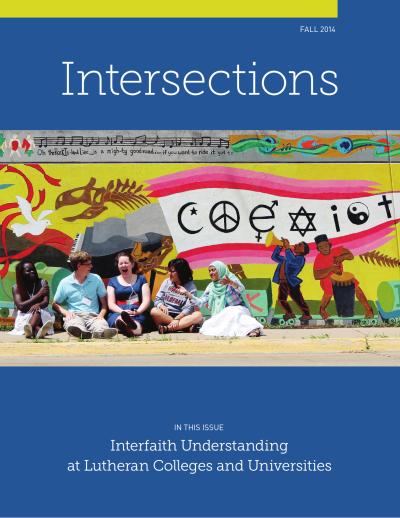 Article
Well, Well…Plumbing Our Depths, Telling Our Stories
Ann Boaden
No. 40 · Fall 2014
Beginning with a college visit that turned into a grieving mother’s confidence about her daughter’s last moments, Boaden uses John 4’s well of living water to argue that an interfaith education worthy of the name requires Lutherans to plumb the depths of their own tradition’s wells — with rituals, stories, and seasons intact — before they can see, respectfully, into the wells from which others drink.
-
 Reflection
Vocation
Matt Peterson
No. 10 · Fall 2000
In a chapel homily, St. Olaf student Matt Peterson quotes former St. Olaf professor Howard Hong’s 1955 Our Church and the World—“the tragedy is that we seem to have lost the full grasp of the Christian vocation”—to argue that vocation, from the Latin vocare, is centrally a call into daily communion with God and into continually becoming Christian, not the title of a successful career marked by GPA, win-loss records, honorary degrees, or net worth. Drawing on Anthony Bloom on prayer that must be lived, he indicts the dread of Monday, the “come hell or high water” demand for production, and the “faith community” that we take on faith.
-
 Editorial
From the Editor
Tom Christenson
No. 16 · Winter 2003
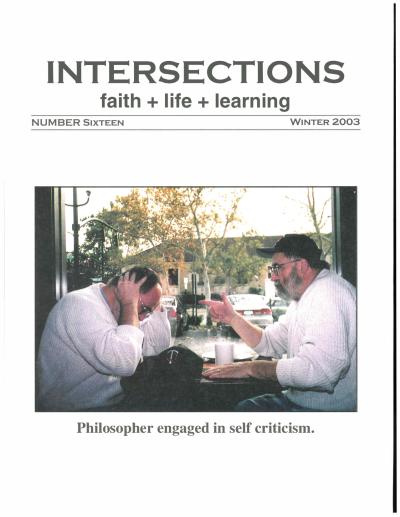
Christenson previews this issue’s papers from the Vocation of a Lutheran College Conference—Curt Thompson on “the Lutheran knot,” Carol Gilbertson on the creative dimensions of language, Bruce Heggen on theological vocabulary in the state university, Susan Poppe on the boundaries of campus freedom, and Sig Royspern’s oracular gems—welcomes Robert Benne’s response to the previous issue as a sign that Intersections is becoming a locus of continuing conversation, and confesses his reluctant consent to appear on the cover.
-
 Article
The Breadth and the Depth: Dimensions of Christian-Muslim Relations at Educational Institutions of the ELCA
Mark N. Swanson
No. 33 · Spring 2011
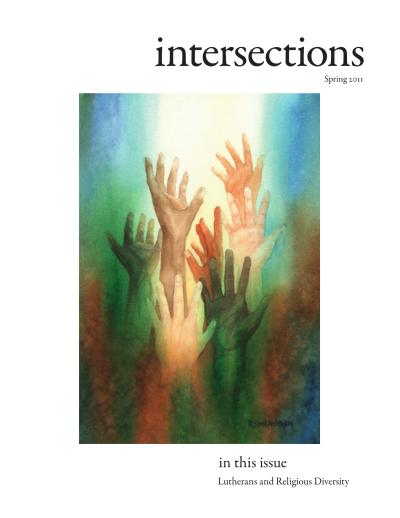
Swanson reflects on the spatial metaphors of depth and breadth that shape Lutheran higher education and argues that the study of Islam and real conversation between Christians and Muslims can contribute to both the broadening of horizons and the deepening of faith, drawing on his experience at the Lutheran School of Theology at Chicago and pointing to hospitality as a Christian practice in which depth and breadth come together.
-
 Editorial
The Vocation of a Lutheran College: Some Transitional Thoughts
James M. Unglaube
No. 4 · Winter 1998
Unglaube offers final reflections on thirty years in Lutheran higher education as he leaves the ELCA Division for Higher Education and Schools to join Carthage College, his alma mater. He recalls colleague Richard Solberg’s influence, the closing of Upsala College in 1995, the Higher Education and Namibia program shared with Naomi Linnell, the growth of endowments from $70 million to $1 billion in 25 years, and the Vocation of a Lutheran College project he credits Paul Dovre with inspiring. He likens the twenty-eight ELCA colleges to flowers on a rose bush—same Lutheran tradition, each blossom different—requiring constant nurture if the partnership between church and college is to thrive.