After Months of Clouds, the Sun
Dry leaf breezes more wish than
shhh. Sun shines somehow. You can
walk into a space of wishing. Not
sit at your desk head and despair.
Not screen your eyes to blur.
Get up. Walk into breeze and light.
The few stiff rags still hanging on
branches all say locked too long
inside rooms with and without
a window but always the screen.
The kind of looking out you were
doing there was not looking
but addiction to latest explosion
and aftermath. See how the world
holds together—trunks stay rooted,
branches still etch a delicate corner
of sky. The combined shadows of
stop and street signs suggest
weathervane. How to spin
on weather’s hinge
into joy.
First Bird
I thought if I could only live
Till that first shout go by—
Not all Pianos in the Woods
Had power to mangle me—
—Emily Dickinson (348)
Mid-January in the Midwest. Worms twist
in workable loam. Cooled-ash feathers skip
a glowing coal from redbud branch. Its alien
eye gleams, flits, sends spring wheeling.
First bird luck plucked from the bloody crown
of Christ, fire created or stolen. Phenology,
a fairy tale that lures robin from shadows
to glyphs of grass and buds over lawn.
The trouble is when, is should. Remind me
how it happens, the sudden violence that
gets a person feathers. Do the words of forest
music simply frighten or do they mangle?
Give me this season of dread and urge to live in it.
-
 Editorial
From the Publisher
Mark Wilhelm
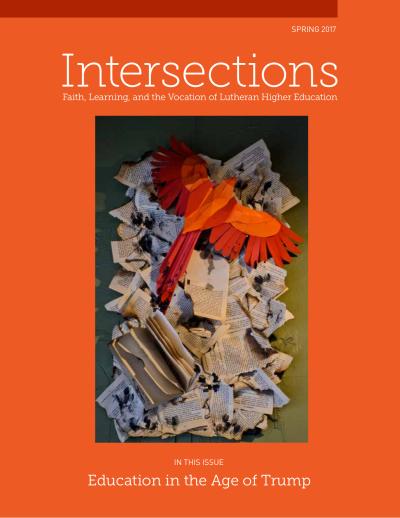
Wilhelm describes how ELCA colleges and universities have shifted the definition of Lutheran higher education away from institutional markers toward alignment with educational values drawn from the Lutheran intellectual tradition — and previews a NECU-convened faculty working group whose recommendations will go to the ELCA college presidents at their June 2017 conference on Lutheran identity.
-
Editorial
From the Editor
Jason A. Mahn
Mahn introduces “Education in the Age of Trump” by recounting a difficult academic year on his own campus — the Augustana “chalking” incident, a Latinx Unidos rally, and post-election conversations with marginalized students and quietly conservative Trump supporters alike — and frames the issue’s essays as careful (re)imaginings of the vocation of Lutheran higher education in an anxious political climate.
-
Article
Higher Education in the Age of Trump
Daniel B. Braaten
Braaten surveys what the Trump administration has and has not done on higher education — from the selection of Betsy DeVos and a rumored Falwell-led task force to the travel ban and expanded deportation priorities — and argues that Lutheran colleges, guided by the ELCA’s social message on immigration, have a special obligation to consider what they will do to protect their most vulnerable students.
-
Article
Resistance in the Age of Trump: An Interview with Ivonne Wallace Fuentes
Jason A. Mahn, M. Ivonne Wallace Fuentes
In conversation with Jason Mahn, Roanoke College historian Ivonne Wallace Fuentes describes how she launched a local chapter of Indivisible after the 2016 election, how the skills of teaching and historical research carry over into grassroots advocacy, and how her sense of vocation (vocare) has become intertwined with the work of advocacy (advocare).
-
Article
Religion in the Age of Trump
Daniel A. Morris
Morris reads the 81% evangelical vote for Donald Trump through two historical theses: that evangelicals’ once-coherent story about Godly participation in political life has fallen apart, and that their long-running tendency to exclude others — once aimed at Black Americans and Catholics — has now turned decisively against Muslims. He argues that scholars of religion and politics have a responsibility to tell these stories well, and that appeals to classroom objectivity can no longer be a luxury.
-
Article
Room at the Table: Reflections on Identity and Inclusion from a Lutheran-Friendly Muslim
Rose Aslan
Aslan reflects on her experience as a Muslim professor of Islamic studies at California Lutheran University — teaching “Introduction to Christianity” from her strengths in the Abrahamic religions, preaching an Eid khutba in a Lutheran chapel, and conversing with the university’s convocators — and proposes “Lutheran-friendly Muslim” as a way of being host and guest at once in a pluralistic Lutheran institution.
-
Article
Jonah: The Anti-Hero of Vocation
Martha E. Stortz
In a chapel talk first given at Augsburg College’s Vocation 2.0 series in September 2016, Stortz reads the prophet Jonah as the great anti-hero of vocation — one who tries to outrun God’s call to the great city of Nineveh — and argues that, in a season of urban violence and divisive election-year rhetoric, the story is less about public calling than about being called by the publics in our midst.
-
Article
Why Did the Chicken Cross the Road? A Homily on Liminality and Vocation
Lori Brandt Hale
Drawing on Wes Moore’s The Other Wes Moore, Warren St. John’s Outcasts United, Victor Turner’s anthropology of liminality, and Dietrich Bonhoeffer’s poem “Who Am I?”, Hale considers how Hmong, Muslim, Latinx, LGBTQ+, non-traditional, and other students live in “double liminal” spaces — and asks whether liminality might itself be a place of transformation in conversations about vocation.
-
 Poem
Poem
Original Song Lyrics: "Just a Little"
Mike Blair
No. 48 · Fall 2018
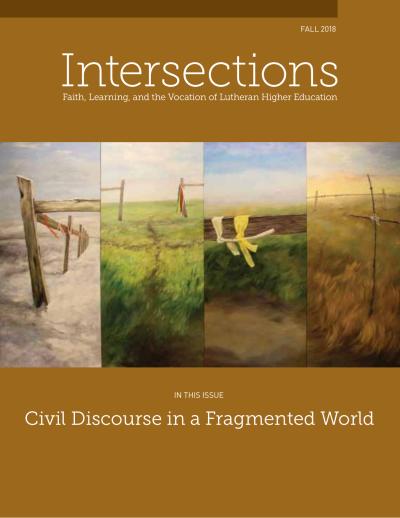
Lyrics for an original song inspired by biblical images and stories, by Emma Lazarus’ “The New Colossus,” and by the faith, hope, love, and courage of immigrant friends and neighbors — led as a devotion during the 2018 Vocation of a Lutheran College conference.
-
 Article
Holy Odors
John P. Trump
No. 14 · Summer 2002
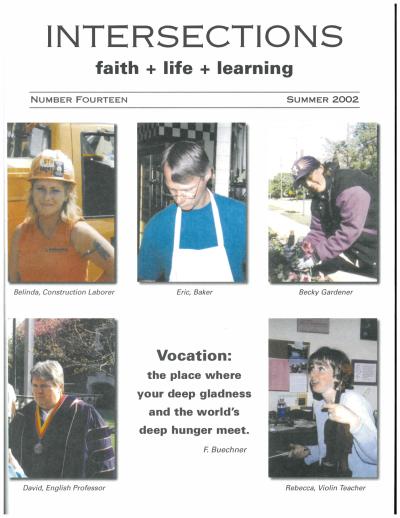
A one-act play by John P. Trump, premiered at Pacific Lutheran University, in which Maggie, a senior studying Reformation history in the library stacks, falls asleep over the Apology of Augsburg and dreams a 16th-century pickled-herring merchant—Herr Leonard Kopp, the man who smuggled Katie von Bora and eight other nuns out of the convent—into existence to argue that her call to archaeology (“digging up old bones”) is as holy as ordained ministry, with Luther’s joke that the church burns incense to insulate priests from the “holy odors” (not holy orders) of everyday life.
-
 Poem
Poem
A Rainfall of Questions Collected in the Form of a Poem
Sig Royspern
No. 16 · Winter 2003
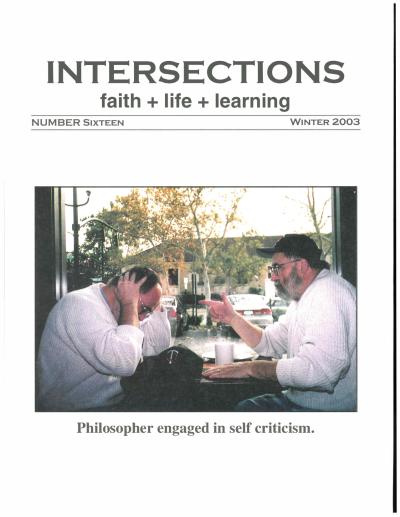
Royspern offers fourteen oracular questions on aging, addiction to possessions, water striders, magnolias, slippery fish, moths and the moon, priests and leaf-rakers, weeds and flowers, the price of education, abandoned groceries, spiritual pilgrimage, melons and oats, similes, and the impossibility of finding a store that sells a spring wind.
-
 Poem
Poem
The Etiology of Eschatology
Kevin Griffith
No. 15 · Winter 2002
A wry meditation on end-times and beginnings in which the last trumpet is only a prelude to the longest dawn, newly handmade animals grow fat waiting for caretakers to name them, dark-robed cryptologists fret over the end of everything, and once everyone has solved the great conundrum the big man simply hits rewind.
-
Poem
Drunks in a Midnight Choir
Kevin Griffith
No. 15 · Winter 2002
A pantoum-like Christmas-season poem in which red-robed choristers, flasks clinking and hands trembling, mangle the words of carols beneath “the midnight sky, your endless dark coat,” trusting that “it’s the season to forgive what’s vile” and that even wise men praise the humble and make glad.
-
 Poem
Poem
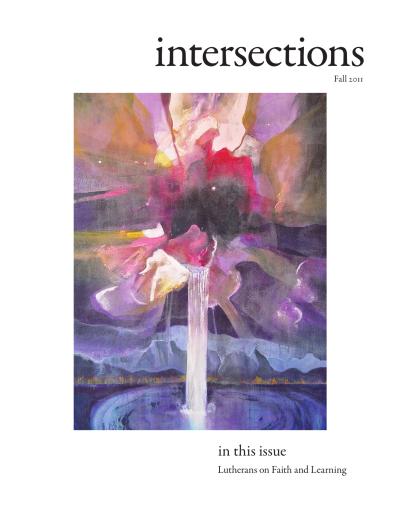
Endtimes
Dave Hill
No. 34 · Fall 2011
A four-stanza meditation on the “last perfect day” when an unblemished Sun makes the cool Ocean roll—and on the relation of each questing mind to the Deep, of each frail mortal to the pulse of the Sea at the edge of the grave. “Let it die full of Life! Let its murmurs and sighs / Give the drama a meaning. Let it not, Lord, die dead.”