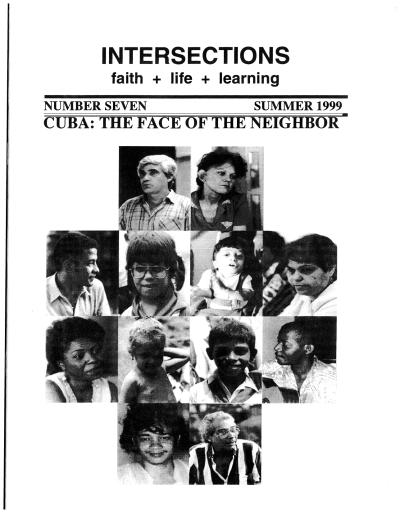
The Face of the Neighbor: An Interview with Four Capital University Faculty About Their Recent Visit to Cuba
Brian Forry Wallace
Capital University
Michael Yosha
Capital University
Reg Dyck
Capital University
Susan Narita
Capital University
Intersections No. 7 · Summer 1999
INTERSECTIONS: What was it that made each of you want to make a trip to Cuba?
Brian Wallace: I had been there twice before. The first two times I’d gone, I felt the need to go back, and I thought it was important to try to take some colleagues with me.
IS: You said you had the need to go back. What was this need?
BW: The first time I went, all I knew was that I needed to go back. It was during the time of the boat lift during August of 1994. It was really devastating. It was dismally hot. People were skinny. Ribs were sticking out of people. Kids were roaming the streets. It was hard to find food. There were long lines to buy nothing. Yet people seemed to have something there that we don’t seem to have in our society. I couldn’t figure out exactly what that was. That’s why I knew I had to go back.
IS: You also said that you wanted to bring some colleagues with you?
BW: Yes, I wanted someone to share it with. It’s very isolating and alienating to experience a transforming event, as travel often is, and then have people at your college look at you as if you have horns coming out of your head. And then after about three weeks you quit talking about it, because you are tired of funny looks. Cuba has become a part of my life, and now it is nice to have a group of people who understand what this is all about.
IS: Besides Brian, had any of you been to Cuba before?
Reg Dyck: No. It was a new experience for all of us.
IS: So what were your motivations for going? Did Brian have to twist your arm?
RD: It didn’t take a lot of twisting, I must say. I was taken by surprise when he asked me if I was interested. I didn’t know it was an option. I had heard about Pastors for Peace here locally, but I didn’t know that much about it. I had been to Guatemala and El Salvador about a year and a half earlier, and I was interested in making comparisons. I was also interested in seeing what an alternative political system would look like, particularly a system that seemed to be run on different values. I was interested in making comparisons with the other Latin American countries I’d visited in terms of the nature of poverty, the nature of work, wealth, the range of freedom, those kinds of things.
IS: Michael, what about you?
Michael Yosha: Well, I was delighted to be asked. I had studied in Japan and in China, and I’d traveled there several times in the past two years. This was a unique opportunity for me to go to another culture. Cuba has a very different kind of political system. I wanted to experience the contrast and bring that back to my classroom here. And also, our neighbors, yet they are quite unknown to most of us. Here’s a country about which we have a lot of stereotypes. I was really interested to see first hand the Cuban people, their organizations and systems, policy deliveries and so on. And also it was such a unique moment in history. With all of the excitement in politics, I think that the experience was worth it. And it was a chance to connect with fellow faculty on different terms. I see Brian five times a week, but we never really get to know each other well until we’re out of the country. And I just thought it was a fun time. Everybody there seems to be on a different channel, and I just thought it was a good way to get to know these people who are our neighbors. Now they have faces.
IS: What about you, Susan?
Susan Narita: I have been interested in Latin America since my days in high school and college when I studied Spanish. I was particularly interested in visiting Cuba because it’s so cut off from the U.S. and we have so little information about it though we have preconceptions. It was exciting.
IS: You talked about our preconceptions. What sort of image did you or do people in general have of Cuba?
SN: My family was apprehensive about my going, partly due to the negative stereotype we have that Cuba is a Communist police state. Americans tend to think that Castro is this horrible dictator, but he really isn’t. Many of my acquaintances assumed that we’d not be safe there, but actually, I felt safer on the streets of Havana after dark than I do in Columbus. My biggest concerns were about the trouble we might have with U.S. authorities on our return because of U.S. restrictions on trade and travel under the Trading with the Enemy Act.
MY: I felt safe there except for the potholes.
SN: He’s teasing, but I was sure I was going to fall into one of those potholes, and that would be the end of me. I mean this isn’t cracked sidewalk. You could really get lost.
IS: Returning to the question about preconceptions. Did you have a certain image in your mind about what it was going to be like, or what people had led you to expect?
RD: It’s sort of hard to remember now what I was thinking before I went. I think I went there quite predisposed to see it positively. I was very interested in Cuba as a political experiment. It’s not a utopia by any means, but I think they have quite a few very impressive values that form their society in a lot of ways that are good.
IS: Tell us more about that.
RD: For example, the way their economy works. The first priority in their national budget is education. The second is health care, and the third is the military. Now try that in the United States! In Cuba there isn’t very much money to go around. It definitely is a poor place, but it is different than poverty in El Salvador or Guatemala. You don’t have the extremes of wealth you see in those other countries. In Havana, there isn’t the wealth you would see in Guatemala, but the poor didn’t look as hopelessly destitute as they do in some of the worst parts of Guatemala.
SN: Cubans frequently talk about how there used to be so much illiteracy. But now everybody goes to school. It’s been a miraculous change. It seems to me that those who stayed behind and didn’t exit to Miami were the workers who really benefitted. It was a great mass of the population. They are now quite well educated. I didn’t see any homeless people either. Of course we were only there for ten days. Did any of you see any homeless?
RD: No, but I heard about it. I stayed on for an extra four weeks, and I heard people talking about that. The housing shortage is a problem. Apartments are overcrowded. But they now have a program where people help to build their own homes. After so many years of labor equity, you earn a flat for your family.
BW: In Cuba there is barely a difference between the wealthy and the poor, like there is in the rest of Latin America. Although, I think that the difference between rich and poor is now growing in Cuba as well. Because of some recent so-called reforms, cab drivers, prostitutes, and others like that now make the most money, more than doctors, teachers, and even engineers.
IS: So, people do well who have the most contact with the tourists?
BW: Yes.
RD: I was just going to say that those who get involved in the market economy are creating the split between the rich and the poor. Of course many don’t see anything wrong with it. We met with the acting head of the North American Division of the Cuban Foreign Service. When we raised questions about these market changes taking place, he said that the changes were difficult, but that certain basic principles would remain the same. But when he listed those principles, they sounded like democratic socialism rather than the hard core socialism we usually associate with Cuba. It seemed that younger leaders want to turn Cuba into a place like Germany or Scandinavia. They want to have health care for everyone, a good social network, and no extreme differentiation between rich and poor.
MY: Yet many people there realize that Cuba has a kind of identity in history, standing for a particular set of values. There are lots of people in Cuba who are committed to those values. They are very much concerned with retaining what they have accomplished such as the advancement in communications, the availability of health care and education for all. They realize things will change, and that there will be changes in market mechanisms. But they’ve also learned to hold on to things they value. Cubans are very nationalistic. They’re proud of themselves as a people, they have a definite sense of character, and a strong sense of history.
BW: If you bring up something like the Spanish American War that happened in 1903, they still get upset about it. We think it’s ancient history.
IS: You talked about education. Did you get a chance to visit schools, or talk to students or teachers?
SN: Yes, we did visit schools. We talked to the director and principal of one school, and were invited to talk to classes. We talked to the students about Cuba, but not a single student asked a question about the United States, which I found to be peculiar.
IS: What do you think accounted for that lack of exchange?
SN: I began to wonder if there was something wrong with us!
RD: I think that they live in a country that is so small, with a huge, dominating country to the north. Their goal is to resist us, and that is going to shape all of their thinking. A lot of people seem to have confidence that they know all they need to know about the U.S. In the same way, many in the U.S. have felt they knew enough about the Soviet Union. Remember when we thought it was the evil empire. That same reductionist attitude towards one’s enemy happens in Cuba. That may have explained some of their wariness of us as Americans.
BW: When I was there in 1994, I was talking with three adolescent boys, and they were asking me about the strike. “What about the strike? What about the strike?” they kept saying. I thought they were talking about some meat packers’ strike in Minnesota or someplace that Cuban television was covering, but they were really talking about baseball. They wanted to know about the baseball strike. There’s an area where Americans and the Cubans have so much in common culturally.
IS: I assume you made contact with university people when you were there.
RD: Yes I did, because I was studying Spanish at the University of Havana. We had classes in the morning, and I met with university students as tutors in the afternoon. They were not a cross section, probably. They were chosen because they were progressive students. They were obviously well educated, so that puts them in a specific category.
IS: What is their view of their future? Did you pick up a sense of where they think Cuba is going?
RD: There is a sense of optimism. They realize that things have to change, that they need to change. There are frustrations about the restrictions of the press. Some would like freedom to travel as well. One woman, a literature major, was frustrated she could not get a visa for her trip to Mexico, but on the other hand, she was passionately dedicated to Cuba and the revolution on the home front. Nobody I talked with wanted to give Cuba over to the Cuban Americans of Miami. No one wanted to join up with market capitalism lock, stock, and barrel.
IS: Who were the Cubans who left and came to Miami?
BW: You can pretty much guess who they were by when they left Cuba. If they left in the fifties up to the sixties, they were general supporters of Batista, and those who left later in the sixties were often quite prosperous professionals who were going out for economic reasons. Later there gets to be more diversity in those leaving.
MY: Returning to your question about preconceptions, most of my surprises were visual. Because of the coverage of the Pope’s visit I had a picture of what Havana was like. Being there it was kind of difficult to get used to. I was startled at how many buildings there were and the quality of architecture. Most of the buildings are now in disrepair, and we walked around in the rubble, but I started not paying any attention to it. I was beginning to think that’s how people adjust. It was a part of daily life.
BW: The Cuban people continue to impress me. People take time to stop in the streets and embrace and talk to one another and meet in their community and in religious services; there was a real spirit of community. It wasn’t just going through the motions. At one point I was in a Methodist church there, and they were having an intercessory prayer, and they asked anyone who had a prayer to come forward. Two thirds of the congregation got up and walked forward. This was a heart-felt thing. There was no sense of having to go to church, go home, go golfing, grade papers, do this, do that.
IS: At the beginning, you said that one of the things you saw that made you know that you had to go back there was the spirit of the people. Is this an example?
BW: Yes. Maybe it’s just that I’m more in tune to see it in a different culture than I can see it in my own. I can ignore it when I’m walking down the streets in Columbus, but part of it is something that no ideology can erase. Usually when I’m around armed soldiers I feel extremely nervous. In Cuba I saw Cuban soldiers riding their bikes with their guns on their backs. But I wasn’t scared.
RD: You know that’s an interesting thing. I was there for July 26, which is a big festival day, and on the Malecon there were people everywhere, dancing and celebrating. Lots and lots of police were there in their green outfits, and they were young guys. People were chatting and being very friendly with them, and they didn’t seem the least intimidated.
SN: What I have been reading lately is that things have changed since last summer in that regard.
RD: Well, the police have cracked down on prostitution. There have been more arrests.
BW: And they’ve cracked down on political dissonance. They have people in jail for long terms for being guilty of nothing but freedom of speech, which we take for granted in the United States.
SN: It seems like we really went at the ideal time because they were saying that tourists are not allowed in the Malecon now, but when we were there, we just walked around. It was great.
RD: In case you don’t know, the Malecon is a kind of parkway area down by the sea. It was a great place to hang out and smoke a cigar.
BW: Not that we did, of course! But we saw other people who seemed to be enjoying themselves immensely. Germans, French, that sort.
RD: I was surprised by the cultural richness. Having more time there allowed me to walk around the city more, and I saw the art galleries, and the architecture. A lot of it is crumbling, but it is still amazing. At the bay, you have the really old buildings, going back to the 1600s, the cloisters and monasteries. From there you can walk through the city and see history charted in the buildings, from the great old religious ones to civic buildings and mansions of later centuries to the 1920s modern style hotels and apartments to the contemporary architecture of the new, well-to-do suburb of Miramar. We went to the ballet and to various concerts and performances. There is a lot of diversity within Cuban culture. We went to a community center where they were having an Afro-Cuban dance, and it was exciting and alive. That’s also true in terms of the jazz scene. I went there thinking mainly of politics, but the country is not all about politics. There’s so much more.
BW: There is a cultural mix that you don’t see until you get down to the bottom.
RD: Yes, exactly.
BW: It’s just like brewing beer. It’s in the mix that the thing happens. The culture bubbles up from the bottom. You could take one of the old international communist meetings during the 60’s when the Cubans were there with the Albanians and the Chinese and the Russians. I think all you needed to do is subliminally play a little salsa music in the background, and in ten seconds you could tell who were the Cubans because everyone else would just be sitting there. Cubans don’t fit into our usual categories. There was this lay leader of the congregation that we were staying with, and she was a member of the communist party but she’s also a noted religious writer, Methodist, I believe.
SN: That really surprised me. Castro didn’t seem opposed to religious organizations like I thought he was going to be.
BW: Not as much as before. Although until ’91, he’d allow anyone to believe in the communist party, and if you did you could become a doctor, a lawyer, or anything that took a university education.
RD: And then, in 1991 Castro had some positive experiences with religious groups, and he admitted that he was wrong, the church could be a very positive force in Cuba. Now, there are even pastors who serve in the Parliament.
IS: Are there international churches that have sent aid to Cuba?
MY: Actually it’s often been the other way around. Cubans have been the ones who have sent aid.
SN: Yes, I know they have sent aid groups to El Salvador and Honduras after the hurricane.
RD: I know a student at Capital Law School who is from Uganda, and he has great respect for the Cuban doctors and other professionals who came to his country to help. As a matter of fact, he said that when he was a little boy, Fidel was his hero. His feelings have changed somewhat since then, but the Cubans had a very positive effect on them.
IS: Well, a few times you have talked about social dissonance and freedom of speech. What is your perception of this? Is this a problem in Cuba? Would the government be in danger if there was freedom of speech?
RD: Well, the coordinator of my language program was a communist party member and advisor to the Young Communist League at the University of Havana. He had committed his life to communism in Cuba. But he said that many things have to change, that they needed to have broader media coverage and more freedom of the press. I asked him about having a multi-party system, but he said that what would happen is that the second party would be Miami. The danger of opening up is not so much of what is on the inside, but what is on the outside. Millions of political dollars would come to support the corporatization of Cuba; I think that’s a very legitimate fear. But in some ways I also think their fear and repression could be working against them.
MY: I was just thinking of this question in terms of China’s attempt to economically open up, but still stay culturally closed. There haven’t really been any success stories that I know of. I think the Cubans are very aware of it. They are walking a very fine line. How does one motivate people to go to school, to become professionals, if people without education make five, ten, twenty times as much? I think they have reasons to be concerned. I think they see what will happen if U.S. money comes pouring into their country.
BW: Of course the fear of outside agents can be a kind of excuse too. Lots of people have been imprisoned for being critical of the regime or for proposing democratic reforms. When people hear criticism they often hear it as sedition. When I was growing up in the South in the ’50s and ’60s during the Vietnam War, some people thought we should get out of the war. We all assumed such people were traitors and a communist sympathizers. Who else would say disloyal things?
SN: We haven’t talked about the embargo. It has done nothing positive in terms of our goals in changing the government in Cuba, but it has certainly hurt the Cubans as a whole.
RD: And it has been so counter-productive to what our government’s overt intentions are.
SN: I don’t understand why it is continued. I don’t understand what kind of strangle hold this embargo idea has on us. Is it an idea pushed on us by Cubans in Miami?
BW: No, I don’t think so. I think it’s just confused thinking.
BW: When I first went to Cuba, I was a bit of an agnostic about the embargo. I thought maybe now that the Soviet Union has collapsed the embargo would press Cuba to change a little. But it is clear that this is not happening.
MY: I really don’t agree with it either. We are not getting what we want out of it, and it reinforces the image of the US as a bully over other countries, and in the long run, it is one of the worst policies we could have as far as our corporate interests. They must think we are crazy. The Germans or somebody are going to beat us to the punch, and in fifteen years from now, we are going to be reading about how this stupid policy made us miss a golden opportunity. Of course that doesn’t give us the right to run down there and exploit them, but, as is so often said, if we don’t, somebody else will.
RD: The Cubans are trying to be careful, though, so as not to be exploited. They’re trying to be careful about what businesses are allowed in the country. In the past, joint ventures meant that the company had to be at least 51% controlled by the Cuban government although now it is becoming more open and flexible.
BW: One thing to remember is that it is more of an embargo on the US because it hasn’t really isolated Cuba.
RD: One of the main effects of the embargo is on Cuban health care. It’s not just that American medicine and medical supplies are banned. Here’s an example. Cuban hospitals bought kidney machines from Europe, but an American corporation bought the European manufacturer. So now the Cuban hospitals have the kidney machines but can’t keep them running because they can no longer bring European technicians to service them. As employees of American corporations, they are now covered by the embargo. Pharmaceuticals are a real problem; there are serious shortages. In a small way, this has become a blessing because the Cubans have developed traditional green medicines they can grow there. Still, they need other medicines. An embargo on such things seems very inhumane.
IS: Michael, I think it was you who said that you were interested in Cuba because they are our neighbors. What do you think it takes to be a good neighbor in such a case?
MY: Part of it is just talking to each other. We could promote sister cities. The whole theory behind that is to break down these barriers and to get to know one another. Our policy has been more checkbook and military, and theirs is more about people. We fondly think of the Peace Corps as being this great success story, and it probably was, but it’s because people respect people being involved. I would like to see more of that.
IS: How could we encourage that at a place like Capital University?
RD: I think we could get more involved with a group like Pastors for Peace. As a matter of fact, I just heard that Professor Hershberger is driving a bookmobile as part of a Pastors for Peace caravan. They will drive to Mexico and then have everything shipped to Cuba. It’s great that someone else from Capital is going down there. I know that Trinity Seminary is also involved.
IS: What difference has this trip made to your life as a scholar and as a teacher?
BW: I’m doing a research project now, using my travels as a resource. I’d like to teach some foreign policy and use Cuba as a case study.
RD: I have developed a course in Latin American literature, and I will definitely use some Cuban literature. It was good to talk to the people about who they thought were important authors. We had a really fine translator who taught me a good deal about Cuban literature.
SN: This experience has had a profound impact on my understanding of U.S. relations with Latin America. I now realize that the image of Cuba in the American media is grossly distorted. My conversations with Cubans exploded the stereotypes I had of the island, its people and its leader. I think I’ve developed a more critical view of the news media in general. I teach ESL. The trip made me more empathetic to my students who experience culture shock. We are enrolling more students from Latin America and it’s important to be aware of the current issues that shape their thinking. After I returned from Cuba it was fun to talk to a class of Columbian students and hear their perspectives on Cuba and on some of the issues we’ve raised here.
IS: What would you like to see from Cuban culture in America?
BW: The way people are valued for who they are, not for what they have, doing things on emotion, being more spontaneous. I have been trying to slow myself down, with some success. I would rather not run across campus so I’m sometimes late. No one cares. I have enjoyed that. I need to take time to talk to those people whom I love.
MY: People who come to the states always say how busy we are. You talk about energy level. I think our energy level is high as well, but maybe it does not enhance our lives.
BW: Energy is not dashing here and there. It’s taking the time to value what is right in front of us. We have to be more understanding.
IS: Often when I have traveled somewhere, after a few months have passed, I find I have images that return to me when I think about the trip. Do you each have a sort of recurrent image whenever you remember your experience in Cuba?
BW: I think that mine would be one of the last days we were all there, when we visited the special needs school. It was for children who were amputees, who were terminal patients, and there was a little girl, Marguerite, who was singing for us. In all of the hospitals, and in all of the schools, and all of the day care centers that I have gone to, they should have been very depressing places. But I was not depressed. I felt like there was so much life there. When the principal of the school was taking us around, she was introducing us to various people, but she stopped to play catch with a little boy for about fifteen minutes. She just totally dropped us, and I said to myself that this is how it should be.
SN: It’s interesting that you say that because I remember now just exactly what you were feeling, and it should have been sad, but it was a very light place. As a matter of fact, I have a tape of that girl singing, and I play it from time to time, and it makes me smile.
BW: I have a lot of pictures from that school, and you can see these kid’s smiles and say just how great they are and how alive and how they didn’t feel somehow abnormal or alone. They were accepted for who they were, and at the same time the teachers wouldn’t take any crap from them. They are treated like whole, responsible people.
MY: Remembering that place makes me see how much can be accomplished when you get your values straight and through commitment, because those kids who are dying are doing quite well in school, and they have accomplished so much without a lot of resources. That’s the image that sticks with me about Cuba.
Brian Wallace and Michael Yosha both teach Political Science. Susan Narita teaches in the ESL program. Reg Dyck teaches English. Their travel to Cuba was supported by a Cultural Studies Grant from Capital University. The interview was conducted by Jessica Brown, a Capital Senior, and Tom Christenson.
-
 Editorial
From the Publisher
Arne Selbyg
Selbyg celebrates the popularity of the previous issue—the first to draw on papers from the annual “Vocation of a Lutheran College” conference—and announces a new Lutheran Brotherhood Foundation grant that will fund the inaugural Lutheran Academy of Scholars in Higher Education, a two-week seminar at Harvard led by Ronald Thiemann on “Finding Our Voice: Christian Faith and Critical Vision.”
-
Editorial
From the Editor
Tom Christenson
Christenson introduces the issue’s contents—papers from the 1998 Vocation conference by Cheryl Ney and Robert Scholz, a response by Jennifer Sacher Wiley, an interview with four Capital University faculty about Cuba, a meditation by St. Olaf senior Erik Haaland, and the journal’s first letter to the editor—and commends the Mount Mary College volume Wagering on Transcendence as a model of a faculty community sustained by Friday-afternoon conversation over a glass of wine.
-
Article
Rooting Science in Empathy: Growing Towards a Sustainable Science Practice for the 21st Century
Cheryl L. Ney
Ney, a DNA biochemist turned feminist science educator at Capital University, traces her own search for the “grounding” of teaching from Ernest Boyer’s scholarship of teaching through Cathleen Loving’s Scientific Theory Profile, Evelyn Fox-Keller’s critiques of science as “truly masculine philosophy” and her biography of Barbara McClintock (“A Feeling for the Organism”), and Arnold Pacey’s definition of science as a web of technical, organizational, and cultural practice. Drawing on the Dutch Science Shops, the Loka Institute’s community-based research, and academic service learning, she calls for “sustainable science practice” rooted in empathy and asks whether Lutheran institutions have the courage to claim an institutional freedom of vision rather than reduce themselves to preparation for the job market.
-
Article
How Can We Keep From Singing?
Robert Scholz
Scholz, professor of music at St. Olaf, responds to Tom Christenson’s “Freedom of a Christian” by walking through his own Nunc dimittis for the St. Olaf Christmas Festival, an Elderhostel choir of singers aged 60 to 95, and the four liberating arts (enablement and change, melioristic, embodying, and critical) as they shape conducting, composition, and music education. He defends the fine arts and folk traditions over “contemporary Christian” soft pop-rock and taped accompaniments, citing Luther’s preface to Georg Rhau’s Symphoniae iucundae and the family of God’s need to interact in song against the virtual community of TV evangelism and the Crystal Cathedrals of the air.
-
Reflection
Some Personal Reflections on the ELCA Vocation of a Lutheran College Conference, 1998
Jennifer Sacher Wiley
Sacher Wiley, a Unitarian Universalist with one Jewish parent and a first-year music faculty member at Susquehanna, reflects on common-ness and other-ness at the 1998 conference—Tom Christenson’s weaver’s warp and Charles Ives’s essay on American music—and proposes four markers of group identity. Against the fear of secularization expressed by some attendees, she suggests that “Christian” might be defined less by belief in Christ as Savior than by living a vocation as Jesus lived, with Cheryl Ney offered as an example of a “working prophet,” or “little Christ,” regardless of specific belief in the Trinity.
-
Reflection
Meditation—Band Chapel Service, St. Olaf College
Erik Haaland
Haaland, a St. Olaf senior, offers a brief Band Chapel meditation that defines art as “the expression of what is deeply human through the manipulation of the physical world” and defends worship—architecture, stained glass, music, eloquence—as an art form requiring our best and most sincere efforts. When the God we worship and the salvation we proclaim do not seem near, artful worship offers not propositions but something real and tangible to hold on to.
-
Institutional Focus
Letters to the Editor
The journal’s first letter to the editor: Pastor John L. Vaswig of Spokane, a Pacific Lutheran University alumnus and member of the PLU Board of Regents, writes after reading James Tunstead Burtchaell’s The Dying Light: The Disengagement of Colleges and Universities from Their Christian Churches to ask whether church-related institutions, in their effort to be open and tolerant, have abandoned a compelling word of hope and forgiveness in Jesus Christ.
-
 Reflection
Truth, Reconciliation, and Redemption in South Africa
Brian Forry Wallace
No. 13 · Winter 2002
Wallace, a 24-year veteran political science professor at Capital University, recounts five weeks of post-apartheid peace-building travel-study with students living south of Cape Town—visiting townships, schools, day-care centers, a children’s AIDS hospital, Robben Island, and Nelson Mandela’s cell—and offers vivid sketches of his student companions Amy, Brian, Meghan, Karrie, Patrick, Meredith, Cheryl, Corin, Debbie, April, and Audra. He concludes that these students—atheists and agnostics and Buddhists and Methodists and Baptists, headed for social work, nursing, teaching, ministry, and parenthood—embody vocation by responding to a voice that calls them out of themselves to be present and to heal in this world, and that they are his link to the redemption of a lost and broken soul.
-
 Poem
Poem
Two Poems: The Advent Carol / The Madonna of Dohany Street
Brian Forry Wallace
No. 2 · Winter 1997
Two poems by Brian Forry Wallace of Capital University: “The Advent Carol,” a litany of the babies who were not adored—the Jewish baby shot with a Luger, the Black child hanged from a tree, the female messiah tossed into a river, the Tutsi infant cut by machetes, the Japanese newborn incinerated by atom bombs, the Chinese baby crushed by Japanese bombs, the aborted Mary’s child—ending with the baby “whom we do not understand, cannot feed, whom we kill”; and “The Madonna of Dohany Street,” on a Holocaust photograph in a Budapest museum of a dead mother and her dead Christ-child daughter in the former ghetto, in which annunciation, nativity, adoration, and crucifixion are seen together in a single instant.
-
 Editorial
From the Publisher
Arne Selbyg
No. 23 · Summer 2006
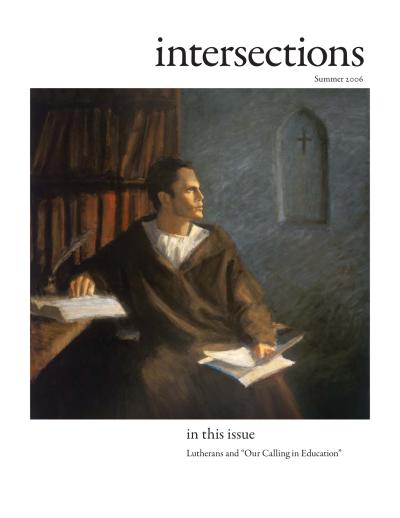
Selbyg features articles based on presentations at the 2005 Vocation of a Lutheran College conference focused on the upcoming ELCA Social Statement on Education, and urges members of the ELCA higher-education community to download the first draft (“Our Calling in Education”) from the ELCA website and submit feedback to the Task Force on Education before the October 15 deadline. He worries that the sexuality social statement on a 2009 timeline will draw more attention than the education statement, but reminds readers that, for Martin Luther and for those who work in Lutheran higher education, education is as important as sex.
-
 Response
"Whose Future?" or "Social Justice and the Lutheran Academy?"
Marsha Heck
No. 1 · Summer 1996
Heck argues that the future of Lutheran higher education lies less in defining Lutheran distinctiveness than in moral action grounded in face-to-face relationships with others. Drawing on David Lotz’s two-kingdoms theology of citizenship, Ernest Simmons’s relational reading of Luther, Arthur Preisinger’s indictment of the German Lutheran misreading of two kingdoms during the Third Reich, Starla Stensaas of Dana College, and Paulo Freire’s dialectic of empowerment, she calls Lutheran colleges to integrate moral reflection with moral action—to move students’ muscles against what is not true as well as to feel truths in their bones.
-
 Editorial
From the Editor
Jason A. Mahn
No. 46 · Fall 2017
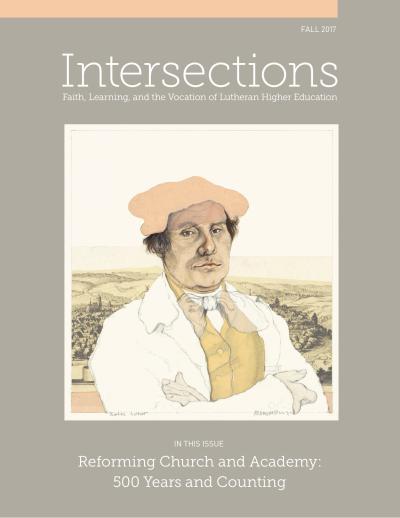
Mahn returns to Luther’s opening thesis on whole-life repentance to argue that the deepest critique of the indulgence economy — and of our own American meritocracy — is the very assumption that grace and human striving can be measured, exchanged, and earned.
-
 Article
The Identity, Mission, Vision, and Goals of a Lutheran College vis a vis Bacon's "Of Studies" and Newman's "The Idea of a University"
Cora Lazor, Mary Theresa Hall
No. 15 · Winter 2002
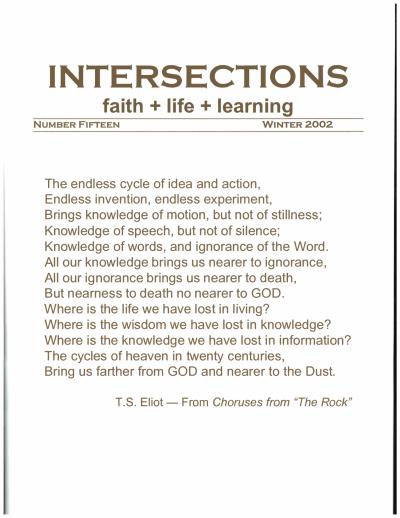
Hall, an Associate Professor of English at Thiel, and Lazor, a Thiel junior and 2002 ELCA Division for Higher Education summer intern, read Thiel College’s Statements of Identity, Mission, Vision, and Goals alongside Sir Francis Bacon’s “Of Studies” (1625) and John Henry Cardinal Newman’s The Idea of a University (engaging Azade Seyhan’s May 2002 PMLA essay along the way). They argue that Bacon’s “Read…to weigh and consider” and Newman’s defense of liberal over technical training underwrite Thiel’s new Writing-Intensive Course requirement, its ten institutional objectives, and its commitment to “service to society” in the Judeo-Christian tradition.
-
 Article
Laboratories for Living in a Diverse World
Elizabeth Eaton
No. 44 · Fall 2016
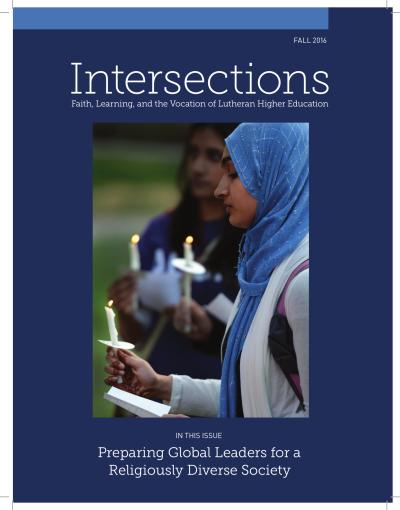
Presiding Bishop Elizabeth Eaton argues that ELCA colleges and universities are called to be laboratories for living in a religiously diverse world. Reflecting on the decline of Christian privilege, the ELCA’s ecumenical and inter-religious work, and her own experience addressing the Islamic Society of North America, she offers three questions about partnerships, formation, and institutions as platforms for new collaborations.
-
 Article
Professing Religion
John D. Barbour
No. 37 · Spring 2013
Barbour reflects on the vocation of a Professor of Religion at St. Olaf College, asking when and how a teacher should disclose personal faith in the classroom. Drawing on his graduate teachers Anthony C. Yu and Langdon Gilkey, and on Augustine’s Confessions, Dorothy Day, Malcolm X, C. S. Lewis, and Kathleen Norris, he argues that teaching autobiography invites teaching autobiographically—and that professing religion is finally a matter of how one believes, not just what.