As you read this issue of Intersections and explore the reviews of influential books about national trends in higher education, I invite you also to consider the implications of the widely used phrase, “the model is broken,” to describe the current reality of higher education. The phrase has its merits and utility. It gets the attention of trustees, administrators, and faculty and causes them to face up to the problems of our enterprise. And the phrase is difficult to ignore when the powerful and influential Association of Governing Boards touts it loudly, but “the model is broken” has its problems.
First, it tends to generate an atmosphere that blames the victim. Hence the rush to blame colleges and universities and their supposedly profligate ways for “breaking” contemporary higher education. Even worse, it generates recommendations for whole-sale change in higher education. ELCA colleges and universities are not infrequently challenged to abandon our long tradition of educating the whole person so that we can shift to the delivery of technical knowledge in preparation for specific jobs. Such a change would mean losing our integrity as we joined with forces that no longer consider higher education a public good but a private benefit and a commodity.
The mantra of “the model is broken” also distracts our attention from the actual difficulties ELCA higher education faces. First, the phrase tends to hide the truth that the gradual decline since the early 1980s in federal and state governmental support for higher education is a significant factor in the financial complications we face. The declining trajectory of public financial support for higher education reflects the growing acceptance of the perspective that higher education is a private benefit, to be purchased by individuals, and not a public good worthy of public investment. Second, “the model is broken” assertion masks that demographic changes are primary drivers of the enrollment, and therefore revenue, challenges troubling our schools. Nothing in our model created these demographic changes or the decline in financial support from government, but the wide use of the phrase implies otherwise.
To say it differently, the constant refrain of “the model is broken” mitigates against the development of wise responses to the challenges facing ELCA higher education. Yes, a wise response will inevitably require changes in what we do. But in the spirit of “there is nothing so practical as a good theory,” ELCA higher education will find its best response to demands for demonstrating the practical relevance of our education by modifying our existing model (our “theory”), not by discarding what we do in favor of an entirely new model.
Our style, form, or model of educating the whole person—body, mind, and spirit—in the liberal arts attuned to pre-professional education has educated leaders for church and society since the cathedral schools of medieval Europe grew into the first iteration of universities in Spain and France a millennium ago. Nothing is broken. To assert otherwise is fear-mongering masquerading as analysis. The “model” has successfully adjusted through the centuries to new situations, and we will do so again in early twenty-first century America.
-
 Editorial
From the Editor
Jason A. Mahn
Mahn reports on the working group “People of Wondrous Ability: Introducing Faculty and Staff to Lutheran Higher Education,” shares creative ways campuses are introducing colleagues to the charisms of the Lutheran tradition, and frames the issue as a set of reflective reviews that move from national trends to homegrown conversations about the state of college.
-
Book Review
The Religious Genealogy of College: Interrogating the Ambivalence of Delbanco's College
George Connell
Connell reads Andrew Delbanco’s College: What It Was, Is, and Should Be alongside Concordia’s Vision Statement for the Humanities and Martha Nussbaum’s Not for Profit, tracing Delbanco’s ambivalent engagement with the religious origins of American college. He asks whether Delbanco’s “college idea” can survive cut off from the religious rootstock that nourished it, and proposes that church-related colleges may serve best not as a “usable past” but as a “usable present.”
-
Book Review
A College Degree or a College Experience? Reflecting on Selingo's College (Un)Bound
Laurie Brill
Brill reads Jeff Selingo’s College (Un)Bound from inside the Lutheran Educational Conference of North America, drawing on LECNA’s alumni research with Hardwick-Day and on Brandon Busteed’s Gallup data to argue that, in an age of competency-based degrees and college-as-commodity, Lutheran colleges must speak more clearly about the transformational, vocational impact of a college experience that develops the whole person.
-
Book Review
Types, Methods, and Sagas in Lutheran Higher Education: Learning from Childers
Lake Lambert
Lambert situates Eric Childers’ College Identity Sagas within the older tradition of the 1977 Association of Lutheran College Faculties volume The Church-Related College in an Age of Pluralism, working through Burton Clark’s “saga” and Robert Benne’s typology of church-related colleges. He commends Childers’ socio-scientific approach while questioning whether a typology can do justice to institutions that resist easy classification.
-
Book Review
Post-Secular Religion on Campus: Conversing with Jacobsen and Jacobsen
L. DeAne Lagerquist
Lagerquist guides readers through Douglas and Rhonda Hustedt Jacobsen’s No Longer Invisible: Religion in University Education and its companion volumes, unpacking the authors’ three-act story of campus religion (Protestant, Privatized, Pluriform), their three-by-two framework of historic/public/personal religion in belief and behavior, and the six questions they pose for campus conversations. She lifts up interfaith etiquette and vocation as especially fruitful zones for Lutheran campuses.
-
Book Review
The Prophetic Vocation and the Nature(s) of College: Reimagining College with Jim Farrell
Peder Jothen
Jothen reads the late Jim Farrell’s The Nature of College as a prophetic critique of the dual nature(s) of college—its socio-cultural “normal” and its ecological habitat—and argues that Farrell’s call to model an “Anthropocene Responsibility” resonates with the prophetic dimension of Lutheran higher education. He proposes a re-imagined “About St. Olaf” that names vocation, ecological dependence, and personal involvement as the operative goods of college.
-
Book Review
The Courage to Change: Creating New Hearts with Palmer and Zajonc
Martha E. Stortz
Stortz reads Parker Palmer and Arthur Zajonc’s The Heart of Higher Education from the landscape of Lent and notes that the book’s strategies all target students, not their professors. Drawing on her own Faculty Formation Group at Pacific Lutheran Theological Seminary and the Ignatian Colleagues Program at Jesuit institutions, she asks what a Lutheran analogue might look like that would form the educators who teach for transformation.
-
Book Review
Learning Across Campus: Hearing Bok's Call to Conversation
David Ratke
Ratke reads Derek Bok’s Our Underachieving Colleges from Lenoir-Rhyne and argues that Bok’s call to think holistically about undergraduate education and to dialogue across disciplinary boundaries names the work already underway at ELCA colleges. He weighs faculty attitudes, the role of skills in the core curriculum and the major, and the importance of the extracurriculum for student formation.
-
Book Review
The Information Deluge: Navigating the Digital Age with Recent Scholars
Virginia Connell
From the reference desk at Concordia’s Carl B. Ylvisaker Library, Connell navigates Ann Blair’s Too Much to Know, Nicholas Carr’s The Shallows, Viktor Mayer-Schönberger’s Delete, and Howard Gardner and Katie Davis’ The App Generation, then describes information-literacy work at Concordia—primary-source assignments, Omeka and TimelineJS exhibits—that helps students move from app-dependent to app-enabled in the Lutheran tradition of reform.
-
 Article
Why All This Talk About Understanding the Mission of NECU Member Institutions as a Vocation?
Mark Wilhelm
No. 56 · Fall 2022
In his valedictory keynote, retiring NECU Executive Director Mark Wilhelm argues that Lutheran higher education is, properly understood, vocation-based education — outlining four core practices recovered over the past fifty years and naming the constructive and corrective work still to be done, including a fuller embrace of DEIJ and of the diverse vocations of NECU’s 27 institutions.
-
 Editorial
From the Publisher
Mark Wilhelm
No. 55 · Spring 2022
Wilhelm announces his planned retirement on January 31, 2023, after serving as the founding executive director of the Network of ELCA Colleges and Universities, and gives thanks for the privilege of helping NECU articulate a shared vision for Lutheran higher education in twenty-first-century North America.
-
 Editorial
From the Publisher
Mark Wilhelm
No. 53 · Spring 2021
Wilhelm reflects on an NPR report of teenagers’ pandemic diaries and the fraught Christian history of struggling to live out Jesus’s ethic of love, framing the issue as a record of NECU institutions working out how to act for the common good through the pandemic of 2020–2021.
-
 Editorial
From the Publisher
Mark Wilhelm
No. 52 · Fall 2020
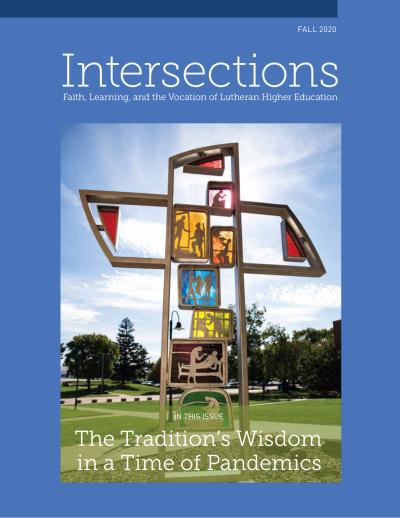
Wilhelm argues that the “hackneyed” expressions of higher education — “you are not just a number,” “the college experience,” “risen to the challenge” — tell the simple truth about NECU institutions even as the Covid-19 pandemic has pushed budgets, employees, and campus life to the breaking point.
-
 Editorial
From the Publisher
Mark Wilhelm
No. 51 · Spring 2020
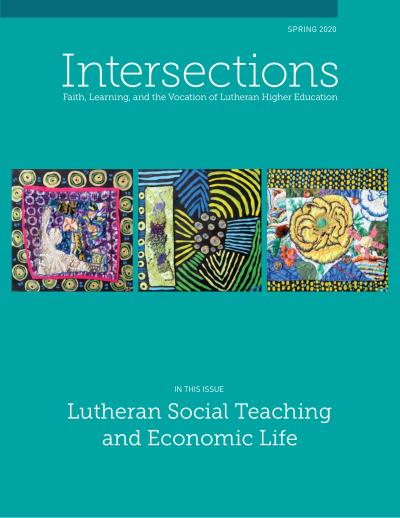
Wilhelm frames the issue by tracing how Lutheran educational ideals — once a primary source of contemporary higher education — were masked in the United States, and introduces a NECU initiative that uses the case of business ethics to explore Lutheran social teaching as an academic resource.
-
 Editorial
From the Publisher
Mark Wilhelm
No. 50 · Fall 2019
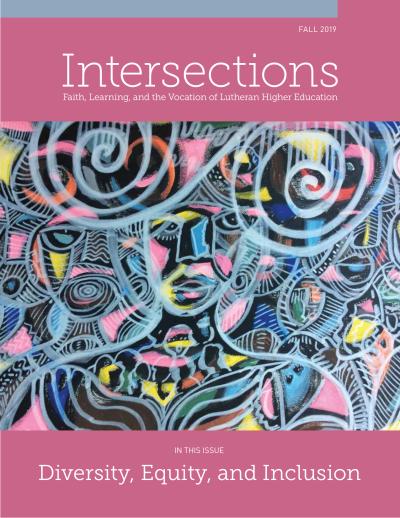
Wilhelm frames the issue by noting that a federal court’s vindication of Harvard’s race-conscious admissions process is a win for higher education’s commitments to diversity, equity, and inclusion — and argues that for Lutheran higher education, the commitment to diversity is an old and foundational claim, rooted in Christianity’s openness to all and reflected in the four diverse gospels of the New Testament.
-
 Article
Creation, Justice, and Communio: Lutheran Insights Empowering Educational Access
Mary Elise Lowe
No. 60 · Fall 2024
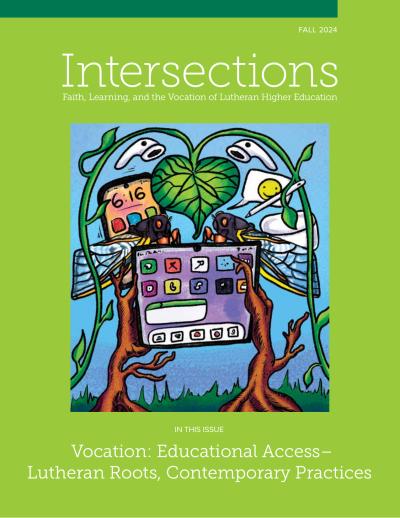
In her VLHE keynote, Lowe names three Lutheran commitments — continuing creation, neighbor justice, and communio — as the “why” that empowers ELCA colleges and universities to pursue equitable access for students often left behind by persistence and graduation gaps.
-
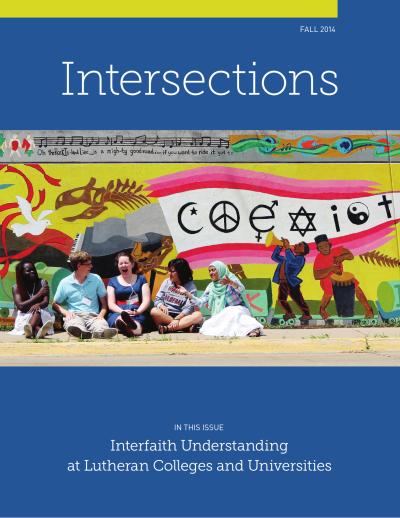 Article
Building on a Firm Foundation: ELCA Inter-Religious Relations
Kathryn M. Lohre
No. 40 · Fall 2014
Lohre traces the ELCA’s twenty-year arc of inter-religious work — from the 1994 Declaration to the Jewish Community and the Lutheran-Jewish Consultative Panel, through the post-9/11 Lutheran-Muslim Panel and the Shoulder to Shoulder Campaign, to fledgling dialogue with Sikhs and the dharmic traditions — and frames Lutheran inter-religious engagement as the strengthening, not the dilution, of Lutheran vocation.
-
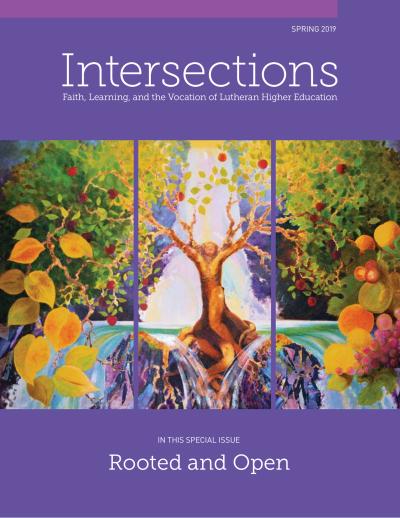 Article
Deep Roots, Big Questions, Bold Goals
Colleen Windham-Hughes
No. 49 · Spring 2019
Adapted from a presentation to the California Lutheran University Board of Regents, Windham-Hughes reads the title Rooted and Open as both reaching back into the Lutheran tradition and opening forward into a shared future, then unpacks the document’s “called and empowered — to serve the neighbor — so that all may flourish” through the lenses of freedom of inquiry as a third path, vocation-centered education, radical hospitality, and civil discourse oriented toward the common good.
-
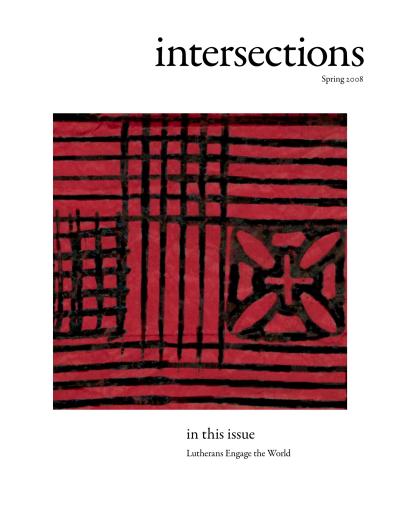 Editorial
From the Editor
Robert D. Haak
No. 27 · Spring 2008
Haak frames the issue around the question of why Lutherans engage the world rather than retreat from it, locating the answer in the doctrines of creation and incarnation, and introduces essays by Erwin on globalism, Carlsen on local community engagement, Marty on multiple callings, and Mattes on the Grundtvigian heritage at Grand View. He also bids farewell to publisher Arne Selbyg, noting the fittingness of the Adinkra (“farewell”) cloth on the cover of this final issue under Selbyg’s leadership.
-
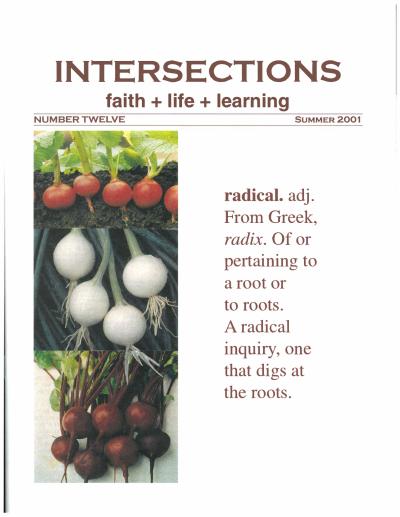 Article
A River Runs Through It: CLU as a Church-Related University
A. Joseph Everson
No. 12 · Summer 2001
Everson borrows Norman Maclean’s A River Runs Through It and the small creek that flows through California Lutheran University’s Kingsman Park as images for the quiet stream of Christian tradition on campus, describes the dialectic of faith and reason (with a “Lord of Life” student congregation, two required religion courses, and a voluntary Wednesday chapel) as the “theology of paradox” that runs from Luther’s simul justus et peccator through Richard Solberg and Richard Hughes, and names six commitments that constitute the CLU ethos—academic freedom (Jeremiah 29:7 and John 8:32), vocation, service (Amos and Habitat for Humanity), grace and graciousness (Portia’s “quality of mercy” speech from The Merchant of Venice), diversity, and reverence (Proverbs 9 as awe and wonder).
-
 Article
Service Beyond the Comfort Zone
Kathryn Wolford
No. 18 · Fall 2003
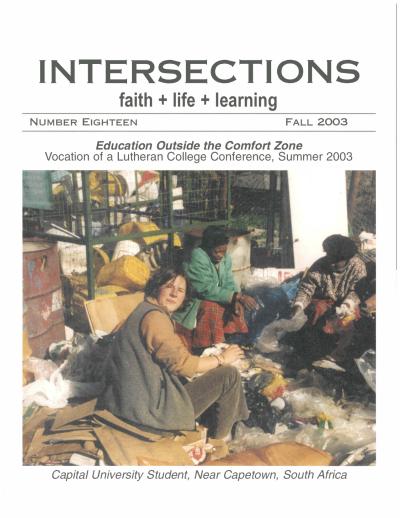
Wolford names economic globalization and the growth of civil society as the two issues shaping Lutheran World Relief’s mission, illustrating with the Guatemalan storekeeper undercut by subsidized “gringo” chickens, fair-trade coffee and chocolate campaigns, and Charles Onyango-Obbo’s warning about anti-terrorism laws in fragile African democracies. Drawing on Darrell Jodock, Art Simon, and the Good Samaritan, she frames the global vocation of Lutheran colleges as inviting students past comfort zones of race, class, ethnicity, and ideas through service-learning that links mercy and justice, and closes with a concrete LWR partnership invitation including site visits, internships, fair-trade campus campaigns, and the “A Place for Peace in Colombia” advocacy program.