A College Degree or a College Experience? Reflecting on Selingo's College (Un)Bound
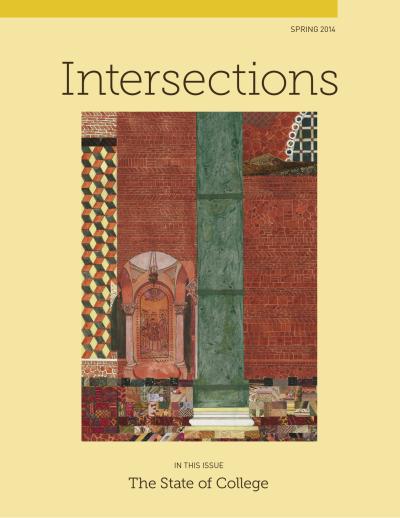
Intersections No. 39 · Spring 2014
Jeff Selingo, author of College (Un)Bound, suggests that the $490 billion higher education industry—which employs 3.5 million people and holds $990 billion in assets—is collapsing under an unsustainable financial model. After the recession of 2008, with continued increases in college costs and the student loan debt surpassing the one trillion dollar mark, families are beginning to question the value of higher education. Most agree that the tuition increase trajectory impacts families’ ability and willingness to pay. Selingo implies that the traditional business model within higher education needs to become a more efficient system. The challenges, in part, arise from a new student-centered world. For example, technology provides an array of choices for students, but that might just entail a disruptive force within higher education.
Rather than continue to conduct the “business as usual” approach (including a sixteen week semester), Selingo asserts that higher education is in need of a paradigm shift to meet the needs of this new student-centered world. While degrees have historically been awarded based upon the number of credit hours, Selingo recommends that competency-based options must be explored. Higher education will be forced to respond to the demands of the marketplace because today’s students “regard their professors as service providers, just like a cashier at the supermarket or a waiter in a restaurant” (Selingo 20).
Selingo writes: “Prestige in higher education is like profit is to corporations. The focus should be on students and learning rather than reputation and rankings” (12). He is right—we should be focusing on students and learning. While he reflects often in his book on the most selective top one hundred colleges and universities and remarks about the lavish facilities—including Lazy Rivers, “essentially a theme park water ride where students float on rafts” (28)—being constructed on campuses and expresses his frustration with the competitive behavior of college presidents regarding rankings interest, Singo does not differentiate by sector. Thus, he presents only a broad brush-stroke of what he observed while working at The Chronicle of Higher Education.
While many of Selingo’s observations, conclusions, and recommendations are controversial, he offers an opportunity to more critically examine the current state of affairs in higher education and to more effectively resist compromising the college experience. The media narrative continues to circle around the topics of unemployment, student loan debt, accountability, graduation rates, and college affordability. Federal officials are in the midst of developing a ratings system that they believe will provide outcome data that will enable families to more effectively evaluate and compare the “return on investment” of a college degree. Performance-based funding is also on the federal agenda. These issues have sparked conversation among parents—students’ primary influencers—and are clearly influencing behaviors. We in Lutheran higher education must respond to these issues of concern with a tactical approach in order to influence today’s conversation.
College Counseling and Selection
A “college degree” is one outcome of the overall college experience. The question to ponder is this: What is the difference between a college degree and a college experience? If a college degree is perceived to be primarily proof of information delivery by the marketplace, then higher education professionals committed to the importance of the overall college experience must re-frame and re-shape the conversation among college-bound families. Unfortunately, the driving force influencing the initial college choice is cost, which often results in the selection of a college that is not the right fit for the student. If more students had access to informed college counseling, more would find a good fit and degree completion rates would improve. Financial literacy is also an issue when dealing with the prospect of financing a college education. If a streamlined course on financial literacy (including details on money management, retirement, financial aid, student loan options, responsible debt management, etc.) were delivered to students and parents, they would be better equipped to make informed decisions and choices regarding financing college.
The college search and selection process is difficult for many families to navigate, despite expansive use of technology. Many become paralyzed by the wide array of options and an inability to obtain informed and reflective college counseling at the high school level. Nationwide, the caseload of public high school counselors serving public high schools is at an all-time high. It is nearly impossible to work with six hundred students in an engaged and meaningful way; this deficiency within our educational system is profound. At the same time, the independent consulting profession is growing exponentially—those families who are able to pay seek college selection guidance from consulting professionals. Those who cannot afford private counselors typically talk with alumni, peers, and teachers, searching for an “easier” way to narrow down the list of choices. The same students often place too much emphasis on rating systems like US News & World Report. Furthermore, families who do not understand the financial aid process often rule out private higher education due to the lack of transparency of the process.
“When students discuss what they are passionate about and what matters to them, they do so differently than when discussing the majors that their parents deem to be a good fit.”
All too frequently, we ask intimidating questions of prospective students: “What are your academic interests?” and “What major are you considering?” Most high school students cringe at the prospect of being asked about a major of choice. Students can speak quite fluently about the classes they enjoy—that is a better starting point. An even more provocative question may be, “What difference would you like to make in this world?” A college experience offers an opportunity to explore and discover, develop relationships with students and faculty members, engage in leadership opportunities, participate in activities, travel abroad, and formulate career objectives. A Lutheran college experience does all this; it also enables students to integrate faith and learning. When students discuss what they are passionate about and what matters to them, they do so differently than when discussing the majors that their parents deem to be a good fit (typically with strong income potential). Many desire permission to engage in conversation “on the porch” before stepping through the front door to select a major. If the college experience is about more than information delivery, we must shift the focus of the conversation from the beginning.
The Meaningful Impact of a Lutheran College Experience
In the quest to respond to the marketplace, we sometimes lose sight of our focus on sharing information about outcomes and developing relationships of trust with students and parents. It is necessary to pay attention to and respond to “the market,” but we must remain grounded in our mission and committed to relationship-building.
The Lutheran Educational Conference of North America (LECNA), which consists of 41 member Lutheran colleges and universities, engaged in a collaborative research effort to more closely examine what Lutheran college and university alumni (Lutheran and non-Lutheran) perceived about their college experiences. Graduates of flagship public universities were also surveyed, resulting in a rich comparative alumni study. This research, completed in collaboration with Hardwick-Day, continues to be a valuable resource for LECNA member colleges and universities. The initial survey in 1999 (updated in 2004 and 2011), quantifies the compelling values of the undergraduate experience—including mentoring, leadership, internships, study-abroad, participation in athletics, and the integration of faith and learning.1
“Alumni reflect not only upon the degree earned but, more importantly, on the emotional, spiritual, and vocational aspects of their college careers.”
The research findings indicate that Lutheran colleges and universities offer opportunities for transformational, intentional development of both the mind and the soul. Students attending Lutheran colleges and universities appreciate that aspect of the experience at different times in their lives. Very few can firmly grasp this transformation during their college experience. And yet, years after entering graduate school and/or the workforce, alumni reflect not only upon the degree earned but, more importantly, on the emotional, spiritual, and vocational aspects of their college careers. Alumni of Lutheran colleges and universities are not equipped to clearly articulate the value of the Lutheran college experience by anything other than their own personal experiences. Their word-of-mouth engagement with prospective families is valuable beyond measure.
Social, economic, technological, and demographic forces are beginning to reshape higher education. Perhaps Selingo is on to something—we may be in the midst of a paradigm shift, a shift that will threaten the existence of some models of higher education. The traditional colleges that survive will be those that “prove their worth” (Selingo 71). Lutheran colleges and universities can and do prove their worth. Just as Martin Luther gained a reputation for questioning, it may be time for us to engage in the same to more clearly articulate the value of a Lutheran college experience. We are called to question everything and advance knowledge for the collective good. Rather than be critical of Selingo’s predictions, we should embrace the opportunity for meaningful discussion with current research and prospective college families. While there are many options for degree attainment, the process of developing the whole person—mind, body, and spirit—is a critical aspect of the college experience. Enrollment officers, development officers, faculty, and staff must speak clearly about the transformational impact of daily life at a Lutheran college or university.
The Lutheran intellectual tradition is grounded in vocation and cultivated by community. God is present and active everywhere; education in the liberal arts for vocation emphasizes living life in relationship with others and enables students to focus on a life outside of one’s self. The commitment to the exploration of vocation—a calling to learn, to engage this world, to enact change, and to utilize careers in service to others—shapes the Lutheran college experience for students of all faith traditions (Torvend). Parents desire that their children live lives of purpose and meaning and positively impact the lives of others. They seek counsel on ways to assist their children in exploring their unique abilities during this launch to young adulthood, particularly in the midst of our seemingly individualistic culture.
At the 2013 Annual LECNA Presidents’ Meeting, Andrew Delbanco encouraged Lutheran college and university presidents to consider the following question: How can we preserve the college experience as a place where young people enter into a process of discovery, become engaged through an experience with a mentor, and emerge from college an intellectually curious adult? He reminded them that educated citizens are vital for a high-functioning democracy. In his book College: What it Was, Is, and Should Be, Delbanco writes, “Students have always been searching for purpose. They have always been unsure of their gifts and goals, and susceptible to the demands—overt and covert—of their parents and of the abstraction we call ‘the market’” (22).
Selingo touches upon the same issue: “I worry at times about what might be lost in an unbound, personalized experience for students. Will they discover subjects they never knew existed? If a computer is telling them where to sit for class discussions, will they make those random connections that lead to lifelong friends? Will they be able to develop friendships and mentors if they move from provider to provider?” (183). The sacrifices resulting from a mobile-provider model and competency-based approach to higher education will be striking. At worst, newer approaches to degree attainment void of the traditional model will potentially yield unfulfilled lives. Preserving and articulating the value of this transformational experience is essential. As Delbanco suggests, to lose that could never be compensated by any gain.
A Pathway to Purpose
During the 2014 Annual LECNA Presidents’ Meeting, Brandon Busteed, Executive Director of Gallup Education, painted a compelling portrait for advocacy of the liberal arts. He reflected upon the details of a research study of 650,000 students in grades 5-12, which highlighted that measures of engagement are predictive of real performance. Busteed concluded that our colleges and universities are troubled with unsophisticated ways of measuring and articulating outcomes, thus presenting difficulties in articulating value. Professed outcomes (better job, better life, engaged citizen) are not being measured outside of features in alumni magazines.
An Inside Higher Education survey conducted by Gallup of chief academic officers reported that 96 percent of provosts are extremely or somewhat confident that they are preparing Americans for the workplace. To the same question, only 12 percent of Americans and 11 percent of business leaders answered the same. Moreover, when Gallup asked parents of 5-12 graders what they thought was the best pathway to getting a good job, liberal arts did not surface as important. According to Busteed, the words “liberal arts” do not represent effective branding, although parents do value twenty-first century skills such as teamwork, critical thinking, skill collaboration, and leadership.
“A good job should instead be defined by the opportunity to do what you find meaningful, to believe in the mission and purpose of the organization, and to build up others by your work.”
And yet, the dream for young people, according to Gallup research, is to get a good job. According to UCLA CIRP data, the top reason freshmen cite for going to college is to “get a good job.” Are we certain, though, that Americans understand what it means to “get a good job”? Busteed argues that the real definition of getting a good job is much closer to “developing a meaningful philosophy of life” than most of us would imagine. We need to change the way that we define “a good job”—which is often equated to monetary compensation—and help people understand what a good job really means. Rather than focus on the financial benefit, a good job should instead be defined by the opportunity to do what you find meaningful, to believe in the mission and purpose of the organization, and to build up others by your work.
The more students are engaged, get their hands on things, solve real problems, and do real work, the closer they will get to outcomes that are measurable—but not by earning potential alone. According to Gallup research, the number one predictor of an engaged student is an engaged teacher or staff person. The number one predictor of an engaged teacher is his or her own great leader. In high school, that would be the principal. In a college, that’s the president. With such strong leaders and mentors, students will be able to say “yes” to three things, and so embark on a life of purpose: “Yes, I have someone who cares about my development. Yes, I am discovering or doing what I like to do. Yes, I am discovering or doing what I’m good at” (Busteed).
How can Lutheran colleges and universities do a better job of articulating their mission in the wake of political and economic headwinds? Selingo, along with Delbanco and Busteed, provide insights that enable us to shape and refine conversations with prospective college families and empower our alumni to speak more intentionally about the contribution Lutheran colleges and universities make in the realization of a life well-lived. We are called to respond by more clearly articulating the value of a Lutheran college experience using language and sharing experiences that resonate with students and parents.
Endnotes
1. This research required a significant investment from LECNA member colleges and a grant from Thrivent Financial for Lutherans, years before specific interest in “outcome” research made its way into the federal agenda. The methodology of the LECNA effort paved the way for additional college consortia to replicate the study, including The Annapolis Group, Catholic College Admission Association, Women’s College Coalition, Minnesota Private College Council, and Council of Independent Colleges. The results of the updated research are on the LECNA website (http://lutherancolleges.org/) and briefly recounted in LECNA’s brochure entitled “Your Values, Our Value” (see LECNA below). This brochure is circulated in a wide variety of settings throughout the year and is mailed to those who request specific information about LECNA member colleges and universities.
Works Cited
Busteed, Brandon. “Why LECNA Will Save Higher Ed.” Presentation at the 2014 Annual Meeting, LECNA. Accessed 1 March 2014, http://lutherancolleges.org/files/Liberal-Arts-Saves.pdf
Delbanco, Andrew. College: What it Was, Is, and Should Be. Princeton: Princeton University Press, 2012.
LECNA (Lutheran Education Conference of North America). Your Values, Our Value. Accessed 1 March 2014, http://lutherancolleges.org/files/LECNACollegeValueweb.pdf
Lopez, Shane J. Making Hope Happen: Create the Future You Want for Yourself and Others. New York: Artria/Simon & Schuster, 2013.
Selingo, Jeffrey J. College (Un)bound: The Future of Higher Education and What It Means for Students. New York: Houghton Mifflin Harcourt, 2013.
Torvend, Samuel, ed. Core Elements in Lutheran Higher Education. Accessed 1 March 2014, http://www.plu.edu/lutheran-studies/core-elements/home.php
-
 Editorial
From the Publisher
Mark Wilhelm
Wilhelm interrogates the widely used phrase “the model is broken,” arguing that it blames the victim, masks the demographic and public-funding pressures actually facing ELCA higher education, and distracts from the work of modifying—rather than discarding—a model of educating the whole person that has successfully adjusted across the centuries.
-
Editorial
From the Editor
Jason A. Mahn
Mahn reports on the working group “People of Wondrous Ability: Introducing Faculty and Staff to Lutheran Higher Education,” shares creative ways campuses are introducing colleagues to the charisms of the Lutheran tradition, and frames the issue as a set of reflective reviews that move from national trends to homegrown conversations about the state of college.
-
Book Review
The Religious Genealogy of College: Interrogating the Ambivalence of Delbanco's College
George Connell
Connell reads Andrew Delbanco’s College: What It Was, Is, and Should Be alongside Concordia’s Vision Statement for the Humanities and Martha Nussbaum’s Not for Profit, tracing Delbanco’s ambivalent engagement with the religious origins of American college. He asks whether Delbanco’s “college idea” can survive cut off from the religious rootstock that nourished it, and proposes that church-related colleges may serve best not as a “usable past” but as a “usable present.”
-
Book Review
Types, Methods, and Sagas in Lutheran Higher Education: Learning from Childers
Lake Lambert
Lambert situates Eric Childers’ College Identity Sagas within the older tradition of the 1977 Association of Lutheran College Faculties volume The Church-Related College in an Age of Pluralism, working through Burton Clark’s “saga” and Robert Benne’s typology of church-related colleges. He commends Childers’ socio-scientific approach while questioning whether a typology can do justice to institutions that resist easy classification.
-
Book Review
Post-Secular Religion on Campus: Conversing with Jacobsen and Jacobsen
L. DeAne Lagerquist
Lagerquist guides readers through Douglas and Rhonda Hustedt Jacobsen’s No Longer Invisible: Religion in University Education and its companion volumes, unpacking the authors’ three-act story of campus religion (Protestant, Privatized, Pluriform), their three-by-two framework of historic/public/personal religion in belief and behavior, and the six questions they pose for campus conversations. She lifts up interfaith etiquette and vocation as especially fruitful zones for Lutheran campuses.
-
Book Review
The Prophetic Vocation and the Nature(s) of College: Reimagining College with Jim Farrell
Peder Jothen
Jothen reads the late Jim Farrell’s The Nature of College as a prophetic critique of the dual nature(s) of college—its socio-cultural “normal” and its ecological habitat—and argues that Farrell’s call to model an “Anthropocene Responsibility” resonates with the prophetic dimension of Lutheran higher education. He proposes a re-imagined “About St. Olaf” that names vocation, ecological dependence, and personal involvement as the operative goods of college.
-
Book Review
The Courage to Change: Creating New Hearts with Palmer and Zajonc
Martha E. Stortz
Stortz reads Parker Palmer and Arthur Zajonc’s The Heart of Higher Education from the landscape of Lent and notes that the book’s strategies all target students, not their professors. Drawing on her own Faculty Formation Group at Pacific Lutheran Theological Seminary and the Ignatian Colleagues Program at Jesuit institutions, she asks what a Lutheran analogue might look like that would form the educators who teach for transformation.
-
Book Review
Learning Across Campus: Hearing Bok's Call to Conversation
David Ratke
Ratke reads Derek Bok’s Our Underachieving Colleges from Lenoir-Rhyne and argues that Bok’s call to think holistically about undergraduate education and to dialogue across disciplinary boundaries names the work already underway at ELCA colleges. He weighs faculty attitudes, the role of skills in the core curriculum and the major, and the importance of the extracurriculum for student formation.
-
Book Review
The Information Deluge: Navigating the Digital Age with Recent Scholars
Virginia Connell
From the reference desk at Concordia’s Carl B. Ylvisaker Library, Connell navigates Ann Blair’s Too Much to Know, Nicholas Carr’s The Shallows, Viktor Mayer-Schönberger’s Delete, and Howard Gardner and Katie Davis’ The App Generation, then describes information-literacy work at Concordia—primary-source assignments, Omeka and TimelineJS exhibits—that helps students move from app-dependent to app-enabled in the Lutheran tradition of reform.
-
 Response
Tat for Teat: Ratke Responds
David Ratke
No. 9 · Summer 2000
Ratke, agreeing with much of VonDohlen’s critique but contending that VonDohlen misreads both Luther and the two-realms doctrine, marshals Luther’s To the Christian Nobility, On the Freedom of a Christian, Temporal Authority, Whether Soldiers Too Can Be Saved, and the “Sermon on Keeping Children in School,” along with Walther von Loewenich, to argue that Luther was well aware of structurally differentiated society, made no claim to a monistic epistemology, and intended the two-realms doctrine to combat—not introduce—dualistic bifurcation between sacred and secular. Our identity is “not as either Christian or academic, but as Christian and scholar.”
-
 Article
Women in Leadership: Obstacles, Opportunities, and Entry Points
Susan Hasseler
No. 41 · Spring 2015
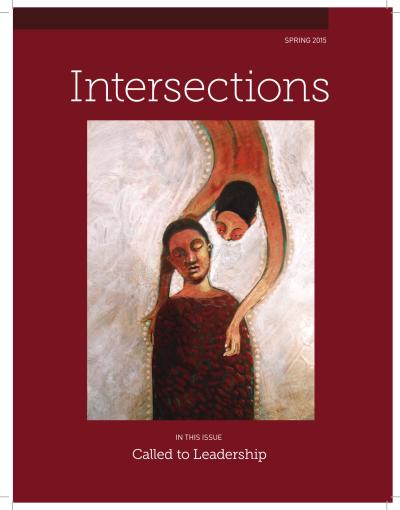
Drawing on two focus-group conversations with female faculty and academic administrators at Augustana College (Sioux Falls), Hasseler traces four obstacle/opportunity themes for women in academic leadership — valuing the intellectual work of leadership, religious and cultural interpretations of gender roles, caregiving realities, and embracing a strong voice — and proposes deliberate next steps for cultivating inclusive excellence on ELCA campuses.
-
 Article
On Recruiting Diverse Students, Rooted in Mission
Eric Rowell, Jason A. Mahn
No. 59 · Spring 2024
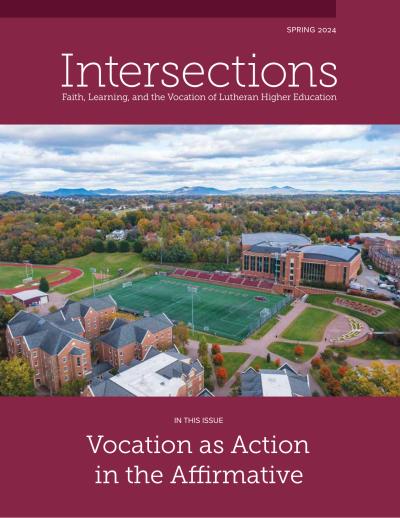
Jason Mahn interviews Eric Rowell, Assistant Director of Admissions and Diversity Outreach at Augustana College, about how recruiting students from a wide variety of backgrounds — rooted in Augustana’s Lutheran commitment to vocation and educating across difference — remains essentially unchanged in the wake of the Supreme Court’s 2023 decisions on affirmative action.
-
 Article
The Lutheran Calling in Education: Context and Prospect
Paul J. Dovre
No. 23 · Summer 2006
Dovre, President Emeritus of Concordia College and co-chair of the ELCA Task Force on Education, undertakes three tasks: focusing on the current social context (young people’s spiritual lives, the state of mainline denominations, the family map, schools, communities, and higher education); reflecting on why Lutherans care about education (creation in God’s image, vocation, Luther’s legacy, the priesthood of all believers, civic righteousness, and hope); and considering the prospects and possibilities for addressing the calling (biblical, confessional, theological, and pedagogical legacies; the renewal of apostolic ministry, the Christian-college renaissance, K–12 reform, and the congregational education explosion).
-
 Article
The Search for a Just Peace in a Globalized World
Munib A. Younan
No. 18 · Fall 2003
Younan, Lutheran Bishop in Jerusalem, grounds Palestinian Christian identity in Incarnation theology and a Lutheran theology of grace and the cross, then surveys the Evangelical movement’s nineteenth-century legacy in the Middle East—the 1864 Arabic Bible, ELCJ schools, women’s ordination, and the Middle East Council of Churches. Engaging Edward Said’s critique of Samuel Huntington, he calls for international and local mutual-recognition agreements (including the Jerusalem Lutheran-Anglican agreement and a Lutheran-Reformed agreement in the Middle East), four marks of interfaith dialogue, and a sharp distinction between Lutheran “Evangelical” identity and the Dispensationalist evangelistic Right whose Israel-Palestine scenarios he names a heresy. He closes by proposing concrete scholarship, faculty exchange, and sabbatical partnerships between U.S. Lutheran colleges and the ELCJ’s churches, schools, and Dar al-Kalima Lutheran Academy.
-
 Response
Lutheran Colleges: The Context for the Conversation
Thomas Templeton Taylor
No. 1 · Summer 1996
Taylor of Wittenberg engages Schwehn’s first argument by sketching the institutional predicament of Lutheran colleges through three converging forces: the collapse of differences among old-line Protestant groups in the wake of ELCA-era ecumenism (with Robert Wuthnow); the secularization of American higher education described by George Marsden; and the post-war decline of liberal arts colleges under pressure to professionalize. The result is an “in-between stage” in which Lutheran colleges retain rhetoric without substance. Following Richard John Neuhaus’s “Eleven Theses,” he argues that, for a time at least, Lutheran colleges’ institutional affiliations must remain actively Lutheran if they are to remain in any sense Christian.