If anything, Derek Bok’s book, Our Underachieving Colleges: A Candid Look at How Much Students Learn and Why They Should Be Learning More is more current today than when it was published in 2006. Bok is worth listening to. While Bok’s entire career has been at Harvard University, where he was also the former president (1971–1991), much of what he has to say is relevant to the readers of Intersections.
The argument of Our Underachieving Colleges is, in many ways, summed in its subtitle. At the time of its publication much of the criticism leveled at American institutions of higher education had to do with their politicization (“colleges and universities have become enamored with left-wing political and social causes!”), with the decline of the liberal arts and the rise of professional degree programs, with the upsurge of postmodern theories (especially in the humanities), and with the lack of a moral or philosophical compass. Bok suggests that these critiques are too narrow. There needs to be, he argues, “a serious look at how much students are learning” and at “what is actually being accomplished in college classrooms” (Bok 8). Actually much of this research has been conducted. The problem is that nobody has taken a long, hard look at the whole forest. Much of the research and reflection has focused on individual trees. Bok aims to remedy that problem. He proposes that we examine and consider undergraduate education more holistically and deliberately as well as dialogically. That is, more conversation about the big picture and how the moving parts work together is needed. Of the moving parts (teaching, student life, international or global awareness, moral development, etc.), Bok is most invested in what actually goes on in the classroom although he does not overlook other areas of undergraduate education and the undergraduate experience.
Historical Perspective
Bok acknowledges that there is much that is true in most critiques of American higher education. At the same time, he argues that history “offers weak support at best for the reports of a decline in the quality of undergraduate education. Loose allegations to that effect have little foundation in fact but instead rest on fanciful visions of some previous golden age” (29). Students “have always arrived on campus deficient in their ability to communicate” (67).
To find an era in which colleges and universities perhaps did not struggle with these concerns, you would have to go to the period prior to the Civil War when only the wealthiest could reasonably afford to attend college. Bok notes that these institutions often aimed to build character and train the intellect. Colleges, he writes, were “united around a classical curriculum aimed at mental discipline and character building.” That may sound enticing and attractive to those of us who teach in the liberal arts. However, he also notes that teaching in this era was characterized by “student recitations, ancient languages, and rigid disciplinary codes” (24). This hardly seems like the kind of education any of us would advocate. Indeed there were numerous complaints about lecturers who were inaudible, who relied on outdated and yellowed notes, who were unresponsive or unavailable to students, and so forth. That could be me talking about some of my colleagues!
“Bok’s point is simply that the problems we face in the twenty-first century are not new.”
Bok’s point is simply that the problems we face in the twenty-first century are not new. In fact, in many ways they are the same challenges, including: the need for quality instruction and a common sense of purpose for higher education, increasing specialization to the point of esoterism and irrelevance in both teaching and research, and a rise in vocational or professional education. Bok doesn’t intend to pooh-pooh these concerns and challenges. But if things haven’t really become worse, can we say that they’ve become better? Many of us would be hard pressed to answer “yes.”
Faculty Attitudes
Bok addresses the accusation that faculty members are more interested in research than teaching. He notes that some faculty members are, but there is considerable research that suggests that faculty find teaching more satisfying.
My own sense is that it depends. My experience at Lenoir-Rhyne suggests that it depends partly on the department and on the individual faculty member. We have some departments that emphasize teaching as part of our activity. In the School of Humanities and Social Sciences, we begin our monthly meetings with a “teaching moment” in which a faculty member shares a problem, idea, or strategy as a way to highlight teaching.
I also know that there are a number of professors who attend to their research and scholarship at the expense of teaching. Some of this, I think, has to do with their socialization in graduate school at research institutions with mentors who were rewarded for excellence in research. How many of us did our graduate work at institutions where success was measured by success in the classes we taught as teaching or graduate assistants? How many of us were measured by our success in classes that focused on developing undergraduate teaching skills? How many of us even took classes that trained us to be teachers of undergraduates?
The socialization of professors is important in another respect. Many of us, particularly in the arts and sciences, love our disciplines. And we expect our students to share that same love if not for the discipline then at least for learning. But many students come to college for the opportunities it brings for providing a more secure career and future. To be vulgar, students come to college to make more money. It’s an investment. As Bok puts it, “useful skills matter more than ever” (36).
Skills Students Seek
Students are looking for courses and majors that will help them achieve material success: “Most students (and the organizations that employ them) are increasingly preoccupied by a need for skills—not just critical thinking and writing skills but oral communication, listening, quantitative reasoning, and … interpersonal competence” (223; see also 36). Students look for majors that will clearly and intentionally help them with these skills. The problem, however, is that “Arts and Sciences professors … tend to be wary of these [skills] and often balk at including them in the curriculum” (36; see also 251). I disagree.
This may indeed be the case at some institutions. But I don’t think it’s the case at Lenoir-Rhyne or at most—if not all—of the institutions where readers of Intersections work. At Lenoir-Rhyne, our core curriculum emphasizes these very skills. We have a six credit hour First Year Seminar course which highlights written and oral communication. Many of the instructors of these courses make extensive use of group projects and activities intended to develop interpersonal skills. Our core curriculum requires that students take a “global learning” elective. Students are required to do service learning and community service which seek to develop abilities to communicate with people from other cultures as well as in leadership. In the “teaching moments” that begin our meetings in the School of Humanities and Social Sciences that I mentioned above, often the topic has to do with precisely these topics. I’m proud of our curriculum because it intentionally and consciously addresses these skills. Our achievement in developing these skills is still a work in progress, but we’re committed to it. Moreover, in all the years I’ve attended the Vocation of a Lutheran College conferences, I’ve heard people from other Lutheran institutions wrestle with and address these same challenges. In fact, often the themes of these convocations are centered on these very challenges. I know that Lenoir-Rhyne is not alone among colleges in thinking hard about these skills and how students learn them.
“Church-related institutions still ‘attempt to teach their students to think about ethical questions of the kind that commonly arise in private and professional life.’”
One of the important themes in Our Underachieving Colleges is the importance of faculty dialogue, especially across disciplinary boundaries. I’ll come back to this later. First, I want to examine Bok’s argument that students are interested in ethics and values and the failure of colleges to address ethics and values. Bok freely admits that church-related institutions still “attempt to teach their students to think about ethical questions of the kind that commonly arise in private and professional life” (41). He argues further that “most colleges … fail to make any deliberate, collective effort to prepare their students to be active, knowledgeable citizens in a democracy, even though civic apathy and ignorance of public affairs are widely regarded as serious problems in America.” I can’t comment on the reality at state-funded institutions. However, that Bok says that church-related institutions are the exception in the United States is worth considering. ELCA colleges and universities consider ethics and train for active citizenship pretty well. I know that many of our institutions work hard at getting the word out that we care about developing ethics and values. Of course, sometimes our message falls on deaf ears. Or sometimes it falls on willing ears, but, to paraphrase a parable that most of us know well, this message falls among the thorny weeds where it is choked out by other competing demands for prospective students’ desires: attractive residence halls and recreational facilities, competitive athletic programs, vibrant social life, appealing location, and cost. Given the economies that most ELCA colleges must work with, we are hard pressed to compete on all those fronts.
Core Curriculum and Majors
Much of the debate within colleges about the skills just mentioned focuses on the general education curriculum and how it achieves those goals. This is wrongheaded, says Bok. The majority of the courses students take often will be in their major. The proportions that Bok mentions don’t altogether mesh with the reality at Lenoir-Rhyne, but I think his point is worth considering. Students can’t write effectively? Have them take another composition course. Students lack quantitative analysis skills? Have them take another math course. Students lack oral communication skills? Have them take a speech class. You get the idea. Sometimes that has been the solution that Lenoir-Rhyne has resorted to. They take a computer literacy placement test in their first semester. If they don’t pass, they take a class (really a tutorial). When students lack knowledge or skill in some silo or another, we have them take a class in that silo.
At the same time, at Lenoir-Rhyne we have attempted to do things a little differently. The six credit First Year Seminar course that I mentioned above takes three credit hours that formerly belonged to composition so that students can develop writing skills in a class that matches their academic interest. All First Year Seminar courses have different titles and content ranging from “friendship, love, and film” to “forgiveness” to “racism and other controversies” to “the science of magic.” Our core curriculum seeks to teach these skills and content areas in holistic ways. Sometimes we’re successful.
Bok makes a further point about expecting the general education curriculum to fulfill all these objectives and outcomes. Too often majors and concentrations aren’t held accountable for developing these skills in students. Is there any reason students can’t write in science classes? Is there any reason that students can’t present their work orally in their majors? Is there any reason that students can’t consider the ethical and moral implications of questions and challenges and innovations within their majors—whether they are science or business or nursing students?
“Is there any reason that students can’t consider the ethical and moral implications of questions and challenges and innovations within their majors—whether they are science or business or nursing students?”
To do this, Bok argues, faculty would have to have ongoing and intentional conversations across disciplinary boundaries. Recently I was in a meeting in which faculty from program X wanted to tell faculty Y what courses should be in major Y. Colleagues were talking to each other across disciplinary boundaries. This was, in its way, a good start. Unfortunately the conversation wasn’t about skills such as critical thinking and so forth, but rather about which courses from silo X the students in major Y needed. A more fruitful and constructive conversation might have taken place had the topic been about skills. Instead, an argument ensued in which disciplinary territory was at stake.
To be sure, these are hard conversations to have. Faculty at Lenoir-Rhyne teach four courses per term, which doesn’t leave them much time for conversations like this. After all, they have committee meetings to attend, assessment plans and reports to write, and student papers to grade. If the conversations take place at all, they do so when the clock is running. They occur during the extremely compressed hour of a school meeting when there is other business to take care of. They also occur institutionally during the end of year “workshop”—which used to be called a retreat. The change in nomenclature is telling. Retreats suggests an easy-going refuge from the busyness of academic and institutional life. Workshops are about getting stuff done. People who know me as a chair know that I’m all about getting stuff done. However, even I recognize the need for Sabbaths and the valuable time and space they offer for unfettered creative reflection. They’re also valuable for spending time outside our disciplinary (or administrative) silos with people who have left their own silos. The needed conversations simply won’t occur unless lovingly tended and cared for like a gardener cares for a garden. They take time and commitment.
Extracurriculum
Bok notes that for many students the defining moments of their undergraduate experience often take place outside the classroom (52). These moments occur while acting in drama productions, belonging to a fraternity or sorority, participating in student government or other campus organization, or competing with athletic teams. That can be a bitter pill to swallow for those of us who are professors. But faculty members overlook the importance of the extracurriculum at the peril of student development and formation.
At Lenoir-Rhyne, we pay attention to the extracurriculum. My sense is that many other ELCA colleges do the same—Augsburg College especially comes to mind. Students are required to earn “convocation credit” in order to graduate. Such credit can be earned by participating in these extracurricular activities as well as attending chapel, doing community service, and attending special events on campus such as lectures and concerts.
Bok makes the further point that faculty should be involved in such activities. Unfortunately, many faculty “equate what an undergraduate education should accomplish with what professors can achieve in their classrooms” (60). I wouldn’t say that this is the case at Lenoir-Rhyne. Many faculty members are advisors to student organizations. Of course, some are more active than others. Furthermore, at Lenoir-Rhyne, faculty are on the convocation committee which considers many, but not all, extracurricular activities. That being said, I think that student life is a world about which most faculty have only a superficial knowledge. I would also say that many student life staff members don’t have deep knowledge about the aims, objectives and outcomes of student learning. More campus-wide conversations and dialogue between these groups would surely open some eyes.
Concluding Thoughts
Our Underachieving Colleges is wide-ranging and ambitious book. Bok examines many issues, but, as I stated at the outset, has two important aims: (1) to think about undergraduate education holistically, and (2) to encourage dialogue and conversation across disciplinary boundaries and the entire campus (student life, athletics, libraries, institutional research, etc.).
While at least some of his accusations seem misplaced in institutions like those represented by the readers of Intersections, there is much to chew on. Lutheran colleges and universities, in my experience, are doing much to address the challenges that Bok examines. Often our success is limited by our resources—human, financial, and temporal. Certainly at Lenoir-Rhyne, while it is in no danger of closing its doors any time soon, these limitations often mean that many of our conversations are about whatever is on the immediate horizon. In our case, these conversations are also limited in that we have three “main campuses”: an undergraduate campus in Hickory, a graduate center in Asheville, and a seminary campus in Columbia, South Carolina. Distance is a challenge!
Our faculty, staff, and administrators are frequently stretched beyond the boundaries of human capacity to attend to all that needs attention. The call to commit and dedicate ourselves to conversation and dialogue about a holistic vision of undergraduate education is one that we’ve already committed to, but also one that deserves recommitting ourselves.
Works Cited
Bok, Derek. Our Underachieving Colleges: A Candid Look at How Much Students Learn and Why They Should Be Learning More. Princeton: Princeton University Press, 2006.
-
 Editorial
From the Publisher
Mark Wilhelm
Wilhelm interrogates the widely used phrase “the model is broken,” arguing that it blames the victim, masks the demographic and public-funding pressures actually facing ELCA higher education, and distracts from the work of modifying—rather than discarding—a model of educating the whole person that has successfully adjusted across the centuries.
-
Editorial
From the Editor
Jason A. Mahn
Mahn reports on the working group “People of Wondrous Ability: Introducing Faculty and Staff to Lutheran Higher Education,” shares creative ways campuses are introducing colleagues to the charisms of the Lutheran tradition, and frames the issue as a set of reflective reviews that move from national trends to homegrown conversations about the state of college.
-
Book Review
The Religious Genealogy of College: Interrogating the Ambivalence of Delbanco's College
George Connell
Connell reads Andrew Delbanco’s College: What It Was, Is, and Should Be alongside Concordia’s Vision Statement for the Humanities and Martha Nussbaum’s Not for Profit, tracing Delbanco’s ambivalent engagement with the religious origins of American college. He asks whether Delbanco’s “college idea” can survive cut off from the religious rootstock that nourished it, and proposes that church-related colleges may serve best not as a “usable past” but as a “usable present.”
-
Book Review
A College Degree or a College Experience? Reflecting on Selingo's College (Un)Bound
Laurie Brill
Brill reads Jeff Selingo’s College (Un)Bound from inside the Lutheran Educational Conference of North America, drawing on LECNA’s alumni research with Hardwick-Day and on Brandon Busteed’s Gallup data to argue that, in an age of competency-based degrees and college-as-commodity, Lutheran colleges must speak more clearly about the transformational, vocational impact of a college experience that develops the whole person.
-
Book Review
Types, Methods, and Sagas in Lutheran Higher Education: Learning from Childers
Lake Lambert
Lambert situates Eric Childers’ College Identity Sagas within the older tradition of the 1977 Association of Lutheran College Faculties volume The Church-Related College in an Age of Pluralism, working through Burton Clark’s “saga” and Robert Benne’s typology of church-related colleges. He commends Childers’ socio-scientific approach while questioning whether a typology can do justice to institutions that resist easy classification.
-
Book Review
Post-Secular Religion on Campus: Conversing with Jacobsen and Jacobsen
L. DeAne Lagerquist
Lagerquist guides readers through Douglas and Rhonda Hustedt Jacobsen’s No Longer Invisible: Religion in University Education and its companion volumes, unpacking the authors’ three-act story of campus religion (Protestant, Privatized, Pluriform), their three-by-two framework of historic/public/personal religion in belief and behavior, and the six questions they pose for campus conversations. She lifts up interfaith etiquette and vocation as especially fruitful zones for Lutheran campuses.
-
Book Review
The Prophetic Vocation and the Nature(s) of College: Reimagining College with Jim Farrell
Peder Jothen
Jothen reads the late Jim Farrell’s The Nature of College as a prophetic critique of the dual nature(s) of college—its socio-cultural “normal” and its ecological habitat—and argues that Farrell’s call to model an “Anthropocene Responsibility” resonates with the prophetic dimension of Lutheran higher education. He proposes a re-imagined “About St. Olaf” that names vocation, ecological dependence, and personal involvement as the operative goods of college.
-
Book Review
The Courage to Change: Creating New Hearts with Palmer and Zajonc
Martha E. Stortz
Stortz reads Parker Palmer and Arthur Zajonc’s The Heart of Higher Education from the landscape of Lent and notes that the book’s strategies all target students, not their professors. Drawing on her own Faculty Formation Group at Pacific Lutheran Theological Seminary and the Ignatian Colleagues Program at Jesuit institutions, she asks what a Lutheran analogue might look like that would form the educators who teach for transformation.
-
Book Review
The Information Deluge: Navigating the Digital Age with Recent Scholars
Virginia Connell
From the reference desk at Concordia’s Carl B. Ylvisaker Library, Connell navigates Ann Blair’s Too Much to Know, Nicholas Carr’s The Shallows, Viktor Mayer-Schönberger’s Delete, and Howard Gardner and Katie Davis’ The App Generation, then describes information-literacy work at Concordia—primary-source assignments, Omeka and TimelineJS exhibits—that helps students move from app-dependent to app-enabled in the Lutheran tradition of reform.
-
 Article
Wilhelm Löhe and Higher Education
David Ratke
No. 30 · Fall 2009
Ratke recovers the educational vision of Wilhelm Löhe (1808–1872), spiritual father of Wartburg College and Wartburg Seminary, drawing on Löhe’s “Aphorismen über Schule und Schulunterricht” and other writings to argue that education is about the formation of whole persons by whole teachers in whole institutions, that all education is religious and never neutral, and that education is for eternity as well as the present — a vision in which the values of Christianity sanctify the so-called worldly means of education.
-
 Response
Tat for Teat: Ratke Responds
David Ratke
No. 9 · Summer 2000
Ratke, agreeing with much of VonDohlen’s critique but contending that VonDohlen misreads both Luther and the two-realms doctrine, marshals Luther’s To the Christian Nobility, On the Freedom of a Christian, Temporal Authority, Whether Soldiers Too Can Be Saved, and the “Sermon on Keeping Children in School,” along with Walther von Loewenich, to argue that Luther was well aware of structurally differentiated society, made no claim to a monistic epistemology, and intended the two-realms doctrine to combat—not introduce—dualistic bifurcation between sacred and secular. Our identity is “not as either Christian or academic, but as Christian and scholar.”
-
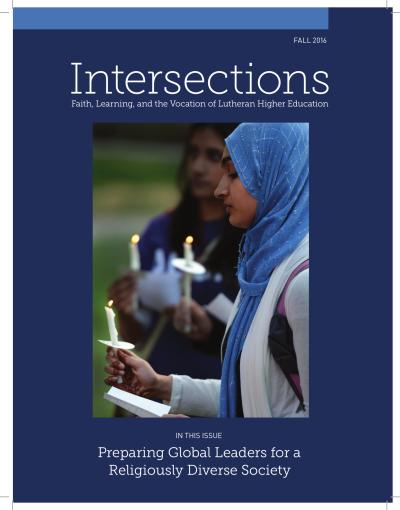 Article
Negotiating Legitimate and Conflicting Values
Eboo Patel, Katie Bringman Baxter, Mark S. Hanson
No. 44 · Fall 2016
In a closing-day conversation at the 2016 Vocation of a Lutheran College Conference, Mark Hanson and Eboo Patel — moderated by Katie Bringman Baxter of Interfaith Youth Core — share case studies in which legitimate religious values come into tension with one another, and make the case that Lutheran colleges should teach interfaith leadership through the hard cases rather than the easy ones.
-
 Article
The Lutheran Calling in Education: Context and Prospect
Paul J. Dovre
No. 23 · Summer 2006
Dovre, President Emeritus of Concordia College and co-chair of the ELCA Task Force on Education, undertakes three tasks: focusing on the current social context (young people’s spiritual lives, the state of mainline denominations, the family map, schools, communities, and higher education); reflecting on why Lutherans care about education (creation in God’s image, vocation, Luther’s legacy, the priesthood of all believers, civic righteousness, and hope); and considering the prospects and possibilities for addressing the calling (biblical, confessional, theological, and pedagogical legacies; the renewal of apostolic ministry, the Christian-college renaissance, K–12 reform, and the congregational education explosion).
-
 Reflection
Meditation—Band Chapel Service, St. Olaf College
Erik Haaland
No. 7 · Summer 1999
Haaland, a St. Olaf senior, offers a brief Band Chapel meditation that defines art as “the expression of what is deeply human through the manipulation of the physical world” and defends worship—architecture, stained glass, music, eloquence—as an art form requiring our best and most sincere efforts. When the God we worship and the salvation we proclaim do not seem near, artful worship offers not propositions but something real and tangible to hold on to.
-
 Editorial
From the Publisher
Arne Selbyg
No. 27 · Spring 2008
Selbyg, retiring this summer as Director for ELCA Colleges and Universities, reflects on his decade serving as spokesperson between the church and its twenty-eight colleges and universities, and argues that the link between the colleges and the church has grown stronger over the last ten years — sustained by supportive church leaders like Presiding Bishop Mark Hanson, the annual Vocation of a Lutheran College conference, and a Lutheran theology of higher education whose principles (questioning authority, returning to the sources, including the excluded, serving the neighbor) remain a strong basis for operating colleges and universities in the twenty-first century.
-
 Editorial
From the Publisher
Arne Selbyg
No. 14 · Summer 2002
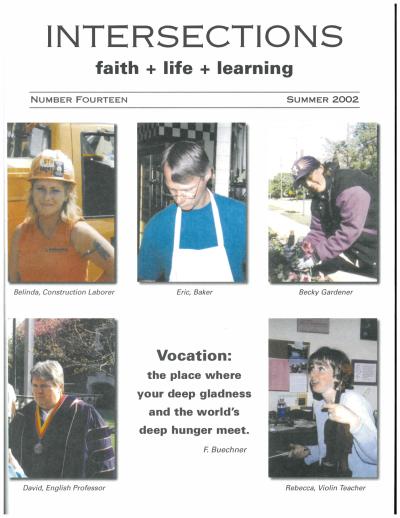
Writing on behalf of the publisher, Sue Edison-Swift names vocation as one of the precious gifts Lutheran theology offers education, reflects on her first ELCA Vocation of a Lutheran College conference, and asks readers to gift future issues of Intersections with feedback—notes on what they read and skipped, and how they ended up with a copy.
-
 Article
Vocation Outside of Career: Discovering Purpose through Comics
María Evelia Emerson
No. 53 · Spring 2021
Emerson recounts building an Augustana Vocational Discernment course around G. Willow Wilson’s Ms. Marvel series, using Kamala Khan’s juggling of family, friendship, faith, and superhero identity to help sophomores see vocation as not what they do for a living but how they want to live.