'In, With, and Under:' The Tradition and the Teaching of Christian Ethics
Intersections No. 17 · Summer 2003
The study of Christian ethics can be a contentious issue at church-related colleges, particularly if students come from diverse religious backgrounds. Does the professor imbue students with the doctrines of the specific Christian tradition of the college, expose them to a variety of Christian traditions, include other religious and philosophical perspectives? What about those students who have no religious background or commitment? These questions about the teaching of ethics are indicative of the debate over the purposes of Christian higher education. Many critics are asking what Christian differences there are in church-related liberal arts colleges.
I suspect that this concern for a strong doctrinal purpose for Christian higher education is related to the belief that society needs a religious basis — usually what is called the Judeo-Christian tradition — to thrive. Citizens need a common identity, history, and purpose, according to this view, which is provided by a shared religion. There are those who claim that a common religion, Christian, civil or otherwise, is not necessary for society to flourish. (There are also constitutional issues at stake, particularly the anti-establishment clause of the First Amendment.) Some claim that a commitment to our democratic process is what binds us together. I affirm this latter position, but I also agree with those who argue that this includes acceptance of at least the “democratic ideals of freedom, equality, and mutual respect.” (Thiemann, 173) Beyond this, we seek to develop common ground out of our distinct religious or secular traditions and perspectives in regards to a sense of the common good.
The dialectic of faith and reason
I believe that a primary purpose of liberal arts colleges is to educate for citizenship in a democratic society.1 Such an education should help develop the skills for participating in the democratic process and contribute to the search for common ground. I think that the dialectic between faith and reason characteristic of the Lutheran tradition is a very useful approach for this task. For Christian higher education, it offers a model that encourages both freedom of inquiry and church-relatedness. For secular higher education, it provides an approach to religious studies which takes seriously faith, along with critical inquiry. (I speak as one who taught religious studies for four years in a public university.) Although I am not Lutheran, I appreciate this tradition and its under girding of the university in which I teach.2
The mission statement of California Lutheran University (CLU), whose liberal arts college I teach in, embraces this dialectic: “Rooted in the Lutheran tradition of Christian faith, the University encourages critical inquiry into matters of both faith and reason.” CLU, founded in 1959, is the youngest of the colleges affiliated with the Evangelical Lutheran Church in America (ELCA). About 30% of its students are Lutheran, with about the same percentage Roman Catholic, and a smattering of students from other Protestant denominations or other world religions. A significant number of students are what some call “unchurched,” representatives of the secular southern California culture which seems to think Christian means fundamentalist. About one-fourth of our students are students of color (18% Latino is typical) or international. We also have a significant number of re-entry students.
CLU students are required to take two religion courses as part of their general education requirements. The first is REL 100: Introduction to Christianity. The second is an upper-level elective. Many students choose “Introduction to Christian Ethics,” in part because the Schools of Business and Education also encourage their majors to take this particular course. As these are large majors, many of the students will come from these schools. Few are religion majors or minors. This course is my primary teaching responsibility. I want to illustrate and support my position by discussing my approach to teaching Christian ethics.
Some might ask how one can have a dialogue between faith and reason with such a diversity of religious backgrounds and the strong secular representation? I perceive teaching Christian Ethics in this setting as an opportunity. It is more characteristic of the religious diversity of the “real” world than in a college with a religiously homogeneous student population. Those students who come are shaped by a religious tradition, and are able to bring their perspective into dialogue with others both inside and outside the classroom. Students’ faith may be strengthened or transformed; in either case there is a maturing. In some cases, common ground is discovered with those from other, or no, tradition. In regards to ethics, some students come to realize that one can follow a personal ethic, while having a wider latitude of behaviors for public policy, and that this is both reasonable and right. Altogether, students learn respect for others different from themselves and commitment to a common good.
An overview of a Christian Ethics course
Although I would be hard pressed to claim that this approach is distinctively or uniquely Lutheran, I believe it certainly resonates with aspects of the Lutheran tradition. In my ethics classes I try to develop communities of moral discourse, in which students develop their ability to reflect on a variety of ethical issues and to articulate a position in conversation with those who may hold different faith commitments and ethical positions. I try to make the classroom a safe space to discuss controversial issues and to hear different points of view. I do this in part by setting ground rules which I ask students to adopt that although we may not agree with someone’s ideas, we do not attack them personally. We give each other the benefit of the doubt, that we want our decisions to be moral. Also, I point out that there are not serious consequences to the positions we may take in class, for the sake of argument; we are not acting as legislators or a jury, for instance.
My Christian ethics class, although hopefully a safe space, is a site of critical inquiry into matters of both faith and reason. This is due in part through the diversity of voices in the classroom. (Exposure to a range of positions usually facilitates critical thinking as to the strengths and weaknesses of each.) To some extent, the diversity of contemporary American society is represented in the class. This, along with the fact that students often do not know each other, makes the classroom similar to a “public square.” Students tell me that they have not participated in depth discussions on the issues we cover with people of such diverse views. I trust that students who participate in this community of moral discourse for a semester will be both motivated and better equipped to participate in such communities, including public ones, after they leave college.
As stated in the catalogue, the purpose of our upper-level Introduction to Christian Ethics class is “to examine and analyze Christian ethics today, its relationship to the Bible and Christian communities; and its thinking on such important personal and social issues” as human sexuality, bioethics, prejudice and oppression, ecology, economic life, war and peace. Students engage in oral debate and group presentations, prepare several case studies, and participate in a service-learning project. Through these and other activities, such as lecture and discussion, students critically reflect on their moral values and principles in light of Christian faith and various philosophical perspectives. Although I present the two aspects of ethics that Larry Rasmussen and Bruce Birch call the ethics of being and the ethics of doing, class assignments center on doing, especially decision-making. I believe, though, that asking students to take a stand on tough issues does help strengthen their character.
We engage in ethical reflection from the first day of class, usually with the Bomb Shelter game/simulation. In this activity, students work in small groups to select twelve people (all the shelter can hold) from a list of twenty to be sheltered during a terrorist nuclear attack on our area. Little is known of these people, other than their sex, age, occupation, and in some cases the race/ethnicity and/or religion and family status. They have agreed to accept the decision of the groups, who are themselves in a safe location and acting in an official capacity. The groups have twenty minutes to choose how to make their decision and to complete the activity. They are asked to track the reasons for their choices and the emotions they feel. Although this activity can be emotionally difficult, I like to use it as it quickly gets to the heart of what moral dilemmas are about.
Many issues and feelings surface during the activity, including the question of whether we ever have the right to make decisions about who is to live or die — is that “playing God?” — and if we do make such decisions, how should we proceed. This activity becomes the basis for an introduction to the elements of an ethical decision, beginning with the distinction between deontological (rule-binding) and teleological (goal-oriented) ethics. All students hold to the rule that one does not take innocent life. But are there situations in which one makes an exception to this rule to achieve a worthy goal? Is it better to save twelve lives than to lose twenty? Why, or why not? These questions relate to the evaluative element of an ethical decision: What ought to be done in this case? Questions about whom to include and on what basis — potential fertility, keeping a family together, ethnic or religious diversity — help clarify values and goals. Questions such as “Can the shelter really only support twelve people? If so, what will happen when the pregnant woman gives birth?” or “Can a diabetic survive without insulin?” relate to the empirical element of an ethical decision: What is the case? This involves examining the relevant facts, concepts and theories, drawing on the social and natural sciences. (See Stivers.)
Deepening our understanding of the evaluative element is a primary focus of the course as we explore the moral traditions we draw on in deciding what ought to be done. How do we use scripture in doing ethics? What are the alternatives in Christian ethics, philosophical ethics? Are Christian and philosophical perspectives compatible? What should be the relationship between the church and politics? Although we discuss these questions separately, all these elements are brought together in assignments, such as case studies. But first, a brief sketch of these elements.
The discussion of scripture and ethics focuses on issues of interpretation and authority. We read about fundamentalist and liberal approaches, often using issues around sexuality as an illustration of the differences. But it is also important to remind students, irregardless of these differences, of the crucial role of scripture — sola scriptura — for Martin Luther and the Reformation and thus most Protestant denominations. This discussion of scripture and ethics leads into a presentation of various theological ethical approaches — Roman Catholic, Lutheran, evangelical, liberationist — as well as philosophical approaches — humanism, egoism, utilitarianism, behaviorism — and the relationship between these. (See Crook.)
In keeping with my goal of helping prepare students for citizenship, I argue that it is important to ground one’s moral claims/arguments/positions both religiously and philosophically. I use Martin Luther King’s “Letter from a Birmingham Jail” as an excellent model of this approach. King grounds his support/practice of civil disobedience both religiously and philosophically by making distinctions between God’s law or the moral law and human law.
The last typology I find useful in developing a framework for doing Christian ethics is how churches relate to social issues, or religion and politics. For this, I use Robert Benne’s article, “Hot and Cool Connections.” Benne identifies four approaches, differing as to whether they are direct or indirect, intentional or unintentional. The “ethics of character,” the shaping of the “deepest inward orientation of persons” through preaching, teaching, worship and discipline, is indirect and unintentional in relating the church to political life. The “ethics of conscience” is also indirect, but intentional in connecting the teachings of the church to politics by activating the conscience of the laity. His third approach is “the church as corporate conscience,” in which the church acts directly to affect political life, through Papal encyclicals, bishops’ letters, and church social statements. Finally, there is the church with power, in which the church moves from persuasion to “more coercive” actions through its use of its institutional power to affect public policy. Although we reflect on each of these, we make extensive use of his third approach.
Elizabeth Bettenhausen has described Luther’s use of reason to discern justice for his time as a model for how we might do the same. In my judgment, this is what ELCA Social Statements seek to do. These statements are a significant aspect of our course readings and assignments. I use these social statements to honor our university’s connection to the ELCA as well as their value as models of ethical reflection and to contribute to ecumenical awareness of the students.
Since most of the students in the class are usually not Lutheran, I explain that these documents are useful case studies in how one church thinks about social issues. I also encourage students to explore the positions of other churches, either through reference books in our library or links on our course web page.
As not even most Lutheran students are familiar with these social statements, a description of the process the ELCA uses in preparing these documents is useful. Students are interested to learn that several of the Lutheran students in one of my classes participated in this process by responding to the study on economic life when it was one of our texts. This also presents an opportunity to compare and contrast this approach with that of other churches — a papal encyclical, for example, or a congregational polity. When we use the statements, we look at the use of scripture, theological claims, social analysis, moral principles, and proposed actions. Each statement reminds us of Luther’s conviction that we are justified by grace through faith, that our engagement in ethical action is our response to God’s grace.
Course activities
To illustrate the usefulness of these documents as resources for critical inquiry into matters of faith and reason as well as education for citizenship, I will describe three units in the course: 1) Human Sexuality and Marriage, 2) Economic Life, and 3) War and Peace. I usually begin with the unit on sexuality and marriage, as it is the one of most interest to students. It also raises important issues in regards to both empirical and evaluative elements of decision-making. What difference, if any, does what the social sciences have to say about sexuality make to a Christian ethic? Are the teachings of scripture on sexuality culturally bound? As part of our exploration of this topic, we read the Message on Sexuality. I explain about the failed attempts to develop a social statement on this topic, which I attribute primarily to differences over interpretation of scripture and the use of empirical evidence — facts and theories. Our prior examination of conservative and liberal approaches to scripture comes alive as we discuss marriage and divorce, or homosexuality. Are more liberal churches accommodating to contemporary culture or correcting a sex negative dynamic ethicists such as James Nelson think colored the Christian ethic historically. Should one’s personal or churchly ethic become public policy?
The unit on economic life draws on the study on economic life, as well as other materials, to present facts and theories. Students are generally much less informed about economic reality than they are the sexual state of the nation, or what the scriptures say about wealth and poverty. Students read the parables of the vineyard (Mt. 20:1-16) and the talents (Mt. 25:14-30) or the stories of the rich ruler (Lk. 18:18-30) and Zaccheus (Lk. 19:1-10) in small groups and discuss the passages in relation to each other. These passages were chosen to illustrate differences, at least on the surface, and to challenge students to think more deeply. Students are introduced to the principle of “sufficient, sustainable livelihood for all” through reading the Social Statement on Economic Life. They then use this principle to examine relevant issues. A recent focus was on sweatshops, using videos, readings, and a field trip. We concluded the unit with a simulation of a Disney stockholders meeting we read about, which considered an anti-sweatshop resolution. Groups of students represented sweatshop workers in Haiti who made Disney clothing, the National Labor Committee/People of Faith Network, and Disney management and Board of Directors. (Many students in the course were business majors.) They strove to find common ground between enlightened self-interest on the part of stockholders and managers and the concern for human rights and “sufficient, sustainable livelihood for all” by workers and activists.
The unit on War and Peace directly engages the relation of religion and the state. We begin with an examination of historic Christian approaches, crusade, just war, pacifism, and liberation theology, and read the ELCA Social Statement “For Peace in God’s World.” My most effective case study on this issue has been the School of the Americas. We begin by viewing the film “Romero,” which tells the story of Bishop Oscar Romero and his assassination. We then find out more about the School of the Americas from both its critics and the US Army (its sponsor). We learn that Bishop Oscar Romero and many others in Central America were murdered by soldiers trained at the School of the Americas. Students form groups to research and represent particular positions — relatives of the disappeared and assassinated, human rights and religious groups, US Army and SOA officials, and current Central American political and business leaders — in a mock Congressional hearing on a bill to close the SOA. Is the School responsible for the actions of its students? Should people of conscience support such a program? What is in the interest of our national security? Who decides? It was more difficult in this case to find common ground between the school and its critics, although some students tried. The majority supported closing the school.
Conclusion
Hopefully, this examination of aspects of my Christian ethics courses has supported my position that critical inquiry into matters of faith and reason is a useful approach in educating for citizenship. This aspect of the Lutheran tradition, as well as the dialectic of religion and politics, undergirds discussions, activities, and assignments. We seldom talk directly about vocation after introducing it as an important concept of Lutheran theology. Yet it continues as a theme. “The use of reason for the discerning of justice,” Bettenhausen claims, “is effected primarily in the social activity of vocation in the various structures of society.” (177) Students think about vocation in this course in terms of how they might act as a citizen, a consumer, a business person or professional, a member of a faith community or nongovernmental organization to put their ethics into practice.
Students are also challenged to question their ethics. For instance, many strongly support the death penalty. Should they maintain this position in light of Lutheran (and Catholic) statements against the death penalty? It is in matters such as this, where one’s predisposition is challenged by the teachings of one’s faith community, that I see the confessional aspect of the tradition emerging. What does it mean to confess faith in God as creator, redeemer, and sustainer and to think about the death penalty? Or human rights? Or the poor and oppressed? Although I believe that one can be against the death penalty or support human rights or be in solidarity with the poor and oppressed on philosophical humanist grounds, for many of my students it is their faith that nudges them toward these positions. It is a response to the call to neighbor love, no matter how different the neighbor may be.
Although the Lutheran dialectical, confessional tradition may not be explicitly at the center, it is “in, with and under” the elements of the course, freeing and transforming.
Notes
- Liberal arts colleges should also prepare students for living in the rapidly changing global community, but that is beyond the scope of this essay.
- See the discussion of models of Christian higher education in Hughes and Adrian. In this paper I am endorsing a Lutheran model of higher education, yet I acknowledge a place for other models, including Anabaptist, the tradition from which I come.
Works Cited
Benne, Robert, “The Church and Politics: Hot and Cool Connections,” reprinted in Moral Issues and Christian Response, Sixth Edition, ed. Paul Jersild, Dale Johnson, Patricia Beattie Jung, Shannon Jung, Fort Worth: Harcourt Brace College Publishers, 1998.
Bettenhausen, Elizabeth, “The Concept of Justice and a Feminist Lutheran Ethic,” The Annual, Society of Christian Ethics, 1986, 163-83.
Birch, Bruce and Larry Rasmussen, The Bible and Ethics in Christian Life (Revised Edition), Augsburg Fortress Press, 1989.
Crook, Roger H. Introduction to Christian Ethics (Third Edition), Upper Saddle River, NJ: Prentice Hall, 1999.
Hughes, Richard T. and William B. Adrian, Models for Christian Higher Education: Strategies for Success in the Twenty-First Century, ed. Grand Rapids, MI: Wm B. Eerdmans Publishing Co., 1997.
Stivers, Robert, et al, Christian Ethics: A Case Method Approach (Second Edition), Orbis Books, 1994.
Thiemann, Ronald F. Religion in Public Life: A Dilemma for Democracy, (A Twentieth Century Fund Book) Washington, DC: Georgetown University Press, 1996.
-
 Editorial
From the Publisher
Arne Selbyg
Selbyg explains that the four essays in this issue grew out of the first Lutheran Academy of Scholars in Higher Education—a two-week seminar funded by the Lutheran Brotherhood Foundation and the Lilly Endowment, led for its first three years by Dr. Ronald Thiemann of Harvard Divinity School—whose official theme “Finding Our Voice—Christian Faith and Critical Vision” became informally “What’s Faith Got To Do With It?”
-
Editorial
From the Editor
Tom Christenson
Christenson introduces the four essays by participants in the first Lutheran Academy of Scholars as fruit of the “genuine conversation” that emerges when specialists set aside their lecturers’ podiums to speak as human beings, and welcomes the issue’s additional “Intersections first”—a response to a response to a review—continuing the conversation between Baird Tipson and Robert Benne about the paradigm of Lutheran higher education.
-
Article
Impelled to Pluralism: Thoughts About Teaching in a Lutheran University
Jim Huffman
Huffman traces his personal journey through three stages of faith—the “comfortable Christ” of his Midwestern Christian childhood, Clark Pinnock’s “faith principle” of accessible salvation, and finally Christ as the “humble teacher”—to a pluralism that rejects religious triumphalism without abandoning Christian commitment. Drawing on Diana Eck, Wesley Ariarajah, John Cobb, the Catholic novelist Endo Shusaku, and the histories of Confucian China and imperial Japan, he then describes how this commitment shapes his teaching of East Asian religion and nationalism at Wittenberg University: insisting on respectful language, working sympathetically through doctrines like Buddhist non-attachment, and helping students see the pernicious effects of triumphalism in both religious and political life.
-
Article
Making Dry Bones Stand: Lutheran Higher Education at Century's End
Diane Scholl
Scholl reads John Winthrop’s “A Model of Christian Charity,” the banishment of Anne Hutchinson, de Crevecoeur’s American farmer, Olaudah Equiano, Phyllis Wheatley, and Hawthorne’s The Scarlet Letter alongside Ezekiel’s vision of the dry bones to ask how a Lutheran college can be a community that holds difference and commonality together. Drawing on Ernest Simmons’s warning against collapsing into either dogmatic absolutism or thoroughgoing relativism and Bruce Reichenbach’s companion essay in this issue, she identifies five features of shared life at a Lutheran college—the liberal arts, political process, the arts, the community of caring, and the recognition of difference and the right to dissent—and argues that the necessary tension between individualism and corporate identity, framed by theological vision, is “our best legacy and our best hope for the future.”
-
Article
Lutheran Identity and Diversity in Education
Bruce Reichenbach
Reichenbach applies the theological taxonomy of exclusivism, inclusivism, and pluralism to Lutheran colleges and argues that institutions self-consciously committed to inclusivism must hold a non-negotiable theological core in paradoxical tension with intentional diversity. Drawing on Richard Hughes, Darrell Jodock, Gilbert Meilaender, Robert Benne, and Mark Schwehn, he surveys the theological themes Lutheran writers identify as identity-forming—the four solas, law and Gospel, two kingdoms, vocation, simultaneously saint and sinner, the theology of the cross—and proposes that diversity at an inclusivist Lutheran college is to be employed in service of educating “head, hands, and heart,” maintained through a critical mass of faculty and staff who carry the “DNA of the school.”
-
Poem
Emily Dickinson in Columbus, Ohio
Caitlin McHugh
McHugh imagines Emily Dickinson waking up on a COTA bus to find “the world had ended, and her violets were gone forever,” then escaping the crowd to wander High Street, taste “actual brewed liquor,” quit “the act of reclusive-drama queen-ghost,” and finally smash a bouquet of violets when she realizes that “Beauty had not stopped for her death, but crawled bravely onward.”
-
Response
Response to Robert Benne
Baird Tipson
Tipson responds to Robert Benne’s comments in the previous issue about his review essay of The Future of Religious Colleges, affirming their fundamental agreement that the Enlightenment epistemology dominant in higher education poses the most serious threat to the vitality of Lutheran colleges. Using the example of lecturing on early Mormon history and the Book of Mormon, he concedes that the methodological “solvent” of Enlightenment historiography acts on Christian as well as Mormon faith claims, and concludes that while H. Richard Niebuhr’s “inner” and “outer” history and Walter Brueggemann’s approach in The Theology of the Old Testament are comforting to believers, they do not offer an epistemology that can stand alongside the Enlightenment model in evaluating truth claims in the academy.
-
 Article
Rich and Poor in an Era of Globalized Religion and Economies: Challenges to Lutheran Colleges
Pamela K. Brubaker
No. 25 · Spring 2007
Brubaker opens with two World Council of Churches communion stories—a generous Aymara potato meal in Bolivia and a gated invitation-only lunch at a prosperous immigrant German Lutheran church in Brazil—to frame the question of which stance Lutheran colleges will adopt toward diversity. Drawing on Richard Hughes and Ernest Simmons on Lutheran “ecumenical confessionalism,” Linell Cady, Ulrich Beck, Held and McGrew, the World Bank’s 2006 Equity and Development report, Mark Juergensmeyer’s Global Religions, Harvey Cox on the Market as God, the WCC’s “economy of life” / AGAPE document, and Larry Rasmussen on universal human rights, she argues that part of the academic work of Lutheran colleges is to educate for critical citizenship by questioning neo-liberal assumptions and equipping students to claim social, economic, cultural, civil, and political rights for the whole human family.
-
 Article
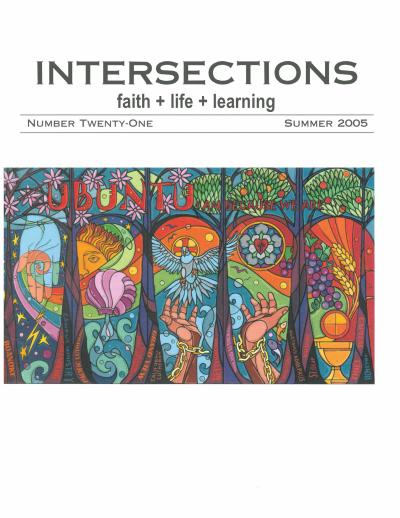
Money, Sex and Power: An Exploration of Some Controversial Issues in the Public Witness of the Church
Pamela K. Brubaker
No. 21 · Summer 2005
Brubaker explores two controversial issues in the church’s public witness—homosexuality and economic life—and the challenges they present for both church and college. Drawing on Beverly Harrison, Elizabeth Bounds, Ron Thiemann, Linell Cady, Marcia Bunge, Richard Hughes, Darrell Jodock, Ernest Simmons, Karen Bloomquist, Garth Kasimu Baker-Fletcher, and Larry Rasmussen, and on episodes at California Lutheran University around “Harmony Week” and Bishop Paul Egertson’s participation in Anita Hill’s ordination, she argues that colleges related to the ELCA are called to educate for “critical citizenship” by hosting rigorous, bold, and unfettered debate—including debate over the neo-liberal globalism that she names a form of economic fundamentalism.
-
 Editorial
From the Editor
Tom Christenson
No. 5 · Summer 1998
Christenson introduces the issue as an illustration of the diversity of interests Intersections aims for, surveys the contents (Lagerquist on method, Mori on art and ritual, Baer on falling walls, Bergendoff as memorial, Funk and Powell in dialogue), urges readers to send in “your good stuff,” asks for distribution feedback, and closes with a sabbatical-year reading list—Kieran Egan, Robert Coles, Daniel Kemmis, David W. Gill, Sallie McFague, Roger Scruton, E.M. Adams, Freeman Dyson, Colamosca and Wolman, Gribbin and Goodwin, van Wyk, Wislawa Szymborska, and Flannery O’Connor.
-
 Article
(Re)Defining Vocation: Gladly Challenging a Vocational Giant
Andrew Tucker
No. 53 · Spring 2021
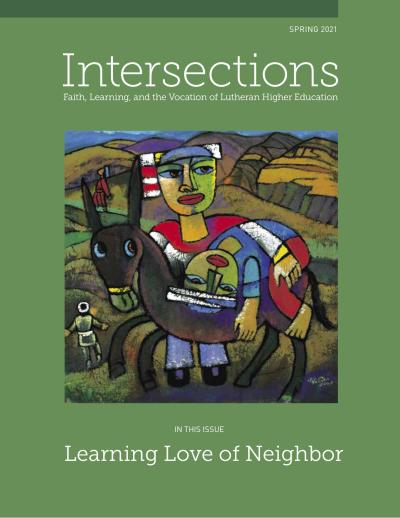
Tucker challenges Frederick Buechner’s famous definition of vocation as “where your deep gladness and the world’s deep hunger meet,” arguing that gladness reflects a privileged perspective and proposing instead that vocation be defined as “any meaningful, life-giving work you do for the world.”
-
 Article
Sexuality over the Lifespan—Social Trends Pose Moral Dilemmas for Communities of Faith
Adina Nack
No. 22 · Spring 2006
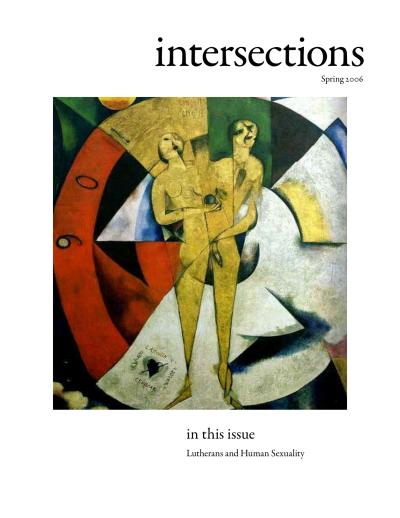
Nack, a sociologist who presented to the ELCA Task Force for Studies on Sexuality, surveys empirical research on three life-stages flagged by the Task Force as particularly contested—premarital sexuality among adolescents and young adults, sexuality after divorce and within single parenting, and sexuality in late adulthood. Drawing on the Alan Guttmacher Institute, the Office of the Surgeon General, AARP, National Council on the Aging, and the World Health Organization’s 2002 definition of sexual health, she closes each section with questions about the church’s role in education, blessing of committed nonmarital relationships, and dismantling stereotypes about aging and sexuality.
-
 Article
Take Heart: Is Neutrality Really What We Need Right Now?
Abbylynn Helgevold
No. 57 · Spring 2023
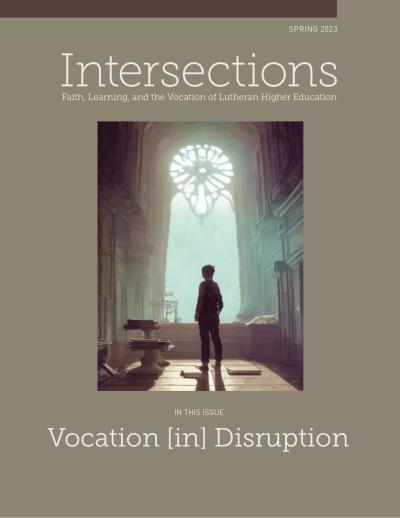
Helgevold, an ethicist at Wartburg College, argues that calls for faculty neutrality on abortion in the post-Roe classroom stifle the courageous conversations Lutheran higher education is uniquely positioned to host — conversations grounded in “Rooted and Open” and the ELCA’s 1991 Social Statement on Abortion.
-
 Article
Deep Roots, Big Questions, Bold Goals
Colleen Windham-Hughes
No. 49 · Spring 2019
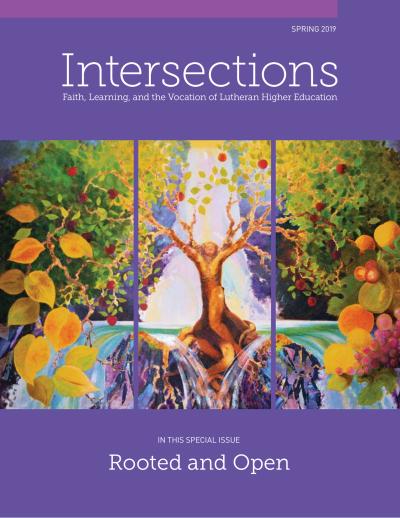
Adapted from a presentation to the California Lutheran University Board of Regents, Windham-Hughes reads the title Rooted and Open as both reaching back into the Lutheran tradition and opening forward into a shared future, then unpacks the document’s “called and empowered — to serve the neighbor — so that all may flourish” through the lenses of freedom of inquiry as a third path, vocation-centered education, radical hospitality, and civil discourse oriented toward the common good.
-
 Article
“A Decolonizing Conversation”: Indigenous Engagement at Luther College at the University of Regina
Marc Jerry, Sarah Dymund
No. 58 · Fall 2023
Jerry and Dymund describe Luther College at the University of Regina’s response to Canada’s Truth and Reconciliation Commission — Land Acknowledgments, a Starblanket ceremony, the Project of Heart, an Elder in Residence, and the unedited video conversation with Elder Lorna Standingready that anchored their 2023 VLHE keynote.