The Dark Angels
To the sidewalk in front of my father’s
Razed bakery I return. To the patch
Of burdock where the stacked ovens deep-browned
The crusts of a million loaves of rolls.
To the cinderblock cracked like the soot-pocked
Windows where I watched, in Etna, the dark
Angels escape the coal smoke as if they
Wanted to swoop back to chimers. To shards
and splinters where I hated the sauerkraut
In the cramped, next-door kitchen, the boiled
Shank end of pork which clustered files against
The latched screen door. To the steep, shale downslope
Where the walls of the bakery are landfill,
Where the first bulldozed soil coats wallboard
And lumber as if coal were refueling
Industry’s return, covering the spot
Where I was careless, once, with Saturday’s
Trash fire. Where it followed the easy weeds
To the brittle boards of the bakery.
Where that neighbor shook free the tiles and sprayed
His hose and a set of obscenities
Keyed to my foolish name. Where my father
Thanked him and led me to the last eclair,
Settled me on the work room’s folding chair
And said nothing except “think,” and I thought
That the neighbor was listening at the window
While I held chocolate and custard until
My father said, “You eat that,” and I did.
Decorative Cooking
My mother repeated the story
of St. Julitta, whose shed blood
spelled the name of God. My father
insisted the name of God was work,
half or more of each day but Sunday.
There was time for food, God’s bounty,
reinforced, from the radio,
by Betty Crocker, who explained
The New Design for Happiness, meals
that showed love for the families
in America’s homes by working
canned soup and cake mixes into
the miracles of ready-to-eat.
In her cookbook, in full color,
she probed the pictorial charm
of food by stuffing pie shells
and peppers, filling tomato halves
and sculpted pastry, creating,
on my father’s favorite page,
mock steak from ground beef and Wheaties,
a strip of carrot for the bone.So pretty, yet economical,
and on our table, each Sunday,
were decorative dinners prepared
the night before: the shimmering,
shaped Jellos; the rank and file
of peeled and slivered apples.
Yearly, the anise Magi cookies,
the browned crosses of holy rolls.
Three times, the flag of celery
and carrots, the field of coconut
holding forty-eight walnut stars.
And once, as God’s duty, we hosted
our former pastor, who had returned
to Pittsburgh to declaim the death
of God. He sat, so heavy, at our table,
the pinwheels of sweet peppers seemed
to churn on the cucumber cogs.
He unrolled, while we passed bread,
four slices of ham and beef;
he unfolded, while we poured milk,
three cheeses, and formed the stack
of a child’s simple sandwich.
My father waited for him
to swallow one bite, and then
he gave thanks for the care with which
our food was prepared, directing
his message to the living God
and his resurrected son while
the pastor held his sandwich in both hands.
An then we decorated our bread
with arrangements of tomatoes
and onions and lettuce before
we added the roll-ups of meat
and cheese, each of them arranged
like the pipes of the church organ
I listened to, this morning,
for the first time in thirty years,
that fat pastor and my mother dead
ten of them, my father driving us
to her grave near the unmarked site
where the minister’s ashes,
according to my father
were scattered like the hopeless.Where God is working, my father
lays wreathes. Where God is working,
my father pulls weeds and hand-trims
the topiary of heavenly hosts.
All morning he wove pine boughs
while I read, and then he called out
the passing of each mile to thirteen,
the right turn through the open gates
to the plot in the Garden of Dreams.
He laid those evergreen crosses
by the headstone of my mother
and the four nearest neighbors
in a symmetry of remembrance,
and then he removed what he’d left
for last month’s anniversary,
adding those branches to the border
of woven designs so they could extend
the decorative work of God
-
 Editorial
From the Publisher
James M. Unglaube
Unglaube opens the journal’s second year by previewing the 1997 Vocation of a Lutheran College conference at Carthage, which will examine the Lutheran tradition from outside (Richard Hughes of Pepperdine on the Lilly Endowment’s Models for Christian Higher Education; David Johnson, President of the University of Minnesota at Morris and Luther College graduate, on the tradition from the public sector) and inside (Ann Pederson of Augustana in Sioux Falls; Timothy Lull of Pacific Lutheran Theological Seminary), and previews Eric Eliason’s emerging proposal for an Academy of Scholars in Lutheran Higher Education modeled on NEH/NSF-style summer seminars.
-
Editorial
From the Editor
Tom Christenson
Christenson explains that this issue breaks from the first two issues’ single-focus pattern to feature three principal papers on the environment, the education of desire, and hiring and personnel policies, plus two poems and a piece of reflective bemusement. He then commends George Marsden’s The Outrageous Idea of Christian Scholarship (Oxford, 1997) and challenges Lutheran scholars to articulate how the particulars of their faith inform their scholarship—in conversation with Calvinist work like Nicholas Wolterstorff’s Reason Within the Bounds of Religion and Art in Action—rather than remaining silently complicit in the view that faith has no place in the academy.
-
Article
The Lutheran Liberal Arts College and Care for the Earth
H. Paul Santmire
Santmire, author of The Travail of Nature, proposes three mandates for the Lutheran liberal arts college: take responsibility for spiritual particularity by confronting the ambiguities of the classical Christian tradition (Lynn White’s charge against anthropocentric Christianity vs. the Franciscan ecological tradition from Irenaeus through Luther) and of classical Lutheran social ethics (the Two Kingdoms, Romans 13, the Third Reich, Bonhoeffer); promote responsible cultural criticism (against Thoreau’s sociopathic anti-urban suburbanism); and promote a holistic environmental ethos through an interdisciplinary core curriculum with ecology as the queen of the sciences, a community that liberates the social imagination (Mumford, Marcuse), a cosmic Liturgical praxis rooted in the Colossians 1:15–20 hymn to the cosmic Christ, and an academy that models ecological responsibility.
-
Article
An Aristotelian Twist to Faith and Learning
Gregg Muilenberg
Muilenburg, chair of Philosophy at Concordia, surveys the four traditional models for faith and reason—conflict, independence, dialogue, and integration—and argues that the Lutheran dialogical model is insufficient for wholeness. Drawing on the post-foundationalist epistemology of perspective and Aristotle’s account of knowing as desire-driven action, he proposes that faith is an ultimate value (an assessment belief of the form ‘x is better than y’), that learning is desire-directed action, and that the core of Christian education is the education of Christian desire—requiring both reflection and commitment, both integration and diversity.
-
Article
Mission and Hiring in the Christian College
Bruce Reichenbach
Reichenbach of Augsburg argues that the Christian or Church-related college’s mission to educate the whole person from a perspective of Christian faith and values can only succeed through intentional hiring of a “critical mass” of faculty, administrators, and staff committed to that mission (following George Marsden and the 1960s Danforth Commission), supplemented by on-going faculty development. He defends an inclusive community-with-diversity, a freedom-and-commitment tension grounded in Alasdair MacIntyre’s account of tradition, and the legality of preferential religious hiring under Title VII of the Civil Rights Act and the relevant case law (Tilton, Hunt, Roemer, Blanton, Grove City, Amos).
-
Response
A Call for Creative Education
Wendy McCredie
McCredie of Texas Lutheran responds to Reichenbach by reframing the four ideas embedded in his claim that “the entire college community should be knowledgeably committed to the college’s mission”—community, knowledge, commitment, mission—and argues that the Lutheran tradition’s unwillingness to be separate from the world should lead us to educate the public about the Lutheran tradition rather than interrogate prospective employees about their faith. She questions whether agreement on “Christian values” is possible (or even Lutheran), and reads Reichenbach’s “creative education” as the dialectical tension between gospel and law, God’s love and our human limits, that members of communities related to the Lutheran church are uniquely positioned to inhabit.
-
Response
Hitting a Moving Target
Harry Jebsen
Jebsen, former Provost of Capital University, responds to Reichenbach by arguing that the institutions, the ELCA, congregations and pastors, students, and curriculum are all moving targets. Drawing on Alvin Toffler’s Future Shock and his own fifteen years of hiring as Dean and Provost (a candidate who hoped the cross out front didn’t mean anything), he traces the drift from the “Mr. Chips” faculty who personified Dana and Midland Lutheran to a campus culture where “everybody is nice to each other” has replaced theological substance, and where MBA programs, conservatories, law schools, and adult-education programs further dilute the focus of the residential Lutheran college.
-
Reflection
Confessions of a Collaborator
Chuck Huff
Huff of St. Olaf offers a tongue-in-cheek public confession of his lifelong sin of collaboration—from elementary-school reports on dinosaurs and Cliff notes on Faulkner, through high-school algebra and college group projects, to borrowed syllabi, group work imposed on resentful students, tutorials, independent studies on every form of self-reliance, and circulated drafts. Even this confession was collaborated on, and (he confesses) he enjoyed it.
-
 Article
Holy Odors
John P. Trump
No. 14 · Summer 2002
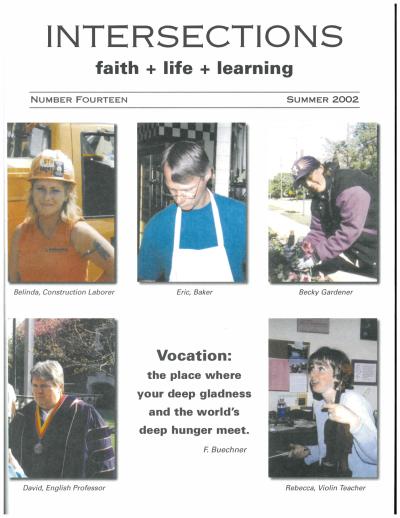
A one-act play by John P. Trump, premiered at Pacific Lutheran University, in which Maggie, a senior studying Reformation history in the library stacks, falls asleep over the Apology of Augsburg and dreams a 16th-century pickled-herring merchant—Herr Leonard Kopp, the man who smuggled Katie von Bora and eight other nuns out of the convent—into existence to argue that her call to archaeology (“digging up old bones”) is as holy as ordained ministry, with Luther’s joke that the church burns incense to insulate priests from the “holy odors” (not holy orders) of everyday life.
-
 Poem
Poem
Poetry: Rituals for an Uninvented Religion / On the Recently Discovered Mass Grave of Mice
Kevin Griffith
No. 6 · Winter 1999
Two poems by Kevin Griffith of Capital University: “Rituals for an Uninvented Religion,” a seven-part liturgical bestiary of made-up customs (lead-filling cups in June, masks for the dying, two bottom-feeding August fish, wax grave markers with wicks, the leap-day child, and the carnival-free day of judgment), and “On the Recently Discovered Mass Grave of Mice,” prompted by New Zealand shepherds’ uncovering of 300,000 mouse skeletons, on the bones “each light as a child’s first question” and the “graveyard rush” we share with the good flock.
-
 Poem
Poem
Unpossible
Tim Knopp
No. 19 · Summer 2004
A new Capital University education graduate reflects on the bargain of trading childhood for “four years closer to some hidden knowledge, four years farther from what I once knew,” as the noon chimes call him out into a campus where professors and students teach one another along worn brick paths that “love is” should be “love can be.”
-
 Poem
Poem
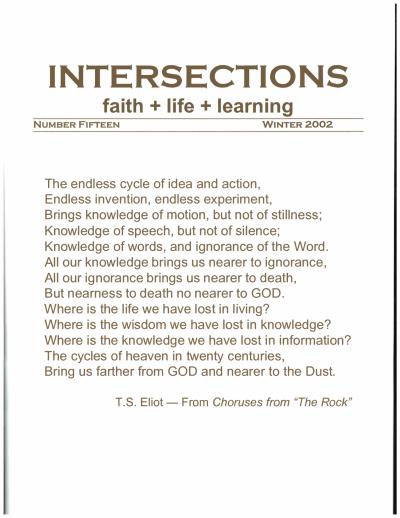
Drunks in a Midnight Choir
Kevin Griffith
No. 15 · Winter 2002
A pantoum-like Christmas-season poem in which red-robed choristers, flasks clinking and hands trembling, mangle the words of carols beneath “the midnight sky, your endless dark coat,” trusting that “it’s the season to forgive what’s vile” and that even wise men praise the humble and make glad.
-
 Poem
Poem
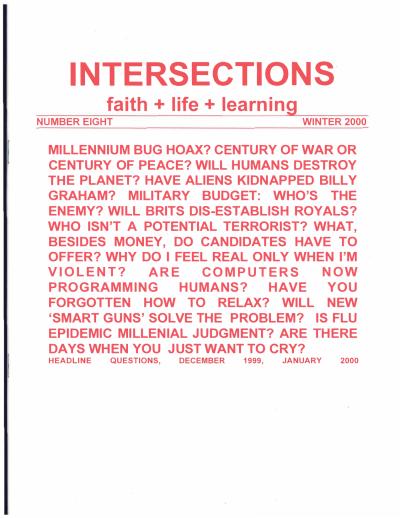
Things That Renew Hope
Sig Royspern
No. 8 · Winter 2000
Inspired by Andrew Greeley’s Religion as Poetry, which defines religion as hope-renewing experiences and the stories, symbols, rituals, and images that preserve them, Rauspern offers a list-poem of small renewals of hope: lovers kissing in the street, the first snowfall of each year, compost and spring sprouts and Jewish humor, kids’ summer mischief, a mother nursing her baby on the bus, small jazz ensembles, two old men reconciling without remembering why, an unscheduled gift, the blues, a child taking him by the hand, and a gray-haired man who threw his cellular phone in the river.
-
 Article
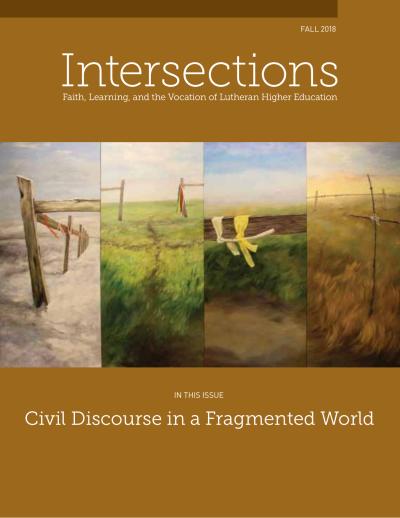
The Musician's Vocation
Jeffrey Bell-Hanson
No. 48 · Fall 2018
Bell-Hanson argues that musicians, who exercise profound influence over the emotional flavor of a moment, are called not merely to technical proficiency but to a sense of vocation: understanding their art well enough to use it responsibly, to intend truthfulness rather than manipulation, and to articulate its significance in dialog with other disciplines.