The Sense of Vocation program at Luther College, made possible by the generosity of Lilly Endowment, has enriched significantly campus life since its beginning in January 2002. The vocation grant has strengthened campus conversations on vocational discernment and has deepened our corporate vocation as a liberal arts college of the church.
The word “calling” has a strong presence in Luther’s mission statement, which affirms that we “challenge one another to learn in community, to discern our callings, and to serve with distinction for the common good.” Our Sense of Vocation program is structured on the theory that vocational discernment occurs at many moments in a student’s undergraduate career.
More than anything else, such a process is based on conversation and dialogue—students literally must “try out” different versions of their vocational call through interactions with their peers, faculty mentors, advisors, coaches, and their work-study supervisors. As a result, we organized the overall program with three distinct areas of focus: General Program Initiatives for the entire campus, the Church Ministry Program for students considering seminary or church service, and the All-Student Vocation Program to enrich the discernment conversations of all Luther students.
The title A Sense of Vocation came from Luther’s “Goals for Student Academic Achievement,” in which we promise that students will develop “a commitment to a life of work that will provide success and fulfillment, guided by a sense of vocation.” The program flows from our mission and reflects our campus culture as a community of faith and learning:
- It supports the ways we seek to embed the dialogue of faith and learning into all our activities, with an intentional focus on the concept of vocation.
- It is deeply interwoven with the academic program, the institution’s heart and soul, yet connects many facets of a student’s life by building on Luther’s strength as a residential college.
- It creates many opportunities for members of nearly every college constituency to ponder vocation as it relates to their lives.
Luther’s Sense of Vocation program is proving to be an effective mix of activities and initiatives. Specifically, our program is advancing the three aims identified in Lilly’s Theological Exploration of Vocation grants initiatives: 1) helping students examine the relationship between their faith and vocational choices, 2) providing opportunities for young people to explore Christian ministry as their life’s work, and 3) enhancing the capacity of Luther’s faculty to teach and mentor students effectively in this arena.
We have successfully found ways for conversations about vocation and the discernment process to occur in many corners of the campus. More than 1,500 students, faculty, staff, alumni, prospective students, church leaders, and Vocation Visitors have directly participated in the program, and that does not count the number of students who have attended classes, lectures, or workshops devoted to the theme of vocation. In reviewing the most significant features of the current program, we remind readers of the institutional structure intentionally designed to create a sustained and persistent presence of vocation themes throughout the campus. Below we discuss key initiatives within each of the three major components: General Program Initiatives, Church Ministry Program, and All-Student Vocation Program.
I. General Program Initiatives
A. Vocation Visitors
Vocation Visitors has been one of our most visible and exciting initiatives, and in terms of sheer numbers of students and faculty affected, has had the largest impact. These program visitors connect current students with alumni, church leaders, and other professionals who have identifiable expertise, who have given special thought to vocation and service, and who can show undergraduates the life and work of practitioners who model vocational living in their respective fields. Their visits to campus are punctuated by any number of activities, and their residencies can last a day, a week, or even three weeks, with most residencies lasting two to three days.
Vocation Visitors act as guest lecturers in courses, mentor students in small group conversations, lead Bible study or daily chapel, or serve as facilitators in reading groups of faculty, staff, and students. Since the spring of 2002, Luther has hosted thirty-nine of these visitors in fields such as church music, journalism, education, religion, environmental activism, feminism, political science, and biology. Notable visitors include Parker Palmer; Reverend Heidi Neumark (author of Breathing Space); and Paul Heltne, President Emeritus of the Chicago Academy of Sciences. In each case, we ask the visitor to address, either in a public lecture or a classroom session, the path of vocational discernment and choices that helped him or her achieve a sense of identity and purpose within the framework of work or service.
Our intention is not so much to offer the stories from Vocation Visitors as a template for students to follow, but rather to illustrate to students a fundamental assumption about vocation. The path toward following Frederich Buechner’s advice about matching “the world’s deep need” to their own “deep gladness” is rarely linear or straightforward; in fact, it takes great patience and wisdom, and students are far more apt to feel strengthened in that journey if they recognize the value of continually reflecting on their work in relationship to their values and life-long goals. We have had the greatest success when Vocation Visitors come for at least three days, ensuring ample time to interact with students and share wisdom about their often circuitous vocational journeys.
B. Faculty Development—Faith and Learning Workshop
As new faculty begin their second year at the college, their understanding of the Luther mission is enhanced by the Vocation Workshop on “Luther College as a Community of Faith and Learning.” Led by three senior faculty members from various disciplines, the Faith and Learning Workshop builds faculty collegiality in a non-threatening, non-doctrinaire environment, establishing arguments for the compatibility of academic excellence and church identification, and clarifying Luther College’s particular identity and mission. Since the beginning of the grant period, forty-eight new Luther teachers have shared in this valuable conversation about personal and institutional vocations. Evaluations regularly tell us that the two-day encounter has a long-term and very positive impact on interactions with their colleagues, and on the development of their roles as teachers and advisors of our students. The Faith and Learning Workshop has become a visible and important component of faculty development at Luther College, and it helps young faculty more fully connect with Luther’s mission.
C. Self-Directed Reading Grants
Because many faculty and staff learn best in independent settings, we designed the self-directed reading program to provide opportunities, particularly during summers and sabbaticals, for those individuals or small focus groups who wish to explore a reading list specifically tailored to their disciplines. For example, thirteen faculty and staff women organized a reading group that “dissected readings, shared experiences and related how these reflective moments of our lives had come together to formulate our work and personal lives.” They also considered how Luther’s women students at various stages of development would benefit from programs and discussions of their own. To date, thirty-five Luther faculty and staff have taken advantage of the opportunity to explore vocation through self-directed reading programs.
D. Publications
Early in the life of the grant, a six-page Vocation Newsletter was bound into the center of the Luther Alumni Magazine and sent all over the world to 35,000 alumni, friends, and benefactors of the college. This attractive piece represented our first general communication to all college constituencies and had a positive impact. We have assembled additional newsletters for distribution in subsequent years. During the grant, we also saw publication of the work, “Called to Ecumenism: A Sense of Vocation at Luther College,” by Vocation Director Ruth R. Kath. The book includes reflections by many different voices on the campus, including a member of the Board of Regents, an international Vocation Visitor, the college’s former Chaplain for Catholic Students, a number of faculty members, and two bishops. We also published a second book called “Vocation Voices,” which included special photos and vocational reflections by some forty members of the Luther community. The work is made available to incoming students, new faculty and staff, and visitors to the campus as a means to both support vocational reflection in the community and ensure the continued telling of the Luther story to our new members as they join us.
E. Faculty/Staff/Student Travel
The Faculty/Staff/Student Travel funds supported travel to conferences or events with a specific focus on the theological exploration of vocation. To date, we have funded such travel for some one hundred individuals, including attendance by two religion faculty and a college pastor at a 2002 “Sharing Stories of Vocation” conference at Pepperdine University. Students have especially benefited from these funds, including two who recently traveled to Washington, DC, to participate in a special conference focused on service, civic engagement, and the connections between Christian faith and environmental activism. The Faculty/Staff/Student Travel funds have been among the most appreciated offerings of the Sense of Vocation program. They have allowed members of the Luther community to benefit from many outstanding opportunities, which in turn enrich campus conversations about vocation.
II. Church Ministry Program
A. Vocation Fellowships
Among the wide circle of current students who are considering either ordination or spending a significant portion of their lives as lay church leaders, the Vocation Fellowships have been an enormous incentive. Annual summer Fellowships of $1,000-$1,500 to current students who work in parish internships or church-related camps have been very popular with Luther students. Since the grant began, we have established mandatory pre- and post-fellowship retreats to assist students with their reflections about vocation and their planned summer employment. Included in each retreat are worship opportunities, group conversation, and time for personal writing. To date, these awards have assisted over two hundred Luther students.
This program has heightened the visibility of ordained and lay ministry vocations, and we have seen significant growth in students’ ability to reflect on their identities and their gifts as they discern their callings. The Vocation Fellowships provide an excellent tool with which to talk about vocational discernment to a whole group of students we had not reached before.
B. Discernment/Seminary Visits
A primary focus of the Lilly-funded initiatives is to enhance the frequency and quality of contact with students who are discerning a call to ordained ministry, either during their college career or in the years just after their graduation. Current Luther students who have expressed an interest in the ministry gather biweekly for group conversation with one of the campus pastors and with an array of visiting alumni and others who share the stories of their vocational paths to ordained ministry. While the DIAKONOS group existed before the grant, it has been revitalized with the assistance of Lilly funds and now enjoys markedly improved effectiveness and visibility. An average of sixty Luther students participate each year, and thirty-nine visitors have met with these students to date. The Discernment Conversations take place not only in the group, but also in one-on-one conversations with each of the three campus pastors.
To supplement these on-campus conversations, we have funded fifty student visits to seminaries of the students’ choice. As a result of such support, student travel to seminaries outside the usual circle of the Midwest has yielded excellent results, including a full scholarship at Vanderbilt Divinity School for one of our graduating senior women this year. She wrote recently: “The grant has enabled me to visit seminaries that I would have otherwise not been able to visit. Because I was able to travel at practically no expense to myself, I discovered a school that I really enjoyed and am now going to attend that school next fall.” Since the beginning of the Lilly grant, over thirty Luther students have gone on to seminary.
C. Alumni Vocational Discernment Retreats
Each summer, the college hosts a discernment retreat on campus for a group of young alumni who have been discerning a call to either ordained or lay ministry. Over the course of several days, we help them talk about their Luther experiences (both encouraging and challenging), the journey to where they find themselves now, and their questions about the future. Our goal is to reacquaint them with the college, the Sense of Vocation program, and each other as sources of ongoing support as they continue their vocational discernment and enter the world of work in the next years. The reflections of these highly engaged recent alumni give the college valuable feedback on the effectiveness of the vocation program and the institution as a whole. To date, some one hundred alumni have participated in these retreats.
D. Church Leader Retreats/Workshops
Church Leader Retreats are designed to support lay and ordained church leaders who are already in the field and in need of renewal. During the grant period, we have offered such workshops as Wellness: Who Nurtures the Nurturer?; Unexpected Outcomes of Pregnancy: Vocation of a Caregiver; and The Book of Ruth. While beneficial connections being forged among members of the various church leader groups may follow naturally, we have been gratified to note the ways in which our own contact with the participants in these groups has broadened our understanding of vocational formation and understanding. The Church Leader Retreats and Workshops also have provided several new opportunities for parish internships for our undergraduates, as connections were made, either with us or with the students directly, during the on-campus time together. To date, forty-eight church leaders have participated in campus retreats. These participants have helped us understand their need for a structure of continuing education credits from the courses and events. One pastor commented on the value of the retreat opportunity:
Last year was my first experience with the Church Leader Retreat, and I thoroughly enjoyed the chance to gather with colleagues who shared a similar vocational path. Ministry is a demanding call, made more so by the era in which we live. The chance to interact with peers has shaped my ministry and given new life to the ways in which I carry out my call.
E. Renewal Opportunities
The Renewal Opportunities for rostered ELCA clergy evolved as a natural extension of our Church Ministry Program. For the past two years, the college has offered the short-term use of our campus facilities (usually three days) to rest, reflect, read, and write. Although not envisioned in our original grant proposal, the program, suggested by Luther’s president, has been appreciated by the ten clergy who have taken advantage of our relatively low cost and effective offer of support.
F. WIYLDE Initiative (Wholly Iowa Youth Leadership Discipling Event)
The WIYLDE initiative reaches out to prospective students during a week of spiritual formation and leadership development designed to help high school youth deepen their fundamental church connection. WIYLDE creates a link with participants’ home congregations and involves youth and leaders from the three ELCA synods of Iowa. While the other initiatives planned to appeal to prospective students in secondary school have not fulfilled their potential, WIYLDE has experienced a strong surge in numbers of participants and promises to continue its remarkable growth. To date, over one-hundred-fifty young people have participated in these events, and several former WIYLDE participants now attend Luther as full-time students. Even with the heavy competition for the relatively small pool of young people in Iowa, WIYLDE seems to be an attractive and effective vehicle for reaching and retaining interest in both home churches and this college of the church.
III. All-Student Vocation Program
A. New Student Orientation
The Sense of Vocation program has added an important component to our traditional three-day New Student Orientation by providing funds for greater involvement from the entire campus and a heightened emphasis on students’ awareness of their new “calling” as college students. In the past, students had read a book as an introduction to the required Paideia I course, an interdisciplinary prologue to the liberal arts with an intense curriculum in writing. Now the focus rests more on finding a book that will cultivate a reflection on issues regarding education, faith, and citizenship. Recent titles include Ernest Gaines’ A Lesson Before Dying and Eboo Patel’s Acts of Faith. Inviting all members of the campus community—from Resident Assistants to Financial Aid staff—to read the book along with incoming students has resulted in a graceful note of hospitality, as well as some lively conversations among people who might think they have nothing in common.
In addition, the orientation now includes a two-hour class meeting facilitated by students’ Paideia I instructors, teamed with a faculty member from another discipline. Our goal in these conversations is to introduce students to a new understanding of vocation—a serious process whereby what they do throughout the next four years will determine their values, core beliefs, and talents that will eventually take root in the wider world. We have also arranged a meeting, sans instructors, among Peer Mentors and students, as an opportunity for students to talk with more experienced peers regarding their initial expectations, anxieties, and hopes for college.
B. Peer Mentors
Luther’s Sense of Vocation program is structured on the theory that vocational discernment occurs at many moments of a student’s undergraduate career, and we recognize fully that students themselves play a vital role in helping their peers discern their goals both in and beyond Luther College. We created the Peer Mentor program to help formalize the ways in which older students can mentor new students, particularly in showing them how to successfully integrate their academic work with the freedom and demands of college life as a whole. In addition, the program was designed to provide a significant educational experience for the mentor, by connecting an upper-level student with a faculty member who discusses in detail the pedagogical assumptions and implications regarding a course that the student has already completed. Thus, the mentoring relationship extends both from faculty to student, as well as from student to student. The program has had its most significant impact on Paideia I, with strong numbers of sections using Peer Mentors. They have also worked in courses within the biology, modern languages, and religion/philosophy departments.
The impact of these encounters has been very impressive. The mentoring students often report that the work has helped them discover an interest or desire to pursue fields in teaching or public service. For the younger students who encounter these older role models, the impact is equally strong, particularly in helping first-semester college students understand their immediate vocation as an engaged student. First-year students become aware, by this informal but sustained encounter, that it is possible to balance the workload of college, and frequently the conversations take a turn toward how the mentor is preparing for the next step in his or her life.
In other words, providing the opportunity for a first-year student to listen as a junior or senior explains how he or she followed the path of a particular major and is now currently weighing vocational questions about teaching, graduate study, or work in volunteer programs is invaluable for the students who are just getting started. As one mentor described it:
For me, conversations have been the most important part of this program because I can talk with students about their worries, successes, and plans for the future and help them out as they try to navigate their first year of college.
C. Curriculum Development Grants
One of the most exciting and successful initiatives of the Lilly grant has been the Vocation Curriculum Development program, which has provided supplemental funds for Paideia Capstone courses and mini-grants for the development of courses with vocational content.
Paideia Capstone Courses. The curriculum development grants have had their strongest impact upon the Paideia Capstone course, an interdisciplinary course that engages students in a critical examination of values, value systems, the process of ethical decision-making, the Christian tradition, and personal service and vocation. We have extended curriculum grants to twelve teaching teams of three faculty members each to strengthen the curricular focus on vocation in these courses. The funds have helped faculty in these important courses clarify how “vocation” can be seen as a defining theological concept in a Luther education. Examples of new Capstone courses include Stewardship and Sustained Development, Making Decisions for U.S. Schools, Health Care Ethics, and Reconciliation in South Africa.
Many Paideia Capstone courses offered in recent years have taken advantage of an award to allow the instructors to shape a special student-centered event that will enhance their understanding of vocation within the context of that particular course. In one recent year, for example, two study abroad Capstone instructors used London’s British Museum as an appropriate setting for conversations with upper-level students on vocational discernment, followed by selected visits to those parts of the museum where the emblems of history and culture would most directly speak to each student’s future plans.
New Course Development. While course development activity in the early days of the Sense of Vocation program was limited, the establishment of a competitive summer grant to three faculty members annually to support the development of a new course with some aspect of vocation has been highly successful. Some of Luther’s best faculty from across the campus have applied to teach an abbreviated version of the new course during our week-long summer alumni program, then fine tune it for offering within the regular undergraduate curriculum during the next academic year. Courses emerging from this innovative program include Martin Luther’s Call for Citizenship: A Theology of Vocation; Vocation and War: Making Judgments; The Path to Wholeness: Finding One’s Vocation in Forgiveness; and Vestiges of Religious Traditions. The inclusion of the summer alumni program in the course development has had the added advantage of drawing a wide range of Luther alumni into the vocation conversation as well.
D. Vocation Advising Workshop
The Vocation Advising Workshop gathers together faculty members from all departments for an annual conversation about the vital task of helping students identify their gifts and talents within the context of their academic program and intellectual growth. The workshop connects relatively inexperienced advisors with seasoned ones, and has become a valuable connector among colleagues and an important component of vocational education and faculty development. One faculty member noted:
I have incorporated the word and idea of “vocation” into my work with students. I find my conversations with students about their career and life plans are often couched in a “bigger picture” with greater meaning. This culture of vocational discernment has encouraged me to inquire and sometimes challenge students about their life plans, getting them to think about their life’s purpose if they aren’t.
Though the inaugural Vocation Advising Workshop did not take place until mid-way through the grant, some one-hundred-fifty faculty members have participated to date. Our goal is to reach all remaining faculty member at Luther over the next three years.
E. Advising Handbook
A Vocation Advising Handbook was prepared in Spring 2004 and revised in 2009, with assistance from major departments across the college. It outlines requirements for every major and centralizes other pertinent advising information. The handbook was completed in time for use in spring registration, and many faculty said they found it to be most helpful in meeting with and advising students. By its nature, the Advising Handbook is a work in progress, requiring regular updating and revision. The Advising Handbook will be on-line soon.
The Advising Team of English Professor Nancy K. Barry and Dean of Student Life Ann Highum has been highly effective. Barry was co-author of the original Lilly grant application and has long been an active member of the Vocation Steering Committee. Highum has co-led the mandatory preparatory workshops for Vocation Fellowship applicants, as well as co-taught one of the most effective and popular courses under our Vocation Curriculum Development program. This creative and energetic team helps to bring the All-Student Vocation Program to its full implementation.
Program Leadership
The leadership of the Sense of Vocation program consists of Program Director Ruth R. Kath, Ph.D., Professor of German since 1979, who also holds an M.A. in Theology (1998), and Nancy K. Barry, Ph.D., Professor of English and Assistant to the Dean for Advising and Writing. The program Administrative Assistant is Constance Barclay. The Sense of Vocation Steering Committee consisting of members from the faculty and administrative staff, including: Michael Blair, Campus Pastor; Jayme Nelson, Assistant Professor of Nursing; Bradley Chamberlain, Associate Professor of Chemistry; Ann Highum, Vice President and Dean for Student Life; Tanya Gertz, Director of Campus Programming; Kath, and Barry.
Long-Term Goals
The long-term plan of Luther’s Sense of Vocation program is to embed vocation program strategies into existing curricular and co-curricular programs where there is consistency with Luther’s mission and where specific vocation initiatives are effective in helping students discover their gifts and discern their call. The college is firmly committed to permanently sustain those aspects of the Sense of Vocation program which are demonstrated to add value to the experience of our students, faculty, and/or staff. Ongoing evaluation—of both the programs and their impact—will help us assess our progress in achieving the goals of this long-term plan.
-
 Editorial
From the Publisher
Mark Wilhelm
Wilhelm traces his decades-long enthusiasm for the Lutheran doctrine of vocation from his St. Olaf days reading Luther’s Open Letter to the German Nobility, notes Parker Palmer’s lecture-circuit ministry and Mark C. Taylor’s reflections on calling, and argues that ELCA colleges should claim vocation as the defining mark of Lutheran higher education—yet warns that vocation risks becoming “the program du jour” rather than a permanent hallmark.
-
Article
Called for Life — Affirming Vocational Discernment
Richard L. Torgerson
Torgerson introduces the “Called for Life” project, a three-year, $278,437 Lilly Endowment-funded collaboration among Luther, Augsburg, and Augustana that—in partnership with Luther Seminary’s Centered Life initiative and Wilder Research—rigorously assessed the effectiveness of campus vocation programs, examining whether students’ exposure to and understanding of calling had increased, and what program elements were most effective in shaping discernment.
-
Article
Called for Life
Brian Pittman, Ellen Shelton, Greg Owen
Owen, Shelton, and Pittman of Wilder Research present the key findings of the Called for Life study, comparing the class of 2007 “Lilly graduates” from Luther, Augsburg, and Augustana to a pre-Lilly cohort from the class of 2001. They report that Lilly graduates were more than twice as likely to associate vocation with “calling” rather than “just a job,” and they identify four common ingredients of effective programming: relationships with caring adults, experiential learning outside the classroom, vocation-infused courses, and peer relationships within a pervasive campus culture of vocational exploration.
-
Article
A College with a Calling: Vocation at Augsburg
Mark D. Tranvik
Tranvik narrates Augsburg’s decade of deep engagement with vocation—from President William Frame’s 1997 visioning process and the 2002 two-million-dollar Lilly grant for Exploring Our Gifts, through five Lutheran theological principles (vocation includes the whole life, lives for the sake of others, ranks all callings equal, cannot be reduced to ethics, and engages public life), to the Wilder Foundation’s Called for Life assessment and the 2008 founding of the Augsburg Center for Faith and Learning under Dr. Tom Morgan and the Bernhard Christensen Chair held by Dr. David Tiede.
-
Article
Called to Serve
Robert D. Haak
Haak describes Augustana’s Center for Vocational Reflection (CVR) and its threefold framework of skills/gifts/talents, passions/values, and needs of the community. He surveys the CVR’s Working with Faith group, seminary visits, spiritual companioning, Servant Leader Internships, international travel reflection, and the major Senior Inquiry curriculum revision—then reports the lessons learned at Augustana: that multiple exposures matter more than any single program, that the language of vocation works even for non-religious students, that student-initiated ideas (like Erin Blecha’s Athletes Giving Back) often succeed most, and that the CVR will soon merge into a new Community Engagement Center.
-
 Editorial
From the Editor
Tom Christenson
No. 18 · Fall 2003
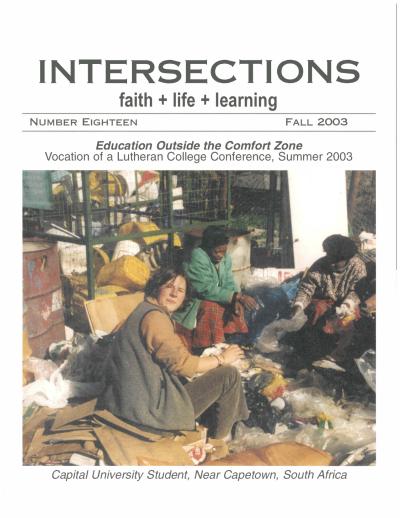
Christenson draws on a ten-year alumni survey at Capital University showing that students most often credit practica, internships, travel-study, and service-learning—not classroom hours—as the places they best learned the university’s stated outcomes, and introduces this issue’s papers from the Summer 2003 Vocation of a Lutheran College Conference on education and global outreach.
-
 Editorial
From the Editor
Tom Christenson
No. 9 · Summer 2000
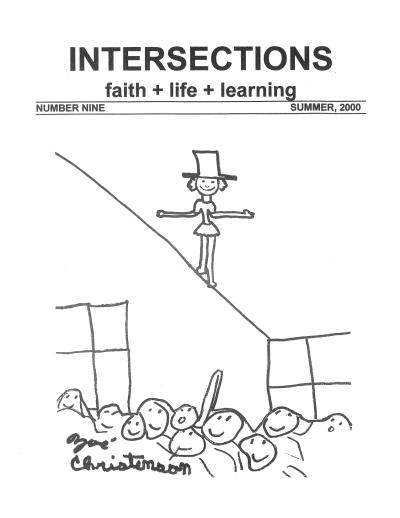
Christenson introduces a varied issue: the VonDohlen / Ratke discussion of the two kingdoms doctrine, Rachel Hammond’s “real gem” of a talk on her time in Ecuador (with an invitation to send contributions to the Home for Perpetual Hope orphanage via her home church in Oberlin, Ohio), Chuck Huff’s essay on the effect of liberal learning on the practice of psychology, and John Reumann’s reflection on a scholarly life lived between academy and church—and notes that the cover artist is his eight-year-old daughter Zoé, whose post-circus drawing of a balancing act struck him in light of Reumann’s opening line.
-
 Editorial
From the Publisher
Mark Wilhelm
No. 35 · Spring 2012
Wilhelm describes the “four-legged stool” supporting ELCA higher education—the annual Vocation of a Lutheran College Conference, the Lutheran Academy of Scholars, the Thrivent Fellows program, and Intersections—and argues that the conversation about Lutheran mission and identity must now be extended beyond college and university personnel to the larger church and community before the gains of a generation are lost.
-
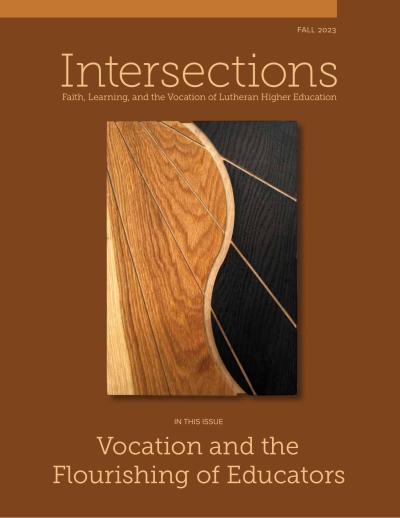 Editorial
Maintaining Our Lutheran Identity: A Source of Strength
Lamont Anthony Wells
No. 58 · Fall 2023
Wells reflects on the well-being of staff, faculty, and administration in Lutheran higher education across four pillars — rest, creativity and innovation, religious diversity and pluralism, and the preservation of Lutheran identity — and addresses the painful reality of Finlandia University’s closure as a reminder of the network’s shared mission.
-
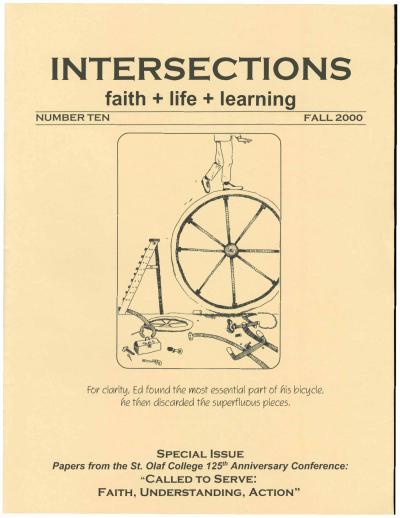 Editorial
From the Editor
Tom Christenson
No. 10 · Fall 2000
Christenson recommends the St. Olaf 125th-anniversary volume Called to Serve—edited by Pamela Schwandt with Gary de Krey and L. DeAne Lagerquist—particularly Walter Sundberg’s “What Does It Mean To be Lutheran?” and Darrell Jodock’s “The Lutheran Tradition and the Liberal Arts College.” He notes that the volume’s biographical sketches of Lars Boe, F. Melius Christiansen, Ole Rolvaag, Emil Ellingson, Agnes Larson, John Berntsen, Arne Flaten, and Howard and Edna Hong show, against an outsourcing age, that the life of an institution like St. Olaf is the committed life of the people who work there.
-
 Book Review
Robert Benne: Quality With Soul: How Six Premier Colleges and Universities Keep Faith With Their Religious Traditions
Joy Schroeder
No. 13 · Winter 2002
Schroeder reviews Robert Benne’s Quality With Soul (Eerdmans, 2001), which assesses the secularization documented by James T. Burtchaell’s The Dying of the Light and names six “bright lights” that resist it: Calvin, Wheaton, Baylor, Notre Dame, Valparaiso, and St. Olaf. Benne argues that piety alone or “generic Christianity” is insufficient—a school’s specific denominational intellectual tradition must permeate mission statements, classroom, and chapel, sustained by a critical mass of identifying faculty (he proposes a 2:1 ratio and at least one-third communicant membership), a first-rate theology department as “trustworthy guardian,” and visionary presidential and board leadership. Schroeder flags the under-representation of student and faculty voices but commends the book as required reading for presidents, board members, and faculty seminars at church-related institutions.