Modeling Virtue: In Which a Social Psychologist Decides He Can Do Good Without Freely Choosing It
Intersections No. 9 · Summer 2000
And now here is my secret, a very simple secret;
It is only with the heart that one can see rightly;
what is essential is invisible to the eye—from The Little Prince by Antoine De Saint-Exupery
I want to measure those essential, ephemeral things;
things seen only with the heart.And the measurement is true if the heart sees my data
and thereby sharpens its vision.—Chuck Huff
As a sophomore in South Georgia in 1975, I was stunned by the barrenness of my introduction to psychology. It was, no doubt, both current and correct; precise and clean. So clean, said my heart, that it was sterile. It stripped the psychological world of wonder.
I sat in a bolted down chair in rows of 20 students each, and watched like you might in a surgery auditorium while the professor dissected my wonder. I was told I should replace soul, meaning, the self, altruism, and evil with negative and positive reinforcement, punishment, control structures, and other such steely and scientifically pristine constructions. Like Danny Saunders in Chaim Potok’s The Chosen I wanted to know “What does experimental psychology have to do with the human mind?” We got rats instead, in clean aluminum boxes with levers and a drinking bottle.
After lectures outlined on a rolling overhead, viewed from the silent ranking of seats, every day I escaped to watch ants run in and out of a small hole in the red Georgia clay. Watching REAL animals, doing real things seemed wonderful. It was a small ant hill; a conical mountain on their barren landscape, several feet from any thing deserving the name of grass. But they fascinated and comforted me with the scurrying, mysterious purpose they displayed. Here was real behavior, enfleshed in meaning and history. I was disappointed in the sterile picture my class gave me of these animals, and, when I got up the courage, I was astonished. The class was a success in at least one sense: I was convinced that psychology was a science, but I was also convinced that psychology was irretrievably boring.
I’d like to take this opportunity to revise that picture of psychology. Psychology is surely scientific, but it is far from boring, and it asks, or at least hints at, some of the enduring questions of the liberal arts. I want to deal with two main reasons for rejecting a scientific psychology as relevant to the concerns of the liberal arts: the claim that it denies human meaning and the claim that it eliminates personal choice and responsibility. These were certainly my complaints about my introduction to psychology. It was barren of human meaning. Tragedy and joy both evaporated into epiphenomena. It left us all looking like machines rather than people with souls. In humans, there was no room for soul, free will, personal choice, or responsibility.
As a sophomore, I was most disillusioned by the denial of meaning. It was not until I became a senior psychology major that the issue of choice and free will seemed central to me. My reaction to the scientific claims of psychology about free will eventually drove me into the arms of philosophy, as I tried to discover why psychologists like B. F. Skinner felt they had to say the odd things they did. I now think much of what Skinner said was not odd, though it was couched in a now-outmoded philosophy of science that required the dismissal of all mental states, and thereby all personal meaning. And I now agree with Skinner that the importance of free will is overrated, though I am still undecided on the question of whether it exists or not.
Modeling and Meaning
The first objection, that psychology denies human meaning, can be stated in a variety of ways. One claim is that psychology takes no regard for the meaning of the individual human life—for the particular cares, concerns, and values of the individual. That its statistical and mathematical formulae obscure the nuance of personal motivation and meaning.
Psychology must plead guilty to this charge. Psychologists do have a peculiar way of understanding the behavior of organisms. It involves making models of how they behave, think, and feel. This is a standard scientific approach, ranging from the precise mathematical models in Physics to models in Sociology that look more like traditional metaphors. In fact a metaphor is a useful model, if you will, of what a model is.
A scientist who builds a model does so by creating a description of the phenomenon that is suited to the purpose and that makes allusions to other descriptions. The purpose is finding patterns in how organisms behave, think, and feel. There is nothing essential about the patterns or metaphors that makes them scientific models, except what scientists do with them. We compare these patterns to data, and when the patterns can no longer be stretched to fit our understanding of the data, we modify the patterns. Making, testing, and modifying these models is what psychological science is about.
And since the patterns refer to the behavior, thoughts, and feelings of people within a particular context, the odd motivations or meanings of a single individual facing that context are usually passed over. When they are not passed over, it is because they suggest something about the model that does not fit people of that “type” or people with a particular motivation—and this is then incorporated into the model and tested against data collected from people of that type or with that motivation. In summary, since psychological science is about modifying models, it overlooks the individual motivation or meaning except when looking might help modify the model.
So you do not despair at the arrogance of psychologists, I hurry to mention that there is a therapeutic endeavor also called psychology that is based both in the science and in the concrete details and meaning of the individual life. Psychologists who do therapy, or case work, or applications in industry often care deeply about the individual meanings people bring with them. These people do biography with their clients in addition to using the scientific models of psychology. And this work with individuals or groups could not be done well without careful attention to the individual meanings and motivations. So here you have a second hedge in my answer that psychology ignores individual meaning.
But there is another way to put this complaint about individual meaning. My most personal reaction to my first class in psychology was that it stripped my world of meaning. It seemed not to care about the meaning in my life, nor to offer the help I expected in finding that meaning. I had hoped to find out about the deepest motivations of humans, about religious rapture, about evil and the struggle against it, about the nature of the human spirit and why I couldn’t get a date. In short, the problem was that psychology didn’t even attempt to ask the real questions about life.
I’m afraid my answer to this charge will be disappointing to you. Science doesn’t attempt to find out things like the meaning of life, or the true nature of evil. It doesn’t attempt this because it would undoubtedly fail. These questions are often about what a thing “really” is “in its essence.” If you think back about what I have said about models, you can get a hint that these are questions we can’t get scientific answers for. We can improve our models about the psychological processes that lead to behavior we call evil or altruistic. We can specify the situational pressures that are likely to modify these processes. We can call attention to the systematic individual differences in reaction to the pressures. But none of this allows us to conclude what evil or altruism “really” is. Most psychologists avoid those questions and attempt to get on with the process of modifying our models by systematic data collection.
We are right, I think, to keep our heads down and collect data when these sorts of questions come up. But we also over-generalize this reaction and remain silent when, instead, we ought to speak. With some notable exceptions, we usually shy away from important questions that involve thinking about values, ethics, and what might be called the “human condition.”
Sometimes psychologists have had the temerity to speak on human issues, and the upshot of that effort has been, in fact, to confirm people’s suspicions of us. In our arrogance at those times, we reduced the complexity of the individual and social world to a few principles and mechanistic causes, denying the richness of people’s own awareness of their motivations and desires and ignoring the complexity of society and culture. The best excuse I can bring to bear for this arrogance is that we thought it was required of us. Sigmund Freud and B. F. Skinner are the two greatest transgressors in this arena, but some cognitive and evolutionary psychologists today are in danger of committing the same errors. The common assumption among these psychologists is that their theories, developed from a narrow domain, are ready for the totalitarian takeover of all human experience. This exuberance is usually the result of a narrow reductionism that really is willing to say that human behavior is “nothing but” disguised sexuality, or contingencies of reinforcement, or schema driven processing, or kin selection. There is much of value in the work of the folks I have just mentioned that we should keep. But we should reject the tendency to theoretical totalitarianism. It makes for bad models, and it either denies or distorts our place in the liberal arts.
Fortunately, we have fine examples of humility in theory construction in the work that has been going on down in the trenches of psychological research. Much of psychology now has broken down into mini-theories that attempt to deal with small bits of the immense complexity in a single area. These theories about pieces of the human experience keep a multitude of psychologists busy collecting data and off their soapboxes. For an example of a totalitarian theory and its demise into mini-theories, let’s look at Lawrence Kohlberg and his theory of cognitive development in moral reasoning.
According to this approach, as children age and become more cognitively complex, they are able to think more complexly about moral issues too. And this complexity follows a clear set of stages from early childhood into the adult life, starting with concrete reasoning about punishment and gain, and ending, for the select few, in careful reasoning based on principled stands. It may surprise you to hear that this theoretical approach has been almost entirely dismantled by the legions of psychologists working in this area. Among the many things we have found out are that moral development does not flow smoothly across all domains of reasoning, nor is individual progress in moral reasoning or behavior necessarily based on cognitive development, nor are principled stands about justice and fairness the only basis on which complex moral thinkers make their decisions. The response to this data-rich wave of complexity has been the building of mini-theories in the area: theories about the effect of peers on altruism or aggression, about the development of understanding of intention in harmful and helpful acts, about the role of empathy in helping, about the distancing methods used to deny responsibility, about the relation of childhood temperament to the moral emotions, and about a host of other things all in this one area.
This recourse to mini-theories has occurred all across psychology and, in addition to providing a bracing reconsideration of old theories it has brought with it some modicum of humility. This retreat to mini-theories explains in part why psychologists are mostly keeping their heads down in the trenches these days, and also why psychology may seem a bit boring.
The proximate task of a psychological science is not to confirm or enlighten personal meaning, but to modify and test models of behavior, models of thought and feeling, and even models of how people find personal meaning. Scientific psychology is not biography or personal therapy and we should not hold it to those standards.
Psychology Denies Free Will
The second complaint about psychology that I want to discuss is that it denies free will, and thus undermines personal responsibility. This accusation has been made variously and on several levels, but there are two that I want to deal with here. First, the complaint that psychology makes all our choices out to be predetermined by our prior physical and psychological states. And secondly that this assumption of determinism reduces personal responsibility by making it plain we could not have done anything other than what we in fact did—that in short our choices were not real choices—they were determined and we can be excused from responsibility for them.
There is one thing we need to have clarity on: psychology does indeed assume determinism. It would be an odd science that did not. As a psychologist, I try to construct models of biological, psychological, social, and cultural processes that are empirically testable and that explain the particular psychological phenomenon I care about. Explanation is about discovering these processes, and this analysis does not stop at a decision or a choice by an individual. It looks beyond that decision to see its determinants.
Perhaps an example here will help. During WWII a variety of people risked their lives in a sometimes successful attempt to rescue European Jews from the Nazis’ mass murder. The most celebrated of these has become the village of Le Chambon in France. But there were small groups of people all over Europe who participated in similar heroics. In my social psychology class, I ask my students to write an essay explaining the social and psychological processes that resulted in these heroic enterprises.
Two answers I often get are “They were courageous people” or “God gave them courage.” I do not doubt these descriptions of the matter. In fact, I believe them in many cases to be true. But as a psychologist I must then ask the students how these people became courageous or how God gave them courage. And why did these people help and not some others, often equally brave? How did they get started helping? How did they choose the particular folks they helped or the way in which they helped? Why did they continue to help (if they did)? These are social psychological questions that go beyond and behind the decision of the person and attempt to explain that decision in terms borrowed from scientific models of conformity, social cognition, moral development, persuasion, cognitive dissonance, stereotyping and prejudice, attraction, and a host of other influences.
The crucial question is whether by explaining these people’s decisions and choices in this manner we have explained their courage away, or simply made their courage more intelligible. What might we be explaining away? One thing we might be explaining away is the peculiar stories of each individual helper, and the meanings this had both for that person and for those who helped. These are important, even crucial, but scientific psychology does not do biography on this minute scale. Nor does it deny the importance of the biography to the individual. It simply insists that the social and psychological process are still there, intertwined with the details of the individual story. I hope that by now I have convinced you that this is not an explaining away but is making models of behavior and choice on a level that ignores some of the individual detail.
Another thing we might be explaining away is the soul or the psyche or the self that makes these choices. This self or soul is conceived by many to be independent of the social and psychological processes, and to insert itself into the these processes with a decision to help. It is this self that we often call courageous or cowardly. Since it remains calm at the center of the psychological storm, its courage or cowardice is unsullied by any of the psychological processes I have been mentioning, and so the individual, or God, can truly claim the credit or take the blame. This self, not subject to our scientific models, contains the true springs of action. I readily admit that psychological science is interested in explaining away this part of what we value in our description of action.
On this account, the self or soul is crucial to the decision, is inseparable from the decision, and makes its decision “freely,” that is, without influence from all the various influences on moral development I have been describing. And it is this “free decision” that makes it possible to say it is the person’s decision rather than a decision that has happened to the person.
This free self or soul is the center of the moral hero we find in many fairy tales, newspapers, and biographies, and in much moral advice today. She acts alone, and it is strength of will and courage that allow her to do good. Often she must act in the face of social disapproval of her good deeds or even threat of harm, and these threats are described in a way that makes it clear that they should constrain her decision, but her strength of will and moral integrity overcome them. We praise her both for the good she does and for the strength of will and courage she shows.
And here is the danger we sense in explaining her courage in the causal language of moral development. We fear that if there is no courageous self or soul standing outside these explanations, then neither the courage, nor the strength of will, nor even the good are really hers. The courage happened to her, the strength of will is merely a habit or temperament, perhaps inherited, and the good is simply behavior that we call good. And so, without the courageous self that stands outside of psychological explanation, we feel we lose the morality along with the hero. Some claim we lose the ability to praise people for the good they do or to blame them for their evil. We will have undermined the motivation to do the good, and perhaps even the possibility to do anything we would recognize as “good.”
Let’s stop here for a moment and take a data break. When I discover myself in the midst of heavy philosophical slogging (particularly of this slippery slope kind), I often find it useful to look up from my armchair and ask “Could we possibly collect some data that might help clear the air here?” In this case I think some developmental psychologists have done so.
William Damon and Anne Colby are developmental psychologists who have spent a good deal of their time doing research on how we develop our moral stances. They too have been pursuing the question of why people are moral, and of how they become that sort of person. In a recent study they did in depth interviews with a set of what they call “moral exemplars” in order to find out how they became respected leaders in virtue. For this study to make sense, I will have to give you some background, so please bear with me.
Colby & Damon’s first step in their study was to compile a set of criteria that would identify moral exemplars. They did several-hour interviews with a panel of 22 moral philosophers, theologians, ethicists, historians, and social scientists to help them refine a set of criteria that might identify moral exemplars. This resulted in the following list of criteria:
1. A sustained commitment to moral ideals or principles that include a generalized respect for humanity, or a sustained evidence of moral virtue.
2. A disposition to act in accord with ones moral ideals or principles, implying also a consistency between one’s actions and intentions and between the means and ends of one’s actions.
3. A willingness to risk one’s self interest for the sake of one’s moral values.
4. A tendency to be inspiring to others and thereby to move them to moral action.
5. A sense of realistic humility about one’s own importance relative to the world at large, implying a relative lack of concern for one’s own ego.
Then, beginning with their panel and moving out, they solicited nominations for people who excelled at these criteria. After a few rounds of nominations, they ended up with 84 nominees, a number too large to allow in depth interviews with all of them. Their final group of interviewees consisted of 23 individuals from all political spectra, ranging in age from 35 to 86, equally split among the genders, of varying or no religious background, and with formal education ranging from 8th grade to PhD. and MD. The main thing these people had in common were remarkable stories of lives of moral commitment. Their causes were various, though chief among them were poverty, peace, and health care (particularly for the poor or for children).
They then did extensive interviews with each of these, and used independent sources to check, as well as they could, biographical details revealed in these interviews. The resulting book contains in depth stories of 5 of these people, and the tentative theoretical conclusions Colby & Damon draw from the interviews. For my purposes here I would like to highlight some of the commonalties they found among their sample of moral exemplars.
1. A self concept that was closely aligned with their vision of the good, so much so that there was no choice between the self and the good, but instead a unity.
2. A constant examination of the self and its goals and an openness to change in these, influenced heavily by the communities in which they were embedded.
3. A clear feeling that they could not have done otherwise than they did.
I am not surprised that these conclusions match in many respects those of psychologists who have studied people who helped rescue Jews during the Holocaust. I am particularly taken with the final point, that these moral exemplars often felt that they had become the kind of people who could not have done other than to help in the way they did. Their choices were constrained by their own, publicly made commitments, by the communities of caring in which they were embedded, by their own clear sense of what the good was, by their close identification of who they were with that good, and by their past history of following that sense of the good. To have done something other than help would have been not to be who-they-were in that situation. This feeling of constraint is often echoed by those who helped Jews during the Holocaust.
Now, let’s trek back to the issue of free will, the self, and our moral hero. These real life moral exemplars do not sound much like the moral hero. The moral hero acts alone, while our moral exemplars are embedded in communities of concern. The moral hero makes a decision to do the moral thing, and it is this decision for which we praise her. Our moral exemplars live in a way that they feel constrained to do the moral thing—so that their moral action flows from their life and the demands of their surroundings.
It is possible that Colby and Damon, in their search for moral exemplars, missed the real moral heroes out there. Perhaps the sampling strategy missed them. Perhaps the interview situation required self-deprecating comments about constraint. We will, of course, want to do more research. But perhaps too we have rediscovered something about virtue that Aristotle mentioned when he said that virtue was a learned habit and that one role of real friendships was to support the friends in their endeavors to be good. The friendship our moral exemplars found in community enabled them to practice and extend the other virtues they held dear. They did not always see the good, but when their friends pointed it out, they looked carefully, and took the advice seriously. Their openness to expanding their conception of the good over their lifetimes was an index both of their commitment to the good and to the seriousness with which they took their friends.
The free will that we so desperately desire can be found in this account of moral development, but it is not central. I, frankly, do not miss it. Our moral exemplars were constantly reexamining their understandings of the good, and constantly revising their behavior to accommodate their understanding. And so they were choosing, but they were choosing their constraints. To the extent that we are creatures whose self-examination, based on our friendships, causes us to redirect our thoughts, goals, and behaviors then we can say there is some choice or free will here. But it is an odd sort of free will, not really like our moral hero, and based on choice among constraints. Its exercise makes possible, real, genuine, human, and humane goodness, with all its shortsightedness and folly, and with all its glory.
The moral exemplars in Colby and Damon’s study did not reach their lofty ethical heights in a flash of willpower, but by constant small choices. They took a path that often seemed the only one available, given their personal and situational constraints. Sometimes on the journey they found they had gotten up a path it was impossible to back down. But given their understanding of the good, given the communities they found themselves in, given their empathy for suffering, it was better to go on than to pause. They had chosen some of their constraints (the villagers of LeChambon chose their pastor knowing what he would preach). Other constraints were thrust upon them.
If this sounds restrictive and difficult, if it feels oppressive, remember the long Christian tradition of the “slave for Christ.” Freedom, in this tradition, consists of perfect obedience to the constraints imposed by Christ’s love for us and for others. Jewish and Muslim traditions also include this idea. This context is perhaps the right place to mention two other characteristics of the moral exemplars Colby and Damon studied.
4. Most, though not all, were grounded in some religious belief and community.
5. All, without exception, were optimistic about their life and genuinely happy.
Note that these are people who feel they could not have done other than what they did, and they seem genuinely happy about it. A Benedictine nun I know says that her practice is built out of doing the next thing. The goals are not lofty, the will is not central, what is central is “these people now who need help” or “this phone call I must make.” If the constraints are correctly chosen, and if one has both luck and some skill, doing good is within our capacity regardless of our level of heroism.
And so my conclusion about free will is to doubt its centrality to moral reasoning and action. Our picture of real moral exemplars suggests we need only an odd form of free will, based on the choice of constraints, to be recognizably moral. More central to our moral exemplars is constraint in the form of self-image, community influence, situational demands, past history, and public commitment. We should worry less about free will and more about appropriate constraint. In this picture of the moral exemplar, choice is not at center stage. Moral development is the main story, guided by community influence, situational constraint, self image, and occasional and often limited personal choice.
Bringing the lesson home to the academy
In the epigram at the beginning of this paper, I provide a scientist’s reply to Saint-Exupery’s insistence that only the heart can see the essential things: psychological science, with its measurements and models, can help sharpen the heart’s vision by providing maps and pointing at the places of interest. The model of the moral exemplars I have laid out in this paper has done just that. It suggests that a focus on morality as choice (with all the free will baggage this implies) will not help us understand the moral development of real moral exemplars. Instead, we need to understand the moral exemplar as someone who cultivates moral virtue within a community of commitment.
Those who read the maps, clinical psychologists, reporters, consultants, humanists, should not complain, as I did as a sophomore, that the map is not the landscape. It requires detachment to read (and certainly to construct) a map. But we should not mistake that methodological detachment for a lack of concern about the real world. Indeed, the reason I collect data and make models is because of a passionate belief that these will help us understand humans and human concerns. It was a human concern with encouraging morality that led me to the scientific study of morality. This suggests that a scientific psychology can, despite my sophomoric objections, lead us to talk about deeply meaningful issues in a way that is respectful of our humanity.
What does this excursion into scientific psychology suggest about how I might now teach my sophomores? First, I know my early resistance to psychology as a science informs my presentation of it today. I help students struggle with the detachment that is required to do a scientific psychology. I cannot help them get a date, but I can help them understand the attraction process and some basic patterns of mate selection. The proper use of a map requires stepping back from the particular and getting a larger picture. This is hard when this Friday night stretches out in endless isolation. But it should be attempted. Some discussion about what a scientific psychology can and cannot do for us is a helpful way to begin the attempt.
Second, instead of submerging my students in the minutia of the science, I make sure to point out the larger features of the landscape, and especially those that connect to our concerns in the liberal arts. A scientific psychology can give us a different perspective on truth, beauty, and goodness. It cannot answer the question of what they really are, but it can contribute to the discussion about how we might attain them.
One byproduct of the argument in this paper is a complication of C. P. Snow’s claim that there are two cultures: one of science and one of humanism. This is an issue less of how I treat my students and more of how I treat my colleagues. As I hope this paper shows, there is nothing in the nature of the two endeavors that makes this split necessary. We can at least talk across the divide. And perhaps even make friends.
Endnote
* This paper was originally the Fall, 1998 Mellby Lecture delivered to the faculty of St. Olaf College, in honor of Carl Mellby, a great soul and polymath on the faculty. For those who care about such things, I would like to acknowledge my indebtedness to: the works of Daniel Dennett and Ted Honderich on the free will problem; to John Darley and Kelly Shaver for imparting an abiding interest in moral reasoning and behavior; to Ed Langerak for insisting that I defend my notion that I could do well (and even do good) without free will; to L. DeAne Lagerquist for taking my forays into religious studies with the appropriate amount of seriousness and patience; and to Teresa Tillson for her constant intellectual companionship and her steadfast interest in virtue. DeAne Lagerquist, Matt Rohn, Doug Schuurman, Gordon Marino, Rick Fairbanks, Ed Langerak, and Carol Scholz provided much needed feedback on the lecture version of this paper.
-
 Editorial
From the Publisher
Arne Selbyg
Selbyg reports on the “Reclaiming Lutheran Students” research by the Lutheran Education Conference of North America (partly funded by the Aid Association for Lutherans), which found that alumni of Lutheran colleges report higher satisfaction with the overall quality of their education than alumni of flagship public universities, with more than eighty percent affirming that their college helped them develop moral principles and benefit from spiritual development, while also noting that parents of Lutheran high school students remain largely unaware of both the magnitude of financial aid offered and the quality of the education provided.
-
Editorial
From the Editor
Tom Christenson
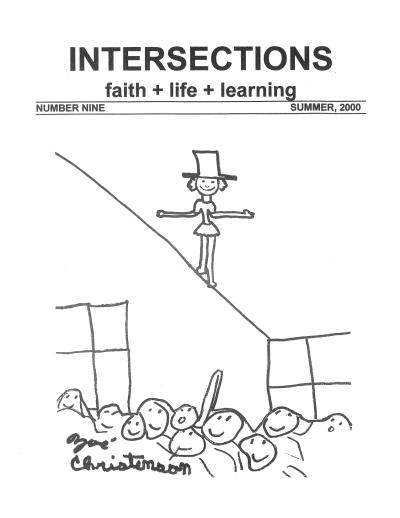
Christenson introduces a varied issue: the VonDohlen / Ratke discussion of the two kingdoms doctrine, Rachel Hammond’s “real gem” of a talk on her time in Ecuador (with an invitation to send contributions to the Home for Perpetual Hope orphanage via her home church in Oberlin, Ohio), Chuck Huff’s essay on the effect of liberal learning on the practice of psychology, and John Reumann’s reflection on a scholarly life lived between academy and church—and notes that the cover artist is his eight-year-old daughter Zoé, whose post-circus drawing of a balancing act struck him in light of Reumann’s opening line.
-
Article
A Fifth Teat on a Cow: The Irrelevance of the Lutheran Doctrine of the Two Kingdoms for Academic Life
Richard VonDohlen
VonDohlen, responding to Richard Hughes, Carol LaHurd, David Ratke, Philip Nordquist, and Robert Benne, argues that the Lutheran doctrine of the two kingdoms as commonly deployed in recent discussions of Lutheran higher education rests on a faulty sociology (taking Luther’s sixteenth-century structure for our highly differentiated society) and an epistemological monism (assuming a single neutral reason against the pluralism described by Alasdair MacIntyre and others), making it anti-intellectual, hostile to interdisciplinary dialogue and Christian social ethics, and ultimately as a defense of theology’s relevance about as useful as “a fifth teat on a cow.” Drawing on his experience on the Catawba Valley Hospice Ethics Committee, his Dutch Reformed and dispensationalist background, and the ELCA social statement “Sufficient, Sustainable Livelihood for All,” he calls for an “intellectually ecumenical” dialogue between Lutherans and non-Lutherans willing to take each other’s paradigms seriously.
-
Response
Tat for Teat: Ratke Responds
David Ratke
Ratke, agreeing with much of VonDohlen’s critique but contending that VonDohlen misreads both Luther and the two-realms doctrine, marshals Luther’s To the Christian Nobility, On the Freedom of a Christian, Temporal Authority, Whether Soldiers Too Can Be Saved, and the “Sermon on Keeping Children in School,” along with Walther von Loewenich, to argue that Luther was well aware of structurally differentiated society, made no claim to a monistic epistemology, and intended the two-realms doctrine to combat—not introduce—dualistic bifurcation between sacred and secular. Our identity is “not as either Christian or academic, but as Christian and scholar.”
-
Reflection
Calling and Learning: On Losing and Then Finding Myself
Rachel Hammond
Hammond, a Capital University junior who spent two semesters studying in Guayaquil, Ecuador, recounts watching the sucre collapse from 10,500 to 29,000 per dollar between September and January, the overthrow of President Jamil Mahuad, the freezing of bank accounts over $4,000, the threatened eruption of the volcano at Baños, and her work at an orphanage that needed only $6.81 to feed a child for a month—and calls her fellow students, in light of Elie Wiesel’s warning that indifference is the enemy, to recognize their education as a gift and a responsibility to speak for those who cannot speak for themselves.
-
Article
Serving Two Masters: Teaching and Writing Between Academy and Church
John Reumann
Reumann reflects on more than fifty years navigating between academy and church—the Society of Biblical Literature and Exegesis (whose Doktorvater Morton Enslin was unceremoniously dumped at Toronto by “young Turks” Robert Funk and others, while Harry Orlinsky saved the day at the centennial), the 1978–1987 New American Bible Revised New Testament committee with its bishops, the U.S. Lutheran–Roman Catholic dialogue volume on “Righteousness,” and the 1999 Joint Declaration on Justification—and uses his Anchor Bible and Augsburg commentaries on Philippians, Colossians, and Romans to illustrate Krister Stendahl’s judgment that one can no longer master all the literature: epistolary research, rhetorical and discourse analysis, social-world readings, feminist scholarship on Euodia and Syntyche, the koinonia and friendship debates (Sampley, Fitzgerald, Witherington), and the house-church recovery of Filson. The academy is antepenultimate, the church penultimate, God ultimate—professors as “believers, testifiers, witnesses” serving pro bono, pro ecclesia, and pro Deo.
-
 Reflection
Confessions of a Collaborator
Chuck Huff
No. 3 · Summer 1997
Huff of St. Olaf offers a tongue-in-cheek public confession of his lifelong sin of collaboration—from elementary-school reports on dinosaurs and Cliff notes on Faulkner, through high-school algebra and college group projects, to borrowed syllabi, group work imposed on resentful students, tutorials, independent studies on every form of self-reliance, and circulated drafts. Even this confession was collaborated on, and (he confesses) he enjoyed it.
-
 Response
On the Outside Looking Out: A Personal and Social Psychological Response
Chuck Huff
No. 2 · Winter 1997
Huff of St. Olaf—a self-described “Metho-Bap-terian” from the South educated at Bob Jones University—offers a personal response to Bouman’s themes (welcoming the rejection of biblical inerrancy, the distinction between gospel and scripture in the homosexuality debate, the gospel-in-the-creeds reading that releases him from Hellenistic conundrums, and the recasting of justification by faith as meaning rather than insurance policy) and a social-psychological response in which a planned study of campus social networks at St. Olaf was discontinued when preliminary interviews revealed that everyone—storied Lutherans, secular faculty, feminists, fundamentalists—felt like outsiders. Continuing the tradition requires constructing a conversation that is thoughtful, fair, inclusive, charitable, focussed, and still true to the tradition.
-
 Article
Vocation and Civil Discourse: Discerning and Defining
Lynn Hunnicutt
No. 48 · Fall 2018
Hunnicutt draws on Rabbi Amy Eilberg’s reading of Moses’ calling to identify four features of vocational discernment — attention, wonder, communal consciousness, and humility — and argues that these same qualities are also key aspects of civil discourse, so that forming students for vocational discernment is simultaneously forming them for civility.
-
 Reflection
Fumbling Toward Integrity: A Sermon on Mark 8:34-38, Pastor Kaj Munk, and Father Maximilian Kolbe
Darrell Jodock
No. 34 · Fall 2011
Preached at the 2007 ELCA Convocation of Teaching Theologians at Lenoir-Rhyne College, Jodock holds up two World War II martyrs—Polish Franciscan Father Maximilian Kolbe, who took the place of a condemned father in Auschwitz’s starvation bunker, and Danish pastor-playwright Kaj Munk, who was shot by the Nazis after helping save 97 percent of Denmark’s Jews—as mirrors for our own priorities. Drawing on the rescuer characteristics identified by Samuel and Pearl Oliner (agency, moral independence, universalistic caring, a history of care-giving) and on Jesus’s words in Mark 8:34-38, Jodock asks how we who routinely opt out at the first sign of opposition might fumble toward integrity in our own time.
-
 Article
Redemption Through Imperfection
Kyoko Mori
No. 5 · Summer 1998
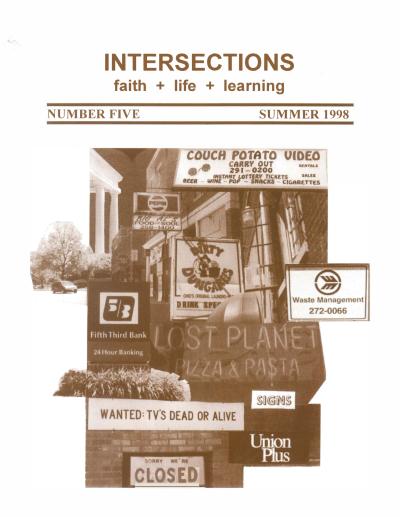
Mori, drawing on a visit to the Philadelphia Museum of Art with a friend, contrasts Marcel Duchamp’s Étant donnés—a peephole work whose mysterious motion sweeps every viewer into a shared, perpetual performance—with the static, glass-encased Liberty Bell as parody of spiritual experience. She extends the contrast into a meditation on rituals (comfort and consolation) versus art (truth, however painful), and on writing as a redemptive process that moves from orderly first drafts toward chaos and deeper, frightening truth—closing with master potters who skewed each finished vessel slightly so that art and decoration could be told apart. Parts are excerpted from Polite Lies (Holt 1997).
-
 Reflection
Tom Natalini
Tom Natalini
No. 40 · Fall 2014
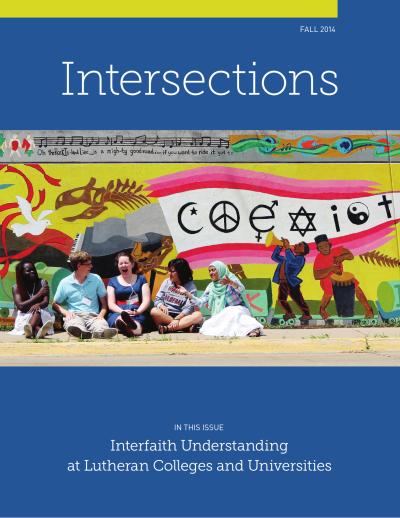
Natalini, a Susquehanna University senior raised Lutheran, schooled Mennonite, and seasoned by a meditative encounter in India, reflects on his journey through churchgoing, philosophy, near-Jewish conversion, and Buddhist practice to a stance he calls patience — neither Christian, Jew, Buddhist, seeker, nor “none.”
-
 Article
Why Did the Chicken Cross the Road? A Homily on Liminality and Vocation
Lori Brandt Hale
No. 45 · Spring 2017
Drawing on Wes Moore’s The Other Wes Moore, Warren St. John’s Outcasts United, Victor Turner’s anthropology of liminality, and Dietrich Bonhoeffer’s poem “Who Am I?”, Hale considers how Hmong, Muslim, Latinx, LGBTQ+, non-traditional, and other students live in “double liminal” spaces — and asks whether liminality might itself be a place of transformation in conversations about vocation.
-
 Article
Vocation Outside of Career: Discovering Purpose through Comics
María Evelia Emerson
No. 53 · Spring 2021
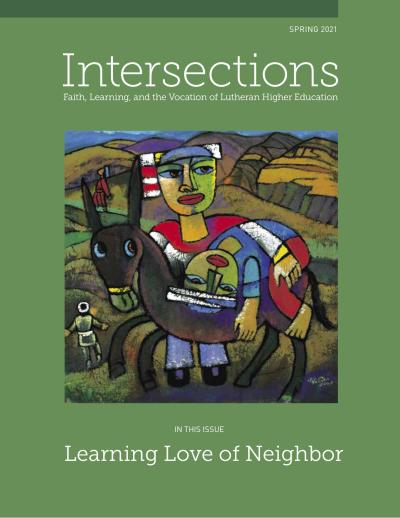
Emerson recounts building an Augustana Vocational Discernment course around G. Willow Wilson’s Ms. Marvel series, using Kamala Khan’s juggling of family, friendship, faith, and superhero identity to help sophomores see vocation as not what they do for a living but how they want to live.