Introduction
Aristotle taught us much of what we assume about intellectual methodology. He maintained that any well-designed investigation must determine the nature and scope of the subject matter, establish its end or purpose, examine the existing wisdom on the matter and argue for that which under critical scrutiny remains essential to the proper understanding of the phenomenon. This brief investigation of church-related higher education will follow a similar pattern. In the first section, I will briefly characterize the traditional categories for understanding the relationship between faith and reason. In the second, I will examine the epistemic structure of values and argue that one understanding of faith sees it as sharing that structure. In the final section, I will propose a new view of the relation of faith to learning in the context of church related higher education and draw some initial conclusions concerning the nature of that education.
Since any investigation must proceed with the aid of assumptions, and, since the disclosure of such assumptions is essential to responsible scholarship and critical assessment, allow me to confess the following operational assumptions: First of all, recent developments in epistemology have shown it philosophically undeniable that all of our knowledge is perspectival in character. Knowing and learning take place in contexts and unavoidably reflect those contexts. That there is no Archimedean point is now as obvious in epistemology as it is in physics. The debt for this change in epistemic attitude is owed to the philosophers and historians of science who argued persistently and painfully for a position that often alienated them from their colleagues and their tradition. As a consequence, we are now “invited” to see faith and learning as much more intimately related (owing to the shared quality of perspective) than any self-respecting scholar would have admitted during the prior two centuries (in the so-called foundationalist era, a time when knowledge was thought to have an indubitable base).
That few, if any, persist in the error that is foundationalism does not, however, entail that the new perspectivalism is immune to error. Very often the truth of the dictum, “All knowledge is perspectival”, is confused with its fallacious converse, “All perspective is knowledge.” A proper investigation of the difference would require another forum, but there are at least a few earmarks. Perspective is usually unassailable. Knowledge is defeasible (falsifiable), and welcomes, even demands, rational challenges. Perspective is relative. It is its essence to be such. Knowledge, on the other hand, is relative only to its perspective. In all other respects it is absolute.
A closely related assumption reminds us that knowing, like believing, is an activity in which people engage. It is not generically human, as the Enlightenment had us believe. Nor is it inert and sterile, as modern science had us believe. Knowing is acting in pursuit of a goal, and as such, is to be understood in terms of the knower’s precipitating desires and beliefs. Aristotle was right to insist on this interpretation of knowledge as action; but, he was wrong to restrict it to merely practical knowing. All knowing involves a pattern of action which must be practiced, perfected and habituated through a constant commitment to it. Perhaps Plato was right in describing learning as more like loving than like seeing.
Approaches to Faith and Learning
Over the centuries there have been many different ways of understanding the relationship between faith and learning (faith and reason). Ignoring for the moment subtle variations and a history of muddled terminology, the Christian tradition presents four main models: conflict, independence, dialogue and integration.
Conflict, in its early expression, assumed that faith, based on divine revelation, is a translational process defying justification and hostile to reason. “I believe because it is absurd.” (Tertullian) In its modern expressions, conflict takes the form of assuming that both faith and reason (e.g. religion and natural science) are speaking of the same material world and speaking in the same positivist language. So scientific materialism and creation science, for example, square off assuming that both cannot be right. In the one case, natural science has been uncritically extended into natural philosophy and, in the other, biblical faith has been presented as natural science. Both extensions are confused because they assume there is only one project, only one perspective, and only one set of tools. This confusion involves both a philosophical category mistake and a failure to undertake the self-critical hermeneutical task.
Independence is clearly an advance over conflict for it acknowledges the integrity of both faith and reason and assumes that each has its own inviolate realm of discourse, subject matter and language. Faith involves divine revelation which is independent of human reason even if not contradicting it (Barth). Faith and reason pose no problems left alone to their proper spheres. Today this view is expressed in a strict separation of religious from scientific thought. One purports to deal with the objective material world and the other with the subjective personal one. Science deals with facts and religion deals with values. However this approach is also confused. There is no fact/value separation. All facts are theory laden and all theories involve value judgments. Knowledge is contextual and perspectival. The knower cannot be completely separated from that which is known. It is this awareness that leads to the final two ways of relating faith and learning, both of which presuppose that the relationship between faith and learning is a close and complementary one.
Dialogue assumes that each side has much to learn from the other. This becomes especially clear when certain types of fundamental questions or methodological parallels are considered. While disciplinary integrity must be maintained, there are questions of ultimate significance which both sides can approach from their respective analyses. Dialogue fosters the sort of interdisciplinary cooperation necessary for dealing with the complex issues of our emerging global society and the sort of self-critical examination necessary for intellectual honesty and humility. Such dialogue preserves disciplinary integrity while also accommodating the wider human condition in and through which it takes place.
This understanding of the relationship of faith and learning is particularly at home in the Lutheran tradition where faith is understood as trust in the justifying power of God’s grace brought into critical relationship with the other realms of human experience and thought. The dialectical pursuit of truth in such a fashion is clearly a viable expression of a doxological vision.
While dialogue may be the most realistic goal in relating faith and learning, it is not the only one reflective of the Reformational heritage. There is a fourth option, that of integration. In this understanding of the intimate connection of faith to reason, the two are seen to function in intrinsic complementarity, each disclosing unique dimensions of reality and connecting them through a common metaphysical vision. Integrative relationships stimulate both faith and reason to reach out through the educative activity to a common confession of a universe seen as an integrated whole. Such wholeness is said to be the ultimate goal of education.
There is, however, little agreement on matters of method and practice even among those committed to such integrated education. As there is little to be gained, beyond endurance, by plowing through these well-tilled church/college taxonomies, and as these schemes appear to place the plow before the horse by restricting education before understanding it, our time might be better spent in speculating directly on the character of integrative education we seek.
The Structure of Value and Faith
There is nothing philosophically perspicuous about saying one values something. The term ‘value’ is as vacuous as it is ubiquitous. Upon reflection, however, it is clear that values are beliefs, albeit beliefs of a special sort. It seems to me that values are assessment beliefs. That is to say, they are beliefs assessing one “thing” to be better than another, and thus have the general form: ‘x is better than y.’ Of course values never display just this form, for values are never devoid of content and rarely absolute. Virtually anything can be the object of a value. People, events, physical objects, situations, ideas; all are objects of assessment beliefs. Consequently, any assessment will have to be relative to the nature of the thing being assessed and the purpose to which that thing is put. For example, one does not actually say that one values cats. Rather one says that cats are to be valued over dogs, or cats are better than parrots; or more properly, that cats are nicer pets than dogs or parrots. So also, values will be relative to the individual holding the belief. We may differ with regard to cats, or disagree about what makes a good pet. But all of this is well understood, so well understood that we rarely consider values to have a structure at all and presume all matters of valuing completely relative and beyond rational debate.
If the basic structure of a value (x is better than y with respect to some purpose for some person) is somewhat pedantic, the characteristics associated with values are anything but. Most of the world’s great tragedies are constructed around the lives of individuals struggling with values. From Oedipus to Lady Macbeth to Willy Loman, the drama recurs. There are simple reasons for this to be found in the character of valuing. I will mention only two. Values are beliefs that people hold most dear to them. They are the beliefs we will least often give up; for they are the source of our identity, our community and are reflective of our sense of purpose.
Values are also protected from examination by elaborate psychological mechanisms designed to fool others, but as often, to fool ourselves. Yet, despite all the secrecy and subterfuge, the nature of our values is painfully obvious through our actions. Values are the guides for the living of our lives. They are the objects of our pursuits. There can be no such thing as a latent or inactive value. If something is valued, it is pursued. If it is not pursued, it is not valued in those circumstances or valued less than something else. Thus, our actions are inerrant records of our values. They, like the oracles of old, are not always easily interpreted, but they will never lie. Herein lies life’s drama: What should we value? How do we responsibly pursue it? Why do we not pursue that which we believe we value? In short, the ultimate question of both life and learning is: How then should we live?
It seems to me that the answer to this question is itself the statement of a value and therein lies the connection of value to faith. We ought, of course, to live our lives responsibly and with integrity. All other values and the pursuits they occasion ought to be subservient to this higher value. But why value responsibility and integrity in one’s life? There appears to be no further value to which one can appeal in answer. There appears no value demonstrably higher, no principle from which it can be deduced. This is no mere philosopher’s dilemma, no idle logician’s puzzle. There can be no more fundamental demand. But how can we answer it? By faith. By our faith we might answer that a life of responsibility and integrity is required of us as a response to God’s self-revelatory acts of creation and redemption. We have no higher value to justify that belief. It has no goal beyond itself, it is the paramount value.
It may seem unconventional, even odd, to speak of faith as a value. Faith is a relation between a believer and the object of that believing. The oddness attending the term ‘faith’ so used, is, I suspect, very much the same as that which attended the use of the term ‘value’ initially. Valuing, as we have seen is also a relation between a person and a thing. One speaks loosely when one calls something a value. That looseness is transferred to the claim that faith is a value. The only difference is that faith is an ultimate value. In all but this respect, it shares the structure of lesser values.
If what has been suggested here is correct, in other words, if faith is to be understood as ultimate value; then two implications follow for the investigation of faith and learning. Each is rooted in our prior assumptions and each will be treated briefly in the subsequent section. First of all, learning is action, and action, as Aristotle taught us is caused by desire. Knowledge and belief condition our actions making them feasible or useful. And the emotions help us to find the courage to act. But only desire causes us to act. We are motivated to act by our desire for the objects of our values. Thus, it would seem to follow that learning cannot be fully understood without first understanding the process of desire that moves it. Moreover, if faith constitutes an ultimate value, our ultimate object of desire, then faith must be intimately, perhaps causally, related to knowledge. But these are not new contentions. They have always been part of the claims of the church, though not couched in Aristotelian terms.
Secondly, the perspectival character of knowledge leads one to expect that faith will be the focal point of a believer’s perspective. There would seem to be no reason why one’s faith would function peripherally if it constitutes one’s ultimate value. One need not be apologetic about the situation. Perspectives are to be expected. Perspectives are like interchangeable camera lenses. Each is designed to focus our attention on some aspects of the scene by eliminating other foci from our field of view. Telephoto lens enable us to make clearer and more precise images of distant things by eliminating any panoramic potential in the scene. We do not criticize the lens for doing so. That is simply how it works. So it is with epistemic perspectives. They are unavoidable. They are desirable.
An Aristotelian Approach to Faith and Learning
The ultimate goal of all education should be the production of wholeness in the lives of human beings. Wholeness involves integrity - the integrity that accompanies a life wherein actions reflect professed values. Consequently, the nature of education, so constructed, is value-directed and action-directed, the nature of education, so contrued, is value-directed and action-directed.
Good education, then will help students to understand their values, trace those values to their implications and effectively pursue them. Moreover, since the pursuit of goals alone, will not, no matter how effective, produce wholeness except that the pursuit is a responsible one, good education must be directed toward the responsible pursuit of values. Finally, since the activating force in all action is desire, the core of education should be education of the desire.
As desperate as the realms of value and action may seem, they have as their common element the unique human faculty of desire. Those things we call values are the patterns of desire we use as guides for our lives. Moreover, it is only by virtue of the power of desire that we act. We may plan our actions with the aid of practical reason. We may evaluate them with theoretical wisdom. We may encourage ourselves to act with emotion. But we only act from desire. Thus our actions are as well judged by our desires as our desires are surely evidenced by our actions. This relationship, not unlike the oracles of old, never lies but always stands in need of interpretation. Therein lies life’s drama and education’s mission. If we ask the timeless question “How then are we to live?”, we are asking what is worth valuing and pursuing. To know the answer to this question is to know how to desire well. Education can help us to learn to live responsibly and with integrity but it can only do so if we are encouraged, challenged and guided to desire aright. If the ultimate goal of education is rightly described as wholeness, then its core must be the education of desire.
The nature of education, I would like to suggest, is to be seen as perspectival faith directed action. If learning has been properly characterized as a human action activated by desire then the core of education is the education of desire. If one’s faith is the ultimate value or object of desire for the Christian (or for any person of faith), then the core of Christian education is the education of Christian desire. Such an education involves reflection on the life of faith understood as directing one’s desire toward the realization of one’s ultimate values. Such reflection will necessarily investigate the proper relationship between these ultimate values (including, but not restricted to, our confessional roots) and our proximate values (including, but not restricted, to our ethical concerns). These relationships are not obvious, but they are imperative, if we are to retain our identity in a changing culture. All the disciplines in a college must contribute to the education of desire. Some will contribute to the store of empirical knowledge necessary for effective and responsible action. Others will help us see the implications for our faith and life of the actions we contemplate. Others still will help us understand our natures, our failings and help us accept our limitations graciously. But all will be united in the common task of helping students and ourselves understand what it is to desire aright and live well. It must be emphasized that desire requires freedom and is individual. So also is the action resulting from such desire. Thus the enemy of education is indoctrination and regimentation.
The situation is no different in the case of Christian education. one’s faith is the ultimate value or object of desire, then the core of Christian education is the education of Christian desire. Such education requires both understanding and commitment, both reflection and cultivation. One must reflect on the life of faith and virtue for the demands are by no means obvious. How we are to live our lives is not made plain by the mere holding of admirable values. It demands difficult investigations into the character of that which we hold dear. Such reflection will necessarily investigate the proper relationship between our ultimate values (including those we call our confessional roots) and our proximate values (including our present ethical concerns and personal ambitions).
All the disciplines of the college contribute to this reflective task. Some will contribute to the store of empirical knowledge necessary for effective and responsible action. Others will help us see the implications for our faith and life of the actions we contemplate. Others will challenge us to see the world afresh and give us the power to exceed our egocentric ambitions. Others still will help us understand our natures, our failings, and help us to accept our limitations graciously. But all will be united in the common task of helping us to understand what it is to desire aright and live well. That not for our own sake alone but also in praise of the one that made us.
The education of Christian desire requires reflective activity but it also requires cultivating activity. If reflection tells us how to desire and act, cultivation helps us to desire and act. What we are cultivating in this aspect of the education is commitment. This is much more difficult and time consuming work. Again, all the disciplines will contribute to this task in their own way. Little is know about how this happens, but we have all seen it in the lives of students and faculty who possess such commitment and are not affraid to admit to their stuggle with the life of faith. This situation may only be right, for one does not teach commitment. It has to be exemplified, nurtured and ecouraged in the context of a community of those who take it seriously. It is important work even for its nebulousness. Reflection without commitment is otiose as surely as commitment without relfection is obtuse.
It is imperative to see that the task of educating students to Christian desire is a multifarious one. The sort of reflection described demands competencies no one sort of individual can possess. We need to understand the natural world throroughly that better we can appreciate the magnitude of God’s self-revelatory act of creation. So also, we need to understand the human world thoroughly that better we can appricieate the magnificence of God’s redemptive act. No less mutifarious is the task of cultivating commitment. We will need those who challenge “easy faiths” and shallow commitment; and those who strengthen through doubt. We will need those who nurse “damaged faith;” and those who encourage through devotion. As there is not one path to commitment, so there is no one guide.
By way of recapitulation and recommendation, it has been suggested that we need no longer apologize for the pursuit of knowledge in the context of faith. We cannot avoid the perspectival character of learning, and the perspective of faith is a perfectly legitimate one. It has also been suggested that we can begin to understand the perspective of faith seeking understanding - - the integration of faith and learning - - if we come to see faith as the ultimate object of desire. Correspondingly, since learning and living are activities, they are brought about by the interaction of desire and belief, it seems correct to see Christian education as the education of Christian desire. Finally, that this project consists of two distinct tasks in tension - - reflection and commitment - - is no accident. It mirrors the tension of trust and assent comprising faith, the tension of desire and belief precipitating action, and the tension of faith and learning essential to Christian life. When these tensions are utilized productively, they provide the climate in which education flourishes.
If the trip to this point has been tortured but safe for Lutherans; the recommendations it produces are straight-forward, but threatening. If wholeness is the goal of education, it does not seem to me that the traditional Lutheran understanding of education as dialogical is sufficient. As is obvious from the preceding, wholeness comes through commitment to integrated desire and action. Dialogue is involved in that process but it is no substitute for it. Thus, it is paramount for church-related higher education to find and nourish scholars who are devoted to the active integration of faith and learning. As Plato taught us, the enemy of true learning is hypocrisy. The integration model is the only one that safeguards it.
The other enemy of learning is narrow-minded provincialism. The education of desire follows no privileged pattern. It is the province of no culture and surely no denomination. In fact, the education of desire is facilitated by as many and varied a set of examples as possible. The examples must, however, be lived examples, since desiring aright is a practiced art not a theoretical one. What this means for church-related higher education is that we have an obligation to make our campuses, and especially our faculties more diverse. On the eve of the millennium, we can do no better for ourselves and our future, than to genuinely commit ourselves to integration and diversity.
-
 Editorial
From the Publisher
James M. Unglaube
Unglaube opens the journal’s second year by previewing the 1997 Vocation of a Lutheran College conference at Carthage, which will examine the Lutheran tradition from outside (Richard Hughes of Pepperdine on the Lilly Endowment’s Models for Christian Higher Education; David Johnson, President of the University of Minnesota at Morris and Luther College graduate, on the tradition from the public sector) and inside (Ann Pederson of Augustana in Sioux Falls; Timothy Lull of Pacific Lutheran Theological Seminary), and previews Eric Eliason’s emerging proposal for an Academy of Scholars in Lutheran Higher Education modeled on NEH/NSF-style summer seminars.
-
Editorial
From the Editor
Tom Christenson
Christenson explains that this issue breaks from the first two issues’ single-focus pattern to feature three principal papers on the environment, the education of desire, and hiring and personnel policies, plus two poems and a piece of reflective bemusement. He then commends George Marsden’s The Outrageous Idea of Christian Scholarship (Oxford, 1997) and challenges Lutheran scholars to articulate how the particulars of their faith inform their scholarship—in conversation with Calvinist work like Nicholas Wolterstorff’s Reason Within the Bounds of Religion and Art in Action—rather than remaining silently complicit in the view that faith has no place in the academy.
-
Article
The Lutheran Liberal Arts College and Care for the Earth
H. Paul Santmire
Santmire, author of The Travail of Nature, proposes three mandates for the Lutheran liberal arts college: take responsibility for spiritual particularity by confronting the ambiguities of the classical Christian tradition (Lynn White’s charge against anthropocentric Christianity vs. the Franciscan ecological tradition from Irenaeus through Luther) and of classical Lutheran social ethics (the Two Kingdoms, Romans 13, the Third Reich, Bonhoeffer); promote responsible cultural criticism (against Thoreau’s sociopathic anti-urban suburbanism); and promote a holistic environmental ethos through an interdisciplinary core curriculum with ecology as the queen of the sciences, a community that liberates the social imagination (Mumford, Marcuse), a cosmic Liturgical praxis rooted in the Colossians 1:15–20 hymn to the cosmic Christ, and an academy that models ecological responsibility.
-
Poem
Two Poems: The Dark Angels / Decorative Cooking
Gary Fincke
Two poems by Gary Fincke of Susquehanna University: “The Dark Angels,” a return to the sidewalk in front of the father’s razed bakery in Etna, the soot-pocked windows, the Saturday trash fire, the last eclair on the work room’s folding chair; and “Decorative Cooking,” the mother’s story of St. Julitta, Betty Crocker’s “New Design for Happiness,” the Sunday dinners of shaped Jellos and anise Magi cookies, the visit of the former pastor returned to Pittsburgh to declaim the death of God, and the father who lays evergreen crosses by the mother’s headstone in the Garden of Dreams.
-
Article
Mission and Hiring in the Christian College
Bruce Reichenbach
Reichenbach of Augsburg argues that the Christian or Church-related college’s mission to educate the whole person from a perspective of Christian faith and values can only succeed through intentional hiring of a “critical mass” of faculty, administrators, and staff committed to that mission (following George Marsden and the 1960s Danforth Commission), supplemented by on-going faculty development. He defends an inclusive community-with-diversity, a freedom-and-commitment tension grounded in Alasdair MacIntyre’s account of tradition, and the legality of preferential religious hiring under Title VII of the Civil Rights Act and the relevant case law (Tilton, Hunt, Roemer, Blanton, Grove City, Amos).
-
Response
A Call for Creative Education
Wendy McCredie
McCredie of Texas Lutheran responds to Reichenbach by reframing the four ideas embedded in his claim that “the entire college community should be knowledgeably committed to the college’s mission”—community, knowledge, commitment, mission—and argues that the Lutheran tradition’s unwillingness to be separate from the world should lead us to educate the public about the Lutheran tradition rather than interrogate prospective employees about their faith. She questions whether agreement on “Christian values” is possible (or even Lutheran), and reads Reichenbach’s “creative education” as the dialectical tension between gospel and law, God’s love and our human limits, that members of communities related to the Lutheran church are uniquely positioned to inhabit.
-
Response
Hitting a Moving Target
Harry Jebsen
Jebsen, former Provost of Capital University, responds to Reichenbach by arguing that the institutions, the ELCA, congregations and pastors, students, and curriculum are all moving targets. Drawing on Alvin Toffler’s Future Shock and his own fifteen years of hiring as Dean and Provost (a candidate who hoped the cross out front didn’t mean anything), he traces the drift from the “Mr. Chips” faculty who personified Dana and Midland Lutheran to a campus culture where “everybody is nice to each other” has replaced theological substance, and where MBA programs, conservatories, law schools, and adult-education programs further dilute the focus of the residential Lutheran college.
-
Reflection
Confessions of a Collaborator
Chuck Huff
Huff of St. Olaf offers a tongue-in-cheek public confession of his lifelong sin of collaboration—from elementary-school reports on dinosaurs and Cliff notes on Faulkner, through high-school algebra and college group projects, to borrowed syllabi, group work imposed on resentful students, tutorials, independent studies on every form of self-reliance, and circulated drafts. Even this confession was collaborated on, and (he confesses) he enjoyed it.
-
 Reflection
Tom Natalini
Tom Natalini
No. 40 · Fall 2014
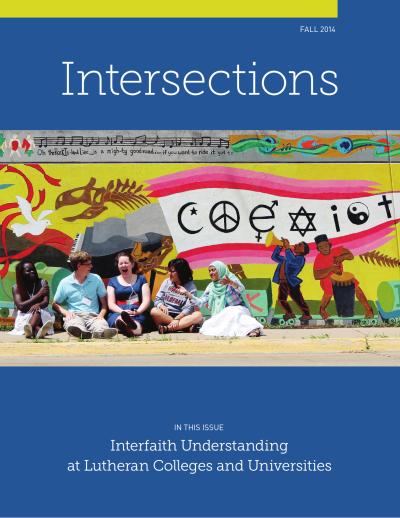
Natalini, a Susquehanna University senior raised Lutheran, schooled Mennonite, and seasoned by a meditative encounter in India, reflects on his journey through churchgoing, philosophy, near-Jewish conversion, and Buddhist practice to a stance he calls patience — neither Christian, Jew, Buddhist, seeker, nor “none.”
-
 Article
Assessing Self-Assessment Instruments at Finlandia University
René Johnson
No. 55 · Spring 2022
Johnson surveys three self-assessment instruments presented at the NetVUE conference — PathwayU at Colorado State, the Intercultural Development Inventory at Friends University, and Mark Savickas’s Career Construction Counseling Manual at Union College — and describes Finlandia’s use of the CliftonStrengths© assessment to link students’ personhood to “behaviors that benefit the community.”
-
 Article
Community-Based Research as Engaged Citizenship
James Paul Old
No. 63 · Spring 2026
6 min audio
Old argues that genuine citizenship requires more than charitable gestures — it demands long-term, reciprocal community partnerships — and describes how Valparaiso’s Community Research and Service Center embodies that vision even amid the financial pressures threatening such programs.
-
 Article
Community-Building On Campus and Beyond
Krista E. Hughes
No. 54 · Fall 2021
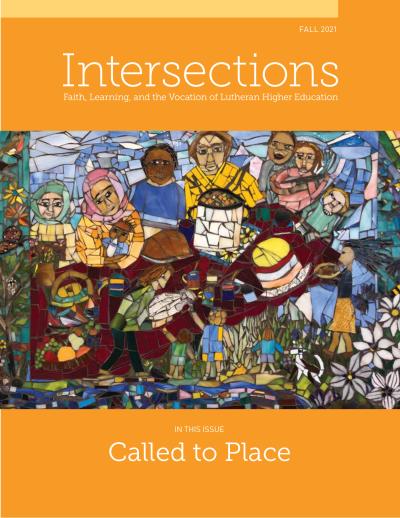
Hughes describes Newberry College’s effort to build a “culture of community” that mirrors South Carolina’s demographics while reckoning with the institution’s founding ties to slavery — and names the challenges and promising city-college collaborations that shape this ongoing work.
-
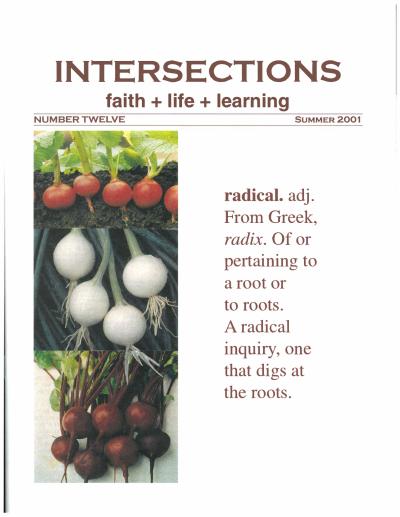 Article
The Vocation of a Lutheran College
L. DeAne Lagerquist
No. 12 · Summer 2001
Lagerquist places the twenty-eight ELCA-affiliated colleges in the context of American higher education from Harvard (1636) through the “old time college,” the post-Civil-War research university, and the postwar expansion—drawing on Christopher Lucas, Philip Schaff’s Neo-Lutheran/moderate/Old Lutheran categorization, Sydney Ahlstrom’s scholastic/pietistic/critical currents, Luther’s appeal to the German nobility, Lewis Hyde’s gift economy, and Alasdair MacIntyre’s After Virtue. She proposes five characteristic practices (the school as learning community, study of Bible and Christian tradition, participation in the arts as makers and audience, application of learning in service, and on-campus Christian worship) grounded in Lutheran teaching about grace, image-and-fall, gratitude, and revelation through created “masks,” and four virtues these practices engender in graduates—loving gratitude, faithful wisdom, bold freedom, and hopeful humility.
-
Institutional Focus
Serving and Building Community at Concordia College
Larry Papenfuss
No. 55 · Spring 2022
Papenfuss, director of the Dovre Center for Faith and Learning, frames eight ways Concordia College serves the world by building community — from quality teaching and liberating liberal learning to interfaith cooperation and modeling “diversity with particularity” as a Lutheran “third path” institution.