Professional Education/Liberal Arts Education: Not a Case of Either-Or but Both-And
Intersections No. 24 · Fall 2006
On the Road to Both-And: What's Been the Journey Thus Far?
Does it ever seem that we somehow are driven to put things in neat little boxes? It’s either this OR that. Surely, it can’t be a little of both! When it comes to the educational world, there seem to be similar trends. The specific American higher educational trend for exploration in this paper is the tug-of-war, or mythical pushme-pullyu, between liberal and professional educational preparation. The literature is abundant about the benefits of each alone—each in its own little box. In reality, what the literature is beginning to show is that we need to put those little exclusive boxes away and employ less either-or thinking and more both-and thinking.
Historically, American higher education has changed with the times like the rest of education. In the beginning, American colleges originated with the “deeply held conviction” that education in the liberal arts was essential for the preparation of “moral, civic, and intellectual public leaders” (Grubb and Lazerson 2). During this early period in higher education and until the close of the nineteenth century, one did not need a college degree to enter any profession. This included law, engineering, even medicine. Job skills were learned on the job, with a return to school for professional training if it was found necessary, but only after having already worked in the profession first. The impetus for higher education in these times truly was for the elite in society. Those who were seen as future public leaders needed the moral and civic preparation that was made possible through a liberal arts education. So, early colleges were primarily about liberal arts preparation of future civic leaders.
Even while liberal arts education reigned in the nineteenth century, a shift was beginning. The shift toward professional education began first in 1802 with the founding of West Point, followed in 1824 by Rensellaer Polytechnic, and continued in 1862 with the passage of the Morrill Act which established land-grant institutions in each state (Grubb and Lazerson 2). This shift was in large part to support the fast-growing industrial class. This was the first adaptation of the college curriculum to meet labor demands. The liberal arts did not quickly wane despite the slowly growing belief that the liberal arts were not helpful in getting a job. Recall that joining a trade or profession in this time did not even require holding a degree. Some viewed a liberal arts education as “academic, irrelevant, even sissified” (Grubb and Lazerson 3). So one begins to see the first evidence of an attempt to combine the two sides, to develop the both-and, through an emphasis on the “liberal and the practical.” The industrial world realized the need for specialized skills while still needing moral, intellectual, and civic-minded citizens. This period in American higher education saw the beginning of the notion that knowledge has a moral purpose (Grubb and Lazerson 3).
Shortly before the turn of the twentieth century, a specific shift in the engineering field changed the face of professional higher education forever. Between 1870 and 1918, the professionally prepared engineer “displaced the unschooled mechanic” as the proportion of engineers who were graduates with engineering degrees grew from 11% to 50%. As this shift was then replicated in many other professions, “self-education” in America began to diminish. (Grubb and Lazerson 6) Attendance in college was now more for personal gain (money, job) than for civic responsibility as in the past. After World War II, there was a marked increase in professional degrees granted. With this increase in numbers of degrees granted as men returned from war came the beginnings of the shift in who attended college. The early college attendees were largely from the upper class. The advent of the GI Bill after World War II encouraged the start of college education for the middle class as well (Brint et al. 154). By the end of the World War II era, the work market had changed so much that a college degree had become far more important in getting a job.
The early twentieth century brought a desire to focus on adding to the knowledge base as interest in professional education grew. This brought about the growth of the research university, allowing the further decline of the arts and sciences—the search for truth in the liberal sense had been replaced by the scientific search for truth. With the growing “authority of science” (Grubb and Lazerson 5), the world of professional education became divided. A defining line between professional and vocational education was drawn. Vocational education meant more focused technical training. This left professional education to begin to include aspects of liberal arts thinking. This set professional education apart from vocational education. To be professionally prepared meant to be a thinker as opposed to being vocationally prepared, which meant to be a technician. The professions themselves joined in this distinction as codes of ethics were developed as guiding forces for the professions (Grubb and Lazerson 5). While professional and vocational education grew apart, liberal arts and professional education were growing together. To be a professional meant holding ethics for the profession. Ethical thinking grew from liberal arts education. Therefore, early trends for both-and had roots in the early twentieth century.
The “Knowledge Revolution” of the twenty-first century is causing a shift away from “occupations rooted in industrial production to occupations associated with knowledge and information” (Grubb and Lazerson 1). Skills for the twenty-first century require higher-order thinking not just occupational skill. Specific work skills become obsolete as employees change jobs with greater frequency therefore requiring flexible skills to allow quick adaptation to any job. A college education becomes essential to function in this fast-paced changing workplace. Attendance in college has increased to keep pace with this need for skilled education, resulting in a situation in higher education some have coined “College for All” (Grubb and Lazerson 1). But as the numbers attending college for a professional education to gain a job have increased, the professions themselves have begun complaining that the professional college curriculum has become too narrowly focused on occupational or technical skills. Missing in the professional education curriculum is the very thing the liberal arts provided in order to create critical thinkers and problem solvers needed to function in the twenty-first century workplace (Grubb and Lazerson 13). The professions themselves paint a picture of the worker who has been educated in the both-and model. Needed is the professionally educated worker who is also liberally educated.
Challenges exist for higher education in the twenty-first century in the form of new “types of for-profit and non-profit organizations” (Harrington 46) offering options in higher education. These new challenges raise the question again as to whether liberal education is useful in today’s world and whether liberal education can survive such competitive economic times. During the course of the late twentieth century, the numbers of degrees awarded in professional fields grew. “In 1970, 50% of all bachelor’s degrees were awarded in a liberal arts subject. In 2000, nearly 60% of the degrees were awarded in a pre-professional or technical field” (Lagemann 6). Why is this? The economy of today comes into play here. “Today’s college students do not have time or money to waste” (Lagemann 6). Today’s college students see getting a job as the objective and they therefore are choosing more vocationally directed majors. “Hundreds of institutions now award 80% or more of their degrees in these fields” (Brint 151). Of interest is the finding that with economic upswings, interest in arts and science degrees tends to grow. In times of economic decline, interest is spurred in professional education. Since 1970, the fields that have grown the fastest have been those considered to be professional. In the time period between 1970 and 2000, the number of undergraduate degree recipients almost doubled, yet the number of graduates in every field considered part of the liberal arts was in decline (Brint et al. 159). Liberal arts colleges may have fallen victim to the market-driven shift primarily in geographic areas with declining high school graduate numbers. To keep pace, curricula were changed in the 1970s and 1980s to boost enrollments and to “accommodate student preoccupation with the immediate job market” (Delucchi 414). We need to ask ourselves, given the cry from the professional fields for both-and, whether we should be altering liberal arts education to respond to market demands in this way. Even Harvard has changed over time. In the 1940s they had a core that was considered a “humanist enterprise.” In the 1970s, with a faculty that had lost confidence in values, they “turned toward expertise.” Their current proposal has a “sense that Values—aesthetic, civic, moral—are important again, even if we don’t have confidence we know which values are important” (Katz 6). The grounding importance of what a liberal education provides keeps popping up. Maybe we need to listen to the both-and cries.
There are two initiatives of the American Association of Colleges and Universities (AAC&U) worthy of mention in this both-and case being made. The first is the 2002 Greater Expectation National Panel Report, which begins the charge for the intersection of the liberal and the professional.
The report calls for liberal education in the twenty-first century to provide students with the knowledge, skills, and tools necessary to thrive in a complex world and notes our students must become empowered, informed, and responsible. The report suggests that liberally educated people become empowered as they master intellectual and practical skills, informed by knowledge and how to acquire knowledge, and responsible for their own actions and for their contributions to civic life. This new paradigm offers great promise for the goals and purposes of liberal education in the twenty-first century. (Harrington 50)
The second initiative of the AAC&U is the recent launching of a ten-year campaign called Liberal Education and America’s Promise: Excellence for Everyone as America Goes to College. This campaign is to “champion the value of a liberal arts education.” This has grown from a belief that there is “an emerging, if hidden, consensus among business and civic leaders, professional accreditors, and college educators on the key outcomes of a quality undergraduate education. This consensus underlines the importance of an engaged and practical liberal education for all students, regardless of their chosen institution or field of study” (Humphreys and Davenport 36).
Maybe we are beginning on the road to both-and….
Getting There: Reaching Both-And
In order to move away from the either-or to the both-and, it’s important to understand what each side contributes. Simply, professional education provides job skill and specific professional or occupational knowledge. Professional education provides very specific context for the application of skill. Teachers need to learn to think like teachers and apply that skill in a classroom. Lawyers need to think like lawyers and learn how to apply that skill in the courtroom. Doctors need to think like doctors and learn how to apply their medical knowledge in the hospital. So in large part, professional education provides background in a specific context. According to Gardner and Shulman, professions have six common characteristics (14). First, professions have members who hold a “commitment to serve responsibly, selflessly, and wisely.” Second, professions each have a unique body of theoretical knowledge undergirded by research and beliefs. Third, professions are all about practical skill and “practical performance,” often called simply practice. Fourth, professions are constantly evolving and full of daily experience that is unpredictable, requiring “complex judgments and decisions leading to skilled actions.” Fifth, professions allow constant growth in the profession through research and reflective daily practice. Lastly, professions have communities in which standards for the profession are set. If these six tenets are what comprise professions, then it could be said that a professional education should prepare one to embrace all six characteristics.
The AAC&U defines a liberal education as a “philosophy of education that empowers individuals, liberates them from ignorance, and cultivates social responsibility, characterized by challenging encounters with important issues, and more a way of studying than a specific content” (Smith). Defined thusly, liberal education provides something quite different from professional education in that it is the antithesis of specific content or context. Liberal education has been historically considered to be the “pursuit of knowledge for its own sake” and to prepare learners for a future in leadership in “positions of power and influence.” Liberal education is for “understanding and democratic citizenship.” Liberal disciplines were thought to “broaden the horizons of undergraduates” and “develop skills in analysis, written and oral communication, and critical thinking” (Brint et al. 152). Liberal education has long been, “concerned with important educational aims: cultivating intellectual and ethical judgment, helping students comprehend and negotiate their relationship to the larger world, and preparing graduates for lives of civic responsibility and leadership” (Schneider 6).
Liberal education also, however, provides specific skills. Skills repeatedly cited include: creative problem solving, verbal skills, being able to think on one’s feet, being willing and eager to learn, and oral communication and interpersonal skills (Hersh 3–4). Often mentioned by corporate CEOs when asked which skills they want in their employees is the ability to know how to learn. These CEOs will also list liberal arts skills like problem solving, critical thinking, seeing things in a new light, making sense of ideas in old and new contexts, presentation skills, cogent communication skills, and social skills to be able to work cooperatively in a variety of settings (Hersh 3–4). These are all skills that are transferable to any job situation.
The liberal arts develop in students a set of intellectual skills and a body of knowledge that will serve them over their lifetimes as workers, no matter what they go on to do in life. More than that, we also claim that a liberal education will equip them as individuals and citizens by acquainting them with a core body of knowledge that we expect educated men and women to possess, and in the process develop in them habits of mind and heart that our society needs (Bernstein, Marx, and Bender 37).
A liberal education should provide something even more important—it should provide the connections. Students should experience the liberal arts not as a list of courses to complete, but as a coherent body of knowledge and a way of thinking that connects all that is learned. A liberal arts education should also provide “a moral foundation” that clearly communicates the purpose of an undergraduate education—to be a better person (Harrington 48).
The Intersection is the Key
The practical arts and the liberal arts are not mutually exclusive. As a matter of fact, as mentioned above, today’s employers want skills of thinking, problem solving, communication, interpersonal skills, and “learning for learning’s sake” in order to survive the rapidly changing technological world in which we live. These “well-rounded,” “practical” skills employers want are the very skills gained from a liberal arts education; yet, many students and parents think that liberal education is largely a luxury and irrelevant AND obtainable at any college (Hersh 5).
Many students, and perhaps their parents too, tend to have limited, narrow views of what college should provide. The current economic stress causes them to think that it is all about obtaining a job rather than about obtaining the “knowledge, skills and capacities” (Hermann 46) to land a job and live a fulfilled life as worker, family member, and citizen. These students fail to see the value in the content of the liberal arts. Perhaps this is because the worlds of liberal and professional education fail to intersect. If the “stuff” of the liberal arts was presented as not only something to learn but also as something connected to their current and future lives, the students might find it to be of value. Civic leaders are bemoaning that we are losing our young; they cite “declining rates of civic knowledge and political participation” (Humphreys and Davenport 43). When the intersection exists, students come to realize “It’s more than getting a job—it’s growing as a person” (Hermann 46). A choice between either the professional or the liberal need not be necessary. Useem states, “The old dictum of combining the ‘liberal arts and the useful arts’ has stood the test of time. Only now it is more applicable than ever” (3).
In the real world, the separation simply isn’t feasible. A professional practitioner is not a mere technician. According to Shulman, president of the Carnegie Foundation for the Advancement of Teaching, practice must be grounded in “personal and social responsibility” (18). The professional and the liberal must intersect to provide that grounding. Professional practice is also not formulaic—it is in constant change. To educate for flexibility in order to cope with constant change, undergraduate education must become integrated. When we design and implement integrative learning, we have the:
power to bridge—at last—the long-standing cultural divide in which one set of disciplines, the arts and sciences, has been regarded as intellectual but not practical, while the professional fields are viewed as practical but, for that very reason, inherently illiberal. Analysis and application are starting to come together, where once they were presented as alternative educational pathways (Schneider 9).
Schneider further finds support for the intersection from Greater Expectations: “liberal education must become consciously, intentionally pragmatic, while it remains conceptually rigorous; its test will be in the effectiveness of graduates to use knowledge thoughtfully in the wider world” (11).
Shulman reinforces this. “Learning ideas, practices and values, and developing the capacity to act with integrity on the basis of responsible judgments under uncertainty, and to learn from experience, is a reasonable description of what liberal learning should be about as well” (19). Likewise, Elizabeth Stone says, “What we need to keep our eye on is giving our students what we had—the chance to think critically about whatever subject engages us passionately, without making absurd and arbitrary distinctions between the liberal arts and job training” (B5).
There is an impression that the liberal arts are directionless and the professional studies are narrow. The intersection of the two worlds is where we have a particularly unique fit—and that fit is vocation. If vocation is “having a calling: knowing who one is, what one believes, what one values, and where one stands in the world” (Lagemann 8), then a liberal arts education is especially facilitative of the development of this aspect. The key here is that vocation is not solely an individual venture, despite the definition. True calling involves knowing one’s place in one’s society and that comes only from experience with that society—the practical and liberal intersect.
Arriving at the Intersection
As stated above, by the late 1990s, the professions themselves were saying that professional education was lacking the very skills needed to be successful. According to Grubb and Lazerson, these critics were saying that what was needed in professional education was “broader higher-order and interpersonal skills: critical thinking, reflection, and problem-solving skills; the use of communication and information technology effectively and appropriately; the ability to work in interdisciplinary teams”; and, generally, the ability to recognize the multiple sides of situations confronted in the professional world (13). This cry for the skills that are hallmarks of a liberal education was heard from all around the professional world—from medicine, law, business, teaching and social work.
To address these concerns, it is important that we first acknowledge the historical trend of the vocationalism of American higher education and avoid the turf wars. We need to “integrate nonvocational ideals with vocational realities” (Grubb and Lazerson 16). One example here is ethics. Ethics is an issue in all professions and the study of ethics, both for its own sake and also embedded within the profession, provides for deeper understanding of decisions and human behavior and responsibility in the workplace. More blatant introduction of civic responsibility blended with a student’s emerging vocational learning is another example toward achieving intersection. Incorporating liberal arts ways of thinking into professional education is an option too. This can be achieved by including more problems to solve and issues to consider in professional courses that require the way of thinking of a liberally educated person—and thus allows for the intersection of the profession and the liberal arts. Learning communities can also be key where professional and liberal courses are linked and students begin to see connections between disciplines so they are prepared early to find and appreciate interdisciplinary ways of thinking. According to Astin, the world of professional education needs to focus less “on the external aspects of society: economics, acquisitiveness, competitiveness” and more on the internal: values, beliefs—the human experience (37).
How the content is delivered in professional education is what is crucial. Methods that integrate liberal learning are possible and can be positive. When humanistic activities are integrated in nursing courses, for example, students see the connection between the liberal and the professional. One specific example in nursing, shared by Hermann, is viewing the film, And the Band Played On which chronicles the epidemiology of the AIDS virus in America (Hermann 44). Students then receive content input in regard to epidemiology, followed by written reflection on the film and the impact upon society. Examples of integrating the professional and liberal arts can be found historically as well. Originally, schools of business, such as Wharton (founded in 1881), “focused on developing the moral character and general intellect of students—not simply on vocational or professional training.” Similarly, at Dartmouth in 1900, faculty members from political science, history, sociology, and rhetoric taught many first-year courses in the general management curriculum (Sharpe and Prichett B19). Team-teaching between professional education faculty and liberal arts faculty is another approach to show connections daily to students. This approach also provides a humanistic orientation to the professions (Adams and Pugh 64). Shulman further provides examples of integration from medicine and law, where daily rounds and use of the case method give us something to consider (20). He states that the approaches that seem to bring intersection are those that require “communal questioning and learning” about the professional issues and tasks at hand. In a specific example in the field of law, Shulman and his colleagues observed students being challenged to analyze cases and defend responses while listening to and respecting others’ opinions. According to Shulman, “students feel deeply engaged” (22). In such learning experiences, accountability in class is high—students participate in risky, anxiety-ridden discussions that are safely navigated by teachers who teach for the interpersonal engagement as much as the content to be learned.
Just as professional education needs aspects of the liberal, liberal education must also be practical. The skills gained in a liberal education must be put to use while in college. Rather than expecting students “to connect the dots and see the larger figures that emerge from the units in our curriculum” (Bernstein, Marx, and Bender 38), the crucial aspect here is that we must show students the connections. Community-based real-life experience embedded within liberal education provides for that connection.
The rationale for these better linkages with the practical world of work is that it helps liberal arts students to see the obvious day-to-day problems that are solved only by a critical thinker (who was probably liberally prepared). The skills acquired from being liberally educated are long-term and can be called upon in any situation in the future. Students learning in a liberal arts environment need practical experience in order to see how applicable their knowledge of how to learn is in the world of work (Carnevale and Strohl). Stimpert further suggests that the intersection of the professional and liberal comes when liberal arts education has a greater focus on the student’s life outside the classroom (46). He suggests that faculty need to be seen by students outside the classroom on a regular basis and that student life needs to offer opportunities for intellectual engagement as well. Students need to see that life of the mind in action—not just in the classroom.
But even in the classroom, we must be careful to make the connection from the liberal arts to application. Lagemann states that liberal arts faculty need to remember that it is the people one is teaching, not the subject. True liberal arts education is not about “furnishing the mind.” It is about “shaping, energizing, and refining the mind” (11). This is what ultimately contributes to that development of vocation and the ability to transfer knowledge to the workplace, home, and community. In the liberal arts, we need to protect against hiding behind canonical value. A subject should not be learned simply because it’s good for you. Faculty must make connections always to the human experience. Students should be required to explore what a subject means to them and their world today. A liberal education should “illuminate the human condition” (Lagemann 12). Greater opportunity for connection in the world is necessary. Service learning is one way to achieve this. The true test of what one has learned is in the application of it. That comes when students have meaningful chances to use knowledge in the real world while learning—not just afterward.
Why Travel This Road?
In our rapidly changing world, today’s college graduate will move into a job in the future that does not exist today. Liberal arts preparation provides skill to adapt and be able to do that. As Hersh puts it, “rigid specialists…are quickly left behind.” “Liberal arts graduates have learned how to learn” (Zeigler, as quoted in Hersh) and will adapt and survive. According to Jones, by the year 2020, there will be a shortage of twenty-one million skilled workers to fill jobs (34). He goes on to say these shortages will be in jobs that don’t even exist yet. For this reason we need to train for flexibility in a future that is rapidly changing around us. Hersh explains that the most practical education today is both “wide and deep,” one that is “transformative and liberating” (Hersh). As stated by a liberal arts alumnus Hersh interviewed, “It’s not just multiple choice, it’s the ability to write an essay…it’s not in the skills, but in the style of thought.” David Kearns, former CEO at Xerox shares, “We are reminded that the real challenge of today’s economy is not in making things but in producing creative ideas. Today, the race goes not just to the swift, but to the inventive, the resourceful, the curious. And that is what a liberal arts education is all about” (as quoted in Jones 37).
As competition for higher education increases, with more providers entering the higher education market claiming to offer a quality educational experience, the choices become like those for all businesses in a competitive market: “hold, fold, or adapt” (Harrington 48). Holding may only be an option for the relative few with big names and big endowments. Folding may become the fate of more than just a few. Adapting may be the reality. How adaptation takes place will be the question. Done carefully, the intersection of the professional and liberal arts, where the liberal arts’ moral grounding is reclaimed, or in some cases maintained, is essential. In today’s pluralistic world, however, we can not have just one moral objective. The earlier days of educating the elite to be productive citizens in a simpler, less diverse world are gone. If we are to reclaim/maintain the moral imperative, we must be more cognizant of the diversity that exists. Diversity makes liberal arts education even more relevant. Furthermore, our students will live a longer life given advances in medicine. The world is more complex and interdependent. We still have the need for citizen-leaders. Liberal education provides the timeless knowledge and skills “that are neither job—nor place-in-time specific. They are skills that will not become obsolete” (Harrington 51).
Carnevale and Strohl give further support for the intersection being needed now more than ever. They state that the liberal arts “broad societal mission and the employer’s more narrow economic interest are converging.” The “new knowledge-based economy needs the kind of graduates that liberal education provides—workers who have general skills, who can think outside the box, participate in team efforts, and flourish in interdisciplinary settings” (Carnevale and Strohl). As the world becomes smaller, we must better understand ourselves in order to be able to understand others. If the corporate world is becoming more international, then we need to invest time in developing our students’ inner selves—“the sphere of values and beliefs, emotional maturity, moral development, spirituality, and self-understanding” (Astin 34). As our world becomes more global, we must restructure at home. “With company managers giving fewer direct orders and depending more upon subordinate initiative, team learning, and self-reliance,” students need to learn in settings where personal initiative is cultivated and valued (Useem).
Are We There Yet?
The road is seemingly under constant construction, but we have made a great deal of progress and should be able to learn much from our past. In a study by Brint et al., when colleges enroll more intellectually capable students (as measured by SAT), arts and sciences major numbers increase (169). Likewise, enrolling more financially independent students increases enrollments in arts and sciences majors. In this same study, it was stated that as the need for advanced study increases in the future, so will the need for undergraduate majors in arts and sciences. Currently, a bachelor’s degree is, in large part, a “mass terminal degree” (Brint, et al. 174). That means there is less need or interest at the moment to pursue advanced education, but before much longer, advanced study will perhaps become more prevalent for the professional education piece.
The first challenge then becomes: Do we retreat from the both-and and remake ourselves as preprofessional educational ground? Do we market ourselves more as providing preprofessional education? Does this become an opportunity to totally reclaim liberal arts education as preparatory for graduate professional education? How do we make sure we learn from our past in the post-World War II times when liberal education became nothing more than a “fragmented set of general electives” (Carnevale and Strohl 4)?
Faculty are key in the educational process. Grubb and Lazerson suggest that faculty enthusiasm for teaching and service should be celebrated and supported, rather than pushing all faculty to feel like “wannabe researchers” (19). This emphasis on teaching and service allows the time and focus to work with students to integrate professional and liberal thinking, and “connect classroom to the workplace in mutually beneficial ways” (20).
The second challenge becomes how we facilitate the development of faculty for whom teaching comes first, yet who can integrate scholarship as a tool to stay current and further fuel their enthusiasm for teaching. This challenge is not only important with new recruits. It is just as important for those well on their way or through the promotion and tenure process. The challenge is not simply to offer faculty development. It is to find ways to facilitate faculty participation and even ownership of the revitalization of liberal arts ways of thinking and knowing in the classroom—both the professional education one and the liberal education one. There really are two challenges here—firstly, “Are we doing this?” and secondly, “How do we do it well?”
Public opinion and understanding is perhaps our biggest challenge. In a world impacted by economic downturns, our consumers (both students and parents) are asking more and more about the payoff in a liberal arts education. Many feel a professional education is just as good. As one survey respondent said, “If I’m going to be an accountant, what do I care what someone did in ancient Egypt” (Hersh)? We need to help the public see that a liberal arts education is not irrelevant, but essential. As Schneider describes it, liberal education is “disguised” (10). While we reinvent and make sure we are engaging students in both the practical and the liberal, the general public still largely misunderstands us. We need to do a better job of telling our stories through our recruitment materials and our websites. The public values the outcomes that a liberal education provides, but not the name of liberal arts education (Schneider 10). We must fix this. Institutional identity must be examined and made clear. This helps us tell our stories. “Ideally, a statement of identity will also educate prospective students, their parents, and the public about the purposes and value of a liberal arts education more generally” (Stimpert 45). Likewise, mission statements of colleges and universities need to be examined for the messages being sent. Mission statements are often directed outward—as a promotional device (Deluccchi 423). The challenge question to ask here is whether that mission statement is congruent with the curriculum. In order to maintain some flexibility, have our mission statements become bland, one-size fits whatever the shift in times? How do we say who we are and how we combine professional and liberal studies to today’s student? Do our recruiting materials provide a “coherent and compelling vision of what a liberal arts college education should or could be” (Hersh)? Do we market the intersection of the professional and the liberal?
Harrington leaves two questions for us as we ponder the issues: “In what kind of world will our students live? And, what kind of education will best equip them to lead productive lives” (50)? In the end, the professional-liberal pushme-pullyu is mythical. The compartmentalization of the higher educational world is false. Breadth and depth are possible to achieve in four years and actually can be “complementary if neither is relied on as an end, but rather a means” (Harrington 51). We must continue to strive for the intersection and to guard against leaving too much of liberal arts education behind. If we do, we risk becoming “fragmented and inauthentic…where we act either as if we are not spiritual beings, or as if our spiritual side is irrelevant to our vocation or work” (Astin 38). If it is in the intersection between professional and liberal that vocation and spirituality may reign, especially in the Lutheran tradition, then it seems we have a duty to be a leader is modeling the achievement of the intersection.
Works Cited
Adams, Elsie B., and Darrell L. Pugh. “The Humanities and Professional Studies.” College Teaching 42.2 (1994): 63–65.
Astin, Alexander W. “Why Spirituality Deserves a Central Place in Liberal Education.” Liberal Education 90.2 (2004): 34–41.
Bernstein, Daniel, et al. “Disciplining the Minds of Students.” Change 37.2 (2005): 37–43.
Brint, Steven, et al. “From the Liberal to the Practical Arts in American Colleges and Universities: Organizational Analysis and Curricular Change.” Journal of Higher Education 76.2 (2005): 151–80.
Carnevale, Anthony P., and Jeff Strohl. “The Demographic Window of Opportunity: Liberal Education in the New Century.” Peer Review 3.2 (2001): 10–13.
Delucchi, Michael. “‘Liberal Arts’ Colleges and the Myth of Uniqueness.” Journal of Higher Education 68.4 (1997): 414–26.
Gardner, Howard, and Lee S. Shulman. “The Professions in America Today: Crucial but Fragile.” Daedalus 134.3 (2005): 13–18.
Grubb, W. Norton, and Marvin Lazerson. “Vocationalism in Higher Education: The Triumph of the Education Gospel.” Journal of Higher Education 76.1 (2005): 1–25.
Harrington, L. Katharine. “To Seek a Newer World.” Liberal Education 89.2 (2003): 46–51.
Hermann, Mary L. “Linking Liberal & Professional Learning in Nursing Education.” Liberal Education 90.4 (2004): 42–47.
Hersh, Richard H. “The Liberal Arts College: The Most Practical and Professional Education for the Twenty-first Century.” Liberal Education 83.3 (1997): 26–33.
Humphreys, Debra, and Abigail Davenport. “What Really Matters in College: How Students View and Value Liberal Education. Liberal Education & America’s Promise.” Liberal Education 91.3 (2005): 36–43.
Jones, Roberts T. “Liberal Education for the Business Expectations.” Liberal Education 91.2 (2005): 32–37.
Katz, Stanley N. “Liberal Education on the Ropes.” Chronicle of Higher Education 51.30 (2005): B6–B9.
Lagemann, Ellen Condliffe. “The Challenge of Liberal Education.” Liberal Education 89.2 (2003): 6–13.
Schneider, Carol G. “Practicing Liberal Education.” Liberal Education 90.2 (2004): 6–11.
Sharpe, Norean Radke, and Gordon D. Prichett. “Business Curricula Should Integrate Liberal-Arts and Vocational Skills.” Chronicle of Higher Education 50.30 (2004): B19.
Shulman, Lee S. “Pedagogies of Uncertainty.” Liberal Education 91.2 (2005): 18–25.
Smith, Barbara Leigh. “Learning Communities and Liberal Education.” Academe 89.1 (2003): 14–18.
Stimpert, J.L. “Turbulent Times.” Change 36.4 (2004): 42–49.
Stone, Elizabeth. “Liberal Arts: Vocation vs. Vocational.” Chronicle of Higher Education 51.12 (2004): B5.
-
 Editorial
From the Publisher
Arne Selbyg
Selbyg situates this issue in the ongoing ELCA conversation about education that began with the 2005 conference and is feeding into the second draft of the ELCA Social Statement on Education, previews the 2007 conference (“The Vocation of a Lutheran College — Engaging the World”) at Augustana College, Rock Island, and lifts up Luther’s insistence that the church and its members contribute to their wider communities rather than retreat into self-centered enclaves.
-
Editorial
From the Editor
Robert D. Haak
Haak introduces the issue’s essays by Stanley N. Olson, Kathryn L. Johnson, Gail Summer, Lake Lambert, and Steven C. Bahls; argues that on Lutheran campuses, professional programs in business, education, and nursing are not “second-class citizens” but integral to the institution’s vocation; cites Olson’s mantra (“Because of Christ, the world; because of the world, vocation; because of vocation, education”); and thanks Matt Marohl for assisting with the editing.
-
Article
Vocation and the Vocation of a Lutheran College (Cows, Colleges and Contentment)
Stanley Olson
Drawing on a childhood image of contented cows on Lutheran-owned farmland in Northfield, Olson—Executive Director of the ELCA Vocation and Education unit—asks whether Lutheran colleges are content because they draw nourishment from the Lutheran tradition, or merely because they happen to be standing on Lutheran soil. He proposes the mantra “Because of Christ, the world; because of the world, vocation; because of vocation, education,” and traces what each clause demands of the colleges and universities of the ELCA.
-
Article
Freedom of a Christian-College: Looking through the Lens of Vocation
Kathryn L. Johnson
Johnson, Paul Tudor Jones Professor of Church History at Louisville Presbyterian Theological Seminary, re-reads Luther’s 1520 treatise The Freedom of a Christian as a paradigm for the “freedom of a Christian college” amid the pressures of professional preparation. She traces Luther’s paradoxical claim that a Christian is “a perfectly free lord of all, subject to none” and at the same time “a perfectly dutiful servant of all, subject to all,” and argues that the same dialectic frees a Lutheran college to engage the professions without being captured by them.
-
Article
The Divide Within (Not Between) Liberal Arts and Professional Education
Lake Lambert
Lambert, then Board of Regents Chair in Ethics at Wartburg College and Project Director for the “Discovering and Claiming our Callings Initiative,” argues that the real divide in higher education runs not between the liberal arts and the professions but within each — between teaching that forms students for callings and teaching that merely transmits content or credential. He calls Lutheran colleges to recover, across both liberal arts and professional disciplines, a shared commitment to vocational formation grounded in the Lutheran tradition.
-
Article
Liberal Arts and Professional Education: A Call for Philosopher-Servants
Steven C. Bahls
Bahls, President of Augustana College (Rock Island), calls for a renewed commitment at Lutheran colleges to form “philosopher-servants” — graduates whose grounding in the liberal arts and the liberating gospel equips them for thoughtful service in business, education, nursing, and the other professions. Their impact, he argues, is “a good thing and a fact that we can be proud of as those who labor in Lutheran higher education.”
-
 Article
(Re)Defining Vocation: Gladly Challenging a Vocational Giant
Andrew Tucker
No. 53 · Spring 2021
Tucker challenges Frederick Buechner’s famous definition of vocation as “where your deep gladness and the world’s deep hunger meet,” arguing that gladness reflects a privileged perspective and proposing instead that vocation be defined as “any meaningful, life-giving work you do for the world.”
-
 Article
Return to Purpose: Learning in an Age of Collapse
Ahmed Afzaal
No. 54 · Fall 2021
Afzaal argues that the cascading crises facing higher education are not temporary glitches but symptoms of planetary and civilizational collapse — and that colleges must embrace “double-loop” learning and return to a shared sense of purpose if they are to help humanity descend gradually rather than catastrophically.
-
 Editorial
From the Editor
Jason A. Mahn
No. 39 · Spring 2014
Mahn reports on the working group “People of Wondrous Ability: Introducing Faculty and Staff to Lutheran Higher Education,” shares creative ways campuses are introducing colleagues to the charisms of the Lutheran tradition, and frames the issue as a set of reflective reviews that move from national trends to homegrown conversations about the state of college.
-
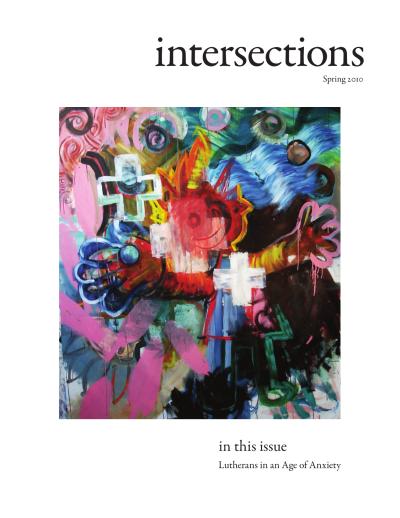 Article
Living at the Intersection of Fear and Hope
Mark S. Hanson
No. 32 · Spring 2010
Hanson draws on his January 2009 ELCA/ELCIC visit to Jordan, Israel, and Palestine—a Hebron Quran that did not burn, fifth graders dancing at the Hope School, a conversation with King Abdullah II—to frame the vocation of Lutheran higher education at the intersection of fear and hope. Engaging Brueggemann, Sittler, Buechner, Auden, Strandjord, Douglas John Hall, W. Robert Connor, Lewis Mudge, and Cynthia Moe-Lobeda, he argues that Lutheran colleges are called to critical inquiry that does not collapse into a hermeneutic of suspicion, to a “thinking faith” that resists religious fundamentalism, and to communities of discernment that work for the common good.
-
 Institutional Focus
Embodying the Tradition: The Case of Wittenberg University
Baird Tipson
No. 2 · Winter 1997
Tipson, President of Wittenberg University, locates Wittenberg in the “American” strain of Ohio Lutheranism founded in 1845 under Ezra Keller (a Pennsylvania College and Gettysburg Seminary graduate and disciple of Samuel Simon Schmucker), with English-language preaching, financial support from the pan-Protestant New England Society, Presbyterians on the Board, and an Episcopalian teaching Latin. He names two ongoing challenges—remaining authentically Lutheran while welcoming a pluralistic student body (just under a quarter are Lutheran in a primary service area that is 5% Lutheran), and making the tradition clear and compelling to non-Lutheran or lukewarm Lutheran students—and presents the five things every Wittenberg graduate should be able to do (respond to the human condition; recognize, define, and solve problems; develop a sense of vocation; assume servant-leadership; take moral responsibility) as authentic expressions of the Gospel and of the university’s ELCA relationship.
-
 Article
Leading Students to Distinguish Between Career and Vocation: Reflections from a Lutheran Law School
Steven C. Bahls
No. 20 · Fall 2004
Bahls, writing as former dean of the Capital University Law School, argues that most law students and many legal educators confuse vocation with career—asking “what kind of lawyer do you want to be?” rather than “who do I want to be?” Drawing on John O. Mudd’s five attributes of a well-prepared lawyer and Susan Daicoff’s empirical research on lawyer dissatisfaction and the “amoral professional role,” he turns to Ernest L. Simmons’s and Darrel Jodock’s articulations of Luther’s understanding of vocation and proposes five steps—reflection, assessment, vision, integrative thinking, and reassessment—along with explicit leadership from law school deans, engagement of career services offices, and leadership within the profession (illustrated by Capital’s joint venture with the Columbus Bar Association).