It is a great honor to be here with you tonight. St. Olaf College has earned a distinguished place in American higher education, not only for excellence in the liberal arts, but also for abiding identity and attachment to its founding denomination. Let me add my words of congratulations to those already spoken, not only for 125 years of ever-expanding educational excellence but also for the way in which you are choosing to celebrate this year -- with a conference, a book, and new mission and identity documents.
Since this is an after-dinner speech, I’d like to begin with a few words from Garrison Keillor, whose humor often revolves around religion, especially the particular blend of religions in this region. Here is a Keillor excerpt called “Singing with the Lutherans”:
“I have made fun of Lutherans for years—who wouldn’t if you lived in Minnesota? But I have also sung with Lutherans and that is one of the main joys of life, along with hot baths and fresh sweet corn. We make fun of Lutherans for their blandness, their excessive calm, their fear of giving offense, . . . , their lack of speed, and also their secret fondness for macaroni and cheese. But nobody sings like them. If you ask an audience in New York City, a relatively “Lutheranless” place, to sing along on the chorus of “Michael Row the Boat Ashore,” they will look daggers at you as if you had asked them to strip to their underwear. But if you do this among Lutherans they’ll smile and row that boat ashore and up on the beach and down the road!
Lutherans are bred from childhood to sing in four-part harmony. It’s a talent that comes from sitting on the lap of someone singing alto or tenor or bass and hearing the harmonic intervals by putting your little head against that person’s rib cage. It’s natural for Lutherans to sing in harmony. We’re too modest to be soloists, too worldly to sing in unison. And when you are singing in the key of C and you slide into the A7th and D7th chords, all two hundred of you, it’s an emotionally fulfilling moment…
I once sang the bass line of “Children of the Heavenly Father” in a room with about three thousand Lutherans in it; and when we finished we all had tears in our eyes, partly from the promise that God will not forsake us, partly from the proximity of all those lovely voices. By our joining in harmony, we somehow promise that we will not forsake each other. I do believe this: people who love to sing in harmony are the sort of people you could call up when you’re in deep distress. If you’re dying, they will comfort you. If you’re lonely, they’ll talk to you. If you’re hungry, they’ll give you tuna salad!”
When I got this Keillor passage over the internet a few months ago, I dropped it into the St. Olaf file because it reminded me of the year I spent as Senior Fellow in the Lilly Fellows Program in the Humanities and Arts at Valparaiso University. I was there long enough to glimpse the difference between the Missouri Synod and the ELCA and the difference between German and Norwegian ancestry. Like all denominational differences, these seem larger to insiders than to outsiders. The reason the Keillor quote connected so well to the year at Valparaiso was that it led directly to a memory. It was a pleasure that year to introduce Goshen College professor of music emerita, Mary Oyer, to the Fellows. She led us through a rich array of hymn traditions, all the way from Amish singing from the Ausbund to African and Cheyenne music in the Mennonite Worship Book. To extend Keillor’s image one could say that if you ask Mennonites and Lutherans together to “row the boat ashore,” we not only row it up the beach and down the road, but we might even start to levitate.
We not only share a love of hymn-singing, but we also share the other history Keillor enjoys making fun of—the potluck dinner with its famous menu. How is it, then, that we differ? To answer that question we need to go back to the sixteenth century. Here’s how Walter Sundberg described it in his essay, “What does it mean to be Lutheran?,” in Called to Serve:
“In the earliest years of the Reformation, Luther found himself in conflict not only with Rome but also with ‘radical reformers’ who taught that the true community of faith is made up of believers who experience personal conversion. These reformers taught a wide variety of doctrines, the effect of which was to exhort Christians to make a self-conscious commitment to Christ that expresses itself in outward behavior. Some insisted that Baptism is for adults, not infants, because only an adult can make a responsible decision for Christ…. Some stressed that moral discipline is not only the fruit of faith, but the necessary proof that faith is genuine. Luther argued that the general effect of these teachings is to bind faith to certain works. These works become the ‘angels’ of authority” (6).
Today’s Mennonites were one group of the radical reformers in this description. We were Anabaptists, who dared to baptize each other as adults and thereby challenged the authority of both church and state. We expected that conversion would result in a life of obedience to the cross, even unto death. For thousands of Anabaptists, who fled Catholics and Calvinists and Lutherans alike, this sense of radical commitment led to martyrdom, a fact that has shaped our community as much or more than theology.
If we were 16th century disputants today, heresy hunters, we would each be advocating for one horn of a dilemma—to vastly oversimplify, let us call these the horn of grace and the horn of discipleship. Mennonites have maintained that discipleship is different from “works righteousness” and have their own terms of derision for the opposite problem—“cheap grace.” The signs of conversion most highly valued historically have been pacifism, service, and community—all ways of submission of the individual to the will of the church and the welfare of others.
Yet the Mennonite Church, like the ELCA, is undergoing great change. You and your Catholic brothers and sisters and have signed the 1999 Augsburg Accord, after three decades of ecumenical dialogue, indicating that the reciprocal condemnations both groups made of the other in the sixteenth century no longer apply to the crucial doctine of justification.
Our church is attempting to unite both Mennonite Church and General Conference Mennonite Church beliefs, practices, and histories at the present time. We are much more diverse theologically, ethnically, and socially than we were in the mid twentieth century. The attempt to unify has heightened some of these differences, and yet it also calls us back to founding principles, to the distinctives of our faith.
If you read the essay “Keeping the Faith: Integrity with Your Heritage,” with Keith Graber Miller as first author, you have an outline for the elements of our tradition: radical break from both Catholicism and Protestantism in the sixteenth century resulting in persecution. Persecution leads to loss of intellectual leadership and isolation. Higher education re-emerges in America when the church, partly under the influence of both progressivism and revivalism, begins to recognize that it will lose the youth of the church if they leave the farm and the small town to go off to the city for an education. One person described Goshen College in its early days as the place which was needed so that Mennonites would not go to the University of Chicago. But it was also a place filled with hope that Mennonites might make a special contribution to education. John S. Coffman’s 1904 essay, “The Spirit of Progress,” traces a line of radical Christian thought from the medieval Waldensians to the present day Mennonites and urges the next generation to extend this spirit into the future.
Coffman’s essay tracing a Spirit throughout Time was a method that later leaders would also rely on. Since we have a history of persecution and no highly developed creedal tradition passed on through propositional truths, we pass the torch from generation to generation largely through stories and songs and a few central images. We are a people of narrative.
For us, church history has been as influential than theology or even biblical studies in shaping our identity. In Mennonite colleges, where the study of Anabaptist history and Mennonite history has ignited Mennonite intellectuals, lay members, and clergy with a sense of their identity and central questions ever since 1944 when Goshen Dean Harold S. Bender’s “The Anabaptist Vision” appeared in Church History. Other seminal texts have been John Howard Yoder’s The Politics of Jesus and J. Lawrence Burkholder’s The Problem of Social Responsibility from the Perspective of the Mennonite Church. But probably most powerful of all has been experience. Some of these expereinces include being conscientious objectors to war, of seeking to demonstrate commitment through international relief work, and of going into cities to try to alleviate the pains of poverty. Today, poets and painters have expanded and sometimes challenged the historical identity project. Finding consensus among all these claims to faithful identity is elusive. We have come to embrace ambiguity and paradox, just as you have done. Let me attempt, however, to define what is distinctive, the ideal form of Christian higher education as we try to practice it at Goshen College.
The Mennonite model of both “calling” and “service” is rooted in a theology of suffering and humility, is passed on most effectively through narrative, singing and other experiential forms, and, at its best, aspires to nothing less than the formation of a communal conduit for God’s grace so that “healing and hope” in the form of peacemaking and service “flow through us to the world.”
The best way to illustrate this thesis is to use some teaching experiences as a case study. In the mid 1990’s, when I chaired the English department at Goshen College, I taught a course called the Senior Seminar in which I was searching for methods that would help our students use their literary analytical skills, reflect on their learning after four years, bond with each other and with Goshen College, and prepare to enter the world. In it, I describe the course I just finished teaching, “The Literature of Spiritual Reflection and Social Action.” The premise for this course was simple. I asked three people I respect for their learning and their Christian faith to tell me about the book that made the most significant change in their lives. Amazingly, each person could tell me immediately what the book was and what happened when he or she read it. To the books they picked, I added one of my own.
One of those books, and the first one we read, was Man’s Search for Meaning by Viktor Frankl, a survivor of Auschwitz, Dachau, and two other concentration camps. The 16 students who elected to add this one-hour class on top of a regular load were all Mennonites. Two Chinese professors who are exchange scholars in our international service-learning program, the Study-Service Term (SST), audited the class. They claim no religion, but were extremely interested in ours and offered points where they saw agreement or disagreement with Eastern thought, especially Buddhism. The person who chose the Viktor Frankl text, and who came to class to talk about its impact on his life, is a Methodist-turned-Presbyterian. He is also wheelchair-bound, having been diagnosed with multiple sclerosis a decade ago.
My method for designing the course could be called a Pedagogy of the Holy Spirit. I believe it evolved out of my own prayer life and the prayers of many people who lift up Goshen College to God every day. The idea came as a flash of inspiration. The people walked into my life at the right moment. The course did not so much develop along pre-planned lines as it unfolded out of mystery. I am still awed by what took place in those winter afternoon presentations and discussions.
I did not plan it, but our first book was about suffering, terrible suffering, meaningless suffering. We never used the word “martyr,” as we would have done if we had been studying about the 4,000 Anabaptists who were drowned or torched in the 16th century instead of 6 million Jews exterminated in the twentieth century. But there were passages of this book that resonated with Mennonite students in special ways, often without their knowing why. Frankl described his purpose this way: “I had wanted simply to convey to the reader by way of a concrete example that life holds a potential meaning under any conditions even the most miserable ones” (12). If there were time today, we could parse every word of that statement for its relevance to the thesis of this paper. But you have already done that, noticing words such as “simply,” “concrete example,” “meaning,” and “miserable.”
Throughout the book the author’s tone is remarkable. I can only give it one of my highest compliments—it is humble, suffused with love. Frankl writes for the living, but he carries the memory of those who died. He begins his book with this statement, “We who have come back, by the aid of many lucky chances or miracles—whatever one may choose to call them—we know: the best of us did not return” (19). Mennonites of the sixteenth century might have said the same. In a chapter called “The Case for Tragic Optimism,” Frankl gives what could be called an apology for the course itself: “All we can do is study the lives of people who seem to have found their answers to the questions of what ultimately human life is about as against those who have not” (146).
At Goshen College we do a lot more than study people’s lives. We also study chemistry, math, poetry, computer science, art, history, etc. Individual classes in a random sample of courses would probably not differ drastically from those of any other good liberal arts college. But we do have a special place in worship and in our academic life for the narrative—especially the life narrative or spiritual autobiography—and we encourage our faculty to tell their own and other’s stories—to testify. I came to Goshen College expecting to stay three years in 1976. Instead, I never left. What drew me and held me were powerful stories. I can recall, from among scores of personal narratives I know well, the story of Carl Kreider, dean and president emeritus, who told the students in a 1978 chapel service that he chose to borrow money in the 1930’s in order to attend Goshen rather than take a full scholarship to Oberlin because “he did not want to break his parents’ hearts.”
He went on to describe a journey of the highest intellectual and spiritual challenges in a way that was so beautiful, both in its use of simple yet eloquent language and through gentle tone of voice and body language that I found myself saying, “There’s something here they never heard of in graduate school. And I want to find it.”
Among the narratives that shape our theology, our campus community and our individual choices at Goshen College is an important set involving international service-learning. The program behind these narratives, called the Study-Service Term (SST), was instituted 30 years ago as part of our general education package. Since then, about 6,000 students have spent 13-14 weeks in a “significantly different” (usually “third world”) culture and have spent half of that time in a service assignment. Over one hundred faculty have led units of students in this powerful form of experiential education. Almost everyone who participates tells others about ways his or her life was changed, sometimes dramatically.
Goshen, Indiana, is a town of 24,000 in the middle of America, and the students on our campus, like most residential college students, are mostly white, mostly middle-class students. Yet if the dormitory walls were to give up their secrets, they would ring with stories of suffering and ecstasy that come from such places as Chengdu, Abidjan, Jakarta, Port au Prince, San Jose, Tecucigalpa, Jena, Santo Domingo, and hundreds of villages from all parts of the globe. Students make meaning out of experiences such as watching a sleek Mercedes with tinted windows roar past beggars lined up on both sides of the street, walking through suffocatingly beautiful rain forests, digging wells, worshipping in mud huts—or in spectacular cathedrals, trying to understand the mysterious opposite sex under even more mysterious circumstances, recognizing the privilege Americans carry with their passports and the resentment privilege breeds. The most touching stories, however, usually come from the families with whom students live and from the generosity of their hospitality. Students return back home with softer, more sensitive, hearts and stronger minds. On SST hearts and minds are connected because the stories require the engagement of both. If a student reads about some cultural fact first and then sees a version of the practice or value described, there is either an “aha” moment or a moment of cognitive dissonance due to either the perception or the reality differing from the expected. But the experience is more than clinical, as observation in a laboratory might be. It usually matters some visceral way to a student. It may come at a moment of physical pain or exertion or homesickness or hunger. It may induce guilt, fear, a flood of tears, quiet musing, or a surge of adrenaline. Even people who want to be objective or detached cannot avoid the subjective on SST. But those who gravitate to the subjective are not safe either. If they are to make meaning, they must draw back far enough to see and seek information outside themselves. The journals of students under these circumstances become a place of exploration of self and other, facts and feelings, and a record of rapid maturation.
The narratives of SST, though different in every case, often bear the mark of the redemption narratives of the Bible, whether or not our students (and even faculty) always recognize these marks. Listen to these words from student David Roth, writing last year, after returning to the Dominican Republic following four days in Haiti.
I’m going to bed tonight tired, but a good tired that has come from thoroughly extending myself in every intellectual, emotional and physical way during the Haiti trip. I am spent intellectually—I pushed so hard to soak up every word from every speaker, pushed my brain constantly for three days, examining/connecting/critiquing ideas presented to me. I spent myself in staying up late all the nights to talk among wonderful people in fascinating subject areas. And I’ve never learned so much in three days, never. I think my life/views/opinions have been altered permanently in some areas, like thinking about poverty, and about dependence/service issues, and about entering a culture you have little knowledge of. And it feels good to be spent. The rush I got from all the input has given me so much to ponder in a long-term sense.
Again, we could spend a long time, if we had it, reading this entry closely, but you will notice how explicitly it addresses the topic of this conference—and that it is conscious in doing so. Both the deliberate placement of the student in a disorienting situation and assigning him to learn via the reflective mode of journaling are part of the pedagogy and part of the deeply imbedded and too often unarticulated philosophical-theological structure of our curriculum. The form the student gravitates toward naturally is the narrative. Perhaps, ironically, one reason why we have not done a good job of explaining our narratives philosophically or theologically is that we have experienced their reality so profoundly and find them to be self-evident, requiring little or no justification.
Our purpose in examining David Roth’s words, however, is to observe the structure of his narrative and some of the allusions to the biblical narrative one could draw out of it. Robert Frost has said that poetry begins in wonder and ends in wisdom. In this case, the narrator begins in exhaustion and ends in a “rush” that he recognizes will be the stockpile of memory on which he will draw—“ponder” for the rest of his life. If I were writing comments on this entry (something the faculty leaders do on SST), I would point out to David that he has written in these sentences his own psalm, with the usual structure of great exertion mixed with pain leading to deep satisfaction from yieldedness. He has therefore discovered something profound about his own name, “David.” He is a singer and dancer before the Lord. He has also wrestled, like Jacob, for a blessing. Now he will ponder these things in his heart, like Mary.
I do not consider such observations to be “mere piety”—a patina of religiosity over an experience not presented as religious by the student. Rather, I see this as an opportunity simultaneously to deepen learning (has he ever thought about the structure of the Psalms?) and deepen faith (does he recognize the biblical power of naming to his own calling in life?).
The author Madeleine L’Engle has a great following among Mennonites. She has visited the Goshen campus at least three times since I have been there. I have read her trilogy to both my children. Inside a dog-eared copy of her book The Wind and the Door is her admonition, in her own handwriting, to my son, Anthony: “Be a namer.” Ever since L’Engle’s first visit to Goshen, wherein she named the process of naming for me, and ever since I read the passage in that same book about Progo the angel, whose job it is to name all the stars, I have had a deep appreciation for the power of naming in education, especially church-related education. What would happen to the world if every one of the students who left our campuses, were truly and deeply named? L’Engle herself would say that war and violence would subside and the world would reflect more clearly God’s design in creation. The secret to building a redemptive community is to lavish love and attention on each of its members, as God has lavished love on us. What is a more profound way to do that than to help each member discover meaning in his or her name? We become peacemakers as we ourselves are filled with the peace that passes understanding. We become servants as we are served by Christ upon his knees.
When each member of a community comes to know the meaning of his or her own name, another kind of naming occurs—the naming of the powers and principalities—that attempt to separate us from the love of God. As we become firmly rooted ourselves, our eyes open to the rootlessness around us. The apostle Paul gave us a name for evil forces—“powers and principalities.” Theologians John Howard Yoder and Walter Wink have expounded on the concept and redeemed it for a secular age. Walter Wink has also suggested that institutions, as well as individuals, can draw sustenance from the idea of vocation. Noting that in the book of Revelation the New Testament churches of various cities were addressed not by the name of their cities, but by the names of the Angels who defend the church from the Powers and Principalities, Wink asks us to consider the possibility of taking seriously what kind of angels our institutions might have or recover.
In a February 13-15, 1998, meeting in Mundelein, Illinois, of educators who wish to transform higher education by recalling its spiritual roots, a Catholic nun reminded the group that during Vatican II, the various orders were asked to focus on their “founding charism.” I have found it fruitful to reflect on what the “founding charisma” of Goshen College might be and what its angel might be named. Perhaps these will be useful images for you also.
As I have walked with you through a theology of suffering and humility, visited a few narratives, and found a few more names for the profound spiritual process which produces peacemakers, servant-leaders, and strong communities, I found myself thinking again about the New Testament Church, so full of conflict, so alive with promise. I thank you for providing the setting of this conference and sharing with me your traditions, which stimulated my own thinking. On SST it is a truism that when we go abroad we come to know our homes better. That transformation has happened to me here among you.
The poet is Sarah Klassen.
Praise God
Bells toll a sombre invitation
And the people come.
The women’s shoes have been removed
For death. Doomed,
She’s arrayed in a dull red
Petticoat. Before the end
She lifts a slender hand
Like this
As if in benediction,
Pulls from her aching mouth the
Wooden gag
Meant to keep her mute
And begins
Bravely
Singing her terrified heart out.Listen.
August 16
I told Martin I had no culture,
And I don’t.
We were sitting in the grass and I looked at his hair like black wool twisted into living snakes and I wanted to cry.
For I have no culture.
He’s named after a reverend, a hero.
He closes his eyes when listening to Paul Laurence Dunbar or Maya Angelou and “He’ll rise.”
But what am I?
He eats soul food.
I hate sauerkraut and sausage,
I don’t even have a generation, too young for “X.”
What do I do?
Hang a flag upside down and bitch about the class system.
I have no heritage, no ethnicity.
If I have a culture it’s one of greed and lustful power.Samantha makes tortillas and talks Spanish with her mom,
Her aunts start prayers with phrases like, “dios mio.”
And what do I have?
Old women with doilies on their heads
Who scorn me for liking the taste of beer and having long hair.
I have no war to protest like my father.
So I remain sarcastic and hateful.
But I want a hero.
Not some athlete or politician.
I want someone who pinches and twists my soul until I can raise my hands and shout, “Halleluya!”
Instead I remain some pseudo-leftist without a cause.
Wanting to be idealistic in this world that preaches conformity and compromise.
I distrust that system of buy, buy, and buy and I hate and disbelieve this corporate vengeful Christianity until I realize that I don’t believe in anything. I want to believe or trust or cry.
I’m tired of protests.
For once, I want to celebrate something.
-
 Editorial
From the Publisher
Arne Selbyg
Selbyg explains that, while Intersections usually publishes papers from the annual Vocation of a Lutheran College conferences, this issue gathers presentations from a St. Olaf 125th-anniversary conference—a companion to the volume Called to Serve edited by Pamela Schwandt—because the theology and educational perspectives behind them apply to any Lutheran college and clarify what makes ELCA church-related colleges excellent institutions for students of any faith.
-
Editorial
From the Editor
Tom Christenson
Christenson recommends the St. Olaf 125th-anniversary volume Called to Serve—edited by Pamela Schwandt with Gary de Krey and L. DeAne Lagerquist—particularly Walter Sundberg’s “What Does It Mean To be Lutheran?” and Darrell Jodock’s “The Lutheran Tradition and the Liberal Arts College.” He notes that the volume’s biographical sketches of Lars Boe, F. Melius Christiansen, Ole Rolvaag, Emil Ellingson, Agnes Larson, John Berntsen, Arne Flaten, and Howard and Edna Hong show, against an outsourcing age, that the life of an institution like St. Olaf is the committed life of the people who work there.
-
Article
Faith, Understanding, and Action
Paul J. Dovre
Dovre frames the St. Olaf 125th anniversary—originally read as part of a presentation with the St. Olaf Cantorei and organist Paul Manz—around T.F. Gullixson’s story of an immigrant woman who “turned her face to the west wind” and the 1874 gathering at the Holden parsonage of B.J. Muus, Harold Thorson, O.K. Finseth, K.P. Haugen, and O.O. Osmondson. He weaves Anselm’s “faith seeks understanding,” Harold H. Ditmanson on the universal relevance of Christian faith, and the music of Venatius Honorius Fortunatas, John Rutter, Herbert Brokering, Ralph Vaughan Williams, and John Tavener into a meditation on faith as motive, understanding as modus, and action as consequence, against the “ill winds” of poverty, child homicide, AIDS, and consumer gluttony.
-
Article
Toward an Adequate Theology of Christian Higher Education
Robert Benne
Drawing on his forthcoming Eerdmans volume Quality With Soul—Thriving Ventures in Christian Higher Education, which studies St. Olaf, Valparaiso, Notre Dame, Baylor, Wheaton, and Calvin, Benne argues that these schools have kept their souls because a critical mass of boards, administrators, faculty, and students treat the Christian account as comprehensive, unsurpassable, and central. He critiques four inadequate theologies of Christian higher education—pietism, liberal theology (Whitehead, Henry Nelson Weiman, the “values” turn, and accommodation to diversity and multiculturalism), “First Article” approaches (including Merrill Cunninggim’s Methodist version and a Lutheran two-kingdoms quietism), and reactionary/triumphalist theology—and contrasts the Catholic (Notre Dame), Reformed (Calvin, Wheaton, Baylor), and Lutheran (St. Olaf, Valpo) ways of relating faith and learning, calling Lutherans to recover “Christ and culture in paradox” as serious extended conversation rather than as a lazy excuse.
-
Article
Education for Peace and Justice
David J. O'Brien
O’Brien surveys justice and peace education in Catholic higher education from Vatican II through the 1980s pastoral letters on nuclear weapons and the American economy, contrasting evangelical radicals (“what would Jesus do?”) with comfortable accomodationists, and argues that Catholic social teaching remains the church’s “best-kept secret.” Drawing on Bryan Hehir, David Hollenbach, Pope John XXIII, Patricia Hample’s “placing ourselves in the world to be of use,” and Martin Luther King’s last book on the “world house,” he develops pastoral care, solidarity (rooted in the mystical Body of Christ), and a realistic vocation-and-citizenship as the three needed responses for Catholic and Lutheran colleges alike.
-
Reflection
Vocation
Matt Peterson
In a chapel homily, St. Olaf student Matt Peterson quotes former St. Olaf professor Howard Hong’s 1955 Our Church and the World—“the tragedy is that we seem to have lost the full grasp of the Christian vocation”—to argue that vocation, from the Latin vocare, is centrally a call into daily communion with God and into continually becoming Christian, not the title of a successful career marked by GPA, win-loss records, honorary degrees, or net worth. Drawing on Anthony Bloom on prayer that must be lived, he indicts the dread of Monday, the “come hell or high water” demand for production, and the “faith community” that we take on faith.
-
 Article
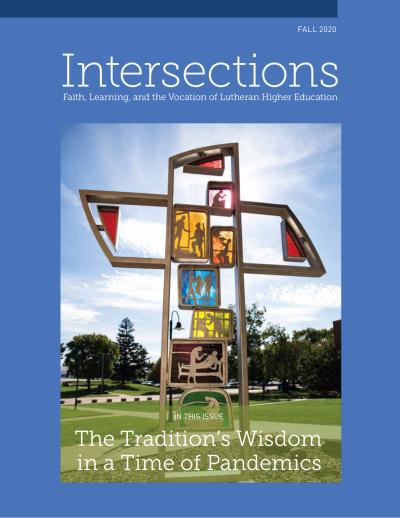
Learning from Luther on Covid-19
Carl Hughes
No. 52 · Fall 2020
Reading Martin Luther’s 1527 treatise “Whether One May Flee from a Deadly Plague,” Hughes finds practical and spiritual guidance for a pandemic age: serve the neighbor, follow medical experts, honor those whose vocations put them at risk, and trust that even when we fail, God will not abandon the community.
-
 Article
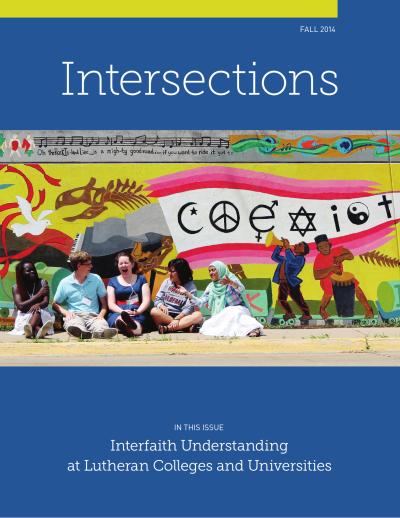
Well, Well…Plumbing Our Depths, Telling Our Stories
Ann Boaden
No. 40 · Fall 2014
Beginning with a college visit that turned into a grieving mother’s confidence about her daughter’s last moments, Boaden uses John 4’s well of living water to argue that an interfaith education worthy of the name requires Lutherans to plumb the depths of their own tradition’s wells — with rituals, stories, and seasons intact — before they can see, respectfully, into the wells from which others drink.
-
 Article
Academic Vocation: What the Lutheran University has to Offer
Wendy McCredie
No. 19 · Summer 2004
Writing as a practicing Lutheran, a trained literary scholar, and the associate director for interpretation at the ELCA churchwide office, McCredie articulates a vocation for ELCA colleges and universities grounded in the dialogical tension Gilbert Meilaender names between “bonds of particular love” and “a love which is open to every neighbor.” Drawing on Berube and Nelson, Marsden, Pelikan, Schwehn, Toulmin, Simmons, Hughes, MacIntyre, and Wolterstorff, she argues that Lutheran tradition resists both the easy separation and the collapse of sacred and secular, that human reason errs while God’s grace makes action possible, and that listening to the marginalized and to those outside the tradition is itself a theology of the cross enacted in classroom and collegial life.
-
Reflection
David Kamins
David Kamins
No. 40 · Fall 2014
Kamins, a Jewish student at Muhlenberg College, reads Rabbi Joseph Soloveitchik’s The Lonely Man of Faith alongside his own journey at the Interfaith Understanding conference on the eve of Shavuot, finding in the dual figures of Adam I and Adam II a way to remain firmly grounded in his faith community while going out to learn from those around him.
-
 Institutional Focus
So That All May Flourish Study Guide
No. 57 · Spring 2023
A chapter-by-chapter study guide to So That All May Flourish (Fortress Press 2023), a new volume by NECU authors that develops the central tenet of “Rooted and Open” and offers discussion questions for use in orientation programs, classes, workshops, task forces, and professional development settings.
-
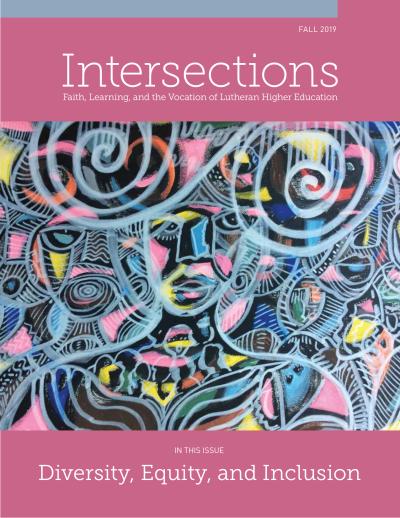 Article
Making Diversity Matter: Inclusion is the Key
Monica Smith
No. 50 · Fall 2019
Smith, Augustana’s inaugural Vice President for Diversity, Equity and Inclusion, frames the work of a Chief Diversity Officer as that of a disrupter and argues that while diversity in higher education is already happening, inclusion is a choice — one requiring a fundamental institutional transformation that diversifies faculty and staff, infuses diversity into the curriculum, invests in professional development, and draws on senior leadership to dismantle barriers.