Enter a keyword or select a filter to search articles.
Professor of Political Science
Capital University
Brian Forry Wallace
No. 13 · Winter 2002
Wallace, a 24-year veteran political science professor at Capital University, recounts five weeks of post-apartheid peace-building travel-study with students living south of Cape Town—visiting townships, schools, day-care centers, a children’s AIDS hospital, Robben Island, and Nelson Mandela’s cell—and offers vivid sketches of his student companions Amy, Brian, Meghan, Karrie, Patrick, Meredith, Cheryl, Corin, Debbie, April, and Audra. He concludes that these students—atheists and agnostics and Buddhists and Methodists and Baptists, headed for social work, nursing, teaching, ministry, and parenthood—embody vocation by responding to a voice that calls them out of themselves to be present and to heal in this world, and that they are his link to the redemption of a lost and broken soul.
Brian Forry Wallace, Michael Yosha, Reg Dyck, Susan Narita
No. 7 · Summer 1999
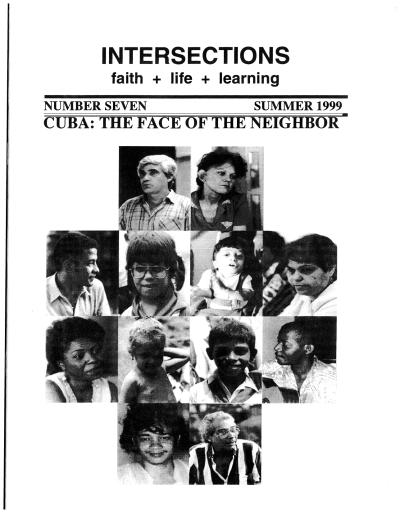
Four Capital University faculty—political scientist Brian Wallace (returning to Cuba a third time after the 1994 boat lift), English professor Reg Dyck, ESL teacher Susan Narita, and political scientist Michael Yosha—recount their summer 1998 trip with Pastors for Peace, describing Cuban priorities of education, health care, and military (in that order), the cultural richness of Havana from sixteenth-century cloisters to Miramar, the Cuban Foreign Service’s vision of a Scandinavian-style democratic socialism, the counter-productive U.S. embargo (including its effect on kidney dialysis machines), Castro’s 1991 reconciliation with religious communities, and a recurrent image of a little girl named Marguerite singing at a school for amputee and terminally ill children. The interview was conducted by Capital senior Jessica Brown and Tom Christenson.
No. 2 · Winter 1997
Two poems by Brian Forry Wallace of Capital University: “The Advent Carol,” a litany of the babies who were not adored—the Jewish baby shot with a Luger, the Black child hanged from a tree, the female messiah tossed into a river, the Tutsi infant cut by machetes, the Japanese newborn incinerated by atom bombs, the Chinese baby crushed by Japanese bombs, the aborted Mary’s child—ending with the baby “whom we do not understand, cannot feed, whom we kill”; and “The Madonna of Dohany Street,” on a Holocaust photograph in a Budapest museum of a dead mother and her dead Christ-child daughter in the former ghetto, in which annunciation, nativity, adoration, and crucifixion are seen together in a single instant.
 Reflection
 Article
 Poem
Poem