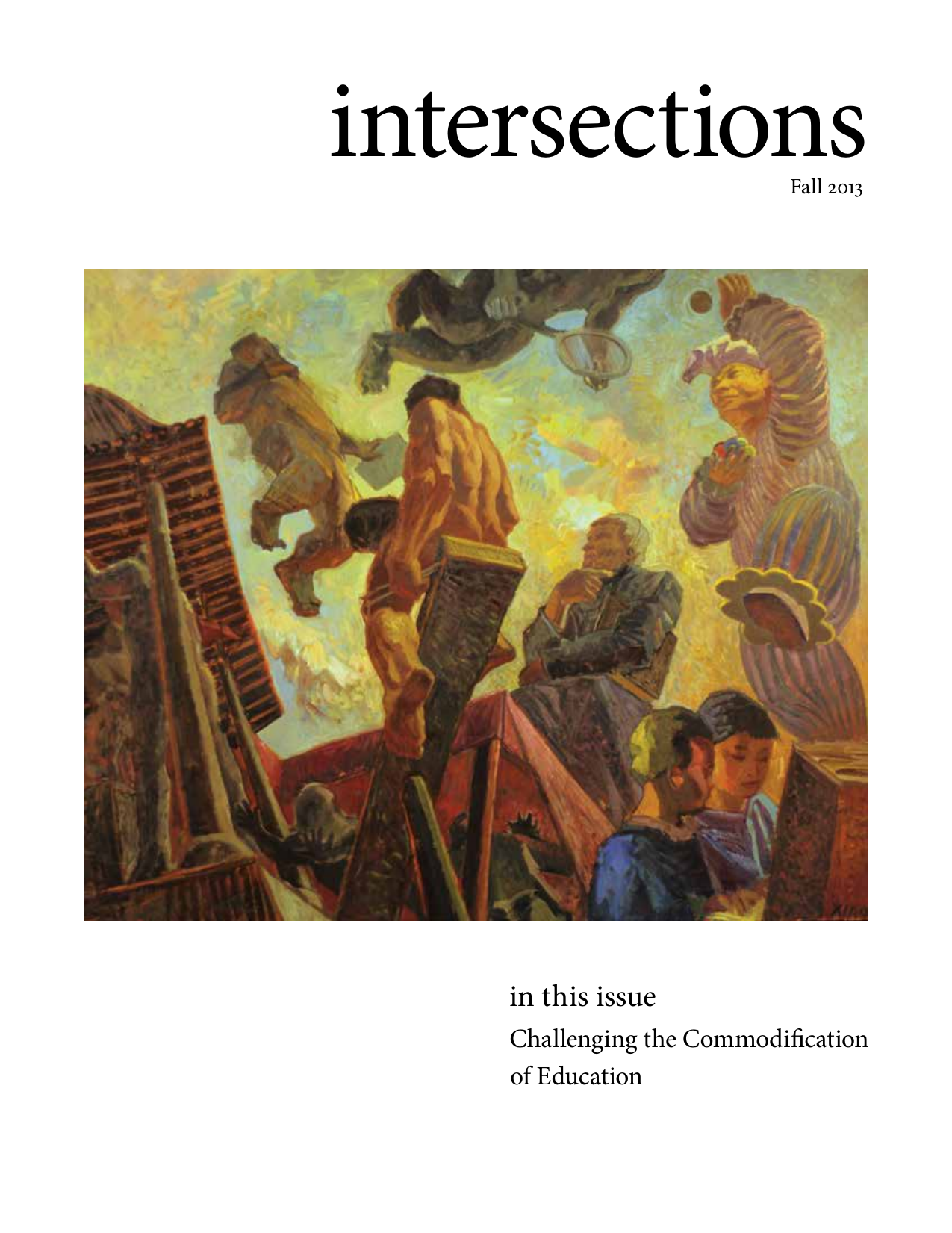
Challenging the Commodification of Education
The Fall 2013 “Challenging the Commodification of Education” issue draws on the 2013 Vocation of a Lutheran College Conference, asking what a Lutheran sense of vocation adds when colleges are priced and sold as commodities. DeAne Lagerquist recovers Luther’s “gift economy” as a counter to market logic; Mark Schwehn defends the “value added” of Lutheran liberal arts through the “local genius”; Tom Crady and Karl Stumo report from Gustavus and Pacific Lutheran recruitment; Patricia J. Lull preaches on Matthew 10; Duin and Childers introduce Project DAVID as a reinvention framework.
Editors
Articles in this Issue
-
 Editorial
From the Publisher: Staying Connected
Mark Wilhelm
Wilhelm frames Intersections as a tool for maintaining relationships among leaders in ELCA higher education, welcomes the journal’s new editorial advisory board, and points readers toward the 2014 Vocation of a Lutheran College conference at Augsburg and a special interfaith understanding conference at Augustana with Eboo Patel and Presiding Bishop Elizabeth Eaton.
-
Editorial
From the Editor
Jason A. Mahn
Mahn reads Michael Sandel’s What Money Can’t Buy alongside Larry Rasmussen and Martha Nussbaum to ask how Lutheran schools can articulate the “value added” of vocation without commodifying it, and previews the 2013 Vocation of a Lutheran College conference papers, Patricia Lull’s sermon, and Ann Hill Duin and Eric Childers’ Project DAVID essay that make up the issue.
-
Article
Welfare of the City and Why Lutherans Care about Education
L. DeAne Lagerquist
Lagerquist takes readers on a historical tour from sixteenth-century Saxony through the founding decades of Lutheran higher education in the United States to the present day, recovering Luther’s “gift economy” alongside Lewis Hyde and Oswald Bayer as a counter to the market logic that increasingly governs American higher education. She offers four propositions on vocation and commodification and proposes that Lutheran institutional vocation is to accept and pass along the gifts that come to our schools for the well-being of students, neighbors, and the world.
-
Article
The Value of Evoking Vocation and the Vocation of Evoking Value
Mark Schwehn
Schwehn answers Michael Staton’s call to “disaggregate” the components of a college degree by insisting that Lutheran education is integral and whole. Working through Bruce Kimball’s history of liberal education, Cardinal Newman, and Leon Kass on Athens and Jerusalem, he argues that Lutherans should defend liberal learning on instrumental grounds and offers the figure of the “local genius”—exemplified by his Valparaiso colleague John Strietelmeier—as the form of human excellence that Lutheran colleges uniquely cultivate.
-
Article
"We're Looking for a College—Not a Vocation": Articulating Lutheran Higher Education to Prospective Students and Parents Seeking Relevance
Karl Stumo, Tom Crady
Drawing on Sallie Mae and UCLA enrollment data, the websites of competitor institutions, and candid voices from the field, Crady and Stumo describe a recruitment landscape in which yield rates have collapsed, discount rates have soared, and the word “Lutheran” often presents an obstacle until it is patiently unpacked. They survey mission language at Augsburg, PLU, Gustavus, and Wartburg and argue that strategic message development is the only way for ELCA schools to make vocation and Lutheran identity “credible, relevant, differentiating, and compelling” to prospective families.
-
Article
More Value than Many Sparrows: A Sermon on Matthew 10:26-31
Patricia Lull
Preaching at the 2013 Vocation of a Lutheran College conference, Lull recalls her own arrival at the College of Wooster the summer after Kent State and contrasts that era’s sense of students as participants in a college’s mission with today’s talk of “butts in seats.” Reading Matthew 10:26-31, she promises that the way of the cross—and its hard opportunities for slow-paced learning, genuine debate, and access for students who cannot pay the full cost—is the easy yoke, the lightest burden of all.
-
Article
Reinventing Lutheran Liberal Arts: A Preliminary Report on Project DAVID
Ann Hill Duin, Eric Childers
Duin and Childers introduce Project DAVID—Distinction, Analytics, Value, Innovation, Digital opportunity—as a framework for showcasing strategic reinvention across ELCA liberal arts institutions. Building on Childers’ College Identity Sagas and reading Selingo, Norris, and Popenici alongside the AAC&U, Adrian College, NITLE, and the Delta Cost Project, they pose framing questions about distinction, vocation, affordability, value propositions, two-track innovation, and BYOE technology that ELCA campuses can use to face their own “Goliath” moments.