Enter a keyword or select a filter to search articles.
Former President
Concordia College
Paul J. Dovre
No. 34 · Fall 2011
Drawing on Hughes and Adrian’s Models of Christian Higher Education and on Ernest Simmons, Darrell Jodock, Tom Christenson, Robert Benne, and Richard Hughes, Dovre sketches a Lutheran learning paradigm shaped by four deep narratives—the biblical, the confessional, the theological, and the vocational—and traces their implications for curriculum (the study of scripture, theology, and vocation), for the religion faculty’s college-wide responsibility, and for pedagogy (moral deliberation, dialectic, paradox, the engagement of faith and the secular disciplines).
No. 30 · Fall 2009
Dovre offers a reminiscence rather than a research paper, drawing on Aristotle’s ethos, logos, and pathos to trace fifty years of change at Midwestern Lutheran colleges through the key issues of survival, respectability, faithfulness, and relationship to the church — from the dependence of the 1950s through the independence of the late twentieth century to the partnership of the 2000s — and identifies key variables (the student marketplace, faculty formation, and the identity/diversity paradox) for shaping the identity and mission of Lutheran colleges into the future.
No. 23 · Summer 2006
Dovre, President Emeritus of Concordia College and co-chair of the ELCA Task Force on Education, undertakes three tasks: focusing on the current social context (young people’s spiritual lives, the state of mainline denominations, the family map, schools, communities, and higher education); reflecting on why Lutherans care about education (creation in God’s image, vocation, Luther’s legacy, the priesthood of all believers, civic righteousness, and hope); and considering the prospects and possibilities for addressing the calling (biblical, confessional, theological, and pedagogical legacies; the renewal of apostolic ministry, the Christian-college renaissance, K–12 reform, and the congregational education explosion).
No. 10 · Fall 2000
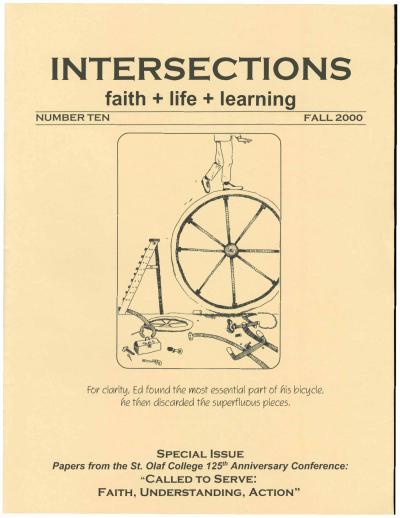
Dovre frames the St. Olaf 125th anniversary—originally read as part of a presentation with the St. Olaf Cantorei and organist Paul Manz—around T.F. Gullixson’s story of an immigrant woman who “turned her face to the west wind” and the 1874 gathering at the Holden parsonage of B.J. Muus, Harold Thorson, O.K. Finseth, K.P. Haugen, and O.O. Osmondson. He weaves Anselm’s “faith seeks understanding,” Harold H. Ditmanson on the universal relevance of Christian faith, and the music of Venatius Honorius Fortunatas, John Rutter, Herbert Brokering, Ralph Vaughan Williams, and John Tavener into a meditation on faith as motive, understanding as modus, and action as consequence, against the “ill winds” of poverty, child homicide, AIDS, and consumer gluttony.
 Article
 Article
 Article
 Article