My association with Lutheran higher education dates back to 1952 when I enrolled at Concordia College in Moorhead, Minnesota. Since then, with the exception of just six years, I have been involved in Lutheran higher education as a student, teacher, dean, president and consultant. In this essay I share my perceptions on several of the key trends that have characterized the past fifty years in the history of Midwestern Lutheran colleges. In both method and content, this should be regarded as autobiographical rather than academic, for it is more about reminiscence than research.
As the template for the historical assessments that follow, I draw from the classical sources of persuasion as identified by Aristotle and others. According to the classics, people are persuaded or convinced by three distinctive categories of proof: ethos, logos and pathos. Ethos is the power of one’s personality, character and reputation. We say we are convinced because the person making the argument is deemed to be honest, trustworthy, knowledge- able or loyal. I think that organizations and institutions have ethos as well and it is derived from their mission, their narrative, their values, their traditions and their character. The ethos of a college is transmitted through the people who constitute the institution, primarily the faculty and staff.
Logos is the second source of persuasion and it has to do with arguments and evidence, that is to say, with logic. When we say that a speech was substantive and persuasive, it means that we were convinced by the arguments and supporting evidence the speaker was able to offer. I believe institutions have a logos in that they make a case for what they stand for or what they have to offer their constituents. If they present well formed arguments and supporting evidence, good programs and sound learning, they are both respected and understood.
Finally, pathos is a form or persuasion that appeals to our wants, desires, convictions or values. Such persuasion may appeal to either our basic instincts or our higher inclinations. Institutions also offer pathos to their constituents as they appeal to ideals, values, aspirations, fears, hopes and even dreams. To the extent that people are inspired by, or in congruence with, these elements they will be content, moved or even inspired.
In my view, at mid-twentieth century, Midwestern Lutheran colleges made their case to their constituents of faculty, staff, alumni, church members, friends and students primarily on the basis of pathos and ethos. These colleges were generally places of unity and common focus, shaped by religious and ethnic identity and a strong sense of shared values and commitments. With the passing of the generations and the presence of a more diverse faculty and a more secular and pluralistic culture, both the pathos and ethos declined in their efficacy. Many new faculty “knew not Joseph” and so the traditions, values and general character of these places did not have a strong impact on them. Toward the end of the century, spurred by serious self-examina- tion, growing numbers of inquiring faculty and the support of the church, logos became the focus and the basis for institutional renewal. I believe that this emerging logos is having a significant impact upon these institutions.
As a way of explicating these matters, let me share my per- ceptions about the church and Midwestern Lutheran colleges during this period of change. The church was a major part of the context within which these colleges carried out their mis- sion during the past half century. There have been substantial changes in the church’s experience and those changes have had an impact in the life of the schools. For example, the church has changed from a mono-ethnic institution growing from within to a multi-ethnic church depending on outreach for growth. At a different pace perhaps, the schools have experienced a simi- lar trend toward greater diversity in the ethnic, religious and economic backgrounds of students, faculty and staff. In similar fashion, the church has made the transition from being insular to being energetically ecumenical. Mirroring this, the colleges have attracted students from a broad ecumenical spectrum. The church has changed from a body fairly clear about positions on moral and ethical issues to a church that is full of divisions over such matters. While the colleges may not have experienced such divisions in the ways that the church has, they are clearly places with a diversity of opinion and a liberal bias in such matters. At mid-century the church was a major collecting and distribution point for benevolence dollars and the colleges enjoyed high pri- ority in that distribution. By century’s end, benevolence dollars were scarce and the colleges, thought to be able to fend more or less on their own financially, were much lower on the priority list. Somewhat shadowing this development, a church that at mid-century paid close attention to its schools and held them accountable in a number of ways, now has both less time for, and less claim upon, such accountability.
There have been substantial changes in the church’s experience and those changes have had an impact in the life of the schools.
A second template identifies four key issues around which I will discuss developments in the five decades of the second half of the twentieth century. Those key issues are survival, respect- ability, faithfulness and relationship to the church. In the 1950s the leaders of the Midwestern colleges were Stavig at Augustana (SD), Christianson at Augsburg, Carlson at Gustavus, Ylvisaker at Luther, Becker at Wartburg, Granskou at St. Olaf and Knutson at Concordia. All except Carlson had ministerial preparation and parish experience. All were active leaders in their respective church bodies; they served on key boards and committees and were frequent speakers and teachers at regional and church wide events. It should also be noted that these men gave leadership at a time when institutional authority was more centered in the office of the president than at any time since then.
Of the key issues, survival was the one that occupied most of the attention of these colleges. These were the post-depression, post WWII days when campus infrastructures were rundown, facilities were totally inadequate for the expanding growth caused by returning veterans and there were not enough qualified faculty to cover all of the classes. Lutheran colleges were not unique in these regards; their state was the common state of most of higher education. A piece of good news was that although the faculty was stretched thin, there were among them some giants who defined the quality and character of these institutions. The second issue was respectability. Most of higher education had been given a pass on rising academic standards during the survival years of the 1930s and 1940s. But in the post war period the accrediting bodies began to flex their muscles. There was pressure to add PhDs to the faculty, to improve library holdings and to provide adequate equipment and facilities, particularly in the sciences.
With respect to the third key issue, faithfulness, the story is rather straightforward: each college was a monoculture of the sponsoring church body; almost all of the faculty and staff were Lutheran as well as most of the students. In most cases attendance was required at daily chapel and the religion require- ment consisted of several classes taken over four years. Campus rules and norms reflected the culture and expectations of the church. The mission identity of these colleges was not a matter discussed very often; it could simply be taken for granted. The ethos and logos of these places was not very self- conscious but it was constitutive and one can only wonder how these institu- tions could have prevailed through times of testing without this reality. As a contribution to the logos of these institutions, the Lutheran College Faculty group undertook a decade long study that resulted in the publication of Christian Faith and the Liberal Arts (Ditmanson), which examined the theological underpinnings of a Lutheran college and their implications for the curriculum. With respect to the church relationship, there was a strong tie. The financial support of the church body was a significant variable in the financial well being of each school. The church kept a close and loving eye on these colleges. The governance relationship between the church and the colleges was very strong; in most cases, church leaders had places on the governing boards and every board member was a member of the sponsoring church. Governing boards paid more attention to the details of managing the colleges, a practice grown out of the necessities of the 1930s and 1940s.
The decades of the 1960s and 1970s were marked by leader- ship changes at many of the colleges; from Stavig to Balcer at Augustana, from Christianson to Anderson at Augsburg, from Ylvisaker to Farwell at Luther, from Carlson to Barth at Gustavus, from Becker to Bachman at Wartburg, from Granskou to Rand at St. Olaf and from Knutson to Dovre at Concordia toward the end of that period. It should be noted that, in several cases, the new leaders brought stronger academic credentials and often less theological education. This was the case at Augustana, Luther, Wartburg, Gustavus and Concordia. With respect to the defining issues, while material survival was not in question, there was significant financial pressure related to expanding and improving campus facilities and providing necessary financial assistance to students. Federal policies and resources turned out to be of immense importance in meeting these needs with the advent of loans and grants for students, loans for building student housing and loans and grants for improving academic facilities. On several campuses there were construction projects underway every year for twenty years in succession. Since loans had to be repaid and grants did not cover all of the construction costs, each of the colleges put additional resources into fundraising with good results. Alumni, church members and community friends were committed to these schools and their generosity followed.
During these decades the schools grew in academic respect- ability. Faculty numbers grew and the percentages of faculty with PhDs increased as well, all of which was very important to accreditation agencies. New programs were initiated on every campus and library and laboratory facilities were upgraded. Faithfulness to mission and tradition became more challeng- ing during this period of time for a number of reasons. With pressure for academic respectability and shortages of person- nel, faculty appointments were likely to place more emphasis on academic qualifications than other factors. Most of the new academics came from research centers in which they had been shaped by modernism that placed priority on scientific methods of establishing truth claims. This trend, in turn, placed pressure on the humanities and the religious values that were intrinsic to distinctiveness of the schools. Curriculum changes tended to diminish the size of the religion requirement. Chapel atten- dance was by now voluntary but still substantial. The advent of the civil rights movement and the anti-war movement led to myriad changes in the society and its institutions. Some of those changes (e.g. more diverse faculty and student bodies) had a posi- tive impact on the colleges while others (destructive life styles) did not. Other consequences were the increasing secularization of the schools, the demise of in loco parentis and the restructur- ing of campus governance.
As it had in the 1950s, The Association of Lutheran College Faculties was minding the logos of Lutheran colleges, addressing both the rapidly changing culture of the late 1960s and 1970s and the challenges for Lutheran colleges. The Association’s work led to the publication of The Church-Related College in an Age of Pluralism: The Quest for a Viable Saga by Richard Baepler and others in 1977. The American Lutheran Church initiated the “Theological Development Program for Faculty” in the 1970s, a program that helped shape a number of persons who would emerge as faculty and administrative leaders in the 1980s and 1990s. However, the attention given to institutional mission (pathos) by most colleges in the 1960s and 1970s was less than the attention given to institutional quality. The discussions of mission rarely gave systematic attention to the ways in which the mission might impact academic life. However, in most cases faculty leaders were persons who had come in the 1940s and 1950s and were infused with the pathos and ethos of which I wrote earlier.
There were several emerging trends in these decades with respect to the colleges’ relationship to the church. To begin with, while church support was still a stable and growing part of the church’s budget reflecting the continuing priority of the colleges, church benevolence declined substantially as a percentage of the rapidly growing budgets of the colleges. Another marked trend in this period was the growing generosity of individual church members with respect to the financial needs of the colleges. In the case of the American Lutheran Church, a major church-wide campaign was very successful. During the 1970s, some Lutheran colleges revised their governing documents to include non- Lutheran members on their boards. This reflected the growing ecumenism of both the church and the colleges as well as the desire to “spread a bigger net” in search of influence, financial support and enrollment. In the Lutheran Church in America, colleges developed covenants with synods in their regions as a way of setting forth the mutual commitments that would guide the relationships. It is accurate to say that, with respect to Midwestern Lutheran colleges, college presidents were still thought of as prominent in the leadership of the church.
The decade of the 1980s saw a myriad of leadership changes in these colleges: At Augsburg College Oscar Anderson was succeeded by Charles Anderson; Augustana moved from Charles Balcer to Bill Nelson and then to Lloyd Svendsbye; St. Olaf from Sidney Rand to Harland Foss and Mel George; Luther from Elwin Farwell to H. George Anderson; Wartburg from William Jellema to Robert Vogel and Gustavus from Ed Lindell to John Kendall. In all but one case, the new presidents came from academic backgrounds. While finance is always an issue for private colleges, financial survival was not a defining issue in the 1980s. Federal and state financial aid programs were very helpful in maintaining vigorous enrollment. Many of the schools launched and com- pleted sophisticated and successful fund raising programs.
In terms of academic quality, the Lutheran colleges were respected by the public. It was during this decade that various national rank- ings of colleges first appeared and Midwestern Lutheran colleges earned high ratings. These ratings reflected the academic quality that had been built in the faculty and the attention that was being given to building strong academic programs.
Perhaps the most challenging issue in the 1980s was faithful- ness to the tradition and mission. By the 1980s the academy was shaped by the enlightenment focus on knowledge as opposed to learning, and the pedagogy of the scientific method held sway. These developments have been chronicled by George Marsden (The Soul of the American University), Douglas Sloan (Faith and Knowledge), and Mark Schwehn (Exiles from Eden) with respect to the academy in general and by James Burtchaell (The Dying of the Light) and Robert Benne (Quality with Soul) with respect to religious colleges. The consequences of these trends were to diminish confidence in religious knowledge and the role of faith in the life of the school. Augmented by the reality that secular values were shaping the culture, these trends were real sources of stress for most religious colleges, including Lutheran colleges in the Midwest.
There was more religious diversity on the campuses in the faculty, staff and student body.
In addition to the growing secularity of the schools, there was more religious diversity on the campuses in the faculty, staff and student body. While most of the faculty in the 1950s and even into the 1960s had come through the Lutheran pipeline, the majority of appointees in the 1970s and 1980s did not. That meant that the ethos, which had been carried in the DNA of the faculty in the fifties, sixties and seventies, could not be counted upon to carry the tradition in the eighties and matters of mis- sion could no longer be taken for granted. While in the past academic criteria and institutional/missional fit were held in bal- ance in the faculty selection process, by the 1980s academic cri- teria held sway. A related shift in the profile of incoming faculty in the seventies and eighties is that they had been shaped in ways that meant their primary allegiance was more in the direction of discipline and department and less to the institution which they served. I don’t think this was a self-conscious commitment on the part of most people, but it was nonetheless a growing reality. The consequence was a diminished religious ethos and pathos. During these decades one noted subtle changes in the rhetoric of many colleges with a growing emphasis on academic distinctive- ness and a softening in the emphasis on religious identity and mission. This was in some measure due to the fact that Lutheran schools were attracting an increasing number of students from other religious traditions whom they did not want to offend.
The connection between the colleges and the church also changed in the 1980s. The college presidents were less likely to be church leaders. The church was stressed for resources, and hence the financial support for colleges diminished. While Lutheran colleges were included in the mission circle of the newly formed Evangelical Lutheran Church in America (ELCA), they were less central to that mission. The implication of these develop- ments in the church meant that the colleges would assume a larger role in defining the ways and extent to which they would embrace their relationship to the Lutheran church and their mission identity. While it was clearly not the case that any of the Midwestern colleges were hostile to their Lutheran identity or trying to distance themselves from their mission, the close of the 1980s became a kind of watershed for these colleges; the relation- ship to the church had changed, the self understanding of these schools as institutions of the church had eroded and the faculties were not always “at home” in the academic communities of the Lutheran church. In short, the ethos that had been carried by an earlier generation had largely disappeared with their retirement, the pathos was less clear and compelling and the logos of the Lutheran academic tradition was not a significant factor.
Enter the 1990s: There were myriad changes in leadership: Frame was leading Augsburg, Wagner and Halvorson led Augustana, Baker and then Torgerson came to Luther, Edwards served at St. Olaf and Steuer at Gustavus. All of these leaders had academic backgrounds and represented a new generation. Most of them were intrigued by the questions of relationship, identity and mission and they came to these conversations with a refreshing curiosity. They were leading healthy schools. While some were more robust from a financial view than others, all were viable; while some had more success in attracting students than others, all had stable numbers. Academically, these schools each continued to make one or more list of best colleges. There were centers of excellence on each campus reflecting the quality and ingenuity of the faculty. A challenge dating from the 1980s was around the “vocationalism” that was sweeping the country. From grade school on students were being pressed to pick a career and pursue a professionally oriented education. This was a special concern to colleges with a strong liberal arts tradition.
Viewed through the lens of faithfulness to the Lutheran tradition, the 1990s were years of renaissance. The roots of this renaissance were both external and internal. There was a heightened awareness of a values crisis in the society. At the same time, there was an emerging spirituality among the young. In the academy, the postmodern movement provided a critique of mod- ernism, rationalism and the scientific method. Along with a new generation of leaders came a new generation of faculty members who had, in part, been shaped by this critique, young people who were curious about religious matters and college identity and open to deep conversation about value, meaning and faith. Providing counsel and leadership were some key faculty and administrative leaders who were schooled in the logos of Lutheran higher education.
Out of this crucible of change religious colleges found both incentive and support for a new self-examination of mission and identity. Many Midwestern Lutheran colleges initiated formal discussions about the meaning and implications of their mission and identity as Lutheran schools. The ELCA supported these efforts with annual conferences on the vocation of Lutheran colleges. These conferences were (and are) well attended and led to the publication of Intersections, a journal that features essays about faith and learning. The Lilly Endowment, sensing the new opening for such matters, launched a mammoth program enabling many colleges to initiate comprehensive programs cen- tered on the Christian idea of vocation. Most of the Midwestern Lutheran colleges participated in the program. The ELCA initi- ated the Lutheran Academy of Scholars where faculty members could devote themselves to a serious intellectual engagement between faith and learning. Endowed professorships were cre- ated on a number of campuses in support of academic endeavor informed by faith commitments. A number of curriculum proj- ects emerged and for many the touchstone was institutional mis- sion. The Lutheran Educational Conference of North America (LECNA) launched a major research effort designed to identify the unique impact of Lutheran colleges upon their graduates.
Many Midwestern Lutheran colleges initiated formal discussions about the meaning and implications of their mission and identity as Lutheran schools.
To return to the template of ethos, pathos and logos, what hap- pened in the 1990s was the beginning of the reconstruction of a logos in behalf of the mission of Lutheran colleges. Mirroring the leadership of their predecessors in the 1950s and 1970s, faculty members examined the Lutheran confessional, academic and intellectual traditions and found a trove of helpful propositions upon which to build an understanding of both personal and institutional callings. This logos is compelling enough to gener- ate conviction, yes even passion, for the cause. Thus we have the re-energizing of the pathos of these institutions and, over time, an emerging community ethos as well. This is not to suggest that questions about mission and identity are now settled. Indeed, that would defy the Lutheran tradition that is almost constantly in motion about such matters. As the society changes around these schools, the task or reinterpretation must go on.
Financial support continued to decline in 2000 as church- wide resources grew scarce and the fiscal wellbeing of most of the colleges made their need less compelling. The ELCA went through a re-organization in which higher education was joined with theological education. While church wide direct financial support continued to decline, the ELCA continued to spon- sor staff development and faculty interchanges in a variety of forums. Out of a vision of unity in mission and interconnected- ness in ministry, leaders of Midwestern Lutheran colleges have, in some cases, provided leadership in initiating and supporting partnerships with other institutions and agencies of the church.
In summary, survival was the issue defining the 1950s, respectability was the compelling issue of the 1960s and 1970s and faithfulness to Lutheran identity and mission emerged in the late 1980s and continues into the current decade. Over the span of the five decades, the relationship with the church evolved from dependence to independence to partnership. The profile of the presidents transitioned from churchly to academic; the cultural inclinations moved from sectarian to secular; the intel- lectual paradigm shifted from pre-modern, to modern, to post- modern and the demographic profile moved from homogeneity to a growing diversity. Entering the new century, Midwestern Lutheran colleges enjoyed regional and national reputations for excellence and possessed a robust attitude about their viability. Leaders of excellence mediate complex and stressful institutional agendas in a time of material uncertainty and cultural change. The case for Lutheran colleges, once resting on strong ethos and pathos, is being reconstructed around a lively and rich logos.
What then of the future of these colleges as expressions of the Lutheran tradition in higher education? Perhaps the most obvious answer is that, given the significant autonomy that characterizes Lutheran colleges, they will evolve in unique ways. Given the evolution that has occurred in the past decades, the colleges them- selves will be primary in defining their relationship to the church. Setting these matters aside, let me identify a set of key variables in shaping the identity and mission of Lutheran colleges.
The first variable is the student marketplace. It is very dif- ficult to characterize the rising generations of college students; they are at once liberal and conservative, religious and secular, spiritual but not necessarily religious and materialistic but committed to social action. Clearly, this profile suggests many vantage points for engaging with students around religious mat- ters. We can be reasonably confident that they will come from the full range of religious persuasions including non-Christian traditions, and so colleges will continue to make adjustments, curricular and pedagogical, to that reality. While Lutherans will perhaps remain the largest cohort group in the Midwestern schools, they will not always be in the majority. While these products of postmodernism are interested in the spiritual side of things, they are poorly informed with respect to confessional, theological and biblical matters. This presents a special chal- lenge and opportunity to those who teach religion. In addition, today’s students are not great worship attenders so campus min- istry leaders will face a continuing challenge in the engagement of students in corporate religious practices. These students are close to their parents, sometimes called the “hovering” genera- tion. Cell phones and instant messaging mean that students are always networking and parents are a significant part of their life experience. Colleges will continue to find their way in adapting to this reality which presents both opportunity and obstacle.
Another set of variables informing the status of these colleges in relationship to their mission and identity evolves around the faculty. Faculty recruitment will be especially crucial for faculty, more than anyone else, must represent and affect the mission of the college. Each college has the right to ask and expect that faculty members from any faith tradition will uphold the mis- sion of the college. While the exegesis of that mission is always a work in progress, colleges should recruit people who are willing to engage that dialogue in a constructive and sympathetic way. Discussion of these expectations should be part of the recruitment and screening process.
For many reasons, the formation of the faculty ethos will be of high importance. The faculties are and will be composed of a significant number of persons from non-Christian and non- Lutheran traditions. The presence of this kind of diversity presents both opportunity and challenge; the opportunity (and need) for dialogue (a Lutheran staple) and the challenge of educating those from other traditions. In reflecting on this diversity, Darrell Jodock put it this way, “In order for these colleges to retain the advantages of a tradition that challenges them to become more deeply and more profoundly what they already aspire to be, the tradition needs to be articulated more clearly and affirmed more intentionally.” (32) Since persons entering the professoriate in recent years have been oriented around disciplinary identity rather than institutional identity, there will be a continuing challenge for Lutheran colleges to integrate these persons into the community and engage them in the activities that give life to it. As noted ear- lier, the postmodern consciousness of faculty educated in the later part of the last century and the early years of this century may be an asset to these schools. The typical post modernist recognizes the legitimate place of religion in intellectual discourse, is open to the spiritual dimension of their own being and respects the impor- tant role of context, or community, in framing one’s perception and life practice.
Faculty are not the only element in the human variable of course. One thinks about the important roles of presidents, other college leaders, regents and staff. Leaders of experience and informed commitment to the Lutheran project in education are scarce so continuing attention to leader identification and development will be essential. The colleges will want to be self conscious in filling leadership positions with people who share the vision and mission of Lutheran colleges. The influence of persons who are either ill-informed or indifferent to such mat- ters has been, and will be, detrimental to Lutheran schools. Of almost equal importance to the selection of such individuals is the provision of continuing education experiences around mis- sion and identity. Again, if board and staff development around these issues is only left to chance, the results are likely to be drift and a growing indifference to such matters.
Another variable, perhaps the most important, centers on how we navigate the identity/diversity paradox. We acknowledge the value of both identity and diversity but have tended in recent years to give the greater weight to diversity. This is perhaps not surprising for institutions that were monocultural in the recent past (and defensive about it) and are well informed about, and widely influenced by, the diversity movement in higher educa- tion. It is also to be expected of Lutheran colleges that are, by tradition, culturally engaged institutions. The challenge will be achieving a relationship between these two powerful variables that will be consonant with the mission and identity of a Lutheran college. I think that multiculturalism becomes an asset when the cultures that inform it are well represented. That is, one of the special gifts that Lutheran colleges have to contribute to the multi-culture that is our world is a substantive, high quality and unapologetic representation of the Lutheran and Christian traditions. In other words, this identity becomes an asset, something to build on and never be apologetic about. Of course I am not arguing for some new parochialism but for a hearty multiculturalism that draws special strength from what the Lutheran tradition brings to it. One of those strengths is a commitment to engage in conversation with other faith traditions and to literally “test all things,” including our own tradition. This view of the identity/diversity paradox underscores earlier comments about the importance of recruiting faculty for mission and providing excellent opportunities for growth in understanding and sustaining the Lutheran tradition.
Another variable centers on the distinctiveness of the college program, the key dimension of a school’s logos. In recent years and out of the impulse of the Lutheran teachings on vocation, colleges have been paying increasing attention to Lutheran narratives in the construction of curricula. While “faith and learning” is not a Lutheran invention, it has always been central to the Lutheran intellectual tradition and Lutherans have brought special resources to it. In the biblical, theological and confessional nar- ratives of the Lutheran tradition, we find resources that apply to both the form and content of education. One thinks of Lutheran teachings on vocation, the two kingdoms, simul justis et peccator, original sin and the priesthood of all believers. Or, with reference to the biblical tradition, one recognizes distinctive traditions of historical, literary and rhetorical criticism. Concerning pedagogi- cal matters one thinks of the place of dialectic, the paradox, moral deliberation and discernment in community.
The pathos of campus life is another significant variable in the unfolding of Lutheran identity and mission. Proclamation, prayer and praise are staples of the Lutheran tradition and are formative of community. One calls to mind the worship centers on many campuses and the high quality programs in sacred music and art that involve large numbers of students. Given the challenge posed by individualism in religious matters and the secularism of harried life styles, worship will be a challenge for this group of colleges. We will need creative and winsome lead- ers who can both gather students in and reach out to students where they gather. Given the impulse to serve others that is strongly present on our campuses, campus ministry will find ways to identify with and inform such endeavors. Under the aegis of Lilly-funded programs and church-wide initiatives, the vocation idea has taken root on many campuses and, increas- ingly, in the lives of many students. This trend is fortuitous for the mission and identity of these colleges.
On most campuses the gathering of the community is increas- ingly problematic. Whether a lecture or a concert, a faculty meeting or morning coffee, a worship service or an athletic event, participation is a challenge. The busyness of the culture and the ubiquities of electronic communication combined with the individualism of the social order explain some of this. So in the coming decades we must continue to invent new modes of gather- ing the community and new strategies to build the unity and social coherence that is essential to the living out of our missions.
What of the variables related to the relationship of the col- leges and the church? The Unit for Education and Vocation is intended to create synergies among the educational ministries of this church. Hopefully, the resources of theological education will enrich the colleges as they engage in the dialectic of faith and learning. On the other hand, the real-world disciplines of the liberal arts colleges will be of benefit to the seminaries in their dialogue with a world of many faiths and cultures. There are some early and promising signs of collaboration. May their number multiply. The social statement on education prepared and adopted in 2007 calls upon bishops and pastors, churchwide and synods, to be more intentional in advocacy and support of the colleges. In turn, the colleges are called upon to affirm their unique identities as Lutheran colleges, to feature the Lutheran teaching on voca- tion, to maintain programs of liaison with various expressions of the church and to collaborate in shared ministry projects. The embodiment of these commitments will go far in defining the relationship of college and church.
I have often described the current decade as a time of renais- sance in mission for religious colleges in America. One sees signs of this revitalization at many turns. Many Midwestern Lutheran colleges have been in the vanguard of this renaissance. Hopefully, this good beginning will provide the foundation for the continuing renewal of Lutheran colleges in coming decades. I believe in, and am committed to, such a future.
Works Cited
Baepler, Richard. The Church-Related College in an Age of Pluralism: The Quest for a Viable Saga. Valparaiso, IN: Association of Lutheran College Faculty, 1977.
Benne, Robert. Quality with Soul: How Six Premier Colleges and Universities Keep Faith with Their Religious Traditions. Grand Rapids: Eerdmans, 2001.
Burtchaell, James Tunstead. The Dying of the Light: The Disengagement of Colleges and Universities from Their Christian Churches. Grand Rapids: Eerdmans, 1998.
Ditmanson, Harold H. ed. Christian Faith and the Liberal Arts. Minneapolis: Augsburg, 1960.
Jodock, Darrell. “The Lutheran Tradition and the Liberal Arts College: How Are They Related?” Called to Serve: St. Olaf and the Vocation of a Church College. Eds. Schwandt, Pamela, Gary Stuart De Krey, and L. DeAne Lagerquist. Northfield, MN: St. Olaf College, 1999. 13-36. http://gustavus.edu/faith/pdf/called_to_serve.pdf
Marsden, George M. The Soul of the American University: From Protestant Establishment to Established Nonbelief. New York: Oxford UP, 1994.
Schwehn, Mark R. Exiles from Eden: Religion and the Academic Vocation in America. New York: Oxford UP, 1993.
Sloan, Douglas. Faith and Knowledge: Mainline Protestantism and American Higher Education. Louisville, ky: Westminster John Knox, 1994.
-
 Editorial
From the Publisher
Mark Wilhelm
Wilhelm reports on the difficult financial season facing the ELCA churchwide organization — a ten-percent budget reduction announced in November and significant cuts to unrestricted grants for colleges and universities — while affirming that the ELCA’s commitment to the mission of its schools remains strong, including its commitment to engaging the “other,” the theme of this issue.
-
Editorial
From the Editor
Robert D. Haak
Haak frames the issue around the question of Lutheran college identity as formed in distinction from some “other,” introducing essays by Witherup on the Joint Declaration, Reuther on Holden Village, Afzaal on Christian-Muslim dialogue, Dovre on the history of Midwestern Lutheran colleges, Radecke on service-learning, and Ratke on Wilhelm Löhe — each making the claim that the “other” is an essential partner in conversation who helps us know who we are and shape who we will become.
-
Article
Bringing an Ecumenical Milestone Out of the Shadows
Ronald D. Witherup, S.S.
Witherup draws attention to the tenth anniversary of the Lutheran-Catholic “Joint Declaration on the Doctrine of Justification” signed on Reformation Day 1999, summarizes the document’s claim that justification is the work of the triune God received by grace alone through faith, surveys the remaining questions raised by Pope John Paul II and the 2006 endorsement by the World Methodist Conference, and proposes a pastoral strategy for bringing this ecumenical milestone out of the shadows in Catholic parishes.
-
Reflection
On Sharing the Sacred Sauna
Rosemary Radford Ruether
Reprinted from the National Catholic Reporter (August 1968), Ruether’s reflection from her time as a theologian on the faculty of Holden Village describes Lutheran community life in the mountains of northern Washington from a Catholic perspective — finding more catholicity in this Lutheran retreat than in many Roman Catholic communities — and culminates in a celebration of the Holden sauna as “the new sacrament, the new fellowship, the new theology.”
-
Article
Between Suspicion and Trust
Ahmed Afzaal
Afzaal argues that scholars and educators have a unique vocation to shift Christian-Muslim relations from suspicion to trust, drawing on the 2007 Muslim open letter “A Common Word,” Robert Shedinger’s Was Jesus a Muslim?, and Muhammad Iqbal’s Reconstruction of Religious Thought in Islam to argue that Christianity and Islam converge in the insight that religion is a spiritual force for social justice and human liberation — an insight obscured by the modern Western discourse of sui generis religion.
-
Article
SCAM-ing Service-Learning and Mission Trips: A Satirical Essay
Mark Wm. Radecke
Radecke couches his research on best/worst practices in service-learning and short-term mission trips in a fictional Screwtape-style correspondence between Horatio Gumnut, CEO of “Spiritual Consultants and Mercenaries, Incorporated” (SCAM, Inc.), and Dwayne Pipe, an untenured professor seeking to sabotage a colleague’s Nicaragua mission trip — cataloging through indirection the disorienting dilemmas, commodification of the poor, exhaustion of reflective practice, and false noblesse oblige that derail such ventures, while pointing toward the genuine philoxenia, accompaniment, and structural awareness that mark a transformative experience.
-
Article
Wilhelm Löhe and Higher Education
David Ratke
Ratke recovers the educational vision of Wilhelm Löhe (1808–1872), spiritual father of Wartburg College and Wartburg Seminary, drawing on Löhe’s “Aphorismen über Schule und Schulunterricht” and other writings to argue that education is about the formation of whole persons by whole teachers in whole institutions, that all education is religious and never neutral, and that education is for eternity as well as the present — a vision in which the values of Christianity sanctify the so-called worldly means of education.
-
 Article
A Lutheran Learning Paradigm
Paul J. Dovre
No. 34 · Fall 2011
Drawing on Hughes and Adrian’s Models of Christian Higher Education and on Ernest Simmons, Darrell Jodock, Tom Christenson, Robert Benne, and Richard Hughes, Dovre sketches a Lutheran learning paradigm shaped by four deep narratives—the biblical, the confessional, the theological, and the vocational—and traces their implications for curriculum (the study of scripture, theology, and vocation), for the religion faculty’s college-wide responsibility, and for pedagogy (moral deliberation, dialectic, paradox, the engagement of faith and the secular disciplines).
-
 Article
The Lutheran Calling in Education: Context and Prospect
Paul J. Dovre
No. 23 · Summer 2006
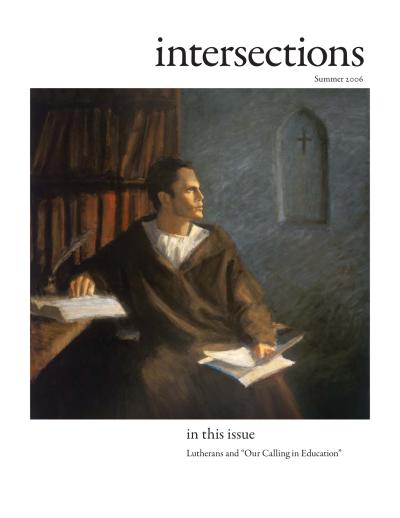
Dovre, President Emeritus of Concordia College and co-chair of the ELCA Task Force on Education, undertakes three tasks: focusing on the current social context (young people’s spiritual lives, the state of mainline denominations, the family map, schools, communities, and higher education); reflecting on why Lutherans care about education (creation in God’s image, vocation, Luther’s legacy, the priesthood of all believers, civic righteousness, and hope); and considering the prospects and possibilities for addressing the calling (biblical, confessional, theological, and pedagogical legacies; the renewal of apostolic ministry, the Christian-college renaissance, K–12 reform, and the congregational education explosion).
-
 Article
Faith, Understanding, and Action
Paul J. Dovre
No. 10 · Fall 2000
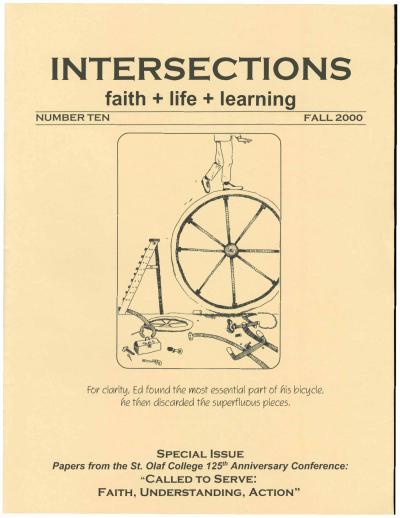
Dovre frames the St. Olaf 125th anniversary—originally read as part of a presentation with the St. Olaf Cantorei and organist Paul Manz—around T.F. Gullixson’s story of an immigrant woman who “turned her face to the west wind” and the 1874 gathering at the Holden parsonage of B.J. Muus, Harold Thorson, O.K. Finseth, K.P. Haugen, and O.O. Osmondson. He weaves Anselm’s “faith seeks understanding,” Harold H. Ditmanson on the universal relevance of Christian faith, and the music of Venatius Honorius Fortunatas, John Rutter, Herbert Brokering, Ralph Vaughan Williams, and John Tavener into a meditation on faith as motive, understanding as modus, and action as consequence, against the “ill winds” of poverty, child homicide, AIDS, and consumer gluttony.
-
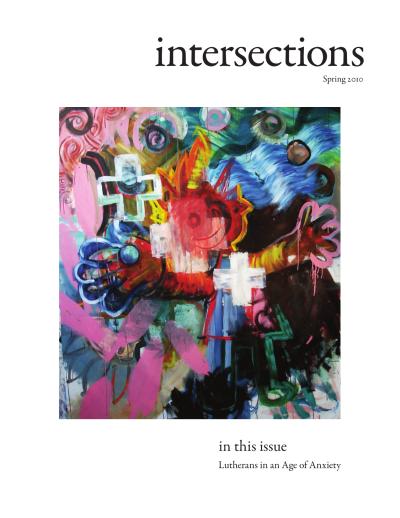 Article
Living at the Intersection of Fear and Hope
Mark S. Hanson
No. 32 · Spring 2010
Hanson draws on his January 2009 ELCA/ELCIC visit to Jordan, Israel, and Palestine—a Hebron Quran that did not burn, fifth graders dancing at the Hope School, a conversation with King Abdullah II—to frame the vocation of Lutheran higher education at the intersection of fear and hope. Engaging Brueggemann, Sittler, Buechner, Auden, Strandjord, Douglas John Hall, W. Robert Connor, Lewis Mudge, and Cynthia Moe-Lobeda, he argues that Lutheran colleges are called to critical inquiry that does not collapse into a hermeneutic of suspicion, to a “thinking faith” that resists religious fundamentalism, and to communities of discernment that work for the common good.
-
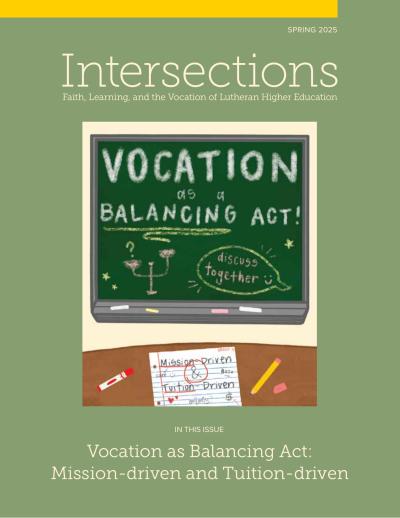 Institutional Focus
So That All May Belong: Lutheran Roots for Diversity, Equity, Inclusion, and Justice
Altheia Richardson, Angie Hambrick, Caryn Riswold, Colleen Windham-Hughes, Deanna Thompson, Marcia Bunge, Robert Clay
No. 61 · Spring 2025
22 min audio
The full NECU statement grounds DEIJ work in Luther’s 16th-century reforms and Lutheran theological claims about the image of God, equal dignity, and the limits of human knowing — offering definitions, Lutheran roots, and calls to action for diversity, equity, inclusion, and justice, with belonging as the outcome of DEIJ at work.
-
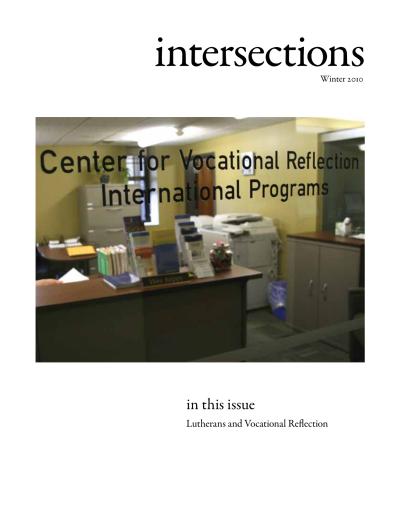 Article
Sense of Vocation
Ruth R. Kath
No. 31 · Winter 2010
Kath describes Luther College’s Sense of Vocation program, organized into three components: General Program Initiatives (Vocation Visitors such as Parker Palmer, the Faith and Learning Workshop, self-directed reading grants, publications, and travel funds), the Church Ministry Program (Vocation Fellowships, the DIAKONOS discernment group, seminary visits, alumni discernment retreats, church leader workshops, clergy renewal, and the WIYLDE youth initiative), and the All-Student Vocation Program (Paideia I orientation, Peer Mentors, Capstone curriculum development grants, the Vocation Advising Workshop, and a Vocation Advising Handbook).
-
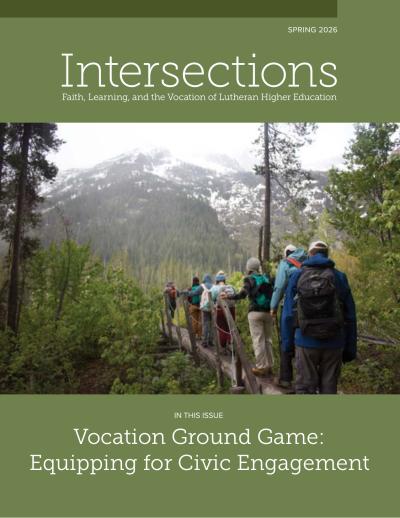 Reflection
I am a Treaty Partner
Kyrie Fairbairn
No. 63 · Spring 2026
7 min audio
A recent California Lutheran graduate reflects on how a course on Indigenous Rights and Practices, and a conversation with a former Chairman of the Lummi Nation, led her to claim a “treaty partner” identity and to challenge readers to learn the treaties that shape the lands they call home.
-
 Editorial
From the Publisher
Mark Wilhelm
No. 46 · Fall 2017
Wilhelm reflects on how NECU’s focused work on Lutheran identity in higher education — including the forthcoming document Rooted and Open: Our Common Institutional Calling — turns out to be a fitting commemoration of the five-hundredth anniversary of the Lutheran Reformation, even though it did not arise from anniversary planning.
-
 Article
From Pietism to Paradox: The Development of a Lutheran Philosophy of Education
Philip Nordquist
No. 8 · Winter 2000
Nordquist traces a four-decade personal and institutional journey from the “Protestant triumphalism” and aggressive moralism of S. C. Eastvold’s 1950s Pacific Lutheran through the 1960 Ditmanson–Hong–Quanbeck volume The Christian Faith and the Liberal Arts, Gordon Lathrop’s 1972 PLU donor address grounding the university in two-kingdoms theology, the ALC’s 1975 Concordia workshop with Bill Narum, Bob Bertram, Harris Kaasa, and Sydney Ahlstrom’s case for the “critical” tradition over the scholastic and pietistic, the 1976 LCA statement distinguishing “Christian” from “church-related” education, and Richard Hughes’s 1997 Carthage address. He concludes that dialectical (two kingdoms) theology, Christian humanism alongside professional studies (the New American College model), Luther’s commitment to universal compulsory education, environmental and civic responsibility, and academic freedom together constitute the bequest of the Reformation—“Christ and culture in paradox” remains the best approach to education he knows.