When Emily Dickinson woke up on
the COTA, she thought that the world
had ended, and her violets were goneforever. In a seat, by papers with curled
edges, she strained to see outside
grime and take in the contemporary world.An old black woman who never showered sat beside
her, and the stench crowded her nostrils. She
tried to move, but the woman refused to provideample room. Unladylike, Emily broke free
by trampling over soiled seats and leaping
over grocery bags. People became disagreeablewith her once again, so she irritably pushed aside the sweeping
crowd in a search for Beauty and got off on High
Street. She tried a place with flashing lights and, keepingan open mind, tasted actual brewed liquor. She said goodbye
to her shell and decided to live it up a little.
She was in charge now — she would tell them all; she could defyall of society, wait for the world to whittle
away into nothing. She was going to read what she wanted
and say what she wanted — a noncommittallife to everyone but herself. Undaunted,
she embraced life and ran around town,
quitted the act of reclusive-drama queen-ghost, and hauntedboldly all those who crossed her path. Around
certain streets, she was a legend — her eyes inciting
fear for many, and most keenly avoided her newfoundwrath. She was queen until a woman, exciting
feelings in her once forgotten, offered her a crude
bouquet of violets. Emily recalled the invitingsearch for Beauty and smashed the plentitude for rudely
continuing its existence. Beauty had not stopped
for her death, but crawled bravelyonward. Her imaginary bubble was popped,
the safety of her cruel alabaster chambers collapsed,
and, as mankind moved onward, her power was cropped.
-
 Editorial
From the Publisher
Arne Selbyg
Selbyg explains that the four essays in this issue grew out of the first Lutheran Academy of Scholars in Higher Education—a two-week seminar funded by the Lutheran Brotherhood Foundation and the Lilly Endowment, led for its first three years by Dr. Ronald Thiemann of Harvard Divinity School—whose official theme “Finding Our Voice—Christian Faith and Critical Vision” became informally “What’s Faith Got To Do With It?”
-
Editorial
From the Editor
Tom Christenson
Christenson introduces the four essays by participants in the first Lutheran Academy of Scholars as fruit of the “genuine conversation” that emerges when specialists set aside their lecturers’ podiums to speak as human beings, and welcomes the issue’s additional “Intersections first”—a response to a response to a review—continuing the conversation between Baird Tipson and Robert Benne about the paradigm of Lutheran higher education.
-
Article
'In, With, and Under:' The Tradition and the Teaching of Christian Ethics
Pamela K. Brubaker
Brubaker describes how she teaches Introduction to Christian Ethics at California Lutheran University—a religiously diverse classroom where about 30% of students are Lutheran, 30% Roman Catholic, and many are “unchurched”—as a community of moral discourse rooted in the Lutheran dialectic of faith and reason. Drawing on Larry Rasmussen and Bruce Birch, Elizabeth Bettenhausen, Roger Crook, and Robert Benne’s typology of “Hot and Cool Connections” between church and politics, she walks through her course’s units on human sexuality, economic life, and war and peace—including the Bomb Shelter simulation, a mock Disney stockholders meeting on sweatshops, and a Congressional hearing on the School of the Americas—to show how ELCA social statements function as case studies in critical inquiry and education for citizenship.
-
Article
Impelled to Pluralism: Thoughts About Teaching in a Lutheran University
Jim Huffman
Huffman traces his personal journey through three stages of faith—the “comfortable Christ” of his Midwestern Christian childhood, Clark Pinnock’s “faith principle” of accessible salvation, and finally Christ as the “humble teacher”—to a pluralism that rejects religious triumphalism without abandoning Christian commitment. Drawing on Diana Eck, Wesley Ariarajah, John Cobb, the Catholic novelist Endo Shusaku, and the histories of Confucian China and imperial Japan, he then describes how this commitment shapes his teaching of East Asian religion and nationalism at Wittenberg University: insisting on respectful language, working sympathetically through doctrines like Buddhist non-attachment, and helping students see the pernicious effects of triumphalism in both religious and political life.
-
Article
Making Dry Bones Stand: Lutheran Higher Education at Century's End
Diane Scholl
Scholl reads John Winthrop’s “A Model of Christian Charity,” the banishment of Anne Hutchinson, de Crevecoeur’s American farmer, Olaudah Equiano, Phyllis Wheatley, and Hawthorne’s The Scarlet Letter alongside Ezekiel’s vision of the dry bones to ask how a Lutheran college can be a community that holds difference and commonality together. Drawing on Ernest Simmons’s warning against collapsing into either dogmatic absolutism or thoroughgoing relativism and Bruce Reichenbach’s companion essay in this issue, she identifies five features of shared life at a Lutheran college—the liberal arts, political process, the arts, the community of caring, and the recognition of difference and the right to dissent—and argues that the necessary tension between individualism and corporate identity, framed by theological vision, is “our best legacy and our best hope for the future.”
-
Article
Lutheran Identity and Diversity in Education
Bruce Reichenbach
Reichenbach applies the theological taxonomy of exclusivism, inclusivism, and pluralism to Lutheran colleges and argues that institutions self-consciously committed to inclusivism must hold a non-negotiable theological core in paradoxical tension with intentional diversity. Drawing on Richard Hughes, Darrell Jodock, Gilbert Meilaender, Robert Benne, and Mark Schwehn, he surveys the theological themes Lutheran writers identify as identity-forming—the four solas, law and Gospel, two kingdoms, vocation, simultaneously saint and sinner, the theology of the cross—and proposes that diversity at an inclusivist Lutheran college is to be employed in service of educating “head, hands, and heart,” maintained through a critical mass of faculty and staff who carry the “DNA of the school.”
-
Response
Response to Robert Benne
Baird Tipson
Tipson responds to Robert Benne’s comments in the previous issue about his review essay of The Future of Religious Colleges, affirming their fundamental agreement that the Enlightenment epistemology dominant in higher education poses the most serious threat to the vitality of Lutheran colleges. Using the example of lecturing on early Mormon history and the Book of Mormon, he concedes that the methodological “solvent” of Enlightenment historiography acts on Christian as well as Mormon faith claims, and concludes that while H. Richard Niebuhr’s “inner” and “outer” history and Walter Brueggemann’s approach in The Theology of the Old Testament are comforting to believers, they do not offer an epistemology that can stand alongside the Enlightenment model in evaluating truth claims in the academy.
-
 Response
Feeling at Home: Dimensions of Faculty Life
Jane Hokanson Hawks
No. 2 · Winter 1997
Hawks of Midland Lutheran College responds to Bouman by reflecting on her path from a Lutheran childhood through the BSN at St. Olaf and thirteen years at four non-church-related institutions to her present home at Midland, where teaching at a Lutheran institution finally feels “right.” Bouman’s framing of the five themes as the Lutheran argument about what it means to be human helped her ad-hoc committee articulate the spiritual role in Midland’s new faculty mentoring program (recently funded by the Lilly Foundation), and grounds her work as a nurse educator confronting the daily humanness of grief, joy, ethical dilemmas, and care across cultural and religious difference.
-
 Article
Fragmented in Faith: The Concerns and Hopes Found in Student Spirituality and Civic Engagement
Emma Bohmann, Monica Sitachitta
No. 63 · Spring 2026
11 min audio
Two Texas Lutheran University students reflect on the cyclical pattern of low spiritual and civic engagement on their campus and argue that distinguishing Lutheran values from Lutheran practice could open space for civic engagement to become a non-optional expression of neighbor-justice for all students.
-
 Article
The Skeptical Theologian's Dictionary
Carl Skrade, Spencer Porter
No. 4 · Winter 1998
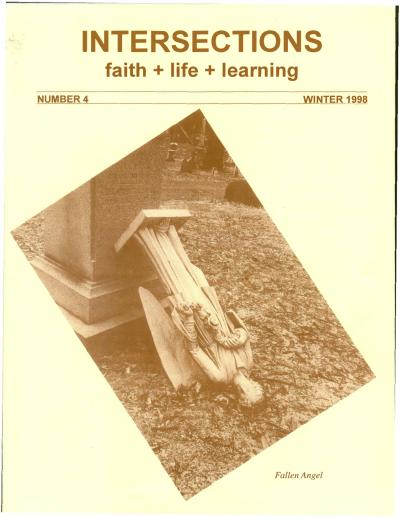
Porter and Skrade offer selections from a mock-lexicon of theological terms: answer, church, faith, God, grace, hope, justification, love, prayer, sin, soul, and theology, among others. Each entry begins with a standard definition and then unsettles it—answer reminds the reader that in theology and poetry the questions matter more than their answers; church alternates between “the mystical Body of Christ” and ordinary human gatherings whose machinery often obscures the gospel; God is the One whose name we are told not to take in vain and yet whose name we keep using; prayer is communion with God yet often degenerates into a list of demands. The form’s irony exposes the gap between the language of theology and its lived realities—a sober, witty corrective for Lutheran classrooms and chapels alike.
-
 Article
Responding to Student Hunger at NECU Institutions
Kristen Glass Perez
No. 51 · Spring 2020
Glass Perez recounts how her work as college chaplain at Augustana and Muhlenberg evolved after a student offhandedly declared, “I am always so hungry at this school,” and shares five lessons learned from launching campus pantries, emergency grant programs, and the HOPE Survey to address food insecurity as a defining calling of NECU institutions.
-
 Article
Risky Speech–Gifted Friendships
Sonja Hagander
No. 44 · Fall 2016
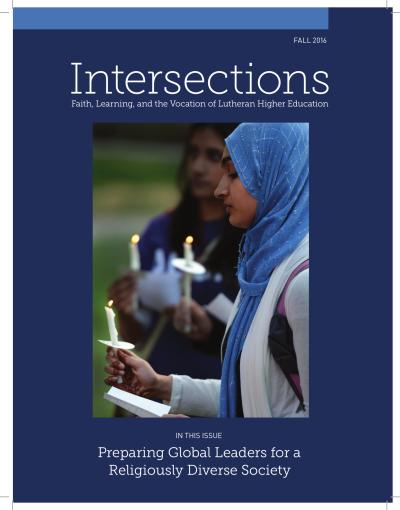
Augsburg College Pastor Sonja Hagander reflects on pastoral care across faith traditions — from a campus chapel service after the 2008 murder of Muslim student Achmednur Ali, to her decade-long friendship with Jewish colleague Barbara Lehmann — and reads the Gospel of John as a roadmap for interfaith friendships marked by love, free speech, public space, and a willingness to risk being changed.
-
 Institutional Focus
Putting Principles into Practice: An Interview with Kenneth Foster about Concordia's Sustainability Council
Kenneth Foster
No. 36 · Fall 2012
Foster, chair of Concordia College’s President’s Sustainability Council, describes the Council’s formation under President William Craft in 2011 as a re-energization of stalled task-force work, its coordination with grass-roots campus initiatives, and its strategy of moving from principles to practice in stewardship of natural resources at a Lutheran liberal arts college.