Serving Two Masters: Teaching and Writing Between Academy and Church
Intersections No. 9 · Summer 2000
The art of teaching always involves a balancing act. We have concern for our disciplines, whether English, history, chemistry, music, or business administration. We have personal standards and perhaps a desire to write something. There are students, whose needs are to be met. There are parents and family who may help pay their way into our classrooms and labs and libraries. There is “the administration” of a department, school, or university, and behind them an often shadowy Board of Trustees. And in a church-related college, some denomination like the Evangelical Lutheran Church in America, with its confessional tradition. All around us is society and the world. At one time or another, I’ve played most of these roles, tuition-paying parent, dean, acting President of a Seminary, Board member at Muhlenberg College, churchman, part of secular society, but mostly learner and, still, teacher. How to put it all together in today’s world?
Jesus’ saying (Matt. 6:24; Luke 16:13) haunts us, “No one can serve two masters; for either a person will hate the one and love the other, or will be devoted to the one and despise the other. You cannot serve God and mammon.” At times, especially the mammon part. In concentrating here on “the academy” and “the church”—the Sorbonne and l’Eglise, as a French savant put it—I will reflect my own experiences in biblical studies. But much of what follows could apply if you substitute the American Chemical Society or Modern Languages Association, the Roman Catholic Church or the United Church of Christ, for my own professional societies and the ELCA.
How to begin? One way is to focus on what will eventually be a major illustration for our topic: writing a commentary for both the world of the academy and usage in the churches. Commentaries are a genre for expounding texts of some importance, like a Platonic dialogue, or a key to James Joyce’s Finnigan’s Wake. The form varies with the work to be discussed, whether Principles of Mathematics or a Hindu epic. Commentary series, especially on the Bible, have, each, their own aims and format.
When volumes of the Anchor Bible began to appear in 1964 from Doubleday and Company, the goal was a fresh translation of the Bible, interfaith, by Protestants, Catholics, and Jews. The translation was to be accompanied by brief comments, a translation to be completed, it was hoped, “before man set foot on the moon.” Such a translation endeavor would inevitably reflect a variety of English styles, by Scandinavian scholars in Europe and professors at Israeli universities, occasionally a British voice, and someone like my graduate school teacher, E. A. Speiser, who spoke Polish in his early years before learning English. When this endeavor began, Professor Krister Stendahl, of Harvard Divinity School, was assigned two volumes to treat Paul’s letters to the Romans and Galatians. This was later expanded to include Thessalonians, Philippians, and Corinthians. A little later Professor Stendahl returned from a sabbatical in Sweden and announced it was no longer possible to write commentaries, at least for him. With that, we were deprived a more definitive work from his pen on Matthew’s Gospel (promised for a German series). The Pauline epistles for the Anchor Bible were assigned to others, including Philippians to me. To this judgment of Krister Stendahl about writing commentaries we shall return later.
Academy and Learned Societies
A second way to begin is with experiences in the academy, especially for me the Society of Biblical Literature and Exegesis (the last two words were later dropped). I first attended an SBLE meeting over fifty years ago when Charles Muhlenberg Cooper, a seminary professor under whom I majored, later President of Pacific Lutheran Theological Seminary, took me to sessions. In those days the Society of Biblical Literature and Exegesis regularly met at Union Theological Seminary, New York, with the Old Testament section in Room 205 and New Testament in 207. One could easily move from one area to the other. Henry Cadbury, Amos Wilder, and my Doktorvater, Morton S. Enslin, usually sat side by side in the second row, a forbidding threesome for young scholars. You might meet the archeologist, W. F. Albright, from Johns Hopkins, holding forth at the next table in a hole-in-the-wall restaurant on Amsterdam Avenue. I began to go annually to meetings. It was assumed at our house that I’d be “with the scholars” between Christmas and New Year’s. My first paper was presented in 1957. Kendrick Grobel, the translator of Bultmann’s New Testament Theology, encouraged publication and, I suspect, was instrumental in getting it printed in the Journal of Biblical Literature.
Occasionally the growing Society ventured outside of New York, as in 1961, when it was hosted by Concordia Seminary, St. Louis. Opinions never heard before in its hallowed classrooms were voiced in debate over the (New Quest for) the Historical Jesus, then a “hot” topic, as it is again today.
My involvement in SBL led to appointment as Associate Editor of its Journal of Biblical Literature in 1961. I might have succeeded Dr. Enslin as editor if he had not been unceremoniously dumped at the Toronto meeting by the young Turks who were remaking the Society. I remark in passing that people whose theological stance one may applaud often prove ruthless in personal relationships with others deemed to stand in their way. But revolutions often have a way of devouring their children, and for all the contributions of Robert Funk and others to SBL, there were dramatic and ironic movements later, as at the 100th Anniversary Awards, when Funk “did a Jane Fonda” and James Robinson had to stand in for him to receive a plaque; the day was saved only by the impromptu oratory of Harry Orlinsky—than whom there are few people I would rather have called upon when the game is on the line. (Harry always appreciated a sports metaphor.) For Professor Orlinsky told of how he got into formal Hebrew studies when he took an 8 a.m. class from a goy, no less, at the University of Toronto—in part because that early hour assured him a place at his favorite pool table. But that’s another story.
My career with SBL did include a year as editor of its Journal at a time in 1971 when the previous editor would not talk with the new regime, and the future editor, Joseph Fitzmyer, S. J., was not available to take over, as yet. I was the middle man with whom all would talk, who had to unclog the pipeline of articles.
In 1972, for almost the first time, I did not go to an Annual Meeting, even though it was to so-called “international” one in Los Angeles. This was in part because our family was on the way to India, during a sabbatical, to teach at Bangalore. In this way I learned that I could live without so much involvement in SBL. There are, of course, other learned societies, like the international Societas Novi Testamenti Studiorum and the more focused and manageable Catholic Biblical Association. All of us who worked on the ecumenical studies Peter in the New Testament (1973) and Mary in the New Testament (1978) found such activity far more satisfying than many programs in the learned societies, because it involved something beyond scholarship, the Church or, more specifically, several churches in dialogue, relishing careful, corporate scholarship.
Thus for me a love-hate relationship with the academy has evolved. Intense involvement at times, and a willingness to let go—an experience that probably many faculty have shared, to one degree or another.
Church and Churches
What, then, shall we say about the Church? For me at least, something of the same love-hate relationship exists here as well, and I suspect for many others in church-related faculties. Of course I must make a distinction between the one, holy, catholic, and apostolic Church and its expression in the Lutheran Church–Missouri Synod or the ELCA. “Church” is local too, and I assume one’s being rooted in a local parish, in a specific worshiping, preaching, teaching, pastoral community of some sort. And perhaps some involvement in a denomination’s wider work, ecumenism, or interreligious affairs. But I’ve found at times, after, for example, an intense week of “Word-and-Witness” workshops, that you may want to get away, for a few days at least, from everything “churchy”; that you can and must let go at times, as I did in the late 1970s with a college board and other church commitments. Neither church nor academia saves us from burnout.
Over the years I’ve been a member of three differently named Lutheran bodies, without ever moving out of southeastern Pennsylvania. I’ve known the bright vision of Lutheran unity in the 1950s and ’60s, and saw us fall apart in the 1970s. Ecumenism has achieved some notable successes, most recently with the “Joint Declaration on the Doctrine of Justification” between the Roman Catholic Church and many Lutheran churches throughout the world. But unity must always be balanced with truth, and I know of few areas in the church that have left more participants bruised and disgruntled than ecumenics. In all this, I’ve never known, or expected, a perfect church, nor do I find such an ekklesia somewhere else in Christendom or in some other religion. The ecclesial arenas can exhibit some of the same arrogance, inability to listen, power struggles, and disparagement of others that we find in academia.
The bottom line? Let me use figures from the system in Greek for accenting words. The academy, much as I love it, is an antepenultimate—sometimes accented but three syllables from the end. The current ELCA, of which I am a part, and even the Church with a capital C, which I love, is penultimate, often to receive the stress but not the be-all and end-all. The ultima or final syllable, the ultimate, belongs to God, to Christ and the gospel, to be loved and served. Such a prioritizing has for me been helpful in navigating both academy and church in life. And mixed through all of this are people in whom academia and church and gospel take shape, as a part of God’s creation and our societies.
Some Illustrations on Academy and Church
How do church and academy work out for each of us? For me, in the specifics of Bible and theological, religious studies. Perhaps it is easier in a “sheltered” denominational seminary or church-related college than in a public university. Yet all the trends that affect society and the academy appear to one degree or another, sooner or later, in our institutions. Like others, we are prone to that arrested development that canonizes the graduate school influences of our prior experiences. There is some truth in the old adage that “Bad German philosophy goes to Oxford when it dies.” (Fill in your own disciples and places). I suspect that it may be a special temptation for the church’s schools to want to show we are “with it”—either with the politically and culturally correct currents of the day or with the ecclesially traditional “faith once delivered to the saints.” Sometimes both! How, then, shall we be properly critical of both academy and church, when we live within one or both, as their denizens and participants?
If I were ever to write an autobiography, it might be titled, Within the Structures, for that’s where I’ve worked. But it might also at times reflect a streak for which “Rebel” is too strong a word, but “Critic” may be in order, making judgments about both academy and church, about the foibles and the achievements of each, sometimes from the vantage point of the other. In chairing an ELCA Task Force on Ministry to agreement on a host of issues (and Churchwide Assembly approval for most all of the proposals), I at one point argued publicly against a particular conclusion that seemed to me unjustified and ecumenically harmful. Critical independence does not always endear you to bishops or church staff or academy structures, but seems to me a part of the important task of “discernment” for which most of us have been trained. One may have to swim against the stream. Yet, in my experience, with awareness that the person with whom I vigorously disagree on one point may be the one with whom I want to ally myself on the next issue before the house.
To return to our first starting-point, how does all this work out in specific cases? It is possible to illustrate from something so basic as Bible translation. I spent many days between 1978 and 1987 on the Revision Committee for the Roman Catholic “New American Bible New Testament.” There one learned what bishops really mean in some churches. Conclusions to which grammar, philology, and exegesis led us as scholars had to satisfy a committee of bishops whose members may or may not have had a charism for textual criticism or interpretation. How shall one navigate at 1 Cor. 6:9 between technical terms like “catamites and sodomites” (which the translator would like to have used, even if it stretches modern readers) and the view that church teaching called for “homosexual perverts”? (A wise Benedictine led the argument for “boy prostitutes” and “practicing homosexuals,” later changed to “sodomites.”) The decision at Phil. 1:1 to render episkopois kai diakonois as “the overseers and ministers,” not “bishops and deacons,” required a careful note to acquaint the faithful with recent results of scholarship.
Writing Commentaries, Scholarly and Churchly
In more detail, I turn to the genre of “the commentary,” something of which many of us are consumers. Besides current work on Philippians (in a German series as well as the Anchor Bible), I’ve written on Colossians for the Augsburg Commentary on the New Testament (1985), and Romans for Commentary 2000 (forthcoming).
Some general observations. Most commentary series evolve. There are excellent and weak volumes in every series. A word in defense of the early volumes in the Anchor Bible by Scandinavian Lutherans, Bo Reicke on James, Peter, and Jude (1964) and Johannes Munck on Acts (1967). If these seem elementary in comparison with later tomes in AB (and are now being replaced), it must be noted that they conform with what the series originally envisioned. A turning point came with Raymond Brown’s two volumes on John (1966, 1970). In the Augsburg series, my Colossians manuscript was completed in the early 1980s, in the barebones style of the series, but by the time the publisher was ready with a satisfactory treatment of Ephesians (to go in the same volume), I was encouraged to add some footnotes. Even within a series format, one explores until an appropriate approach for a given biblical book emerges.
For Philippians I laid out my plans so as to include a treatment of the founding mission in Acts 16:11–40 and Paul’s later contact with the city in Acts 20:6. Do, for example, the persons mentioned there, like the Lydian woman and the Roman jailer, relate to the dramatis personae in Paul’s letter, such as Euodia and Syntyche and Clement at 4:2–3?
Such matters had, of course, even in the 1970s, been part of the challenge in writing a commentary about Paul and Philippi, good reason for Krister Stendhal to reach the judgment already cited about the task. But I suspect he also saw some of the greater changes coming. If I had finished my commentary by 1980, it would have been much simpler than what is “state of the art” today. As with most disciplines, biblical studies have grown enormously more complex in recent years. (Yet publishers often want fewer and fewer pages.) Who can master all the new subdisciplines?
Proliferating Subdisciplines
This is probably the place to inject the remark that, as in other areas, some U.S. investigators have hailed with great glee the claim that “the cutting edge of research” has shifted from Europe (often, read “Germany”) to the United States. Intellectual jingoism can appear in academia as well as in churches and politics. At times true, the claim is also at times blind to the international nature of academic research.
Among the trends affecting New Testament letters, in the U.S. and internationally, have been epistolary research and “rhetorical criticism,” a part of all education in the Greco-Roman world. Rhetoric continued, indeed, down to the nineteenth century as an emphasis, and has again come to the fore as the “new rhetoric.” I find rhetorical criticism important, but report the experience of one younger scholar at a Lutheran seminary, whose attention to rhetoric was not affirmed by colleagues. Why should Lutherans bother with it? To which one answer is the example in Philip Melanchthon’s use of classical rhetoric as he wrote and commented on Scripture.
There has also been increased interest in the social world of Paul’s day, including analysis through categories from modern sociologists. Feminist concerns in recent decades have had predecessors with regard to Philippi in occasional articles over the last century. They had titles like, “Did Euodia and Syntyche Quarrel?” (1893–94 Expository Times 5:179–80) or “The Brave Women of Philippi” (F. X. Malinowski, Biblical Theology Bulletin 15 [1985] 60–64). Lilian Portefaix’s volume, Sisters Rejoice, reflects both the social world of female existence and the “reception theory” of W. Iser and H. R. Janss applied to how Philippian women received Paul’s letter. To this sequence of new approaches one may add “discourse analysis,” a text-linguistic and rhetorical approach to texts, as in a book by Jeffrey T. Reed (1997).
All these waves of interpretation have come upon us while I have been at work on Philippians, each often hailed as “the solution” to old questions. They complicate the task of the conscientious commentator. Maybe Prof. Stendahl was right, you cannot master all the literature and techniques, the way one used to be able to say some Roman Catholic priests did: they could read everything ever written on the theme because they had no distractions like wife or children! Now we are all inundated by “die Literatur.” Not to mention the internet. The challenge is to try to bring together all that matters!
Issues for a Commentator in the Study of Philippians
Running through the interpretation of canonical Philippians have long been questions of integrity and unity for the four-chapter canonical document, and its place of origin. Some scholars have applied the so-called new methods to bolster traditional conclusions about Philippians as a single unified letter. Others, exploring non-traditional positions opened up over the years by scholarly criticism, have offered new vistas on old problems. From the church fathers on, a canonically embedded single letter to Philippi was read as stemming from Paul’s imprisonment in Rome. But then what of the “rival preachers” mentioned at 1:14–18, who, Paul allows, really do preach the gospel, but do so out of “envy and rivalry” (1:15)? It horrified some that such could exist in Rome. To place the site of Paul’s cell in Ephesus enabled Collange in his French commentary to suggest that the “envy and rivalry” against Paul had nothing to do with doctrine but stemmed from a different opinion among some Ephesian Christians over whether Paul should have invoked his Roman citizenship to gain release from prison. Christians in the very Roman city of Philippi would likely have understood Paul’s step, but not all Christians in pluralistic Ephesus approved Paul’s use of privileges with Caesar. How are we to relate church and state? Philippians poses an early example of whether or not to use for a good cause privileges one may have. The great champion of an imprisonment in Caesarea, Ernst Lohmeyer, could never have guessed at such a solution, for Lohmeyer oriented everything in his reading of Philippians to the theme of martyrdom. Paul sought martyrdom, and could therefore not possibly, for Lohmeyer, have used his citizenship to gain freedom. Besides, on Caesarean or Roman scenarios, Paul had already made appeal to Caesar (Acts 25:10–11); that’s why he was in custody. Only in Ephesus, on an earlier chronology, could use of his rights as citizen make sense as the object of envy by other Christians and a rival attitude toward Rome. (Ironically, Lohmeyer was martyred, while rector of the University at Greifswald, during the Russian occupation in 1946.)
Another example concerns the noun koinonia which occurs three times in Philippians (1:5; 2:1; 3:10), plus the related verb at 4:15, and compounds about “sharing” at 1:7 and 4:14. Out of these references have come efforts to see koinonia as the central theme of the entire epistle and, in ecumenical circles, a “koinonia ecclesiology.” But in what sense of this many-faceted Greek word?
In 1977 H. Paul Sampley proposed that Paul, as a Roman citizen, familiar with Roman law, employed here a legal concept. Not a business partnership with Lydia in the purple-goods business, a koinonia which the apostle was said by some to be dissolving at 4:18. But, according to Sampley, a mutual societas with the Philippian church, a “partnership” in the gospel (1:5) involving financial aid for Paul as their missionary (4:15–16). This “business” reading was soon augmented or replaced with a broader interpretation of Paul’s relationship with the Philippians, under “friendship” (philia, a particular and specific Greek understanding). Here reciprocity and a patron-client relationship of benefaction were involved. It fits well for a Roman colonia like Philippi which was under the patronage of the Julian-Claudian Principate. Now the key to Philippians became “friendship.” Perhaps a high-water mark of this line of interpretation appeared in John T. Fitzgerald’s article on “Philippians” in the Anchor Bible Dictionary (1992, 5:318–26) where the very genre becomes “a letter of friendship.” But this notion has had “a checkered history” in scholarship on Philippians, as I noted in a paper published in 1996. I think Paul was going only part way with ideas current in Philippi about friendship. He accepts aspects of it, but also critiques the theme on the basis of God, Christ, and gospel. This encounter between Paul and Greco-Roman friendship is to be seen most prominently in Phil 4:10–20, the so-called “thankless thanks.” The apostle follows the convention that friends never need to say thanks to each other, but he also asserts his independence—and dependence on God. On some issues I thus differ from the more enthusiastic endorsement of the theme by Ben Witherington III (1994; see my 1997 review). The age-old question continues, which friendship at Philippi poses: how shall we relate to cultural norms? Totally affirming, totally negatively, or with discernment?
From Academy to Church and Back Again
Now some examples where in my experience the interplay has moved from academy to church. No treatment of Philippians can neglect the reference to episkopoi and diakonoi at 1:1. It is the earliest written New Testament reference to “bishops,” but in the plural, and without, as holds true in all other acknowledged Pauline letters, any use of the term presbyteroi (in Acts either “synagogue elders” or “church presbyters”). Even the translation of 1:1 is a matter of dispute in English, as noted above from the New American Bible Revised New Testament. No one can claim that the verse involves what later ages read into the office of bishop (or also “deacons”). A lot of nonsense has subsequently been voiced, in print or public television, like Barbara Thiering’s attempt to connect episkopoi in Philippi with Qumran (let alone her idea that Jesus married Lydia after his marriage to Mary Magdalene ended), for we are dealing with a Hellenistic city without enough Jews to have a synagogue (Acts 16:13, only a “place for prayer” of proselytes) and a letter that never overtly quotes the Old Testament. A solid case exists for the origin of Philippian episkopoi and diakonoi to lie in Greco-Roman civil and societal usages.
The biggest change in considering ecclesiology and leadership in early Christianity has come, in my opinion, with the rediscovery of the “house church.” Back in 1939, an article by Floyd V. Filson (JBL 58:105–12), called attention to groups gathered in the house (oikos) of this convert or that, as nuclear, extended-family cells that made up the ekklesia in any place. This phenomenon continued down to the time of Constantine. In Philippi that meant house assemblies chez Lydia and at the house of the Roman jailer (Acts 16); perhaps in the homes of Euodia and Syntyche (Phil. 4:2), maybe Clement (4:3), likely Epaphroditus (2:25). How different these groups must have been! No wonder Paul had to emphasize unity! It is, in my considered judgment, likely that the episkopoi in Philippi were the patron-benefactors, the heads of the household, in each house church. And, yes, some of them were women, in Paul’s day. Such personal research did not obtrude into the reports of the ELCA Study of Ministry, for treatment there drew on presentations to the Task Force by other New Testament scholars and on works in print. But there is reflection in the Report of Section II at the Faith and Order Conference at Santiago de Compostella, Spain, in 1993. The draft (not mine; credit Wolfhart Pannenberg and others) spoke of how “Some argue that, historically, the emergence of bishops in the early church … arose from a transfer of the function of the leader of a house church,” citing Philemon and Phil. 1:1 (On the Way to Fuller Koinonia, Faith & Order Paper No. 166, 1994, p. 242). When this was challenged in discussion, I made a point of quoting only Roman Catholic scholars who have reached such conclusions. The sentence stood. The academy’s research can affect the church. Or is it also that church people, academically able, are contributing to both worlds?
One final example has to do with work on “justification by faith,” notably in the volume that Joseph Fitzmyer, Jerome Quinn, and I did on “Righteousness” in the NT (1982) as part of the U. S. Lutheran–Roman Catholic dialogue. It corrected views in both our churches from the past, but was also addressed to academia. Many of the findings have been taken into my articles on “Righteousness” in the Anchor Bible Dictionary. It also aided in drafting the international Lutheran–Roman Catholic “Joint Declaration” on justification in 1999.
Wirkungsgeschichte of the Text for Academy and Church
How do texts play out in subsequent history? What is their “working history”? Currently it is being asked by some, Did Paul plan to commit suicide as he wrote 1:21, “To die is gain”? Arthur Droge has argued this in learned and popular journals, against a background of Greek practice, among Stoics in particular. But Paul goes on to speak, as Cicero did (in a letter to his brother Quintus, Q. Fr. 1.3) when discussing suicide, of an obligation to stay on; for Paul, in the service of the Philippians and even that he will come to them again (1:25–26; 2:24). All this makes suicide very unlikely in Paul’s plans. Paul cannot be patron saint for Jack Kevorkian.
In working through Philippians I have again and again been surprised by twists and turns in the history of exegesis. 1:21 provides an example of a sense widely found among German and other interpreters, yet rarely heard in the Anglo-Saxon world. We have long been accustomed to take Christos as predicate, “to me to live is Christ, and to die is gain,” as in the King James Version. But John Chrysostom, Luther, and many others have taken “Christ” as subject. This interpretation exercised enormous influence through hymns like “Christus der ist mein Leben, Sterben ist mein Gewinn” (1609); Ernst Homburg, in Catherine Winkworth’s translation, “Christ the Life of all the living” (Service Book and Hymnal 79), and in the spiritual, “In the morning when I rise, … O when I die …, Give me Jesus” (With One Voice 777). The Roman Catholic Einheitsübersetzung of the Bible (1980) has adopted it (“Denn für mich ist Christus das Leben und Sterben Gewinn”). But from commentators in English one would scarcely guess this grammatical option exists.
Amid the currents of Christian history and theology and of ongoing academia, a commentator’s task must be to give a consistent reading of a document, respectable in wissenschaftlich circles (where book reviews are usually written) and helpful in church circles (where preachers account for a considerable portion of commentary sales).
In an article in Journal for the Study of the New Testament (60 [1995] 57–88), Markus Bockmuehl has urged attention to what he calls the “effective history” of Philippians as part of a commentator’s work. That means for me attention to significant voices over the centuries, like Chrysostom, Aquinas, Calvin, Bengel, and Karl Barth, as well as reporting something about sermons and homiletical treatment in the Wirkungsgeschichte of Paul’s letter, not to mention reflections in popular culture.
Working Conclusions
I would not want to be without the welter of voices to be heard in both academy and church, whether I am writing a commentary, teaching, or instructing myself. Penultimates and antepenultimates and even some otherwise unaccented syllables all play a part. Ultimately the One whom James Moffatt called “The Eternal” matters most—in Paul’s experience, God, expressed through Christ, as good news, progressing deep into human lives at Philippi and geographically from the house churches there spreading to wider regions, a Wirkungsgeschichte then and now.
Without academia we can easily delude ourselves, as it was once said about a German professor, “He believes he thinks, and thinks he believes; neither is quite true.” Without church, I lack a full raison d’être. I find it fruitful to try to labor pro bono [for the public good, including academia], pro ecclesia, and pro Deo.
Long ago I learned what a professor in religion ought to be when a group of us, during an institute at Maywood Seminary, went one evening to a performance by Chicago’s “Second City” theater troop. As part of the improvisation, the audience was urged to call out someone to be the subject of a skit. The pastors pointed to me, yelling “theological professor.” One of the actors astutely asked, “Theological professor or professor of some theology?”
In his book, Required Reading: Why Our American Classics Matter Now, Andrew Delbanco has written in his conclusion that we need teachers of literature to be “professors in the old religious sense of that word: believers, testifiers, witnesses.” Philip Melanchthon once said of exegetes, We are “first grammarians, then dialecticians [logicians, systematicians], then witnesses.” I find the possibilities intriguing, in and for both academy and church, and doxologically—as the university sermons at Cambridge, England, ended, “Now to the only God, our Savior, through Jesus Christ our Lord, be glory, majesty, power, and authority, before all time and now and forever” (Jude 25). Let the scholars of God say Amen, in word and praxis.
Works Cited
Collange, J.-F. The Epistle of Saint Paul to the Philippians, tr. A. W. Heathcote. London: Epworth, 1979.
Droge, A. J. “Suicide,” Anchor Bible Dictionary (New York: Doubleday, 1992) 6:225–31.
——— and J. D. Tabor. A Noble Death: Suicide & Martyrdom Among Christians and Jews in Antiquity. San Francisco: Harper & Row, 1992. Esp. pp. 113–28.
Lohmeyer, Ernst. Der Brief an die Philipper, an die Kolosser und an Philemon. Meyer Kritisch-Exegetischer Kommentar. Göttingen: Vandenhoeck & Ruprecht, 1930.
Joint Declaration on the Doctrine of Justification, Official Common Statement, and Annex. Geneva: Lutheran World Federation, 1999. Available at website: www.elca.org.
Mary in the New Testament: A Collaborative Assessment by Protestant and Roman Catholic Scholars, ed. by R. E. Brown, K. P. Donfried, J. A. Fitzmyer, and J. Reumann. New York: Paulist, Philadelphia: Fortress, 1978.
Peter in the New Testament: A Collaborative Assessment by Protestant and Roman Catholic Scholars, ed. by R. E. Brown, K. P. Donfried, and J. Reumann. Minneapolis: Augsburg, New York: Paulist, 1973.
Portefaix, Lilian. Sisters Rejoice: Paul’s Letter to the Philippians and Luke-Acts as Received by First-Century Philippian Women. Coniectanea Biblica, New Testament Series 20. Stockholm: Almqvist & Wiksell, 1988.
Reed, Jeffrey T. A Discourse Analysis of Philippians: Method and Rhetoric in the Debate over Literary Integrity. Journal for the Study of the New Testament Supplement Series 136. Sheffield: Sheffield Academic Press, 1997.
Reumann, J. “Righteousness” in the New Testament: “Justification” in the United States Lutheran-Roman Catholic Dialogue. With responses by J. A. Fitzmyer and J. D. Quinn. Philadelphia: Fortress, New York: Paulist, 1982.
———. “Philippians, Especially Chapter 4, as a ‘Letter of Friendship’: Observations on a Checkered History of Scholarship,” in Friendship, Flattery, and Frankness of Speech: Studies on Friendship in the New Testament World, ed. J. T. Fitzgerald. Supplements to Novum Testamentum 82. Leiden: Brill, 1996. Pp. 83–106.
———. “Philippians and the Culture of Friendship,” Trinity Seminary Review (Columbus, OH), 19 (1997) 69–84.
Sampley, P. Pauline Partnership in Christ: Christian Community and Commitment in Light of Roman Law. Philadelphia: Fortress, 1980.
Study of Ministry, The: Report to the 1991 Churchwide Assembly, and Together for Ministry: Final Report and Recommendations, Task Force on the Study of Ministry 1988–1993. Chicago: Evangelical Lutheran Church in America, 1991 and 1993, respectively.
Witherington, Ben, III. Friendship and Finances in Philippi: The Letter of Paul to the Philippians. The New Testament in Context. Harrisburg: Trinity Press International, 1994.
-
 Editorial
From the Publisher
Arne Selbyg
Selbyg reports on the “Reclaiming Lutheran Students” research by the Lutheran Education Conference of North America (partly funded by the Aid Association for Lutherans), which found that alumni of Lutheran colleges report higher satisfaction with the overall quality of their education than alumni of flagship public universities, with more than eighty percent affirming that their college helped them develop moral principles and benefit from spiritual development, while also noting that parents of Lutheran high school students remain largely unaware of both the magnitude of financial aid offered and the quality of the education provided.
-
Editorial
From the Editor
Tom Christenson
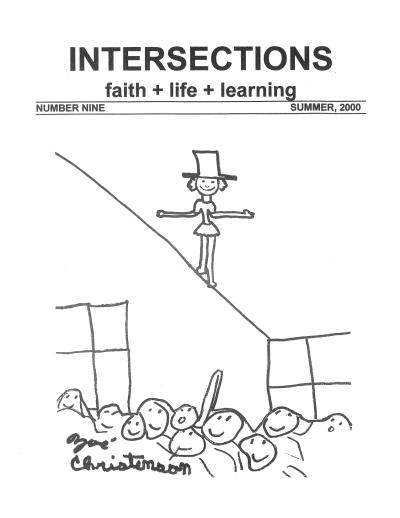
Christenson introduces a varied issue: the VonDohlen / Ratke discussion of the two kingdoms doctrine, Rachel Hammond’s “real gem” of a talk on her time in Ecuador (with an invitation to send contributions to the Home for Perpetual Hope orphanage via her home church in Oberlin, Ohio), Chuck Huff’s essay on the effect of liberal learning on the practice of psychology, and John Reumann’s reflection on a scholarly life lived between academy and church—and notes that the cover artist is his eight-year-old daughter Zoé, whose post-circus drawing of a balancing act struck him in light of Reumann’s opening line.
-
Article
A Fifth Teat on a Cow: The Irrelevance of the Lutheran Doctrine of the Two Kingdoms for Academic Life
Richard VonDohlen
VonDohlen, responding to Richard Hughes, Carol LaHurd, David Ratke, Philip Nordquist, and Robert Benne, argues that the Lutheran doctrine of the two kingdoms as commonly deployed in recent discussions of Lutheran higher education rests on a faulty sociology (taking Luther’s sixteenth-century structure for our highly differentiated society) and an epistemological monism (assuming a single neutral reason against the pluralism described by Alasdair MacIntyre and others), making it anti-intellectual, hostile to interdisciplinary dialogue and Christian social ethics, and ultimately as a defense of theology’s relevance about as useful as “a fifth teat on a cow.” Drawing on his experience on the Catawba Valley Hospice Ethics Committee, his Dutch Reformed and dispensationalist background, and the ELCA social statement “Sufficient, Sustainable Livelihood for All,” he calls for an “intellectually ecumenical” dialogue between Lutherans and non-Lutherans willing to take each other’s paradigms seriously.
-
Response
Tat for Teat: Ratke Responds
David Ratke
Ratke, agreeing with much of VonDohlen’s critique but contending that VonDohlen misreads both Luther and the two-realms doctrine, marshals Luther’s To the Christian Nobility, On the Freedom of a Christian, Temporal Authority, Whether Soldiers Too Can Be Saved, and the “Sermon on Keeping Children in School,” along with Walther von Loewenich, to argue that Luther was well aware of structurally differentiated society, made no claim to a monistic epistemology, and intended the two-realms doctrine to combat—not introduce—dualistic bifurcation between sacred and secular. Our identity is “not as either Christian or academic, but as Christian and scholar.”
-
Reflection
Calling and Learning: On Losing and Then Finding Myself
Rachel Hammond
Hammond, a Capital University junior who spent two semesters studying in Guayaquil, Ecuador, recounts watching the sucre collapse from 10,500 to 29,000 per dollar between September and January, the overthrow of President Jamil Mahuad, the freezing of bank accounts over $4,000, the threatened eruption of the volcano at Baños, and her work at an orphanage that needed only $6.81 to feed a child for a month—and calls her fellow students, in light of Elie Wiesel’s warning that indifference is the enemy, to recognize their education as a gift and a responsibility to speak for those who cannot speak for themselves.
-
Article
Modeling Virtue: In Which a Social Psychologist Decides He Can Do Good Without Freely Choosing It
Chuck Huff
Huff, recalling his 1975 sophomore disillusionment with a sterile introductory psychology in South Georgia (and Danny Saunders’s question from The Chosen), defends a scientific psychology as model-making rather than meaning-finding, traces the collapse of Lawrence Kohlberg’s totalizing theory of moral development into chastened mini-theories, and presents William Damon and Anne Colby’s interview study of twenty-three “moral exemplars” whose lives were marked by self-good unity, constant self-examination in community, a felt inability to have done otherwise, religious grounding, and genuine happiness. Following Aristotle on virtue as learned habit and the Christian tradition of the “slave for Christ,” he concludes that goodness flows from the choice of constraints rather than from the lone free-will hero of fairy tales, complicating C. P. Snow’s two-cultures divide. Originally the 1998 Mellby Lecture at St. Olaf.
-
 Article
Education for Peace and Justice
David J. O'Brien
No. 10 · Fall 2000
O’Brien surveys justice and peace education in Catholic higher education from Vatican II through the 1980s pastoral letters on nuclear weapons and the American economy, contrasting evangelical radicals (“what would Jesus do?”) with comfortable accomodationists, and argues that Catholic social teaching remains the church’s “best-kept secret.” Drawing on Bryan Hehir, David Hollenbach, Pope John XXIII, Patricia Hample’s “placing ourselves in the world to be of use,” and Martin Luther King’s last book on the “world house,” he develops pastoral care, solidarity (rooted in the mystical Body of Christ), and a realistic vocation-and-citizenship as the three needed responses for Catholic and Lutheran colleges alike.
-
 Book Review
The Prophetic Vocation and the Nature(s) of College: Reimagining College with Jim Farrell
Peder Jothen
No. 39 · Spring 2014
Jothen reads the late Jim Farrell’s The Nature of College as a prophetic critique of the dual nature(s) of college—its socio-cultural “normal” and its ecological habitat—and argues that Farrell’s call to model an “Anthropocene Responsibility” resonates with the prophetic dimension of Lutheran higher education. He proposes a re-imagined “About St. Olaf” that names vocation, ecological dependence, and personal involvement as the operative goods of college.
-
 Editorial
From the Editor
Jason A. Mahn
No. 35 · Spring 2012
Mahn introduces five essays from the 2011 Vocation of a Lutheran College Conference at Augsburg, framing how Torvend, Anderson, Svennungsen, Tunheim, and Pribbenow press Lutheran colleges to turn outward—recovering the public character of Luther’s gospel, forming students for moral deliberation, investing in the infrastructure of civic renewal, and pursuing justice and education “off the main road.”
-
 Article
The Idea of a Christian University
Richard Hughes
No. 11 · Spring 2001
Hughes’s lecture at the inauguration of Andrew K. Benton as the seventh president of Pepperdine argues that a Pepperdine-wide “strategy of community-wide conversation,” carried by the new Pepperdine University Center for Faith and Learning, can sustain the school as a Christian university by leaning into the paradox of Christian particularity rather than around it. Drawing on the incarnation, the Matthew 5 and Luke 14 teachings of Jesus, the Quaker and Cane Ridge (Joseph Thomas) abolition traditions, Galatians 2 and Romans 8, and Luther’s simul Justus et peccator as the gospel that frees the scholar to be wrong, to doubt, and to confess “Lord I believe; help thou mine unbelief,” he mines the Churches of Christ heritage—Alexander Campbell, Barton W. Stone, and John Rogers of Carlisle, Kentucky—as a unity-and-freedom tradition that grounds both diversity and academic freedom.
-
 Article
"We're Looking for a College—Not a Vocation": Articulating Lutheran Higher Education to Prospective Students and Parents Seeking Relevance
Karl Stumo, Tom Crady
No. 38 · Fall 2013
Drawing on Sallie Mae and UCLA enrollment data, the websites of competitor institutions, and candid voices from the field, Crady and Stumo describe a recruitment landscape in which yield rates have collapsed, discount rates have soared, and the word “Lutheran” often presents an obstacle until it is patiently unpacked. They survey mission language at Augsburg, PLU, Gustavus, and Wartburg and argue that strategic message development is the only way for ELCA schools to make vocation and Lutheran identity “credible, relevant, differentiating, and compelling” to prospective families.
-
 Article
Learning from Luther on Covid-19
Carl Hughes
No. 52 · Fall 2020
Reading Martin Luther’s 1527 treatise “Whether One May Flee from a Deadly Plague,” Hughes finds practical and spiritual guidance for a pandemic age: serve the neighbor, follow medical experts, honor those whose vocations put them at risk, and trust that even when we fail, God will not abandon the community.