A Chapel Homily
Allow me to quote former St. Olaf professor Dr. Howard Hong. He says, “The tragedy is that we seem to have lost the full grasp of the Christian vocation, its center and its implications.” Hong had it right in his 1955 book Our Church and the World. He had it right then, and he has it right now.
Vocation is a term students seldom hear around here. What is a vocation, and how do you get one? First, vocational schools don’t have a monopoly. You don’t necessarily go to a vocational school to find your vocation, just as you don’t necessarily come to St. Olaf to become liberal and artsy. In fact, I know plenty of people here who have no desire to become liberal. And I know people whose art is only destined for the refrigerator.
The word vocation comes from the Latin verb vocare, to call or to summon. A vocation, then, is a calling or a summoning. Traditionally a Christian concept, a vocation is a calling by God answered by the individual whom God personally calls. A vocation is not a product that any trade school or liberal arts school can tout.
Centrally, vocation is a calling to enter into daily communion with God. Through my daily communion I see how far I am from total communion, and thus I understand my being Christian as continually becoming Christian. Centrally, then, vocation is a call into becoming. Now this becoming, of course, has its implication. The implication is that in my continually becoming Christian I do something that aids me in becoming. Primary is the becoming. Secondary is the doing.
Unfortunately, we say we become English majors, English professors, seniors, or senior citizens rather than Christians. We strike the sense of becoming Christians, or we put becoming Christian alongside rather than foundational to becoming a student, teacher, theologian. We deform the sense of becoming into becoming an accomplished student, musician, or artist rather than becoming a Christian. Add the power of success to the mix and vocation’s tie to becoming Christian is all but lost. Success ties closely with our labels, which makes becoming a “something” even more sought after and subdues the faith-relationship in vocation even further. A “successful” person is successful regardless of religious devotion. Success is a person’s GPA, win-loss record, number of honorary degrees, or net worth.
Hong is right. “The tragedy is that we seem to have lost the full grasp of the Christian vocation, its center and its implications.” God calls us into a relationship with God. Our vocation is our attempt to enter into that relationship in a daily, daylong level. Our vocation is not a title. It is a summoning to be with God as we write papers, change garbages, or file tax returns.
Anthony Bloom writes, “A prayer makes sense only if it is lived. Unless they are ‘lived,’ unless life and prayer become completely interwoven, prayers become a sort of polite madrigal which you offer to God at moments when you are giving time to Him.” If I do not seek to know God and serve God’s people through my vocation, then it is an aimless or vainly directed occupation, a thing that occupies me, a pile of to-dos that fills time and directs according to deadlines and bottom lines.
On some days my papers, exams, rehearsals, and practices are my living out my vocation. And some days they are a pile of to-dos. Soon enough, the to-dos will gain even greater voice—for this very reason, whether or not I treat my future job as the implication of my vocation, I will still have to do my job to pay loans, buy food, and save money.
In the same hour that many Americans finish a 60 to 80 hour work week or an even longer study week, do they, do we not also feel something wrong with this “come hell or high water” demand for production? Is there not something wrong with the passion we have for Friday and the dread of Monday? Is there not something wrong that many people work only so they can retire or graduate? Part is that we are simply overworked—the weekend being our only time to relax, to have time to ourselves, to reflect, to worship, to see our family. Part is that many of us have simply picked up majors, taken classes, or chosen jobs that help fulfill no calling whatsoever. These vocationless careers and educations only afford weekend, holiday, and summer escapes—escapes from the rat race. Is there something wrong with this? We answer now with the same excitement as on Easter Sunday. The pastor says, “HE IS RISEN!” We reply (dryly), “He is risen indeed.”
Today I ask us, “Is there something wrong with the productive nature of school or the busy-ness of business?”
And we respond, (dryly), “Yes, there is something wrong, something flat-line, dead-cold, gravely wrong.”
“Well,” asks another, “How do you know it is dead wrong?”
“Because I’m living in it.”
“So what are you going to do about it? Are you going to change it or get out of it?”
“Well, eventually I will graduate, get a job with vacations, and later I will retire, if that’s what you mean. But right now I am too tired. I just want to finish my work and take a nap.”
There are some, however, who do something about what seems wrong with going to college only to get a degree, living only for the weekend, and working only to retire. They, we, develop philosophies, theologies, and trite maxims to smooth over the contradictions. We rationalize the contradictions.
For example, we now value work independent of its spiritual possibilities. Today, a job’s major connection, often its only connection to faith is that it allows for tithing. Spiritually, work only “pays off” on Sunday. In a collegial setting like this, many students cannot answer what their daily, collegial work affords them spiritually. I often think that our living in a “faith community” means that we take it on faith that we live in a faith community. Where in our daily work and our communal living is the vocation? Really, many of us value daily work because we value daily work. We have lost vocation’s center as a calling, and so all we have left to value is vocation’s implication—the doing. If I value my doing something independent of my becoming a more earnest Christian, then I live by a Godless center, no matter how much religious rhetoric I heap on.
Professor Hong says, “When religion, God, and the Christian faith are used to bolster something else, [then religion, God, and the Christian faith] become something else.” He continues, “The elevation of the secular task was not to mean our accommodation to the world and the glorification of work in itself. It was to make the daily life a witness to the love of God. In a faithless inversion have we not employed the faith rather to dignify what we do, than to redeem the time and human life?”
If I work on a hog farm all day, shoveling hog-piles of waste and I say that this work is my vocation, I do not affix the title vocation to explain that my stuff don’t stink even though the hogs’ does. A vocation is not about making me smell good, look good, or feel good, nor is it about academic success or monetary prosperity. It’s not about positive self-image. If anything, my vocation teaches me about how little I know, how much I want people to think I know, and how little I can do on my own. It reveals to me how grossly I love myself, and how I allow my ego to inflate to Michelin-man proportions. My vocation, if anything, deflates.
My daily work, being part of my vocation, means that I can live in a relationship with God. My actions in this work are prayer and discourse with God. Amen.
-
 Editorial
From the Publisher
Arne Selbyg
Selbyg explains that, while Intersections usually publishes papers from the annual Vocation of a Lutheran College conferences, this issue gathers presentations from a St. Olaf 125th-anniversary conference—a companion to the volume Called to Serve edited by Pamela Schwandt—because the theology and educational perspectives behind them apply to any Lutheran college and clarify what makes ELCA church-related colleges excellent institutions for students of any faith.
-
Editorial
From the Editor
Tom Christenson
Christenson recommends the St. Olaf 125th-anniversary volume Called to Serve—edited by Pamela Schwandt with Gary de Krey and L. DeAne Lagerquist—particularly Walter Sundberg’s “What Does It Mean To be Lutheran?” and Darrell Jodock’s “The Lutheran Tradition and the Liberal Arts College.” He notes that the volume’s biographical sketches of Lars Boe, F. Melius Christiansen, Ole Rolvaag, Emil Ellingson, Agnes Larson, John Berntsen, Arne Flaten, and Howard and Edna Hong show, against an outsourcing age, that the life of an institution like St. Olaf is the committed life of the people who work there.
-
Article
Faith, Understanding, and Action
Paul J. Dovre
Dovre frames the St. Olaf 125th anniversary—originally read as part of a presentation with the St. Olaf Cantorei and organist Paul Manz—around T.F. Gullixson’s story of an immigrant woman who “turned her face to the west wind” and the 1874 gathering at the Holden parsonage of B.J. Muus, Harold Thorson, O.K. Finseth, K.P. Haugen, and O.O. Osmondson. He weaves Anselm’s “faith seeks understanding,” Harold H. Ditmanson on the universal relevance of Christian faith, and the music of Venatius Honorius Fortunatas, John Rutter, Herbert Brokering, Ralph Vaughan Williams, and John Tavener into a meditation on faith as motive, understanding as modus, and action as consequence, against the “ill winds” of poverty, child homicide, AIDS, and consumer gluttony.
-
Article
Toward an Adequate Theology of Christian Higher Education
Robert Benne
Drawing on his forthcoming Eerdmans volume Quality With Soul—Thriving Ventures in Christian Higher Education, which studies St. Olaf, Valparaiso, Notre Dame, Baylor, Wheaton, and Calvin, Benne argues that these schools have kept their souls because a critical mass of boards, administrators, faculty, and students treat the Christian account as comprehensive, unsurpassable, and central. He critiques four inadequate theologies of Christian higher education—pietism, liberal theology (Whitehead, Henry Nelson Weiman, the “values” turn, and accommodation to diversity and multiculturalism), “First Article” approaches (including Merrill Cunninggim’s Methodist version and a Lutheran two-kingdoms quietism), and reactionary/triumphalist theology—and contrasts the Catholic (Notre Dame), Reformed (Calvin, Wheaton, Baylor), and Lutheran (St. Olaf, Valpo) ways of relating faith and learning, calling Lutherans to recover “Christ and culture in paradox” as serious extended conversation rather than as a lazy excuse.
-
Article
Education for Peace and Justice
David J. O'Brien
O’Brien surveys justice and peace education in Catholic higher education from Vatican II through the 1980s pastoral letters on nuclear weapons and the American economy, contrasting evangelical radicals (“what would Jesus do?”) with comfortable accomodationists, and argues that Catholic social teaching remains the church’s “best-kept secret.” Drawing on Bryan Hehir, David Hollenbach, Pope John XXIII, Patricia Hample’s “placing ourselves in the world to be of use,” and Martin Luther King’s last book on the “world house,” he develops pastoral care, solidarity (rooted in the mystical Body of Christ), and a realistic vocation-and-citizenship as the three needed responses for Catholic and Lutheran colleges alike.
-
Article
The Literature of Spiritual Reflection and Social Action
Shirley Hershey Showalter
Showalter, president of Goshen College, opens with Garrison Keillor’s “Singing with the Lutherans” and Walter Sundberg’s account of the Anabaptist “radical reformers” to locate Mennonite identity in a theology of suffering, humility, narrative, and song—tracing it through John S. Coffman’s 1904 “The Spirit of Progress,” Harold S. Bender’s 1944 “Anabaptist Vision,” John Howard Yoder’s The Politics of Jesus, and J. Lawrence Burkholder. She uses her Senior Seminar “Pedagogy of the Holy Spirit” reading of Viktor Frankl’s Man’s Search for Meaning, Madeleine L’Engle’s “Be a namer” and Walter Wink on the angels of institutions, and a Goshen Study-Service Term (SST) journal entry by student David Roth returning from Haiti—closing with two poems by Sarah Klassen—to argue for naming as the redemptive practice of church-related education.
-
 Editorial
From the Publisher
Arne Selbyg
No. 14 · Summer 2002
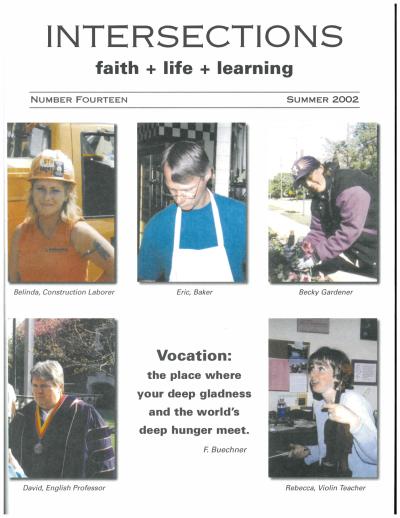
Writing on behalf of the publisher, Sue Edison-Swift names vocation as one of the precious gifts Lutheran theology offers education, reflects on her first ELCA Vocation of a Lutheran College conference, and asks readers to gift future issues of Intersections with feedback—notes on what they read and skipped, and how they ended up with a copy.
-
 Article
Why Interfaith Understanding is Integral to the Lutheran Tradition
Jason A. Mahn
No. 40 · Fall 2014
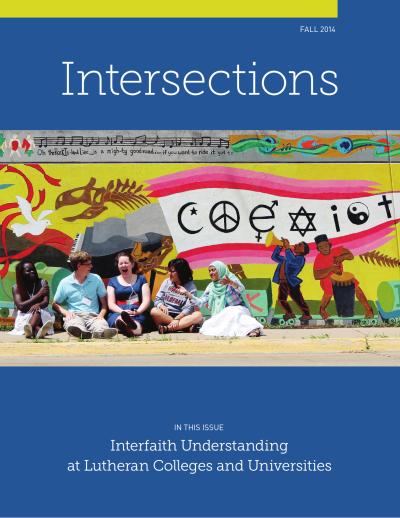
Mahn returns to the root of the Lutheran tradition — church, theology, and pedagogy — to argue that interfaith encounter is not the vanishing point of Lutheran identity but central to it, beginning with confession of Luther’s anti-Judaic legacy, working through the typology of exclusivism / inclusivism / pluralism, and showing how the kenotic Christ and the theologian of the cross open Lutherans to authentic encounter with religious others.
-
 Institutional Focus
Facing Tornados and Climate Change: An Interview with Jim Dontje about Environmental Innovation at Gustavus
Jim Dontje
No. 36 · Fall 2012
Dontje, director of the Johnson Center for Environmental Innovation at Gustavus Adolphus College, describes the Center’s work with solar thermal and photovoltaic systems, LEED certification of Beck Hall, recycling and conservation initiatives, the Linnaeus Arboretum, and the difficult work of building consensus around climate response—reflecting on how Gustavus’s 1998 tornado recovery shaped a community capable of collective action, and on how the “Lutheran identity” both restrains and energizes the college’s environmental ethos.
-
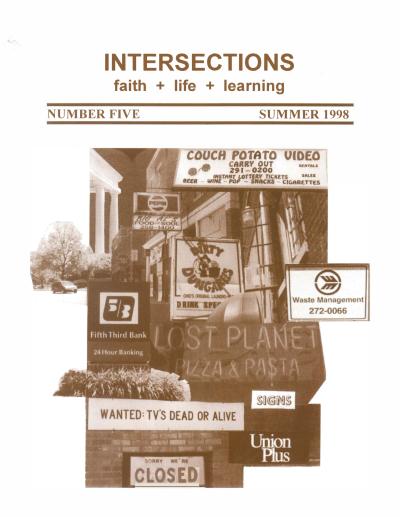 Article
Redemption Through Imperfection
Kyoko Mori
No. 5 · Summer 1998
Mori, drawing on a visit to the Philadelphia Museum of Art with a friend, contrasts Marcel Duchamp’s Étant donnés—a peephole work whose mysterious motion sweeps every viewer into a shared, perpetual performance—with the static, glass-encased Liberty Bell as parody of spiritual experience. She extends the contrast into a meditation on rituals (comfort and consolation) versus art (truth, however painful), and on writing as a redemptive process that moves from orderly first drafts toward chaos and deeper, frightening truth—closing with master potters who skewed each finished vessel slightly so that art and decoration could be told apart. Parts are excerpted from Polite Lies (Holt 1997).
-
Article
Martin Luther, Vocation, and Church Colleges: Nurturing Future Leaders for Faith and Community
Richard W. Rouse
No. 14 · Summer 2002
Rouse, citing Arne Selbyg’s statistic that thirteen of sixteen newly elected ELCA bishops graduated from a Lutheran college (and 49 of 65 in the new Conference of Bishops), argues that ELCA colleges are training grounds for future church and community leaders because of Luther’s doctrine of the priesthood of all believers and his distinction between vocation and station—the basis of PLU’s motto “educating for lives of service, inquiry, leadership, and care.” He describes “Paths Unknown: Where is God Leading Me?” a Western Mission Cluster collaboration of California Lutheran, Luther Seminary, Pacific Lutheran Theological Seminary, PLU, and Trinity Lutheran College that used a dedicated web site (godleading.com), a January-February 2001 online virtual forum reaching over 300 participants in 40 states and Canada and Mexico, and one-day interactive video workshops featuring Trump’s play “Holy Odors,” and reports LECNA’s Reclaiming Lutheran Student Project findings on teaching, community, and faith integration at Lutheran schools.
-
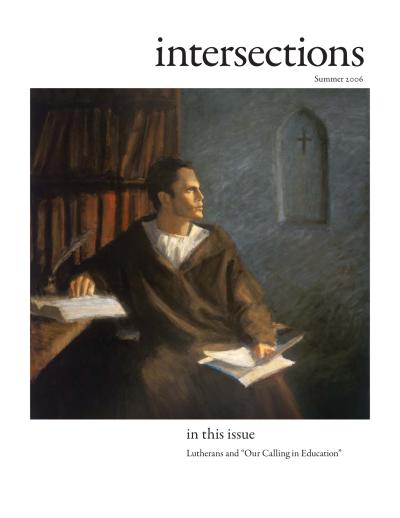 Article
"Our Calling in Education": Working Together to Generate a Strong Social Statement on Public Schools, Lutheran Schools and Colleges, and the Faith Formation of Children and Young People
Marcia Bunge
No. 23 · Summer 2006
Bunge, Professor of Theology and Humanities at Christ College, Valparaiso University, makes two claims about the ELCA’s forthcoming social statement on education: first, that it should be built on a robust Lutheran understanding of vocation, addressing four common misconceptions (vocation as occupation, as self-fulfillment, as ordained ministry, and as “vo-tech”) and recovering the breadth of Luther’s teaching; and second, that the statement should narrow its focus to three urgent areas affecting children and young people — public schools, Lutheran schools and colleges, and faith formation — rather than addressing the full lifespan of education in equal depth.