Cultivating Transformative Responsible Dialogue: Community of Moral Deliberation and Lutheran Higher Education
Intersections No. 35 · Spring 2012
In this essay, I want to propose that our colleges and universities embrace civility through a project of practice and research in transformative responsible dialogue. Such a project would advance the promise of community of moral deliberation in the Evangelical Lutheran Church in America and the turn to responsibility in American liberal education. Dialogue differs from deliberation and discernment, which include judgment, decision, and response. Dialogue forms people for deliberation and discernment. Dialogue moves deliberation and discernment.
Our colleges and universities should undertake this project because the ELCA and the world need it. We cultivate human development with resources and norms that other formative institutions (the congregation, the family) do not possess. We generate essential social capital for urgent problems.
A Deliberative Church in Need
Twenty years ago, at its second biennial churchwide assembly in Orlando, the ELCA adopted its foundational social statement, “The Church in Society: A Lutheran Perspective.” The Preamble reads: “The Evangelical Lutheran Church in America is called to be a part of the ecumenical Church of Jesus Christ in the context in which God has placed it—a diverse, divided, and threatened global society on a beautiful, fragile planet. In faithfulness to its calling, this church is committed to defend human dignity, to stand with poor and powerless people, to advocate justice, to work for peace, and to care for the earth in the processes and structures of contemporary society” (ELCA 1).
Following James Gustafson,1 the statement understands the church to be a “community of moral deliberation” that seeks to discern God’s will so that Christians might “know better how to live faithfully and responsibly in their callings” (ELCA 6). The statement understands deliberation to be a response to diversity, division, and threat: “In dealing openly and creatively with disagreement and controversy, this church hopes to contribute to the search for the individual as well as for the common good in public life” (6).
Community of moral deliberation was a new commitment for a Lutheran church. The concept finds no explicit expression in the Lutheran Confessions. For the Reformers, God created the church for the Sabbath, which is for knowing and worshipping God through the preaching of the Word and the administration of the sacraments. The church is “principally an association of faith and the Holy Spirit in the hearts of persons” (“Apology” 174). The church serves the inner person and brings the person into the spiritual kingdom of Christ, which is “the righteousness of the heart and the gift of the Holy Spirit” (175). By embracing community of moral deliberation, the ELCA enacted a distinctive identity in the global Lutheran communion. It has been energetic and competent in expression. And yet, it has only begun to fulfill its potential for deliberative community.
In 2011, the ELCA convened again in Orlando for another churchwide assembly, where delegates acted upon an eleventh proposed social statement “Genetics, Faith, and Responsibility.” The assembly also acted on a landmark report with numerous recommendations about the future of the ELCA. This is the LIFT Report, “Living into the Future Together: Renewing the Ecology of the ELCA.” The report includes recommendations about member conflict and leadership shortage with implications for community of moral deliberation.
In a section entitled “Communal Discernment,” the report tacitly affirms deliberation while calling for continuation of work begun three years ago to find “better ways to engage emotional and divisive issues and make difficult decisions in this church by means that increase mutual trust, build respect for each other as the body of Christ and deepen spiritual discernment” (LIFT 28). The report calls for work toward “a culture of faithful discernment” throughout the ELCA. As an immediate step, the report recommends a moratorium on social statement adoption pending a review process by the Church Council, which “should reflect the spirit and culture of communal discernment” (28). After long turmoil over sexual ethics and rostered leader conduct (which triggered a review of social statement process in 1995), this recommendation signals perceived loss of social capital due partly to a communal practice originally designed to create social capital. Deliberation, in all expressions of the ELCA, has sought to build up the church. However, leaders see persisting division and alienation as a problem. Modifying social statement process is simply a place to start.
Can ELCA colleges and universities address this problem? The question is real. In a section entitled “Leadership for Mission and Education in the Faith,” the report addresses shortage of congregational leadership in the next ELCA, where the churchwide organization will cede authority and responsibility to synods and congregations due to limited resources. The report recommends our 26 colleges and universities be encouraged to participate in the ELCA’s commitment to “a system-wide network of theological education and leadership development” and to “seek new ways to contribute to the network’s effectiveness.” Development of new “lay mission schools” is one named initiative. Toward this end, the report recommends a group of our presidents be convened “for the purpose of formulating new models of governance and ways for ELCA colleges and universities to relate to and support congregations, synods, and the churchwide organization” (LIFT 27).
If these recommendations are adopted, the ELCA will ask our colleges and universities to step up commitments to congregational leadership development. How should we respond? Doubtless, our church needs help. Many of us claim to be leadership schools. Currently, ELCA officials are considering new programming—lay mission schools. The group of presidents may have other ideas. Given variations in resources and commitments across our 26 colleges and universities, our institutions may respond differently to their recommendations. Given the resource challenges we all face in recessionary and hyper-competitive times, our institutions may have difficulties mustering strong responses.
“What might our institutions do in common that would address urgent ELCA interests?”
But let us entertain the question. What might our institutions do in common that would address urgent ELCA interests? I have noted two: a new culture of faithful discernment and new supports for congregational leadership development. For the sake of discussion, I would argue our institutions can make a common and robust contribution to a culture of faithful discernment and to leadership development that need not require major new resources. How? By attending to the elements of community of moral deliberation that liberal learning cultivates. Deliberation requires certain attitudes, beliefs, knowledge, skills, and behavior. Our colleges and universities are well positioned to form students accordingly. If our colleges and universities devote themselves to formation for community of moral deliberation and our graduates become invested in ELCA congregations, these congregations will have leaders who will contribute to a culture of faithful discernment and congregational life generally.
Liberal Civility and Transformative Responsible Dialogue
I want now to offer an account of community of moral deliberation that incorporates a particular understanding of public civility and dialogue. The ELCA wants to reduce furor, acrimony, and schism over divisive issues. It wants to increase trust and respect among members. It wants movement toward the koinonia (community, fellowship) of biblical Christianity. Again, such are the goods of community of moral deliberation—in theory. In reality, the empirical church has low capacity to deal “openly and creatively with disagreement and controversy.”
How to build capacity? For Lutherans, public morality can help, and cultivating civility can help. But civility must bring people together toward creative result, which I am calling transformative responsible dialogue. This involves civility attuned to the new reaches of human power. So understood, dialogical formation at our schools would cohere with community of moral deliberation and would serve urgent needs of the church and the world.
“Civility” often means what philosopher Michael Meyer calls the “civility of etiquette.” With Meyer, I focus on the Western tradition of “liberal civility” (Meyer 69). The term reflects that civility arose historically with liberal democracy and regulates its affairs. Civility is a virtue that orients the liberal democrat, who lives an essentially private life devoted to commerce and who negotiates interactions with others who are equals and subjects of common dignity and rights (Orwin 553-54). Recognition of the reciprocal rights of others generates toleration and self-restraint, which mitigate social conflict and keep the peace among diverse people within representative democracy.
Critics of the liberal political project quickly note that this conception of civility assumes a “thin theory of the good,” which asks little more of citizens than to leave others alone: Do as you please, as long as you do not hurt others. Civility is a politics of disengagement built upon erroneous understanding of human nature. Critics correctly note that liberal civility is a strategy for harmonious relations among strangers (Bilante and Saunders 33). Liberal civility forms people for life in a pluralistic society (White 451). A pluralistic society is a group of strangers, and the liberal project of governing in pluralism means ordering diverse people in distant relations. Civility makes political life possible by allowing many views of the good to exist openly under conditions where “thick” agreements about the good would be impossible (Boyd 865).
Are these critics right that liberal civility promotes social disengagement? For Michael Meyer and Melanie White, early and contemporary champions of civility (David Hume, Adam Smith, Benjamin Barber, Michael Walzer) see a socially engaged disposition founded upon respect for others, which drives reasoned public discourse toward shared understandings and decisions about societal arrangements (Meyer 72-78, White 446). This concern for others does not equal the solidarity of special relations. But it is more than enlightened self-interest. Civility operates in a moral universe of respect and equality, not moral solipsism. Liberal civility encourages commitment to civil discourse grounded in rational dialogue (White 446). It is a constitutive component of reasonable public discourse (Meyer 72).
For Meyer, the commitment of liberal civility to reasoned discourse gives coherence to public life amid the diversity of civil society. Civility empowers discourse that searches for what John Rawls calls “overlapping consensus” among interlocutors (Meyer 75). While this discourse will always be exchanges of strangers, the public realm can move from thin to thicker through dialogue.
Moreover, because dialogue as striving for shared understanding and reciprocal accord can fail, liberal civility promises to sustain good faith. Meyer contends:
Under conditions of severe disagreement, the primary goal of liberal civility is not to achieve the best outcomes but instead to avoid the worst—especially but not only the…end of civil dialogue. By avoiding some of the worst outcomes, the practice of liberal civility helps create and sustain further dialogue, which can…progress toward ever more intelligible compromises. Moreover the creation of citizens who are patrons of public discourse, disposed to practice and support the disciplines of public justification, is an ideal suitable to ground the standing of liberal civility as a public virtue of character. (76)
In sum, cultivating civility engenders reasoned public discourse through self-regulation and respect for others. The will to dialogue among strangers is no small achievement. Resolving conflict through reason is no small achievement. However, liberal civility is not fully adequate to the terms of contemporary life. We need to deploy civility for constructive and creative conceptions of dialogue, namely, transformative responsible dialogue.
Why? Because we live in a new world where extent norms and institutions cannot sustain planetary life. As Martha Nussbaum observes:
We live in a world in which people face one another across gulfs of geography, language, and nationality. More than at any time in the past, we all depend on people we have never seen, and they depend upon us. The problems we need to solve—economic, environmental, religious, and political—are global in their scope. They have no hope of being solved unless people once distant come together and cooperate in ways they have not before. Think of global warming; decent trade regulations; the protection of the environment and animal species; the future of nuclear energy and the dangers of nuclear weapons; the movement of labor and the establishment of decent labor standards; the protection of children from trafficking, sexual abuse, and forced labor. All these can only truly be addressed by multinational discussion. Such a list could be extended almost indefinitely. (Nussbaum 79-80)
Note the condition for hope: “unless people once distant come together and cooperate in ways they have not before” (emphasis mine). Solving these problems begins with new global practices and institutions that must be dialogical. The world needs dialogues of understanding, insight, and, above all, creativity. Life in an integrated and interdependent world needs less estrangement, less competition, and less coercion. It needs more commonality of conscience, more routine cooperation, and more rapid innovation. It needs billions of people with attitudes, beliefs, knowledge, skills, and behavior to talk together constructively in interconnected societies. Dialogue can put people in motion toward novel outcomes. Such is the “transformative” possibility of dialogue that civility can engender.
A New Moral World
Our great problems did not fall from a blue sky. They are realities of our making, some well-intentioned but unforeseen, and all the result of new powers to reproduce, extend life span, roam the Earth, and harness elemental forces. And they present us with unprecedented challenges. The scale, the speed, the intricacy, and the uncertainty of these realities are daunting. With Nussbaum, we can hope for solutions because humans share novel and immense power to control the processes and materials of nature for human benefit. We cannot say we are powerless to change.
The term for moral thought responsive to new and immense power is “responsibility.” The ELCA’s recommended proposed social statement “Genetics, Faith, and Responsibility” sets forth such an ethic.2 The statement is distinctive because it addresses plant, animal, and human genetics in one framework. It is most important for its responsibility ethic based in Lutheran natural law and previous ELCA social statements.
Responsibility ethics owe much to the German philosopher Hans Jonas, who argues for revision of received moral traditions given the new relationship between human power and life on Earth, a relationship where humanity increasingly bears the burden for the character and wellbeing of the planet. For Jonas, writing in the late 1970s, the extension of life span, behavior control, and genetic manipulation exhibit “the altered nature of human action.” Modern technology has sought to change the environment by creating a wealth of tools. Now technological humans are making over the maker and taking their own evolution in hand. New human power needs new moral governance (Jonas 1-24).
Jonas claims all previous ethical systems generally hold the following: (1) action toward nature is ethically neutral or amoral (no right or wrong); (2) moral standing is limited to humans (anthropocentric); (3) moral norms address the present (not long-term consequences and a remote future); and (4) a good will and common knowledge are sufficient for right action (no dependency upon experts such as climatologists or agronomists). Consider, for example the Decalogue, which Luther understood as middle axioms of the double love command and as a revealed reminder of what God writes on the human heart. Notice the anthropocentric context, the focus on relations and order in the present, and the assumption we know right from wrong and that the problem is the disordered will. For Jonas, the Decalogue does not help us sort out reproductive technologies, global warming, or genetically modified organisms. We live in a different moral world because of science, technology, and modern institutions.
For Jonas, humans must develop an ethic that amends the scope, norms, and methodology of received traditions. Here I want to focus on methodology and implications for formation. Jonas’s analysis challenges not only the adequacy of classic moral codes like the Decalogue. It challenges the adequacy of traditional communities of formation—the family, the village, the church—to fully prepare people for the moral questions of our day. In a world where common knowledge was sufficient to do the right and the good, these institutions could suffice. Moral agency could be solitary. Today, we routinely make decisions that assume dependency upon others, especially persons of particular and expert knowledge, to discern what we ought to do. Inclusivity—knowing how to engage and evaluate the manifold perspectives of others—is a new challenge for moral thought.
“Inclusivity—knowing how to engage and evaluate the manifold perspectives of others—is a new challenge for moral thought.”
Is ELCA teaching on community of moral deliberation adequate to these challenges? In fact, it calls for public, inclusive, and global discourse bringing multiple and relevant perspectives to the deliberative process. Toward that end, Church in Society staff have prepared and field-tested sophisticated guides for responsible deliberation.3
ELCA teaching is good. The churchwide organization has done well with limited resources to support good practice. However, in the future, these resources will be more limited when they need to be expanded, hence, opportunity for our colleges and universities. Where in the ELCA can members gain formation for responsibility—in Jonas’s sense? Our colleges and universities have the potential because we cultivate liberal education; we attend to vocation and ultimate concern; we are increasingly diverse and global communities; and we are essentially discursive and dialogical communities.
As institutions of American liberal education, we now educate students under the claim of responsibility, which compels us to be incubators of community of moral deliberation. I assume the learning goals at our institutions are more or less those of the Association of American Colleges and Universities, which include civic knowledge and engagement, intercultural knowledge and competence, ethical reasoning and action, all grounded in active involvement with diverse communities and real-world challenges (AAC&U 12).
What makes the AAC&U’s turn to responsibility important is its recognition that other learning goals are crucial for responsible agency. They include knowledge of human cultures and the physical and natural world, intellectual and practical skills, and integrative learning. This is why the AAC&U wants liberal education to be the dominant curriculum of American learning—secondary and post-secondary. All citizens today need it (not just social elites), and responsibility theory agrees.
Christian Strangers United in Dialogue and in God
Is a dialogical project at our colleges and universities the right response to ELCA interests and needs—a culture of faithful discernment and congregational leaders for a new church? Colleges and universities differ from congregations, of course. But a common public identity suggests this project would help. ELCA community of moral deliberation seeks to be a microcosm of human diversity, which matches the social assumptions of liberal civility and public discourse. Such discourse, to recall, is the conversation of strangers.
“Is a dialogical project at our colleges and universities the right response to ELCA interests and needs—a culture of faithful discernment and congregational leaders for a new church?”
But are congregations also strangers? In the United States, churches are voluntary associations of civil society, welcoming all who accept the terms of membership. While voluntarism can breed like-mindedness, the typical American congregation is more distant than intimate and more differentiated than unified. While members may long for the bonds and unity of family and friendship, American liberal civility enjoys more vitality in our congregations than the Sermon on the Mount. This means congregations are public in their internal lives as well as external relations. For Lutheran theologian Patrick Keifert, the public internal life of congregations actually forms members for public life in the world. For this and others reasons, Keifert defines the church as “a company of strangers engaged in an evangelical conversation and life on behalf of the world” (Keifert 90-91, quoted in Duty 278). If Keifert’s conception of the church is true, colleges and universities can educate to community of moral deliberation.
The notion of the congregation as strangers engaged in an evangelical conversation and life (another formulation of “community of moral deliberation”) has implications for Christian identity. To assume thick agreement about belief and practice is questionable. When congregations are strangers, the ways they interpret the Apostles’ Creed are many. When congregations are communities of moral deliberation, the motion of exchange will take them to new understandings—sometimes shared. Shared or not, congregations may find their identities in the to and fro of conversation, as Keifert contends.
Cultivating diversity and harnessing the creativity of dialogue have implications for the ecclesiology of the ELCA. Like most communities, churches and denominations tend to believe identity arises from shared belief and practice; the thicker, the better. As Kathryn Tanner argues, modern conceptions of culture encourage people to think they live in incommensurable groups, which cannot and should not communicate. According to these conceptions, cultures are relatively static, homogenous, and generative of shared constructs that make life possible. They are sharply bounded and consistent wholes that seek continuity from one generation to the next. They embrace diversity at their peril. Such conceptions of culture make the possibility of dialogue questionable (Tanner 25-58).
Formation of cultures of dialogue in our colleges and universities and in our congregations may require conversation about the soundness of such conceptions of culture and the sources of shared endeavor. It may require conversation about whether porous and dynamic conceptions of culture are more helpful and needful. Conversation about the nature of culture can legitimate transformative responsible dialogue because people need to feel at home in dialogical space with strangers.
For many of us, the capacity to engage the other in openness will include the confidence that God calls us to be in motion together through complex and critical exchange. For Christians, agency should be ordered to the world as God relates to the world. The theological ground for dialogue stems from the conviction that God creates and sustains the world, in part, through dialogue. Further, God redeems the world, in part, through dialogue, as Paul writes: “Do not be conformed to this world, but be transformed by the renewing of your minds, so that you may discern what is the will of God—what is good and acceptable and perfect” (Rom. 12:2).
How are Christian minds renewed? For the ELCA, dialogue can yield discernment of God’s will, because God shares the world with humans and invites them to cooperate with God’s action in worldly structures. Through the Holy Spirit, God gathers and transforms the world through human cooperation in the diverse contexts where God acts. Christian responsibility says that faithful response to radical dependence upon God and to God’s renewing of our minds occurs in inclusive dialogue.
“…the capacity to engage the other in openness will include the confidence that God calls us to be in motion together through complex and critical exchange.”
Such capacity to discern and respond to God’s action in the world is assumed in what the Lutheran Reformers call “the mutual conversation and consolation of the brothers and sisters” (“Smalcald” III/4). For the Reformers, Christian community is a means of grace—along with the gospel, baptism, the Lord’s Supper and the power of the keys. Although their interest is forgiveness of sins, the Reformers see divine action in the critical communication and solidarity of the faithful. Critical communication can break the idolatry of being conformed to this world. It can engender faithful response to God’s action.
Christian identity, then, includes openness to the grace of dialogue. It includes commitment to seek what is “good and acceptable and perfect” in communal motion. Christians claim this identity because they understand the limits of individual effort to grasp God’s will. Dialogue both reveals and transforms the limitations of solitary agency. The “mutual conversation and consolation of the brothers and sisters” can engender redemptive and creative acts of faith in the free and living God.
A Project of Shared Purpose and Intention
My proposal for transformative responsible dialogue in our colleges and universities is a project of shared purpose and intention. It assumes existing commitments to vocation and responsibility on our campuses. It asks us to pursue forms that undergraduate institutions of liberal education can deliver and that the ELCA and a common world need. Most of what we can do as incubators of community of moral deliberation we are already doing. As American privates, we can be fiercely independent and allergic to common commitments. As academic institutions, we should consider critical conception of responsibility (such as Hans Jonas) and imagine curricula adequate to our context.
The possibility and the promise of transformative responsible dialogue in higher education are being explored and documented. For example, with support from the Ford Foundation, the Difficult Dialogues National Resource Center has enabled 29 United States colleges and universities to do curricular and co-curricular programming to promote civic engagement, academic freedom, and pluralism with a focus on constructive dialogue about complex and controversial issues. Manuel Gómez has written about successes at University of California Irvine in a recent issue of Change (Gómez 10-17). A recent issue of Liberal Education features a social scientific assessment of a three-year, large-scale, multi-campus study in intergroup dialogue around race and gender (Gurin, Nagda, and Sorenson 46-51). The study shows that carefully designed and conducted dialogue courses help students to relate and collaborate across difference, to think more complexly about relations, to open up and trust others more, and to engage in constructive change about gender and race. Beyond such emerging initiatives in higher education, we can learn from the National Coalition for Dialogue and Deliberation in the United States and the Nansen Dialogue Network in Norway and the Western Balkans.
These dialogues are building social capital that can heal and change the world. They share a commitment to inquire, explore, and discover and not to argue, advocate, or persuade. While they emphasize the peace-making power of dialogue, they also understand dialogue creates space for collective imagination and novelty, which responsibility requires. Dialogue lends cooperative and creative power to processes of deliberation and discernment, where groups judge, decide, and respond. Dialogue contributes to a wholesome culture of deliberation and discernment.
Conclusion
The ELCA needs our help. The world needs our help. Our colleges and universities can help by cultivating liberally learned responsible persons who contribute to creative solutions to novel, urgent, and complex problems in the church and the world. These persons, by virtue of a liberal education, can be open to diverse others and can be engaged with them in dialogue, leading to deliberation and discernment. As ELCA educators, we can be thankful this church has a durable and relevant social teaching, which is calling us to embrace civility by educating for transformative responsible dialogue. I look forward to our ongoing deliberations.
Endnotes
1. See, for example, James Gustafson, The Church as Moral Decision-maker (Philadelphia: Pilgrim Press, 1970).
2. This social teaching statement was adopted by a two-thirds vote (942–34) by the twelfth biennial Churchwide Assembly of the Evangelical Lutheran Church in America on August 18, 2011, in Orlando, Florida. See: http://www.elca.org/What-We-Believe/Social-Issues/Social-Statements/Genetics.aspx
3. Division for Church in Society, Evangelical Lutheran Church in America, “Talking Together as Christian about Tough Social Issues” (1999), and “Talking Together as Christians Cross-Culturally: A Field Guide” (Revised Edition, 2009). Both available at: http://www.elca.org/What-We-Believe/Social-Issues/Moral-Deliberation.aspx
Works Cited
AAC&U (Association of American Colleges and Universities). “College Learning for the New Global Century: A Report from the National Leadership Council for Liberal Education and America’s Promise.” 2007. Accessed 1 June 2010, http://www.aacu.org/leap/documents/GlobalCentury_final.pdf
“Apology of the Augsburg Confession.” Ed. Robert Kolb and Timothy J. Wengert. The Book of Concord (Minneapolis: Fortress, 2000). 27-106.
Bilante, Nicole and Peter Saunders. “Why Civility Matters.” Policy 18:3 (Spring 2002): 32-36.
Boyd, Richard. “The Value of Civility.” Urban Studies 43:5/6 (May 2006): 863-78.
Duty, Ronald W. “Congregations and Public Life.” Word & World 26:1 (Summer 2006): 277-88.
ELCA (Evangelical Lutheran Church in America). “A Social Statement: The Church in Society: A Lutheran Perspective.” 1991. Accessed 1 June 2010, http://www.elca.org/What-We-Believe/Social-Issues/Social-Statements/Church-in-Society.aspx
Gómez, Manuel. “Imaging the Future: Cultivating Civility in a Field of Discontent.” Change 40:2 (March/April 2008): 10-17.
Gurin, Patricia, Biren Nagda, and Nicholas Sorenson. “Intergroup Dialogue: Education for a Broad Conception of Civic Engagement.” Liberal Education 97:2 (Spring 2011): 46-51.
Jonas, Hans. The Imperative of Responsibility: In Search of an Ethics for the Technological Age. Chicago: University of Chicago Press, 1984.
Keifert, Patrick R. Welcoming the Stranger: A Public Theology of Worship and Evangelism. Minneapolis: Fortress, 1992.
LIFT task force, Evangelical Lutheran Church in America. “Report of the ‘Living into the Future Together: Renewing the Ecology of the ELCA’ Task Force, Section V.” 2011. Accessed 1 June 2012, http://www.elca.org/Who-We-Are/Our-Three-Expressions/Churchwide-Organization/Office-of-the-Presiding-Bishop/Plan-for-Mission/LIFT.aspx
Meyer, Michael J. “Liberal Civility and the Civility of Etiquette: Public Ideals and Personal Lives.” Social Theory and Practice 26:1 (Spring 2000): 69-84.
Nussbaum, Martha. Not for Profit: Why Democracy Needs the Humanities. Princeton: Princeton University Press, 2010.
Orwin, Clifford. “Civility.” American Scholar 60:4 (Autumn 1991): 553-64.
“The Smalcald Articles.” Ed. Robert Kolb and Timothy J. Wengert. The Book of Concord (Minneapolis: Fortress, 2000). 295-328.
Tanner, Kathryn. Theories of Culture: A New Agenda for Theology. Minneapolis: Fortress Press, 1997.
White, Melanie. “An Ambivalent Civility.” Canadian Journal of Sociology 31:4 (Fall 2006): 445-60.
-
 Editorial
From the Publisher
Mark Wilhelm
Wilhelm describes the “four-legged stool” supporting ELCA higher education—the annual Vocation of a Lutheran College Conference, the Lutheran Academy of Scholars, the Thrivent Fellows program, and Intersections—and argues that the conversation about Lutheran mission and identity must now be extended beyond college and university personnel to the larger church and community before the gains of a generation are lost.
-
Editorial
From the Editor
Jason A. Mahn
Mahn introduces five essays from the 2011 Vocation of a Lutheran College Conference at Augsburg, framing how Torvend, Anderson, Svennungsen, Tunheim, and Pribbenow press Lutheran colleges to turn outward—recovering the public character of Luther’s gospel, forming students for moral deliberation, investing in the infrastructure of civic renewal, and pursuing justice and education “off the main road.”
-
Article
Critical Engagement in Public Life: Listening to Luther's Troubling Questions
Samuel Torvend
Torvend narrates the medieval “spiritual/temporal” division and the neo-platonic devaluation of the body that shaped the world into which Luther was born, then traces the disruptive questions Paul’s letters provoked in Luther: about indulgences, the two estates, vocation, and the public reach of baptism. He argues that Luther’s reform — expressed in Kirchenordnungen, social welfare reform, public schools, and writings on lobbyists, usury, and monopolies — carries a “genetic encoding” of public engagement that Lutheran colleges should reclaim against the temptations of holy apathy and Christian nationalism.
-
Article
Why Lutheran Colleges Need to Engage Civil Society
Ann M. Svennungsen
Svennungsen makes the case that Lutheran colleges must engage the larger civil sphere, drawing on her work with The Presidents’ Pledge Against Global Poverty, Darrell Jodock’s seven fundamental experiences for vocational discernment, David Brooks on civility and modesty, and Michael Sandel’s argument that the affluent are seceding from public life. She urges Lutheran educators to invest in the infrastructure of civic renewal so that service-learning and civic engagement remain central to the Lutheran college curriculum.
-
Article
Practical Approaches for Lutheran Colleges to Engage Civil Society
Katherine A. Tunheim
Tunheim distinguishes a college’s mission from its vocation—a calling from the community—and offers four examples of Lutheran colleges “dancing with their neighbors”: Augsburg’s engagement with the Cedar Riverside Neighborhood, her Gustavus students’ work with the St. Peter Soccer Club, St. Olaf football players in the All-Star After-School Program in Northfield, and Concordia students filling sandbags during the 2009 Red River flood. She presses Lutheran educators to ask the troubling questions that prepare students to lead with ethics rather than merely with money.
-
Article
Hospitality is Not Enough: Claims of Justice in the Work of Colleges and Universities
Paul C. Pribbenow
Pribbenow argues that Augsburg’s incarnational motto — “And the Word became flesh” — grounds a calling beyond hospitality to justice. Drawing on Stephen Carter on civility, Letty Russell on just hospitality, Henri Nouwen, Parker Palmer, Michael Sandel, Bonhoeffer, Niebuhr, and Teresa of Avila, he describes four components of Augsburg’s practice: education “off the main road,” co-created common life, abundance over entitlement, and the anchor-institution model in which colleges become economic and civic partners with their neighborhoods.
-
 Book Review
Types, Methods, and Sagas in Lutheran Higher Education: Learning from Childers
Lake Lambert
No. 39 · Spring 2014
Lambert situates Eric Childers’ College Identity Sagas within the older tradition of the 1977 Association of Lutheran College Faculties volume The Church-Related College in an Age of Pluralism, working through Burton Clark’s “saga” and Robert Benne’s typology of church-related colleges. He commends Childers’ socio-scientific approach while questioning whether a typology can do justice to institutions that resist easy classification.
-
 Editorial
From the Editor
Tom Christenson
No. 21 · Summer 2005
In his valedictory letter as outgoing editor, Christenson recounts the 1994 origins of Intersections, when he took the idea to Naomi Linnell and Jim Unglaube at DHES and persuaded the council of presidents to launch the journal on a shoestring with printing paid by DHES and everything else by Capital University. He summarizes the issue’s contents—papers from the 2004 Vocation of a Lutheran College Conference plus two commissioned pieces from former DHES directors Bob Sorensen and Leonard Schulze—and thanks the student copy editors and Capital’s presidents and provosts who sustained the publication.
-
 Article
Luther's Sutra: An Indian, Subaltern (Dalit) Perspective
Surekha Nelavala
No. 46 · Fall 2017
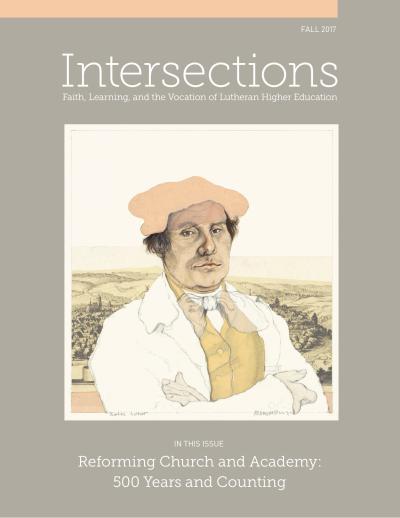
Nelavala traces how Luther’s “sutra” — grace alone, faith alone, scripture alone, Christ alone — reached the mud hut of her Dalit grandparents in rural India, transforming three generations, and then reads the parable of the vineyard laborers from a subaltern perspective in which grace for all is the heart of God’s alternative kingdom.
-
 Editorial
From the Editor
Robert D. Haak
No. 30 · Fall 2009
Haak frames the issue around the question of Lutheran college identity as formed in distinction from some “other,” introducing essays by Witherup on the Joint Declaration, Reuther on Holden Village, Afzaal on Christian-Muslim dialogue, Dovre on the history of Midwestern Lutheran colleges, Radecke on service-learning, and Ratke on Wilhelm Löhe — each making the claim that the “other” is an essential partner in conversation who helps us know who we are and shape who we will become.
-
Article
Money, Sex and Power: An Exploration of Some Controversial Issues in the Public Witness of the Church
Pamela K. Brubaker
No. 21 · Summer 2005
Brubaker explores two controversial issues in the church’s public witness—homosexuality and economic life—and the challenges they present for both church and college. Drawing on Beverly Harrison, Elizabeth Bounds, Ron Thiemann, Linell Cady, Marcia Bunge, Richard Hughes, Darrell Jodock, Ernest Simmons, Karen Bloomquist, Garth Kasimu Baker-Fletcher, and Larry Rasmussen, and on episodes at California Lutheran University around “Harmony Week” and Bishop Paul Egertson’s participation in Anita Hill’s ordination, she argues that colleges related to the ELCA are called to educate for “critical citizenship” by hosting rigorous, bold, and unfettered debate—including debate over the neo-liberal globalism that she names a form of economic fundamentalism.
-
 Editorial
From the Publisher
Arne Selbyg
No. 18 · Fall 2003
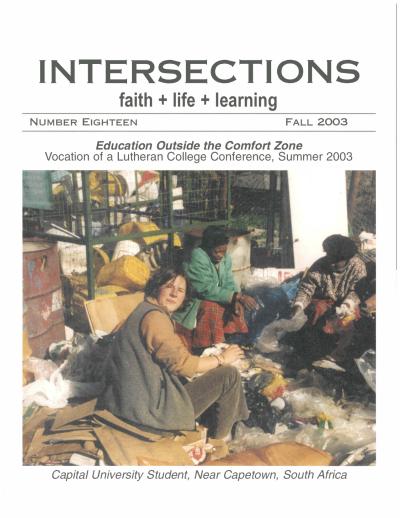
Selbyg reports that the ELCA Church Council’s new strategic directions include the charge to “assist this church to bring forth and support faithful, wise, and courageous leaders whose vocations serve God’s mission in a pluralistic world,” and assures readers that Intersections, the Vocation of a Lutheran College conferences, and related programs will remain among the tools by which the churchwide organization reaches its strategic goals.