Oh! Blessed rage for order, pale Ramon,
The maker’s rage to order words of the sea,
Words of the fragrant portals, dimly-starred,
And of ourselves and of our origins,
In ghostlier demarcations, keener sounds.—Wallace Stevens
Prologue on Perspective
The reflections that follow stem from 30 years of experience as a classroom teacher in higher education. They represent neither a personal memoir nor a systematic analysis of issues surrounding the role of the teacher/professor in higher education in the year 2000. In what I take to be solidly Lutheran fashion, their status is more … paradoxical.
The main paradox of this essay is that it is offered to you as both parochial and comprehensive. It is parochial because in the final analysis it is an apologia for the vocation of teaching in a Lutheran college or university. It is comprehensive because I find that the distinctively Lutheran understandings of education, of teaching, and of learning are remarkably encompassing, empowering, and liberating. I hope to persuade you that this parochial comprehensiveness is a paradox to be embraced, rather than a contradiction to be avoided.
Like the Incarnate Word, the universality of our work as educators in Lutheran colleges and universities is scandalously grounded in its very particularity. It is important that we hold up these paradoxical—even scandalous—understandings of our work. These understandings can be a precious counter-cultural—even prophetic—voice in contemporary academia, where a post-Enlightenment paradigm of instrumentalist rationality is increasingly viewed as the only game in town.
The relationship of these reflections to Lutheran theology, however, indeed to theology in general, is rather more inductive than deductive. I invite you first to join me in some phenomenological reflections about the structure and intent of our work as educators. Only after we have recaptured some of these roots of our work will we attempt to link our findings to theological concepts and to Lutheran ideas about God, human beings, and the relationship between them.
The most important claims I will make are
1. that teaching is a precious and paradoxical servant leadership, and
2. that exercising that leadership in a Lutheran institution of higher education is a distinctive and valuable vocation.
And my ultimate purpose is to provoke you to commit yourself to ongoing discernment and nurturing of your own distinctive ways of embracing that vocation in servant leadership.
Section I explores some features of language and politics in the current state of the academy. These observations will conclude with a description of some my own ways of thinking about things as a student professor of the humanities.
Section II explores the educational process, and the role of teaching in that process, as a form of purposive leadership. This section includes brief characterizations of the leadership implicit in the pedagogy of some famous teachers, and an invitation to reflect on your own models of pedagogy.
Section III consists of a brief descriptive taxonomy of the four kinds of learning that we as teachers are always engaged in leading our students toward, whether we recognize it or not. I believe that this taxonomy, albeit necessarily reductive, is reasonably comprehensive, at least for the purposes of reflecting together about our vocation as teachers. This section concludes with the assertion that only the paradoxical concept of servant leadership adequately captures the vocation of the Lutheran teacher.
In Section IV, the final open-ended section, I offer a series of theses about education, about Lutheranism, and about their relationship. This format is intended to evoke Martin Luther’s own famous use of theses as evocative invitations to discourse in community. Concluding with these theses is not mere homage to St. Martin of Wittenberg, but an affirmation of a style of inquiry and discourse that we would do well to reclaim as appropriate in the academy.
I. Academic Politics, Language, and Methodology
As a student and professor of the humanities, I have interest in how the words we use are shaped by such things as language structure, history, culture, and individual creativity, and in how those words in turn shape the very questions we are able to ask.
In some sense, of course, all academics are preoccupied with the power of language; we are, after all, a guild of talking heads, teaching others to talk as we do. Some of us, especially analytical philosophers, would claim that our collective task is to delimit the treacherous slippage of language as much as possible; their ideal would be to avoid language altogether if we could. Others, like poets in the vein of Sydney and Shelley and linguists in the tradition of Sapir and Whorf, delight in exploring how our languages and other symbol systems inevitably prestructure our apprehension of reality. Still others, like continental philosophers in the tradition of Nietzsche and Derrida, lead us into semiotic fun-houses where we perpetually confront the futility of our desires to grasp the fullness of Being.
In my view, most of the academic and political culture wars being waged these days can be plotted as disagreements about the meaning of the age-old insight that human beings are symbol-using animals. But I think it would be a misuse of our time to argue whether we should align ourselves with postmodernists or neoconservatives in these culture wars.
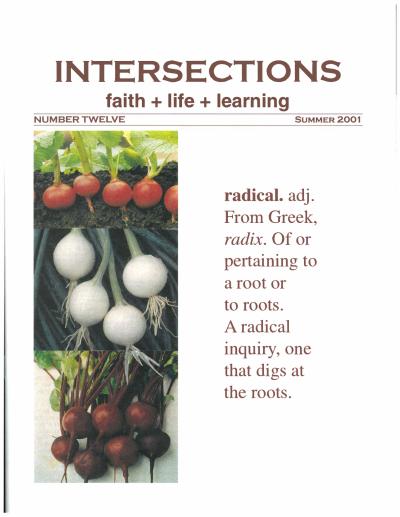
I propose to cut through the Gordian knot by simply taking a brief look at the etymology of the word “education” and of a few related words. Within limits, we can thereby gain historical and cultural perspective on the very concept of education, and on related praxes that we might otherwise take for granted in the usage of our own time and place.
The Oxford English Dictionary tells us that the word “education” came into English from the Latin educare, which originally meant “to rear, to bring up, as one does children or young animals.” In the idiom of contemporary American English, we might say that the historically foundational sense of “to educate” is therefore “to raise,” and that to be “well-educated” is to be “raised well.” I find it interesting and instructive that originally this notion of educare included not only the notion of teaching and training, but also that of nourishing—of ensuring that all the requirements for growth and development of a youth were being met.
The OED also tells us that the Late Latin word educare was in turn derived from a compound of two other Latin words, e and ducere. Now the root sense of e-ducere is “to lead forth,” or “to pull out.” This sense of “leading or pulling” at the heart of the word “education” may be found in other common English words that share their origin in the Latin verb ducere. “Productive” (pulling forward), “reductive” (pulling back), “inductive” (leading in), “deductive” (leading down or away) “ductile” (pullable), and “duke” (leader) are a few that come to mind.
These root meanings of the word “education,” if we take them seriously, enable a radically renewed awareness of the rich connections between “education” and other qualities and concepts that we don’t normally associate with it nowadays. For me, the concept of leadership jumps out of this etymological nexus.
The connotations and connections between education and leadership function not only in the more commonly known Latinate component of the heritage of English. There are uncannily analogous roots at work in the German expressions for education. Take Erziehung, for example. Ziehen is the everyday German word for “to pull,” so Erziehung is, quite literally, “pulling forth.” Ziehen is also the verbal form of the noun Zug, which means “train,” “draft,” or “characteristic.” This noun has found its way into English, as in tug-of-war and tugboat. This Germanic strand of the story suggests that the activity of “train-ing,” of pulling into shape, of tugging is inherent to the meaning of the world “education.”
Of course, the more elevated expression “Bildung” is also used in German, usually to connote the acquisition of putatively higher-level cultural skills and awareness. Here, too, however, the implied role of the teacher as “shaper” and “former” of the student is clear, as it is in the case of the analogous French expression, “formation.”
The etymological evidence would suggest, then, that “education” has historically been viewed quite literally as a form of leadership. Our forebears apparently took it for granted that this form of leadership involved at least the following:
1) nurturing the student
2) training or “pulling forth” the student, an active and purposive leading from one place, condition, or shape to another.
Underlying the ideas of nurture, training, and leading is a clear sense that education is never a thing or a state, but always a process that involves a nurturer, a trainer, a leader—that is, a teacher. As the primary agent of the educational process, the teacher/leader always brings certain assumptions—conscious or unconscious—to his or her leadership. The most significant of these is the assumption of a relationship to the student, to the trainee. As we proceed, I invite you to reflect about your own assumptions regarding this relationship. Is this a relationship of control? Of Pygmalion-like ego-investment? Of condescending good will? Of … love?
There are of course, many possible ways to conceive of the teacher-learner relationship. It might be worthwhile to take a brief look at a few representative models, and see whether we recognize ourselves in any of the mirrors they provide. Consider, for example, the Allegory of the Cave in the Republic, where Plato argues that only the enlightened philosopher-king could properly serve as a teacher, because only the philosopher-king has been freed from the shackles of illusion that constrain all the other denizens of the cave. On this account, the teacher makes a kind of noble sacrifice. Having attained enlightenment, the teacher voluntarily subjects himself again to darkness, and to the cries of pain from his students when he forces their shadow-conditioned eyes to turn to the light. He is the archetypal sage on the stage. He would, however, like Marlene Dietrich, rather be alone. It is a noble sacrifice, though, worthy in the eyes of the republic, whose well-being depends on it. Do you see yourself or any of your colleagues in this picture?
Or do you see yourself or your colleagues in some of Plato’s other well-known analogies of the process of education and the role of the teacher? In the Theatetus, the teacher is presented not as a condescending philosopher-king, but as a midwife. In the Meno, a patient and attentive teacher helps to bring into the consciousness of the slave boy something that was always already there. It just needed to be “unforgotten” (anamnesia). The truth (aletheia) just needed to be roused from its lethargy. Maybe these models make us think more of our role as a guide on the side. Is this a feminine model of the role of the teacher, as opposed to the masculine model of the Republic?
Or perhaps we should revisit that archetypal critical thinker, the Socrates of the Apology. You will remember that Socrates claims that it is impossible for him to be guilty of teaching Athenian youth about false gods, because he doesn’t actually teach or profess anything. All he does is ask a few simple questions about such important things as virtue and justice, in an honest search to find a truly wise man who knows what he’s talking about. It turns out nobody does, especially nobody in any position of authority and responsibility in the polis. Reluctantly—so he says—Socrates must conclude that he is, after all, pretty wise. At least he knows that he doesn’t know anything—unlike all those pompous senators, deans, presidents, preachers, bishops, and board members. Anything familiar here?
One final example: Maybe your theory and praxis as a teacher resonates with Paulo Freire’s Pedagogy of the Oppressed. You may seek a truly dialectical relationship with others, so that both you and your interlocutors may be liberated from the limited imperialistic conceptions of the world that come with your respective ideologies. From this interaction and bona fide dialogue, there should emerge a “true word” that will transform the world for all involved. In this relationship of parity, the implied hierarchical relationship between teacher and student is suspended. In fact, nobody can accurately be called a teacher, yet everybody should view everybody else as a teacher. How often have you said, or heard one of your colleagues say: “I learn so much from my students?”
We could extend these examples more or less at will, and I invite you to continue this reflective game on your own. The point I want to make is that all of us are probably more familiar than we realize with a wide variety of models of teaching. But these models come to us attached to a series of ethical, epistemological, and even metaphysical assumptions about education and about human nature.
We need to reflect about these assumptions. We should regard no model as the “standard” or “default” model. There are choices to be made. And my suggestion is very simple: One of the best ways to discern the appropriate role and function of the teacher is to approach every teaching/learning situation with the question of leadership in mind:
Who is leading whom? The identity, character, authority, and credibility of the leader are important questions. And at least one fascinating mystery about human learning is that to some degree we seem capable of self-guided learning, of auto-didactic efficacy. What kind of teaching appropriately respects such power and freedom?
From where to where? To what ends? In anticipation of the claims made upon us as Lutheran teachers, one might ponder: How did/does God approach the challenge of leading/teaching people? What does the incarnational theology of the cross have to do with being a good teacher?
Of course, getting accurate answers to these questions may not be so simple, and they may vary from case to case. Sometimes it’s hard to tell the leader from the led, the puller from the pullee. As the father of six-year-old and a twelve-year-old, I can attest to that. I of course do my best to “educate” my kids, that is, to nurture them into full selfhood and to raise them up in proper decorum, skills, and behavior.
But I know very well that it is often I who am nurtured and who learn from them—things that I have never known or have long since forgotten. My son’s art work, for example, teaches me to see everyday objects in new and striking ways, and my daughter’s spontaneous dancing reveals to me new and wondrous synergies between sound and motion. I am usually glad these role reversals happen, but they can make you humble about your role as parent/educator. And they can prove to you that it’s not always easy to answer the question: “Who’s leading/pulling whom?”
Sometimes it’s just not possible to identify the starting place or the ending place of the teaching/learning process until after you find yourself at the new place. Most of us involved as professionals in higher education believe that the places we are moving toward, and leading our students toward, are somehow better than where we, and our students, were before. Education, we believe, involves an increase in something. When we teachers are asked to be more specific about the nature of this increase, we generally respond a little impatiently, because it should be obvious that we’re talking about increases in awareness, understanding, appreciation, or skill.
But these sorts of questions about education are legitimate, and the answers to them can only be fully appreciated if we keep before us the question of the purposiveness of our leadership: “From where to where?”
III. A Taxonomy of Learning: Where Teachers Lead Their Students
I offer you this taxonomy not as an end in itself, but rather as a heuristic device to help us think as clearly as we can about the purposiveness of the leadership inherent in our activity as teachers—in any setting, but particularly in the setting of a Lutheran college or university. I suggest to you that all learning can be seen as an instance of one or more of the following, and that each kind of learning may require its own form of leadership:
A. Learning “About” (Information)
B. Learning “Why” (Analysis/Critical Thinking)
C. Learning “How” (Praxis/Work)
D. Learning “For” (Teleology)
My descriptions of these four kinds of learning represent distillations of my own experiences, study, and reflection over approximately 35 years as a student and as a professor in higher education. Let me briefly explain what I mean by each one.
Learning “about” things is a pretty universal human enterprise. When you learn “about” things, you learn that something is the case. You learn that leaves are (generally) green, that things fall when you drop them (at least under certain conditions), that it gets hot in Texas in August, that Tokyo is a city in Japan, that in English grammar the object of a preposition takes the objective case. On the simplest level, this sort of knowledge may be thought of as “information.”
To the degree that such information accords with how things are in the world, or at least with how things are generally thought to be in the world, we refer to such information as “facts.” Much of our learning happens in this category; it consists in absorbing and retaining information.
Learning information is unquestionably important. All education is dependent upon our becoming aware of, or familiar with, facts. No matter how sophisticated, theoretically astute, or creative a person is or becomes, broad familiarity with facts of all sorts is going to be expected of an educated person. We are always learning them, whether they are of any immediate use to us or not. We absorb them through television, newspapers, lectures, conversations, and games. Such ongoing learning about things is part of what we mean when we say that an educated person has a responsibility to have an objective relationship with reality. With regard to this kind of learning, the leadership responsibility of teachers looks something like this:
As purposive teachers, we have the responsibility for helping to provide access to accurate and reliable information, and to ensure that our students achieve appropriate familiarity with that information. We are called to lead our students from ignorance to awareness.
But of course being familiar with information alone, no matter how extensive, does not qualify anyone as an educated person. Human beings, because of apparently inherent curiosity, are not content to know that things are the case. We seem compelled, at least collectively, to some understanding of why things are the way they are. We seek to understand cause, history, development, becoming. As we move from mere awareness that something is the case to being able to give an account of why it is the case, we say we are engaging in “critical thinking,” which involves not merely perception, but judgment, logic, and reflection. Because we now have interpretations of facts, we are able to understand and explain them, at least within some contexts.
These two kinds of learning—learning “about” and learning “why”—may be pretty reliably found in any community of higher learning worth its salt. And you’ll certainly find them in abundance at Lutheran colleges and universities. These kinds of learning are almost universally associated, at least within the world of modern Western higher education, with homo sapiens—with humans as beings who claim to know. In some ways the almost unquestioned respect for these two kinds of knowing has set aside modern universities from almost every other kind of institution in our culture.
I say “almost” unquestioned, because the analytical and experimental aspects of critical awareness have in fact come under fire from some quarters as inherently invasive and destructive. Yet the freedom to learn about things, and, within certain ethical limits, why things are the way they are, has in fact become a widely known and appreciated feature of the purposive environment of higher education. This is good, and it is important. Without this basic respect for learning about the way things are, and learning why they are that way, universities would probably simply replicate or reinforce the prejudices and fantasies of those who have not bothered to discipline themselves to such learning. Therefore the following kind of leadership of the teacher is essential:
As purposive teachers, we have the responsibility for the ethical preservation of an environment in which information, both familiar and unfamiliar, is subjected to the free scrutiny of understanding. We should not take such an environment for granted, because it is not clear that any other institutions in our culture have an equal stake in nurturing and preserving it. We are called to lead our students from passive reception of information to active and critical interpretation of information.
But of course human beings are not merely disembodied minds or talking heads. Homo sapiens though we may be, we are also homo faber. We make things, both of ourselves and in the world. We are not merely bystanders who perceive and cogitators who understand, but agents who act in the world. In so doing, we apply our awareness and our critical understanding of the world and of one another. For such application to be effective, we must also learn how to perform effectively. We must acquire and practice certain skills, which require discipline and habit.
A singer learns about certain sounds and understands how they are produced, but does not stop there. She learns these things not just for their own sake, but so that she can learn how to sing beautifully. A writer learns about grammar, spelling and diction, and understands why certain organizational structures will work with a given readership, not just for their own sake, but so that he can learn how to write effectively.
In using our factual and critical learning, we take it back out of the realm of pure “freedom” and harness it to some performance or production. In an important way, we see our humanness realized in such performance or production. Such learning is part of the heritage and purpose of ELCA institutions. In short, while sheer learning and curiosity are encouraged, so too is the sort of learning that will enable our students to make themselves useful.
As purposive teachers, we should help our students relate their knowledge of information and their theoretical understanding to relevant praxis and meaningful work. In this context, the prevalent dichotomies between “liberal learning” and “applied learning,” and between theory and practice, should be viewed as largely false problems. We are called to lead our students from awareness and understanding to a skillful and disciplined use of that knowledge and understanding.
But useful for what? Without effective engagement with both short-term and ultimate purposes for which we pursue all this learning, it remains unfocused and ungrounded. It is in linking our awareness, our critical understanding, and our action in the world to purposiveness that all these kinds of learning have meaning. By definition, such purposiveness is larger than the individual self. The Greeks, particularly Aristotle, had a profound understanding of the role of such purposiveness in creating the conditions for a meaningful life. Aristotle called it “teleology,” after the Greek word for purpose, telos.
There is no question, at least to my mind, that this last kind of learning is the kind that has caused human beings the most difficulty. After all, our apprehension of our ultimate purposes is cloudy, isn’t it? Especially in modern times, we have learned to be actively suspicious of people, nations, and religions who put too much emphasis on this sort of thing. All too often, the invocation of purpose has stifled the development of the other kinds of learning we have been discussing. When we are confronted with people who tell us we should subscribe to “the” absolute, we rightly question “whose absolute?”
In fact, when we are confronted with the claim that a teacher should be a leader, part of us is conditioned to resist this claim, because it smacks of authority, hierarchy, and loss of the student’s autonomy.
On the other hand, we know in our hearts that it is all too convenient to misuse such appropriate skepticism as a reason for permanently pulling back from investing ourselves in larger purposes. All too convenient, and all too tragic. For fear of being duped, many people refuse to invest their lives in anything larger than themselves. Yet such cynicism is the surest way to stop the educational process short of its full flowering.
Moreover, it is the surest way to live an ultimately meaningless life mired in anomy, in apathy, or even in despair. All our skills and all our awareness and all the sharpness of our critical thinking will careen around aimlessly. Goethe knew this modern malady well, and portrayed it vividly in his play Faust. Along the way to re-engaging with meaningful purpose in his life, Goethe’s hero did make some bad choices, but he was eventually redeemed because he kept caring about something larger than himself.
As purposive teachers, it is our responsibility to actively nurture an environment in which the alphas and omegas of our existence, the big questions of faith and commitment, may be safely pursued in conjunction with the more truncated, but vital learning of information, critical awareness, and skills.
As far as I can tell, every ELCA college or university seeks to engage its students in all four of these kinds of learning. Moreover, most of them do it in such a way as to make it difficult for students to cordon off these four kinds of learning into separate areas. It’s usually not going to be the case that a student will learn information only in, say, a first-year course in physics, that a student’s critical thinking will be engaged only in a logic course in philosophy, that a student’s performance skills will be developed only in theatre courses, or that a student’s faith and values will be engaged only in theology courses. At least, that is, if we teachers are doing our jobs right. If we are, then our students will experience each of these kinds of learning in all of the forty-plus courses they will take on the way to their degrees.
Being a student in this kind of learning environment should be an exhilarating, marvelous, and life-changing experience. If we teachers do our jobs right, our students will master wondrous information they had never dreamed of. They will be invited to develop new and critical understandings of everything from the New Testament to capitalism. They will further develop skills they already had and discover talents they didn’t know they had. They will wrestle with devils—and with angels, and find themselves discerning their vocations in life. The good news is that we get to be part of it all, and see them grow. And if we approach our teaching in this comprehensive way, then we, too, can continue to have marvelous, life-changing, and exhilarating experiences.
One last perspective on this four-fold process of education before I conclude with my ten theses. It is a nearly universal cliche that education involves liberation. Many universities—including public ones—have adopted a version of the Biblical promise as a virtual mission statement: “You shall know the truth, and the truth shall make you free.”
We may now be in a better position to give this common platitude more meaningful content, provided we think of freedom not merely as freedom from some kind of constraint or other. Unfortunately, such a negative concept of freedom is widespread in our culture. The problem is that once we’ve achieved liberation from constraints, we don’t necessarily have anything positive.
There is a flip-side to freedom from, however, and that is freedom to. Freedom to is inherent in the purposive definition of teaching as leadership that I have been attempting to outline. Both freedom “from” and freedom “to” come into sharper focus when we as teachers conceive of our role as leaders to help our students achieve the four kinds of learning we have been discussing.
This role can of course degenerate into tyranny. But let us be bold and clear on this point. We usually recognize the difference between a true leader and a tyrant. So too can we be confident that we can recognize a true teacher motivated by a positive and enabling sense of leadership. The answer lies in the paradox of the servant leader—one who leads not to achieve his or her greater glory, but to enable the student to discern his or her God-given vocation, and to equip him or her to live it fully. In this imitatio Christi, the teacher’s own true vocation is achieved.
IV. Ten Theses for Discussion Among Those Who Teach in a Lutheran College or University
I conclude with an invitation, indeed an exhortation, for you to explore the following theses about your work as a teacher in a Lutheran college or university. Ideally, such exploration will happen in discussion or even disputation with your colleagues in community. It is, after all, in community that such words are fleshed out.
1. If one is not clear what one is aiming at, anything one hits can be described as a bullseye. Such a laissez-faire approach to the teaching function should not be defended under the contemporary rubric of academic freedom.
2. Teaching is a purposive activity. Its purposiveness involves nurture, as well as clarity about the kinds of learning involved.
3. All who profess to teach should be engaged in the definition and defense of their understanding of its purposiveness.
4. Every definition of purpose involves political and ethical choices. The “default” settings in contemporary secular higher education, or in other institutions of our culture, should not necessarily be our guide.
5. The disciplinary methodologies and practices of graduate training and of much academic life, in themselves, provide inadequate models for effective, purposive teaching in institutions of higher education related to the ELCA.
6. Lutheran theology and the tradition of Lutheran Christianity provide a number of concepts, intellectual habits, and behaviors that can help us become better teachers. Among the most important of these are:
- The Gospel liberates us from the need to use knowledge as power.
- We are called to love our neighbors, including our students.
- A Christian is free from all masters, but is called to be the perfect servant of all.
- All truth is God’s truth, and the free use of reason is one of God’s gifts to us.
- “Disputatio” is an appropriate expression of faith, not a sign of its absence.
- All people have vocations; these vocations are discerned in community.
- All things human, including the university and the church, are “semper reformanda.”
7. We can and should lead our students from the tyranny of ignorance to the freedom of awareness.
8. We can and should lead our students from the tyranny of rote knowledge to the freedom of critical understanding.
9. We can and should lead our students from the tyranny of incompetence to the freedom of skillful action.
10. We can and should lead our students from the tyranny of anomy and isolation to the freedom of purposive lives in community.
-
 Editorial
From the Publisher
Arne Selbyg
Selbyg reports that the Lutheran Brotherhood Foundation and the Lilly Endowment have funded the Lutheran Academy of Scholars, which since 1999 has gathered ten to twelve Lutheran scholars at Harvard for two-week summer seminars under Ronald Thiemann (themes: “Finding Our Voice—Christian Faith and Critical Vision” in 1999–2000 and “The Lutheran Public Intellectual: Faith, Reason and the Arts” in 2001), and announces that the academy will move to Berkeley in 2002 under Ted Peters to take up the intersection of faith and science.
-
Editorial
From the Editor
Tom Christenson
Christenson introduces three pieces from the summer 2000 Vocation of a Lutheran College Conference at Dana College—noting that Leonard Schulze was asked to keynote before becoming executive director of DHES—and recommends Peter C. Hodgson’s God’s Wisdom: Toward a Theology of Education and Douglas Sloan’s Faith and Knowledge: Mainline Protestantism and American Higher Education for their accounts of how faith and knowledge have been dissociated in modern higher education and what it might take to recover their connection.
-
Article
The Vocation of a Lutheran College
L. DeAne Lagerquist
Lagerquist places the twenty-eight ELCA-affiliated colleges in the context of American higher education from Harvard (1636) through the “old time college,” the post-Civil-War research university, and the postwar expansion—drawing on Christopher Lucas, Philip Schaff’s Neo-Lutheran/moderate/Old Lutheran categorization, Sydney Ahlstrom’s scholastic/pietistic/critical currents, Luther’s appeal to the German nobility, Lewis Hyde’s gift economy, and Alasdair MacIntyre’s After Virtue. She proposes five characteristic practices (the school as learning community, study of Bible and Christian tradition, participation in the arts as makers and audience, application of learning in service, and on-campus Christian worship) grounded in Lutheran teaching about grace, image-and-fall, gratitude, and revelation through created “masks,” and four virtues these practices engender in graduates—loving gratitude, faithful wisdom, bold freedom, and hopeful humility.
-
Article
Perspectives on Institutional Service: All Hands on Deck
Ruth Henricks
Henricks, President and CEO of Lutheran Family Services of Nebraska, uses Annie Dillard’s image of Christians tourist-like on Deck C to call colleges and social ministry organizations to “all hands on deck” in a church standing at a threshold of shifting demographics—a growing rich-poor gap, a coming Hispanic majority, an aging baby-boom, dual-career families, contingency workers, and for-profit Lockheed Martin-style competitors entering human services. Drawing on Foster McCurley, Andrew Grove’s Only the Paranoid Survive, Justo Gonzales’s Manana, Arthur Becker, Bob Bacher, David Tiede, and the ELCA constitution, she argues that SMOs and colleges are the “hands” of the body of Christ and asks whether we have courage to require Spanish, partner ecumenically, cut services to Caucasian clients, and lead the church from the front rather than the rear.
-
Article
A River Runs Through It: CLU as a Church-Related University
A. Joseph Everson
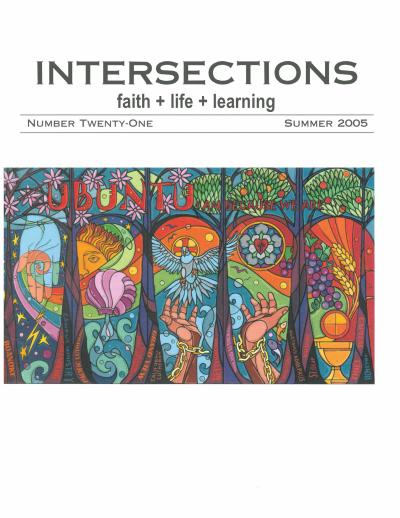
Everson borrows Norman Maclean’s A River Runs Through It and the small creek that flows through California Lutheran University’s Kingsman Park as images for the quiet stream of Christian tradition on campus, describes the dialectic of faith and reason (with a “Lord of Life” student congregation, two required religion courses, and a voluntary Wednesday chapel) as the “theology of paradox” that runs from Luther’s simul justus et peccator through Richard Solberg and Richard Hughes, and names six commitments that constitute the CLU ethos—academic freedom (Jeremiah 29:7 and John 8:32), vocation, service (Amos and Habitat for Humanity), grace and graciousness (Portia’s “quality of mercy” speech from The Merchant of Venice), diversity, and reverence (Proverbs 9 as awe and wonder).
-
 Article
An Aristotelian Twist to Faith and Learning
Gregg Muilenberg
No. 3 · Summer 1997
Muilenburg, chair of Philosophy at Concordia, surveys the four traditional models for faith and reason—conflict, independence, dialogue, and integration—and argues that the Lutheran dialogical model is insufficient for wholeness. Drawing on the post-foundationalist epistemology of perspective and Aristotle’s account of knowing as desire-driven action, he proposes that faith is an ultimate value (an assessment belief of the form ‘x is better than y’), that learning is desire-directed action, and that the core of Christian education is the education of Christian desire—requiring both reflection and commitment, both integration and diversity.
-
 Article
Assessing Self-Assessment Instruments at Finlandia University
René Johnson
No. 55 · Spring 2022
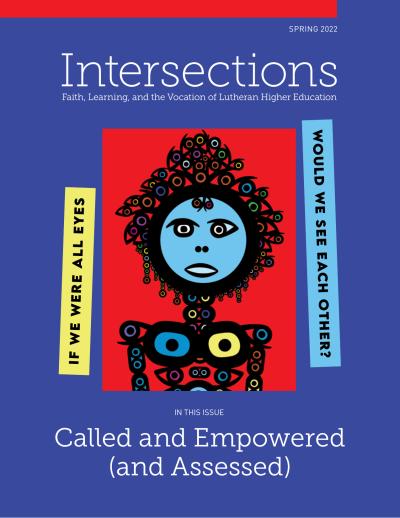
Johnson surveys three self-assessment instruments presented at the NetVUE conference — PathwayU at Colorado State, the Intercultural Development Inventory at Friends University, and Mark Savickas’s Career Construction Counseling Manual at Union College — and describes Finlandia’s use of the CliftonStrengths© assessment to link students’ personhood to “behaviors that benefit the community.”
-
 Article
Say Something Theological: A Meditation on the Vocation of Lutheran Colleges and Universities to Serve the Common Good
Paul C. Pribbenow
No. 42 · Fall 2015
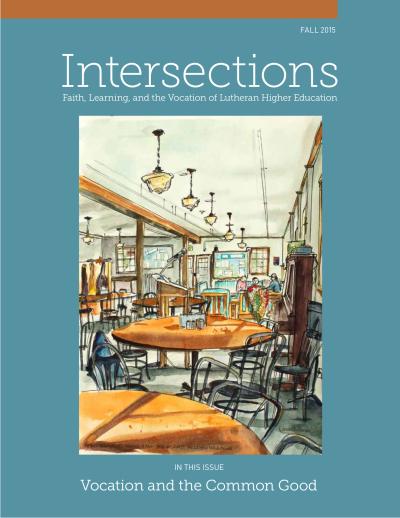
Pribbenow expands Luther’s “priesthood of all believers” into a meditation on doing theology with the Bible in one hand and the New York Times in the other — reading Luke 14 alongside walls, immigration, and hunger in his Minneapolis neighborhood — and argues that the leadership of Lutheran colleges demands a willingness to engage the theological issues at the heart of their public vocation.
-
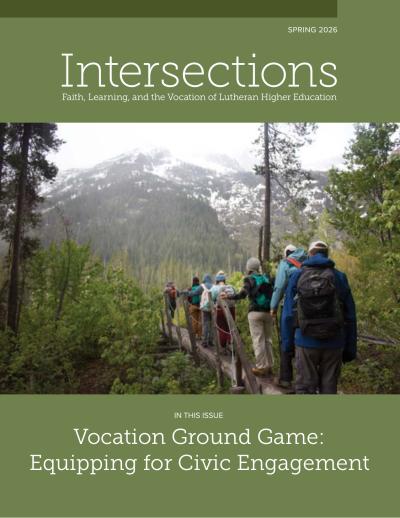 Reflection
I am a Treaty Partner
Kyrie Fairbairn
No. 63 · Spring 2026
7 min audio
A recent California Lutheran graduate reflects on how a course on Indigenous Rights and Practices, and a conversation with a former Chairman of the Lummi Nation, led her to claim a “treaty partner” identity and to challenge readers to learn the treaties that shape the lands they call home.
-
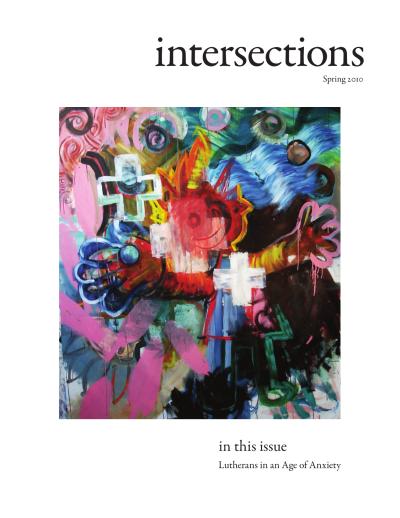 Article
An Apostolate of Hope
David L. Tiede
No. 32 · Spring 2010
Tiede argues that the vocation of a Lutheran college is to be “an apostolate of hope” oriented by three metrics of our time: 12,000 (the Dow), 350 (parts per million of CO2), and $1.25 (the daily income of 1.4 billion people in extreme poverty). Drawing on Darrell Jodock’s “third path” for church-related colleges, Larry Rasmussen’s Batalden lectures, Mark Tranvik, Douglas John Hall, Bill McKibben, Stephen Privett, Peter Singer, and Augsburg’s Center for Global Education, he proposes that justification by faith, critical pluralism, stewardship of God’s earth, and love and justice for our students together prepare wise leaders to renew the future.
-
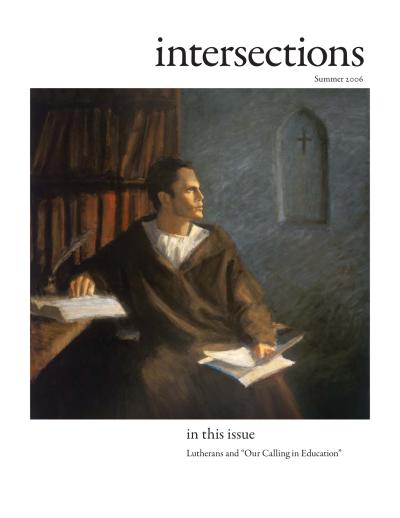 Article
"Our Calling in Education": An Educator's Perspective
Cheryl Budlong
No. 23 · Summer 2006
Budlong, Professor of Education at Wartburg College, asks educators to reexamine their ‘mental models’ of what education itself means in light of the rapidly expanding literature on how young people learn. Drawing on Malcolm Gladwell, Eric Jensen, Ruby Payne, Judith Harris, Robert Slavin, and the AACTE’s Leading a Profession retrospective on the AACTE agenda 1980–2005, she calls on Lutheran educators to articulate vocation intentionally in their classrooms and to ground curricular and pedagogical reform in Wartburg’s focus on Discovering our Calling.