The Identity, Mission, Vision, and Goals of a Lutheran College vis a vis Bacon's "Of Studies" and Newman's "The Idea of a University"
Intersections No. 15 · Winter 2002
Thiel College, established in western Pennsylvania in 1866 as a co-educational institution, is located at the crossroads of the nation’s mid-Atlantic and mid-Western regions. This particular geographical placement underscores the principle of intersection that is quite prevalent at Thiel College, from the intersecting of the general education requirements to form “integrative requirements” to the cross-disciplinary philosophy that permeates its course of studies.
Teaching and studying at an institution of higher education that values such intersections and integrations and that is oftentimes at a crossroads as it responds to the needs of our fluid times are vocations that are both challenging and gratifying. How does a liberal arts college in the Lutheran tradition maintain a strong foothold in its academic heritage while it simultaneously provides for its students “an education with relevance for a lifetime” as it educates them in the liberal arts and professional studies “for service to society”?
The co-authors of this article—one an Associate Professor of English and the other a student of junior status with a dual major in English and Religious Studies who worked as a Summer Intern (2002) at the Division for Higher Education and Schools of the ELCA in Chicago, Illinois—thought it would be challenging to pose this question by considering the intersection of two classical literary pieces—Sir Francis Bacon’s essay “Of Studies” and John Henry Cardinal Newman’s The Idea of a University—with the statements of Identity, Mission, Vision, and Goals of Thiel College.
This article was inspired by discussion generated in two English survey courses taught by Dr. Hall: British Literature to Romanticism, and British Literature from 1798 to the present. In an attempt to make relevant and pertinent the literary selections to the students’ personal lives, career goals, and the mission of their College, she asked the students to do a comparative study of the Identity, Mission, Vision, and Goals Statements found in the academic catalogue and Bacon’s essay “Of Studies” in the fall 2001 semester and Newman’s Idea of a University in the spring 2002 semester. The results of this “assignment” and the students’ insightful treatment of this intertextual analysis form the basis of this article. While this is, admittedly, an ambitious undertaking, we wish to share with the academic communities of the ELCA how select passages of these two literary works, written in the 17th and 19th centuries, respectively, underscore the relevance of our College’s mission and perhaps invite our readers to consider such intersections in their own institutions.
Thiel College’s Statement of Mission
Informed by its historic tradition, Thiel College’s mission is to develop through exemplary education all aspects of the human character—the intellectual, the personal, the moral, and the religious—so that lives inspired by truth and freedom may be committed to service in the world.
(All quotes from the Thiel College’s Statements of Identity, Mission, Vision, and Goals are excerpted from the Thiel College Academic Catalog 2001–2002; all quotes from Bacon’s “Of Studies” and Newman’s The Idea of a University are excerpted from The Norton Anthology of English Literature, vols. 1 and 2, 7th eds., 2000.)
Seventeenth-century England saw writers and scientists who developed new models of expression and experimentation that focused on real people and their actual contemporary world, and that analyzed both of these subjects. Not unlike writers of our own time, the 17th-century writers sought methods to express the diverse ways by which people were appropriating responses to events in their own personal and public lives. Prose writing rivaled poetry as the dominant form of literary expression. Regarded as the primary philosopher of inductive and deductive reasoning and empiricism, Sir Francis Bacon (1561–1626) wrote in the essay genre; unlike the French essayist Montaigne, however, Bacon wrote essays that were not intimate or personal confessions but were treatises that provided methods for and insights into a radical reform of knowledge.
When considered in conjunction with Thiel College’s Mission Statement, Bacon’s 1625 version of his essay “Of Studies” provides the modus operandi of an education that seeks to develop “all aspects of the human character” by grounding this education in reading and study habits. Bacon provides a “how-to” methodology for reading and studying: “Read not to contradict and confute, nor to believe and take for granted, nor to find talk and then discourse, but to weigh and consider” (1542). For an age such as ours—not totally unlike the 17th century—where people tend to argue for the sake of arguing and confronting, Bacon proffers weighing and considering the matter placed in front of us in a manner that “stimulate[s] students’ critical thinking” (“Statement of Vision of Thiel College,” 9). As educators, we often expect quick, immediate responses to our questions and assignments and equate such immediacy with student preparedness and intellectual acumen. By reorienting our pedagogical expectations to encouraging responses that are more carefully and critically considered, we instill in students the value of cogent and thoughtful deliberation.
The May 2002 issue of the PMLA (Publications of the Modern Language Association of America) contained an article by Azade Seyhan, the Fairbank Professor in the Humanities, professor of German and comparative literature and adjunct professor in philosophy at Bryn Mawr College, titled “Why Major in Literature—What Do We Tell Our Students?” Therein, Professor Seyhan convincingly argues that it is the responsibilty of English and language professors to be cognizant of the ramifications and import of cultural history on the educational system and to communicate that to our students. She states:
[I]n an age marked by profound skepticism about the value of the humanities and by the rapid corporatization of universities, where only departments offering majors that guarantee profitable careers are generously funded, our efforts to promote literature as a legitimate field of inquiry ring inevitably apologetic. Universities are not immune to the cultural climate in which they exist. Historically, they have resisted the forces of repression, ignorance, and greed and profit. But they have now become a part of the corporate culture that does not consider promoting critical thought and intellectual awareness its first priority. We are enamored with the Internet, which has rendered the need for reflective reading and research obsolete and collapsed all temporal and analytic categories of knowledge into an unedited mass of simultaneous images. In this culture, students are likely to consider the time and effort necessary for reading serious books onerous and unnecessary. (PMLA 117:3; 511)
Our integrative and major/minor courses at Thiel are rooted in fashioning students to become well equipped for the vagaries of the current culture. The focus of our mission—our raison d’etre—is a commitment “to service in the world.” A life of service equates with discernment, a critical appraisal of the strengths and weaknesses, pros and cons of each circumstance and argument. A student who is equipped with such skills of weighing and balancing is considered by today’s standards to be innovative and entrepreneurial. A spirit of contradiction, naivete, vulnerability, fallacious argumentation, and empty discourse is antithetical to professional and academic advantage and inhibits development of social considerations. Since our Vision and Goal statements address our commitment “to celebrate personal and professional achievement,” one of the greatest values our students can acquire during their course of studies is that of discernment, of “reviewing and evaluating,” of “perceiv[ing] and choos[ing] among those things which are of value” (“The Goals of Thiel College,” 10). In Bacon’s apprehension, “Crafty men contemn studies, simple men admire them, and wise men use them, for they teach not their own use; but that [the knowledge of how to use them] is a wisdom…won by observation” (“Of Studies,” 1541–42). Bacon laid the foundation for developmental psychology’s thesis that a college community learns sequentially—how to study, how to interact, and how to become “knowledgeable and responsible citizens for dedicated service to humanity and enlightened care for the environment” (“Statement of Vision of Thiel College,” 9).
Bacon’s claim that studies “perfect nature and are perfected by experience” (“Of Studies,” 1541) is underwritten in our study abroad, internships, and student-teaching experiences whereby students incorporate and intersect academic training and classroom diligence with professional competence and personal potential. Even for students whose course of studies may not directly lend themselves to such off-campus experiences, our Integrative (or General Studies) Requirements, strongly situated in the liberal arts tradition, “seek to foster in students an integrative world view” (“The Goals of Thiel College,” 10) that includes studies in both Western and non-Western civilizations and that aims to provide experiences that give direction to studies themselves. Bacon believed that “natural abilities are like natural plants, that need pruning by study; and studies themselves do give forth directions too much at large, except they be bounded in by experience” (“Of Studies,” 1541). Grounded in the Judeo-Christian tradition and inculcating in students a purposive and meaningful values system, Thiel College gives students the tools to build the intersection between the “already” and “not yet.” Its holistic curriculum highlights ten institutional objectives, each of which “expresses an intended result of the student’s participation in the Thiel College community, to be achieved through systematic training and disciplined study.” They include: a.) intellectual rigor; b.) problem-solving; c.) imaginative sensitivity; d.) socio-cultural awareness; e.) historical perspective; f.) environmental responsibility; g.) individual and social maturation; h.) a humane commitment to life; i.) physical development; and j.) religious awareness and growth (“The Objectives of Thiel College,” 10–11). Courses in each discipline at Thiel—the humanities, natural sciences, social sciences, fine and performing arts, and business—address at varying levels of intensity and skill expectation these categories of focus in an attempt “to educate the whole person.” Correspondingly, Bacon states, “There is no stond or impediment in the wit but may be wrought out by fit studies, like as diseases of the body may have appropriate exercises…. Histories make men wise; poets, witty [clever]; the mathematics, subtle; natural philosophy [science], deep; moral philosophy, grave; logic and rhetoric, able to contend. Abeunt studia in mores” (“Studies culminate in manners”) (“Of Studies,” 1542; quoted from Ovid’s Heroides), or, as the curriculum at Thiel College translates:
Through liberal arts education, Thiel College seeks to develop in students the skills, social awareness, and intellectual capabilities necessary to succeed in a variety of occupational fields…. Such values and skills equip individuals to re-examine and adapt their values as changes in the world and in themselves demand. (“The Goals of Thiel College,” 10)
Our faculty recently approved for implementation in the 2003–2004 academic year a Writing-Intensive Course requirement that will integrate and strengthen the reading, writing, and oral communication skills of students in a cross-disciplinary way. Rather than limiting the acquisition and refinement of such skills to English or Communication courses, the faculty acted upon a need, made relevant by our global age, to demonstrate the intersection of these skills. Once again, we are reminded of Bacon’s words in “Of Studies”: “Reading maketh a full man, conference a ready man, and writing an exact man” (1542). (In order to maintain the integrity of the original text, the co-authors of this article maintain the use of “man” in citing from these classical pieces.) In order to fulfill the graduation requirements, students meet competency requirements in the English language, a foreign language, mathematics and an Integrative Requirement that consists of courses from five Groups: Commitment in the Global Arena; Commitment to a Humanistic Vision; Citizenship in a Scientific Age; Choosing Depth and Diversity; and Concern for Physical Well-Being (“General Requirements,” 47–49). By taking designated courses within each Group, students will now also be able to meet the Writing-Intensive Curriculum requirement and demonstrate to potential employers one of the primary requisites for success: an ability to see the interrelatedness of life, a skill with which the liberal arts college readily equips its students.
As a student at Thiel College, I find the Identity, Mission, Vision, and Goals to correspond with the educational experience necessary to serve any of my vocational pursuits. Moreover, I discovered this past semester that reading, critiquing, and discussing Cardinal Newman’s Idea of a University enabled my classmates and me to find a practical and reasonable explanation for the value of a liberal arts education.
As stated in “The Goals of Thiel College,” one of the institution’s main purposes is to produce students who are able to “succeed in a variety of occupational fields” (10). My experiences as a lifelong Lutheran, currently working as the summer intern for the ELCA’s Division for Higher Education and Schools, allow me to recognize that the idea of vocation replaces any pursuit for a “career” or “job.” And through my studies at an ELCA institution and internship at the churchwide office, I have witnessed how Lutheran higher education permeates the vocational intent of its students. Similarly, in The Idea of a University, Cardinal Newman disagrees with the benefit of specific career training alone.
John Henry Cardinal Newman (1801–1890) wrote powerfully and prolifically on behalf of academic freedom, especially the value of a liberal arts education at a time when science and industrialism were questioning the usefulness of the humanist education established by the Renaissance. His essays, lectures, and book The Idea of a University are classic statements of the value of a liberal education rather than technical training.
The purpose of The Idea of a University is to reveal “how a liberal education is truly and fully a useful” education (1124). Therefore, Newman continues this literary work to establish that “useful” refers to “not what is simply good, but what tends to good, or is the instrument of good” (1124). Cardinal Newman reinforces this with his argument against the pedagogical theory that education should be “confined to some particular and narrow end, and should issue in some definite work, which can be weighed and measured” (1124). After all, “good” has a variety of means and ends.
In a generation that has the potential to make a plethora of career changes and fulfill a variety of employment needs, specific skills and professions can limit prospective vocations. While writing this article, I find myself in the midst of a project that corresponds with Cardinal Newman’s ideas. During my internship, one of my tasks is to compile all of the majors, programs, and degrees offered at the 28 ELCA colleges and universities, as well as the campus ministry services and varsity athletics. After hours of searching college web sites, my research has revealed that an abundance of vocational opportunities are available to students of Lutheran higher education. However, the vocational preparation at ELCA colleges does not stop with classroom education. The extracurricular organizations and activities offered at ELCA institutions provide a variety of ways to be an “instrument of good.”
While my research revealed an abundance of majors, it revealed just as many campus ministry and athletic opportunities. During my two years at Thiel, I have participated in a variety of organizations. My involvement in Lutheran Student Movement, both on campus and at a regional level, has allowed me to meet a diverse group of people who share a similar faith, and has provided opportunity to better understand my own faith and value system, or as “The Objectives of Thiel College” state, “be encouraged and supported in developing an informed religious faith” (11). By serving as a student representative on the All-Campus Faith and Life Committee, I have a voice in the decisions regarding the faith life of the Thiel community, and the recently started pre-seminary group has provided more discernment opportunities than any religion class could offer. “The Goals of Thiel College” correspondingly acknowledge that “Thiel College believes that the formulation of a meaningful value-system presupposes the ability to perceive and choose among those things which are of value” (9), or as Newman states, “gives a man a clear conscious view of his own opinions” (1127).
Combined with an integrated core curriculum and a surplus of available extracurricular opportunities, a specific major, degree, or concentration does not limit a student of liberal arts education to one field. Through my course work in English and Religious Studies, my fulfillment of the core curriculum, and my leadership roles in campus ministry and Sigma Tau Delta, the English international honorary society, I “acquire a firsthand knowledge of the sources of specific information in the chosen field and familiarity with the sources of general information in the widest possible range of other fields” as stated in “The Objectives of Thiel College” (10). This integrated education reaffirms Cardinal Newman’s definition that “This process of training, by which the intellect, instead of being formed or sacrificed to some particular or accidental purpose, some specific trade of profession, or study or science, is disciplined for its own sake, for the perception of its own proper object, and for its own highest culture, is called Liberal Education” (The Idea of a University, 1123).
In fact, Thiel’s “Statement of Identity” reaffirms the college’s intention to provide both particular instruction and desired education. The statement proclaims that the college “educates students in the liberal arts and professional studies for service to society” (9). The liberal arts aspect provides philosophical education, and the professional studies supply the mechanical knowledge necessary for a certain career. This intersection of knowledge truly does enable the students of Thiel College to better serve society.
One of the Objectives of Thiel College is Imaginative Sensitivity. The institution’s intention is for a student to “learn the technical skills necessary for the highest possible degree of imaginative self-expression” (10). Specific professional studies are vital to an education. However, more is needed if the educated student is going to, as Thiel’s Objectives state, “consider beauty and creativity as indispensable features in the preparation for life” (10). Cardinal Newman underscores this objective: “What indeed can it teach at all, if it does not teach something particular? It teaches all knowledge by teaching all branches of knowledge” (The Idea of a University, 1126). For in an institution like Thiel College, if a student has “taken a survey of all knowledge, he is kept from extravagance by the very rivalry of other studies, he has gained from them a special illumination and largeness of mind and freedom and self-possession, and he treats his own in consequence with a philosophy and a resource, which belongs not to the study itself, but to his liberal education” (1126).
As a contemporary student, I totally support the realistic intention that Cardinal Newman in his Idea of a University assigns to a liberal arts education. Newman states, “If then a practical end must be assigned to a University course, I say it is that of training good members of society” (1126). In fact, I would say this purpose completely corresponds to Thiel’s Statement of Identity. Cardinal Newman recognized that “a University training is the great ordinary means to a great but ordinary end” (1127). A liberal arts education is a valuable yet easily accessible benefit for both its students and “for service to society.” Newman continues to say, “a University is not a birthplace of poets or of immortal authors, of founders of schools, leaders of colonies, or conquerors of nations. It does not promise a generation of Aristotles or Newtons, of Napoleons or Washingtons, or Raphaels or Shakespeares, though such miracles of nature it has before now contained within its precincts” (1126–27). Therefore, my degree from Thiel College, a liberal arts institution founded in the Lutheran tradition, not only equips me for any of my vocational pursuits but also offers me a list of opportunities as long as the inventory of majors I compiled during my summer at the churchwide office.
The creation of this article is proof positive of the principles embedded in the three documents considered herein: Bacon’s “Of Studies,” Newman’s The Idea of a University, and Thiel College’s Academic Catalogue 2001–2002. The lives of a faculty member and a student intersected, initially in the classroom of a British Literature survey course and then continued over the summer via the contemporary classroom of electronic mail and the Internet to provide a new perspective on the value of a liberal arts education in the Lutheran tradition. We allowed ourselves to be “placed in that state of intellect in which [we could] take up any one of the sciences or callings…for which [we had] a taste or special talent, with an ease, a grace, a versatility, and a success, to which another is a stranger. In this sense, then,…mental culture is emphatically useful” (The Idea of a University, 1125).
As a result of reviewing the Identity, Mission, Vision, and Goals Statements as well as the General Education and major/minor course requirements that undergird Thiel College, we reaffirm our commitment to “promoting value choices consistent with the Judeo-Christian tradition developed as a response to God’s action in human history” and to our relationship with the Evangelical Lutheran Church in America. We invite our readers to do the same.
-
 Editorial
From the Publisher
Arne Selbyg
Selbyg announces that the 2001 ELCA Churchwide Assembly has commissioned a new social statement on education, placing it alongside the economy, the environment, abortion, sexuality, health, and peace, and invites Intersections readers to submit input on which topics within the field of education the statement should address.
-
Editorial
From the Editor
Tom Christenson
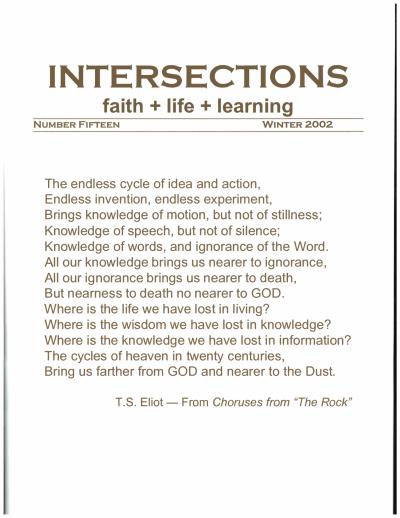
Christenson introduces an issue of varied voices—bishops and university presidents, philosophers and poets, students and their teachers—and defends the T. S. Eliot cover selection (“Where is the wisdom we have lost in knowledge?”) against the charge of being too depressing, arguing with cover artist Ida that Lutherans are realists about human accomplishments and that there is a huge difference between optimism and hope.
-
Article
The Marks of an ELCA College: One Bishop's Reflections
Stanley Olson
Olson, speaking as a bishop and “Harness Boy” whose job is to keep the church’s connections working, replaces his original four-noun outline (fealty, ingenuity, insouciance, focus) with eight marks the ELCA should be able to observe in its colleges: intentional Lutheran identity, significant Lutheran presence, Christian faith at every table, freedom of inquiry, coaching toward vocation, gravity and grace, nurtured community, and excellence by its own standards. Drawing on his survey of all twenty-eight ELCA college mission statements (two tables) and on Darrell Jodock and Mark Edwards, he argues that the Lutheran connection must be made explicit in mission, marketing, and faculty searches, and closes with six reciprocal expectations the colleges should hold of the ELCA—commissioner, mature parent, supporter of adventurous teenagers, advocate, steward of graduates, and a church faithful to its own Lutheran mission.
-
Article
Welcome Strangers
Gregg Muilenberg
Muilenberg, a non-Lutheran philosopher at Concordia, argues that self-consciously Lutheran colleges cannot make non-Lutheran faculty feel welcome through “institutional fit” rhetoric (he cites Concordia’s own hiring boilerplate) because identity must be sustained and developed, not preserved like a pickle. Drawing on Nikos Kazantzakis’s Report to Greco and the three marks of the “profoundly religious person”—commitment to the truth, to the power of the spirit, and to metousiosis through myth—he proposes that faith and reason are best understood as an unending struggle into which strangers must be invited as valuable and active participants, safeguarded by the strongest possible affirmation of academic freedom (citing Martha Nussbaum on Notre Dame and BYU).
-
Poem
Drunks in a Midnight Choir
Kevin Griffith
A pantoum-like Christmas-season poem in which red-robed choristers, flasks clinking and hands trembling, mangle the words of carols beneath “the midnight sky, your endless dark coat,” trusting that “it’s the season to forgive what’s vile” and that even wise men praise the humble and make glad.
-
Poem
The Etiology of Eschatology
Kevin Griffith
A wry meditation on end-times and beginnings in which the last trumpet is only a prelude to the longest dawn, newly handmade animals grow fat waiting for caretakers to name them, dark-robed cryptologists fret over the end of everything, and once everyone has solved the great conundrum the big man simply hits rewind.
-
Article
Honesty of Mind: On the Uses and Abuses of Socratic Ignorance in Environmental Studies, Religion, and the Classroom
Don Braxton
Braxton, taking his cue from David James Duncan’s defense of ignorance as a fly-fisher’s most crucial tool and from Socrates’ midwife’s art in the Theaetetus, defends a doctrine of “honesty of mind” resting on four premises—knowledge is constructed, judgments are wagered amid imperfect knowledge, expertise can disable learning, and we are encumbered by other ways of knowing. He field-tests the disposition against three domains: the climate-change and creationism debates in environmental studies, the post-September 11 turn toward religious pluralism (engaging Union Seminary’s Joseph Hough and Hauer and Young’s “three-world” approach to the Bible), and the liberal arts classroom where students “become democrats of the mind” through Reinhold Niebuhr’s balance of conviction and contrition.
-
Book Review
Paul Dovre, ed.: The Future of Religious Colleges
Baird Tipson
Tipson, president of Wittenberg University, reviews Paul Dovre’s edited proceedings of the October 2000 Harvard Conference on the Future of Religious Colleges (Eerdmans, 2002), summarizing essays by Douglas Sloan on the failure of the “two-realm theory of truth,” George Marsden on faith-shaped scholarship, DeAne Lagerquist, Father David O’Connell, Mark Noll, Robert Benne, Mark Roche on Notre Dame, Joel Carpenter on neo-Calvinist Kuyperianism, and Mark Schwehn on a Lutheran “college-related church” and the centrality of vocation. Against Benne’s suggestion that only two or three robustly Lutheran colleges can be sustained, Tipson defends a less robust but still authentically Lutheran model embodied at places like Wittenberg, Gettysburg, and Roanoke, arguing for the enlightenment commitment to subjecting all truth claims to rigorous criticism and for hiring Marsden-style faith-shaped scholars rather than counting Lutheran heads.
-
 Article
Distinctive Lutheran Contributions to the Conversation about Vocation
Kathryn A. Kleinhans
No. 43 · Spring 2016
Kleinhans surveys the recent resurgence of vocation talk in American higher education — from Frederick Buechner’s widely quoted definition to Lilly Endowment’s PTEV grants and the CIC’s NetVUE Scholarly Resources Project — and uses her chapter in At This Time and In This Place: Vocation and Higher Education to highlight distinctively Lutheran emphases: vocation grounded in creation rather than redemption, the given-ness of multiple simultaneous callings, and a frank acknowledgment of the constraints and “dark side” of vocation.
-
 Response
Tat for Teat: Ratke Responds
David Ratke
No. 9 · Summer 2000
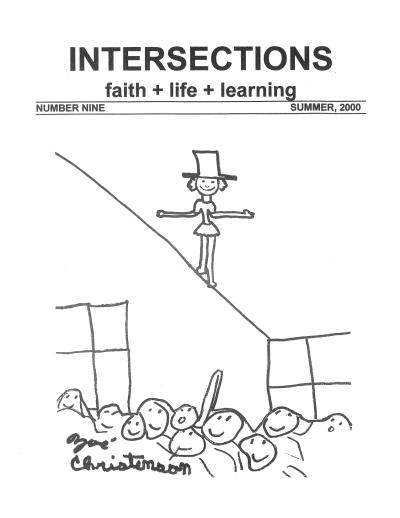
Ratke, agreeing with much of VonDohlen’s critique but contending that VonDohlen misreads both Luther and the two-realms doctrine, marshals Luther’s To the Christian Nobility, On the Freedom of a Christian, Temporal Authority, Whether Soldiers Too Can Be Saved, and the “Sermon on Keeping Children in School,” along with Walther von Loewenich, to argue that Luther was well aware of structurally differentiated society, made no claim to a monistic epistemology, and intended the two-realms doctrine to combat—not introduce—dualistic bifurcation between sacred and secular. Our identity is “not as either Christian or academic, but as Christian and scholar.”
-
 Reflection
On Sharing the Sacred Sauna
Rosemary Radford Ruether
No. 30 · Fall 2009
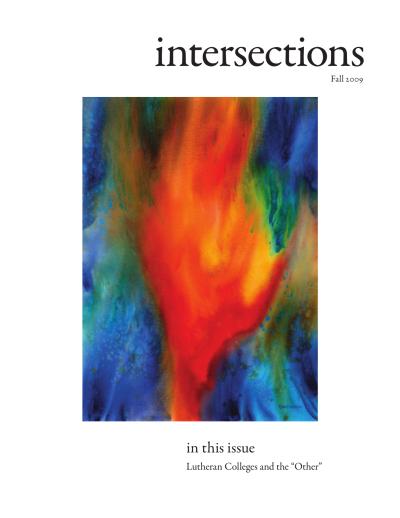
Reprinted from the National Catholic Reporter (August 1968), Ruether’s reflection from her time as a theologian on the faculty of Holden Village describes Lutheran community life in the mountains of northern Washington from a Catholic perspective — finding more catholicity in this Lutheran retreat than in many Roman Catholic communities — and culminates in a celebration of the Holden sauna as “the new sacrament, the new fellowship, the new theology.”
-
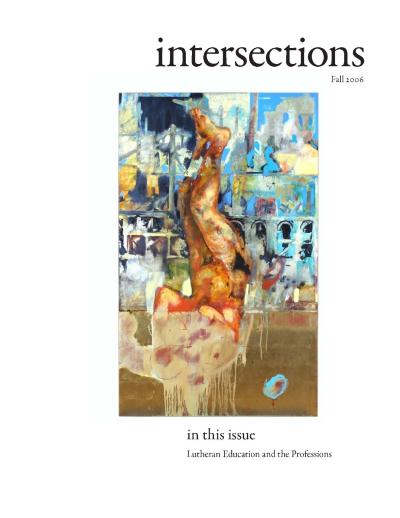 Editorial
From the Publisher
Arne Selbyg
No. 24 · Fall 2006
Selbyg situates this issue in the ongoing ELCA conversation about education that began with the 2005 conference and is feeding into the second draft of the ELCA Social Statement on Education, previews the 2007 conference (“The Vocation of a Lutheran College — Engaging the World”) at Augustana College, Rock Island, and lifts up Luther’s insistence that the church and its members contribute to their wider communities rather than retreat into self-centered enclaves.
-
 Article
Reflections on Our Shared Commitments
Mark S. Hanson
No. 25 · Spring 2007
Originally delivered to the Lutheran Educational Conference of North America in March 2007, Hanson’s address describes the ELCA as “an ecology of interdependent ecosystems” and locates the church’s relationship to its twenty-eight colleges and universities in a shared mission rather than in older anxieties about church-relatedness. Drawing on Wittenberg’s Lutheran Identity Study, Augustana’s “Five Faith Commitments,” Pamela Jolicoeur’s Concordia address, W. Robert Connor on “big questions,” Joseph Sittler on grace, Walter Brueggemann on fear, Jonathan Strandjord on being “other-wise,” and Cynthia Moe-Lobeda’s Public Church for the Life of the World, he names four marks of shared mission: communities of free inquiry, encouragement of religious expression in a diverse society, education for the common good, and the formation of leaders for church and religious communities worldwide.
-
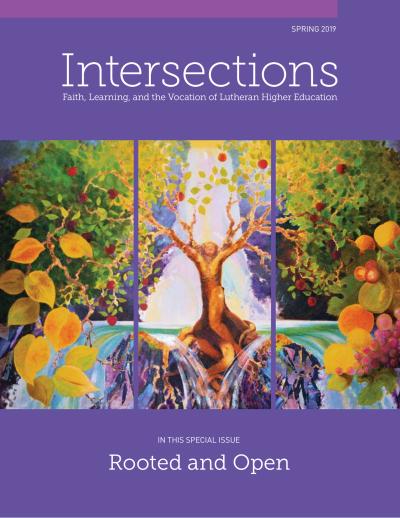 Institutional Focus
About the Cover and Artist
No. 49 · Spring 2019
Kristen Gilje, a Bellingham, Washington artist who spent nine years as Artist in Residence at Holden Village, recounts the “Tree of Life” she painted for the Holden Village 1999 summer theme and the unexpected interpretation Lapidary Fred offered of Yggdrasol, Prometheus, the Druid Tree Spirit, and the crucifix all at once.