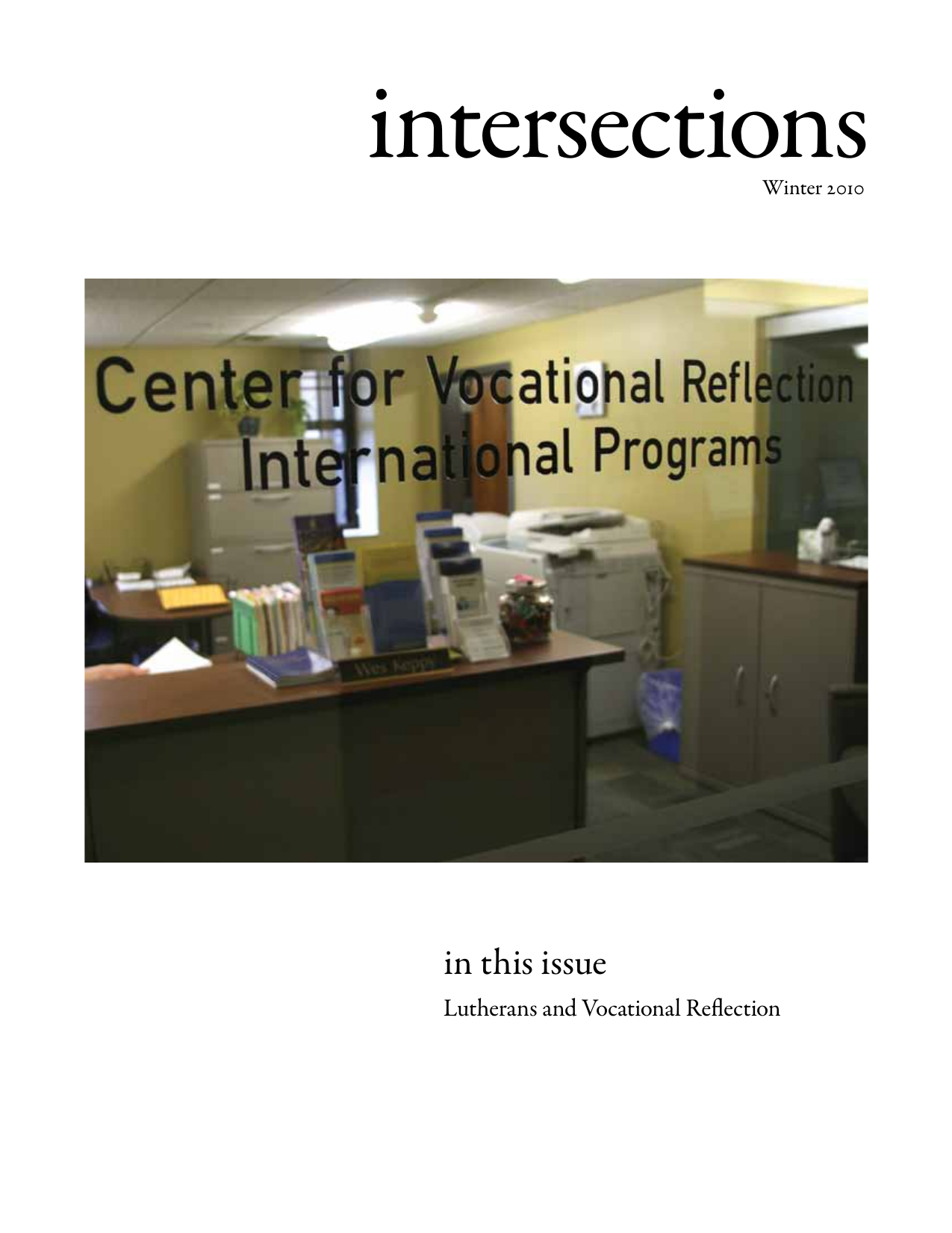
Lutherans and Vocational Reflection
The Winter 2010 issue gathers reports from the “Called for Life” study, in which Luther, Augsburg, and Augustana assessed their Lilly Endowment-funded vocational programs. Richard L. Torgerson introduces the project; Wilder Research’s Greg Owen, Ellen Shelton, and Brian Pittman compare “Lilly” to “pre-Lilly” graduates; Mark D. Tranvik narrates Augsburg’s journey from Exploring Our Gifts to its new Center for Faith and Learning; Ruth R. Kath describes Luther’s Sense of Vocation program; Robert D. Haak chronicles Augustana’s Center for Vocational Reflection.
Editors
Articles in this Issue
-
 Editorial
From the Publisher
Mark Wilhelm
Wilhelm traces his decades-long enthusiasm for the Lutheran doctrine of vocation from his St. Olaf days reading Luther’s Open Letter to the German Nobility, notes Parker Palmer’s lecture-circuit ministry and Mark C. Taylor’s reflections on calling, and argues that ELCA colleges should claim vocation as the defining mark of Lutheran higher education—yet warns that vocation risks becoming “the program du jour” rather than a permanent hallmark.
-
Article
Called for Life — Affirming Vocational Discernment
Richard L. Torgerson
Torgerson introduces the “Called for Life” project, a three-year, $278,437 Lilly Endowment-funded collaboration among Luther, Augsburg, and Augustana that—in partnership with Luther Seminary’s Centered Life initiative and Wilder Research—rigorously assessed the effectiveness of campus vocation programs, examining whether students’ exposure to and understanding of calling had increased, and what program elements were most effective in shaping discernment.
-
Article
Called for Life
Brian Pittman, Ellen Shelton, Greg Owen
Owen, Shelton, and Pittman of Wilder Research present the key findings of the Called for Life study, comparing the class of 2007 “Lilly graduates” from Luther, Augsburg, and Augustana to a pre-Lilly cohort from the class of 2001. They report that Lilly graduates were more than twice as likely to associate vocation with “calling” rather than “just a job,” and they identify four common ingredients of effective programming: relationships with caring adults, experiential learning outside the classroom, vocation-infused courses, and peer relationships within a pervasive campus culture of vocational exploration.
-
Article
A College with a Calling: Vocation at Augsburg
Mark D. Tranvik
Tranvik narrates Augsburg’s decade of deep engagement with vocation—from President William Frame’s 1997 visioning process and the 2002 two-million-dollar Lilly grant for Exploring Our Gifts, through five Lutheran theological principles (vocation includes the whole life, lives for the sake of others, ranks all callings equal, cannot be reduced to ethics, and engages public life), to the Wilder Foundation’s Called for Life assessment and the 2008 founding of the Augsburg Center for Faith and Learning under Dr. Tom Morgan and the Bernhard Christensen Chair held by Dr. David Tiede.
-
Article
Sense of Vocation
Ruth R. Kath
Kath describes Luther College’s Sense of Vocation program, organized into three components: General Program Initiatives (Vocation Visitors such as Parker Palmer, the Faith and Learning Workshop, self-directed reading grants, publications, and travel funds), the Church Ministry Program (Vocation Fellowships, the DIAKONOS discernment group, seminary visits, alumni discernment retreats, church leader workshops, clergy renewal, and the WIYLDE youth initiative), and the All-Student Vocation Program (Paideia I orientation, Peer Mentors, Capstone curriculum development grants, the Vocation Advising Workshop, and a Vocation Advising Handbook).
-
Article
Called to Serve
Robert D. Haak
Haak describes Augustana’s Center for Vocational Reflection (CVR) and its threefold framework of skills/gifts/talents, passions/values, and needs of the community. He surveys the CVR’s Working with Faith group, seminary visits, spiritual companioning, Servant Leader Internships, international travel reflection, and the major Senior Inquiry curriculum revision—then reports the lessons learned at Augustana: that multiple exposures matter more than any single program, that the language of vocation works even for non-religious students, that student-initiated ideas (like Erin Blecha’s Athletes Giving Back) often succeed most, and that the CVR will soon merge into a new Community Engagement Center.