Vocation and the Vocation of a Lutheran College (Cows, Colleges and Contentment)
Intersections No. 24 · Fall 2006
When I was in college, campus legend told of a welcome sign on the edge of town that proclaimed, “Northfield: Cows, Colleges and Contentment.” I confess that we students did not cite that slogan affirmatively. But it could provide a sub-title of my talk. To the submitted title, “Vocation and the Vocation of a Lutheran College” I now add, “Cows, Colleges and Contentment.”
My intent here can be loosely described as sketching a phenomenology. The Evangelical Lutheran Church in America (ELCA) proudly claims its twenty-eight colleges and universities and sometimes ignores them. I am interested in the phenomenon of a relatively healthy, broadly varied, and conspicuously persistent partnership between this denomination and your very independent institutions of learning. Why has this particular set of church/college partnerships worked rather well, in contrast to many other denominational attempts? And, speaking as the bureaucrat that I am, how can these partnerships be nurtured?
I think there are deep compatibilities at work across these partnerships, not only theoretical compatibilities but actual, functioning ones. There is a deep compatibility between lived Lutheran understandings and the mission of a liberal arts college, indeed, between those Lutheran understandings and a university with its breadth of commitments. Why have these partnerships worked and how does the ELCA structure itself now to be a good partner? The answer to both questions, I argue, requires attention to one word, vocation. Vocation is a somewhat neglected unifying theological concept for Lutherans and, I contend, it is a useful unifying concept for a college or university.
The phenomenon I will discuss is the widespread sense of vocation among the people in this church and elsewhere. I suggest that this sense has created and still creates fertile soil for the nurture of colleges and universities. It not only nurtures the liberal arts but can also nurture more technical professional education that may see itself in healthy tension with the liberal arts.
My plan:
- I will present two family stories to illustrate the phenomenon I am calling the fertile soil of sensed vocation in the church;
- I will describe vocation as understood by Martin Luther, from whom I have learned a lover’s quarrel with the institutional church;
- I will outline a three-phrase theological catechism on vocation and its implications.
Vocation Stories and Language
First, the stories: One is about my dad when he was a young man. The second is about my mother, when she and dad were in their last years.
At Augustana College, Sioux Falls, SD, Dad’s advisor was Professor Stanley Olsen. In Dad’s senior year, he made an appointment to talk with Dr. Olsen about plans to go to seminary. In the course of that conversation, Prof. Olsen sensed Dad had some hesitations and asked, “What do you really want to do?” Dad replied, “I’d like to go home and farm with my dad.” And the good professor said, “God needs Christian farmers too.”
God needs Christian farmers too. What did he mean? I think I can explain by telling you what happened. Dad did return to Iowa and joined his father in operating the family dairy farm—remember, “Cows, Colleges and Contentment.” Dad was a very good farmer, proficient and efficient, honoring traditions and always learning, a regular at seminars and night classes, talking things through with the group of neighbors who helped each other. Dad prospered, and he practiced stewardship of the land and all the resources it took to farm it. Pineview Farm milk and cheese were safe and nutritious. Dad was respected as a farmer and as a community member. He served on the board of the regional farmers’ co-operatives, the county fair board, and the board of Waldorf College. He led a 4-H club and coached softball. He and my mother were school boosters, band boosters, community boosters, and were politically engaged. They were deeply involved in their congregation. He was a fine husband and a great dad. What’s a Christian farmer? It is a farmer who farms well and wisely, for the good of others and who fulfills his or her other life roles such as citizen, spouse, community leader, and parent.
“God needs Christian farmers too.”
Late in his life, Dad developed Parkinson’s disease, and that occasions the second story. My mother had been a school teacher. In many ways she was the family scholar and theologian. She taught Sunday school, Bible school, the Bethel Bible Study and even cake decorating. She was president of the Lutheran women’s organization for Iowa. Closer to home she could be counted on to take a meal to a family in need and to get an elderly person to a medical appointment. Mother was always ready to teach and always ready to help.
With Dad’s Parkinson’s came physical limitations for him and, eventually, severe dementia. He could not be left alone. Mother’s community work and teaching grew less and less. Several times in those years Mother talked with me about the changes. She struggled with the fact that she couldn’t keep up her service in church and community. She felt she was neglecting those who needed her, not doing what she was supposed to do. I tried to be supportive and encouraging, but I didn’t give her the key. She found it on her own. There came a visit when Mother told me that she was at peace. “I have realized,” she said, “that this is my calling now, caring for your dad. This is the main thing God is asking of me at this point in my life.” Mother found comfort and peace in the idea of callings that change with circumstances. This old language of the church helped her greatly at a critical point in life.
Two people liberally educated in Lutheran colleges: One found his calling with cows and corn, the other found hers in teaching and service, both found callings in marriage and parenting, in church and community. Both found contentment, a sense of doing what they ought to be doing—cows, community, colleges, and contentment. Except for that one late conversation with my mother, I don’t remember either Mother or Dad using the language of vocation, but I see now that they lived with a clear and satisfying sense of calling. I probably did not learn the vocabulary until I was in college or seminary, but I was nurtured in the understanding, the orientation. Vocation was the way my parents saw the world, the way they saw the Christian life. That sense, I think, was there for them from their Lutheran parents. It made their Lutheran colleges comfortable places to be stretched. Their Lutheran college educations under girded what was already there and the interplay continued throughout their lives.
The sense of vocation is a prevalent phenomenon in the world. However, the sense is much more broadly understood than the term is used. In other words, this sense may be very deeply felt, but left unarticulated. This sense is certainly not limited to Lutherans, nor to Christians, but I argue that it is strongly present in those nurtured in Lutheran soil. And, I am convinced that the presence of a sense of vocation is good news for our colleges and universities and for a church that values them. I think this phenomenon should shape the tasks ahead for the schools and for the ELCA. It certainly shapes what I am trying to do in my bureaucratic job.
I began with stories about individuals, but this sense of calling may also be expressed by groups and institutions. There can be a collective sense of calling. Consider the groups and institutions I mentioned incidentally in telling my parents’ stories—4H club, congregation, farming neighbors, farmers cooperative, Waldorf College board, Augustana faculty, and American Lutheran Church Women of Iowa. Each group had a shared awareness of being called.
Luther and Ourselves on Vocation
The sense of calling is out there. It thrives because it helps people integrate their lives. My prior work was as a bishop of the ELCA. That job included many hours sitting with congregations searching for pastors. I always asked what they wanted in a pastor and always knew one of the answers I would get. “We want a pastor who can help us connect faith with our daily lives.” People are part of churches because they believe, or at least want to believe, that the many parts of their lives are deeply connected. They may not use the language of vocation, but vocation is a metaphor that allows people to connect faith and all aspects of life. People assume that there should be wholeness to life. Integrity is expected. These ideas work for integrated daily living. A person has multiple callings. People have diverse callings.
“…vocation is a metaphor that allows people to connect faith and all aspects of life.”
We don’t fully live out that sense of calling, of course, but notice how people honor vocation even in the breach. Failings are often acknowledged in terms of callings—I’m not as good a dad as I should be. I’m not as good a citizen as one ought to be. I haven’t been a good member. I wasn’t a good student my first years. Similarly, noting flaws in others, we use categories of vocational failure: She’s not a good boss. My parents let me down. He’s pursuing his own interests as a politician, not the community good. And so on. We think in terms of callings.
In the world, I see the awareness of callings provides a seedbed for enthusiasm about our colleges and universities, especially in the church world, and certainly in the Lutheran world where I spend most of my time. It can be cultivated.
Martin Luther reclaimed the ancient idea of Christian vocation.1 In explaining it he used the word Stand, which could be translated “office” or “place.” Luther thought of our life roles as the places or offices in which we have opportunity and responsibility to serve others. Living as Christians is not about obeying a list of rules. It is about discovering and exploring a set of roles to be lived by God’s Spirit.
Luther wrote that a mother or father (and he did include “father”) changing a child’s diaper is doing holy work, fulfilling a Christian calling as a parent. Another time, with another earthy image, Luther said a farmer spreading manure on his field is exercising a godly calling (cows, colleges and contentment?). Luther asked himself, “What does God require of a Christian carpenter?” And, he answered that God expects that the Christian carpenter will make good tables.
I told you that Luther had reclaimed the Christian idea of vocation. There was an edge to his argument. By the Middle Ages, the language of calling was being used much too exclusively for religious roles—priest, monk, nun. Even worse, it was being taught by some that those roles were more holy than any other roles in life. Luther rebelled against such nonsense. That’s likely why he used stories of such common tasks as diaper changing and carpentry. Those roles, Luther insisted, are every bit as holy, every bit as God-pleasing as the roles of clergy and other church workers. “How can it be that you are not called….!” Luther explained that you don’t have to leave your work or give up marriage and family and enter a monastery to live a God-pleasing life. You are called, Luther said, where you are, in the places you occupy and those you may occupy, and there you respond to opportunity and need.
You will have concluded by now that I think this sense of vocation provides a hopeful future for our college/church partnerships. However, I am well aware that there are problems and contrary indications. If Luther dropped in today for a tour of church life in the ELCA, I am sure he would start preaching and teaching about vocation again, loudly. Though Luther’s insight persists in many practical ways, the language of the church often works directly against Luther’s reclamation of the doctrine. We often sound like the medieval church. I can illustrate the persisting problem with a story: On a late August Sunday I was visiting a congregation. The pastor made an announcement that is made all over the church in late August, “We need two more Sunday school teachers—third grade and eighth grade. If you can help, please contact a member of the education committee. Please think about this. We need good teachers.” So far, so good—the pastor affirmed the calling to teach, but then he slipped over the edge into heresy by carelessly adding. “Teaching Sunday School is probably the most important thing you can do as a Christian.” Oops. Church work is important, but it is not more holy than being a parent, neighbor, nurse, executive, professor, secretary or citizen.
Lutheran colleges and universities stand robustly against the tendency to narrow vocation talk to church occupations or to any other limited group of life roles. Decade after decade, your schools by virtue of their existence and work are strong testimony to the worth of all vocations.
Let me exemplify what I mean about the testimony function of Lutheran colleges and universities by noting how Martin Luther’s described callings in four arenas.
- Family and friends – This is the smallest circle of vocation, the intimate one. Human roles here vary, and one’s roles vary over the years, but in this arena we have some of our most persistent callings—in our places as grandparent, sibling, parent, child, and friend. Your residential colleges work these arenas of vocation. You pay explicit attention to what is expected of a friend, a roommate, a parent, a son or daughter.
- Community – Think of the local community but also the region, the nation, the globe. Luther’s world was smaller than ours, but his concept adapts even as we think of ourselves as citizens of the universe and of a neighborhood. Your schools pay explicit attention also to these callings—what does it mean to be part of the student body, a faculty? What’s in the student handbook, the faculty handbook? Do you send students abroad for cross-cultural study? Do you require learning a second language? These all have to do with community callings.
- Work – We live God’s call as employee, employer, self-employed, co-worker, volunteer, retired person, part-time worker. The role of student fits here—it is one’s work in the first decades of life and beyond. You help students learn what it means to be a good student—it is a role that implies outcomes, care, impact from others and on others. Work habits are taught and learned. All this is about callings, yours and theirs. Studies show us that students at ELCA colleges think more and more that college is primarily preparation to succeed in a good job. I say, “Fine.” Give them the skills but also seize your opportunity to shape their definition of what would make a job good and what it means to succeed. And here we might mention that faculty handbook again. Do the criteria for the role and for tenure and promotion take seriously the fertile soil of vocation?
- Institutional church – We must add “institutional” to ”church” because Lutherans argue that all four arenas are part of what it means to be the church, gathered and scattered—but that’s another talk. There are particular callings in the institutional church. At founding and often still, most of your colleges named the preparation of pastors as an explicit part of the mission. The ELCA still receives a plurality of its pastors and rostered lay leaders from ELCA colleges. (Interestingly, some of the schools with the lowest percentage of Lutheran students are sending the highest percentage of those into ordained Lutheran ministry.) And, of course, your students learn to think, to lead, to know something about religion and Lutheranism, to have a chance to help in chapel and do service learning. All those prepare people who have other primary work to also take roles in the institutional church whether as employees or as servant leaders in those communities.
By making the church just one category out of four, Luther set up a conceptual defense against the narrow understanding of vocation. I am convinced that the existence and work of ELCA colleges has a parallel, salutary function. Your work is broad in preparing people for vocations. You work the waterfront. That breadth provides a bulwark against narrowing the idea of vocation to a few jobs in church institutions. It provides an impetus to acknowledge callings in all aspects of life. In nurturing people for their vocations, the schools of this church and the theology of this church are assets for one another. I think Martin Luther would thank God if he knew about the work of your universities and colleges.
My main argument is that the soil tended by this church is fertile for the work you are called to do. There are prospective students and parents and teachers and counselors out there who will resonate with your mission because of they already have good Lutheran instincts about vocation. I think this is also why you find many of your generous donors—people of substantial means also have sensed their own callings and can appreciate how these universities and colleges value and enhance diverse vocations. In students, parents, donors and allies, the sense and appreciation may only be latent. It will take good recruiting, pedagogy and, dare I say it, marketing—but I am deeply hopeful. People out there are instinctively ready to affirm this understanding of higher education.
The Vocation & Education Small Catechism
The Evangelical Lutheran Church in America relates nationally to its affiliated colleges and universities through a unit called Vocation and Education. Leading that unit is my current job—one of my callings. Our unit’s responsibilities include not only this church’s links to your schools, but also to seminaries, campus ministries, youth and young adult work, schools and early childhood centers, outdoor ministries and camps, lifelong learning programs, preparation and certification of those preparing to be pastors and other church leaders, attention to healthy boundaries, multicultural leadership development, and more.
I will conclude by telling you about what I call the “Vocation and Education Small Catechism.” This three line catechism is meant to summarize the theological convictions that unite our diverse responsibilities as a churchwide unit. Sharing this catechism is also a way to tell you the foundation from which I hope to help nurture the great partnerships among 28 universities and colleges and the ELCA. This is a simple theological statement of what lies behind the phenomenon of a widespread sense of vocation.
Because of Christ, the world
Because of the world, vocation
Because of vocation, education
I am using Christian language here because I’m talking about the phenomenon of these particular church and college partnerships. However, I am convinced that those three truths have ready counterparts in the public language of values. More on that in a moment.
Because of Christ, the world
I am a member of St. Luke’s Lutheran Church in Park Ridge, Illinois. It’s a great congregation with a fine old building—hammer-beam ceiling, wide nave, lovely stained glass, and three murals on one side. One of those paintings shows Jesus with hands open and stretched forward toward a representation of the globe. Below are images of people of all ages and of the city. I’m sure the artist meant to show Jesus blessing the world and that would illustrate my point, but to me Jesus’ posture always seems to be an expression of wonder. Wow! Look at that amazing world! Wonder and curiosity are Christian virtues. The world is properly the object of sustained attention. This is a public claim, not only a religious one. The world as it is should stimulate human attentiveness and awareness.
The necessity of attending to the world is a public claim, though we habitually use religious language to state it. Let me give you a Trinitarian reminder of that language:
- The first article of the Apostles’ Creed begins, “I believe in God the Father almighty, creator of heaven and earth….” Right there, in that every-Sunday language is the message that God is a God of all—the whole world is God’s concern—and, hence, ours.
- Our Lord Jesus Christ – What was the first Bible verse most Christian kids memorized years ago? Probably, John 3:16, “For God so loved the world, that he sent his only Son….” If you continue through the Gospel of John, you’ll find many more of these images, “If I am lifted up, I will draw all people to me,” “The whole world has gone out to him,” etc.
- The Spirit – One of Christianity’s three great festivals is Pentecost. The prime Pentecost text, Acts 2, describes a scene in Jerusalem. A crowd from the whole inhabited world heard the message of Christ spoken in their own languages because God’s spirit was working. Babel’s dispersion was symbolically reversed and the world was drawn together again.
- We could go on to the world–affirming language of prophets admonishing kings, of poetry celebrating life and nature, of the doctrines of incarnation, resurrection, justification, sanctification.
The habitual practices of the church also push world awareness. We don’t always get it right, but the push is there—in the biblical texts read aloud, the public prayers, the songs (and even more so with global music entering our hymnbooks), in sermons, and in the causes for which we take offerings and the topics offered at Sunday forums. For more than a century, Lutherans have seen it as their mission to help developing countries with medical, educational and agricultural needs. Last year ELCA Lutherans donated some $80 million for disaster relief and another $17 million to alleviate hunger around the world. Thirty-seven thousand ELCA youth and adults went to San Antonio this summer, to a gathering held close to the US/Mexican border to facilitate conversation about crossing boundaries in the name of Christ.
“Because of Christ, the world—that reality is fertile soil for you. The whole world is our concern. No question is out of bounds. No question is out of bounds, but there are convictions, assumptions. Let’s go on with the catechism.
Because of the world, vocation
No question is out of bounds, but we assume that the truth affects decisions. As Christians, we are not just observers of the world and commentators on its condition. We see the needs of the world and we sense the gifts we have to help meet those needs. Christians are called to respond to the world—it’s part of our identity. According to the gospel of Matthew, Jesus emphasizes this responsibility in a long parable that asks, “When did we see you hungry, naked, in prison…and minister to you.” Or, think of the parable of the Good Samaritan about being a neighbor and meeting needs. Think even of all the agricultural imagery in the Bible—planting, cultivating, harvesting.
When we look at the world wisely, each of us sees needs that we could help meet. This church believes the world calls out for our participation. Or, putting it more theologically, through the world God calls out the gifts in each of us. Where the world is ignorant, you may sense a call to teach. Where it is hungry, you may sense a call to work in a supermarket or restaurant or give generously. Where it is lonely, you may gather people in supportive community, or you may walk with your sibling or adopt an orphaned child.
Remember that vocations come with place, office. In German, it’s Stand. We each have many standing places, many offices, and from each of them we will see realities in the world—things that shape our callings. The office of parent is an obvious example: step into that world, and from the beginning of pregnancy right on through your life, you are a parent, and there are callings for you to fulfill. When a young person sees a need in the world and senses gifts, it may lead to a lifetime of satisfying work. I think that’s what happened with my dad. I think it’s happening at your schools all the time. Collectively, we see this call and varied responses in the institutions of Lutheran Services in America. Together, they are the largest social service agency in the county—and you help prepare social workers, counselors, administrators and others for that vocational group.
“…through the world God calls out the gifts in each of us.”
This idea of the world’s call is a Lutheran one, but certainly not ours alone. For example, Martin Buber wrote of those “who have heard this stunning world calling them by name, and who have paused to cock an ear, straining to catch what will come next.” (Wallace 2006)
Lutherans contend that God calls people (and groups and institutions) through the world in all its aspects. People are called not to what they cannot do, but to what they can do. Or, I should say, the world calls us to what we could do, what we could do if we had the necessary knowledge and skills. And that brings me to the third line of the catechism.
Because of vocation, education
Here’s where I’ve been driving. I do not have to explain to college teachers and administrators that education must follow awareness of call. You have PhD’s and MBA’s and MFA’s and more. Why? Because you love learning, of course, but wasn’t your education sought fundamentally to enable you to follow your vocations? My college mentor, Erling Jorstad at St. Olaf, tells about seeing a poster for Danforth graduate fellowships. He says, “the line that grabbed hold of me was something like this, ‘they see in college teaching their expression of religious vocation.’” (personal correspondence)
Why do schools exist? Surely it’s because we appreciate that we must be prepared to fulfill our life roles. That was Martin Luther’s argument in favor of education for all. And, note the converse. Historically, education was rejected or neglected for some elements of society because it was seen as unnecessary to their life roles as defined by prejudice. Even in sin we affirm the principle.
Lutherans weren’t the only religious people who sensed this need for education, but Lutherans did and do. That’s why we Lutherans have so many colleges and schools and why many Lutherans have become public school teachers, leaders and advocates. Martin Luther insisted that communities ought to attend to education. Of course Lutherans taught Bible and doctrine. Sunday school and confirmation instruction are definitional of a Lutheran childhood. Several of our colleges were founded with a strong awareness of the need to prepare pastors. But, from the beginning, almost always there was another piece—the recognition of the need for Christians to contribute to society and, hence, the need to educate teachers, nurses, citizens. For example, President Paul Formo told me that Bethany College in Lindsborg was founded not just as a liberal arts school but as a school for community skills. It had a music conservatory, a business school, courses in agriculture, and courses for future pastors.
From the church’s side of this partnership, there is the necessity of theological learning related to all four arenas. As a matter of identity, Lutherans assume one not only learns the knowledge and skills for one’s various roles, one also needs to explore the Christian faith from and for each of those roles. We need understandings of God sufficient to each particular calling. What richness is there in the Christian tradition to help a soldier wrestle with her challenges or a nurse with his? How does the ancient faith embrace the wonders explored by scientists and astronauts, by lovers and artists, and parents?
The ELCA is currently working on a social statement on education with the title, Our Calling in Education. I quote from the first paragraph of the introduction of the first draft, “Our calling in the Church is to educate in the Christian faith for vocation and in society to strive with others so that all have equitable access to a high quality education that nurtures personal growth and serves the common good.” (Wallace B2) With the world’s call comes the need to learn. I hope you will take a look at that social statement. A second draft will be a available on line late in 2006 (Task Force 3). We expect a final version to be adopted at our biennial assembly in August 2007. Before adoption, comment is welcome and discussion is invited before and after.
Because of vocation, we educate, in all four arenas named by Luther—family and home, community, work, institutional church. Lutheran colleges and universities consistently respond to the need for education for all those arenas. Again, for the third time in this catechetical lesson I say, there is fertile ground here for the vocation of a college or university and for the vocation of a church with universities and colleges.
Because of Christ, the world
Because of the world, vocation
Because of vocation, education
A final reiteration—this little catechism begins with explicit religious language, “Because of Christ, the world….” However, Lutherans believe that these understandings can and should be argued in the public arena, in values language that need not have religious warrants. We think that the element of faith and a divine caller adds something of great value to this vision, but we also think this catechism describes the way the world is, and we believe that what is should be recognized and taken into consideration. A public-square version of the catechism might sound like this,
Appropriate attention brings world awareness
World awareness brings the world’s call
The world’s call brings desire and need for learning
So I am back to where I started, on the outskirts of Northfield, Minnesota, “cows, colleges, and contentment”—vocation, education and a sense of rightness. There is fertile ground for the ELCA and for the twenty-eight universities and colleges that are continually exploring what it means to have a connection to the ELCA. In the widespread sense of vocation, latent and articulate, there is fruitful potential for us separately and in partnership to do our challenging work with joy and satisfaction. Cows, colleges, and contentment. We are about vocation and education for the sake of the world.
Endnote
1. There are several good studies of Luther’s views on vocation. The classic is Wingren 1999. An excellent and accessible introduction is Kleinhans 2005.
Works Cited
Kleinhans, Kathryn. “The Work of a Christian: Vocation in Lutheran Perspective.” Word & World 25.4 (2005): 394-402. Available on line at www.luthersem.edu/word&world/Archives/25-4_Work-Witness/25-4_Kleinhans.pdf
Task Force on Education. Evangelical Lutheran Church in America. “Our Calling in Education: A First Draft of a Social Statement.” http://www.elca.org/socialstatements/education/CallingInEd.pdf
Wallace, Allison. A Keeper of Bees: Notes on Hive and Home. New York: Random House, 2006. Excerpted in The Chronicle Review: The Chronicle of Higher Education, July 28, 2006, B2
Wingren, Gustaf. Luther on Vocation. Trans. Carl C. Rasmussen. Evansville: Ballast Press, 1999.
-
 Editorial
From the Publisher
Arne Selbyg
Selbyg situates this issue in the ongoing ELCA conversation about education that began with the 2005 conference and is feeding into the second draft of the ELCA Social Statement on Education, previews the 2007 conference (“The Vocation of a Lutheran College — Engaging the World”) at Augustana College, Rock Island, and lifts up Luther’s insistence that the church and its members contribute to their wider communities rather than retreat into self-centered enclaves.
-
Editorial
From the Editor
Robert D. Haak
Haak introduces the issue’s essays by Stanley N. Olson, Kathryn L. Johnson, Gail Summer, Lake Lambert, and Steven C. Bahls; argues that on Lutheran campuses, professional programs in business, education, and nursing are not “second-class citizens” but integral to the institution’s vocation; cites Olson’s mantra (“Because of Christ, the world; because of the world, vocation; because of vocation, education”); and thanks Matt Marohl for assisting with the editing.
-
Article
Freedom of a Christian-College: Looking through the Lens of Vocation
Kathryn L. Johnson
Johnson, Paul Tudor Jones Professor of Church History at Louisville Presbyterian Theological Seminary, re-reads Luther’s 1520 treatise The Freedom of a Christian as a paradigm for the “freedom of a Christian college” amid the pressures of professional preparation. She traces Luther’s paradoxical claim that a Christian is “a perfectly free lord of all, subject to none” and at the same time “a perfectly dutiful servant of all, subject to all,” and argues that the same dialectic frees a Lutheran college to engage the professions without being captured by them.
-
Article
Professional Education/Liberal Arts Education: Not a Case of Either-Or but Both-And
Gail Summer
Summer, Dean of Academic Programs at Lenoir-Rhyne College, traces the historical interweaving of liberal arts and professional education in American higher education (using the rise of engineering as a case study) and argues that the standard “either-or” framing of liberal arts versus professional preparation misreads both. At Lutheran colleges, the “both-and” relationship is shaped by a Lutheran understanding of vocation in which professional programs are integral to, not in tension with, the liberal arts.
-
Article
The Divide Within (Not Between) Liberal Arts and Professional Education
Lake Lambert
Lambert, then Board of Regents Chair in Ethics at Wartburg College and Project Director for the “Discovering and Claiming our Callings Initiative,” argues that the real divide in higher education runs not between the liberal arts and the professions but within each — between teaching that forms students for callings and teaching that merely transmits content or credential. He calls Lutheran colleges to recover, across both liberal arts and professional disciplines, a shared commitment to vocational formation grounded in the Lutheran tradition.
-
Article
Liberal Arts and Professional Education: A Call for Philosopher-Servants
Steven C. Bahls
Bahls, President of Augustana College (Rock Island), calls for a renewed commitment at Lutheran colleges to form “philosopher-servants” — graduates whose grounding in the liberal arts and the liberating gospel equips them for thoughtful service in business, education, nursing, and the other professions. Their impact, he argues, is “a good thing and a fact that we can be proud of as those who labor in Lutheran higher education.”
-
 Article
Sexuality over the Lifespan—Social Trends Pose Moral Dilemmas for Communities of Faith
Adina Nack
No. 22 · Spring 2006
Nack, a sociologist who presented to the ELCA Task Force for Studies on Sexuality, surveys empirical research on three life-stages flagged by the Task Force as particularly contested—premarital sexuality among adolescents and young adults, sexuality after divorce and within single parenting, and sexuality in late adulthood. Drawing on the Alan Guttmacher Institute, the Office of the Surgeon General, AARP, National Council on the Aging, and the World Health Organization’s 2002 definition of sexual health, she closes each section with questions about the church’s role in education, blessing of committed nonmarital relationships, and dismantling stereotypes about aging and sexuality.
-
 Editorial
From the Publisher
Arne Selbyg
No. 13 · Winter 2002
Selbyg reports that Executive Director Leonard Schulze has challenged the ELCA Division for Higher Education and Schools to develop a comprehensive communications plan reaching high school students, college students, parents, pastors, and journalists, and invites Intersections readers to review the redesigned elcacolleges.org website, the “FREE STUFF” brochures, the journal’s advertisements in The Lutheran and related publications, Ernie Simmons’ new Augsburg-Fortress book Lutheran Higher Education: An Introduction, and the ELCA video magazine Mosaic—and to send in their own ideas.
-
 Editorial
From the Publisher
Arne Selbyg
No. 14 · Summer 2002
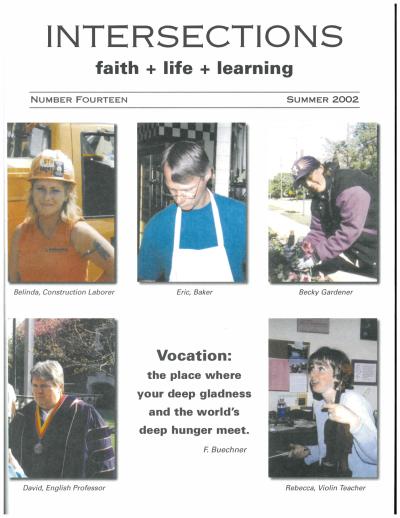
Writing on behalf of the publisher, Sue Edison-Swift names vocation as one of the precious gifts Lutheran theology offers education, reflects on her first ELCA Vocation of a Lutheran College conference, and asks readers to gift future issues of Intersections with feedback—notes on what they read and skipped, and how they ended up with a copy.
-
 Article
Hospitality to the Wild
Laura M. Hartman
No. 54 · Fall 2021
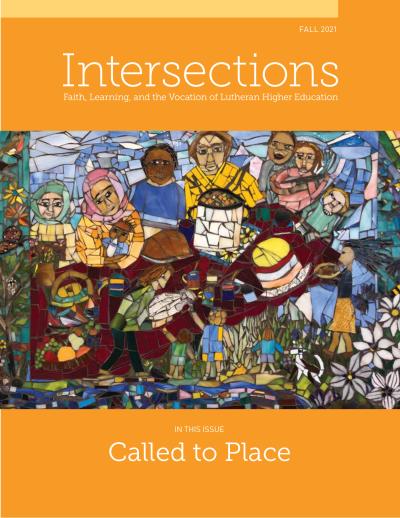
Drawing on research with a Wild Ones Native Landscaping chapter and Marilyn Matevia’s ethic of “creature comfort,” Hartman argues that Christian hospitality must extend to non-human animals and plants — and asks whether college campuses can foster not just human diversity but biodiversity.
-
 Institutional Focus
Facing Tornados and Climate Change: An Interview with Jim Dontje about Environmental Innovation at Gustavus
Jim Dontje
No. 36 · Fall 2012
Dontje, director of the Johnson Center for Environmental Innovation at Gustavus Adolphus College, describes the Center’s work with solar thermal and photovoltaic systems, LEED certification of Beck Hall, recycling and conservation initiatives, the Linnaeus Arboretum, and the difficult work of building consensus around climate response—reflecting on how Gustavus’s 1998 tornado recovery shaped a community capable of collective action, and on how the “Lutheran identity” both restrains and energizes the college’s environmental ethos.
-
 Editorial
From the Editor
Tom Christenson
No. 6 · Winter 1999
Christenson explains that three of the five papers from the 1998 Wittenberg Vocation of a Lutheran College conference appear here (with Robert Scholz and Cheryl Ney to follow in the next issue), passes on Andy Sheppard’s “Books for Belarus” appeal from Southwestern College, and reflects on Douglas John Hall’s The End of Christendom and the Future of Christianity—its claim that disengagement from cultural dominance is the prerequisite for faithful re-engagement, and its retrieval of Christ’s metaphors of “a little salt, a little yeast, a little light” as a possible session topic for a future VLC Conference.