Turning to a Reproductive Justice Framework for Inclusive Dialogue across Differences
Intersections No. 57 · Spring 2023
In the spring of 2022, I developed a special topics course on Reproductive Justice, which I offered as part of Pacific Lutheran University’s online summer curriculum in the momentous month of June. It was a prescient choice, as half-way through our month-long term our work together was dramatically punctuated by the June 24th Dobbs v. Jackson Supreme Court decision overturning the 1973 Roe v. Wade ruling that had shaped reproductive healthcare in the U.S. for half a century. The Dobbs decision catapulted our country into a frighteningly uneven legal terrain—a balkanized landscape where fifty states have now either banned, vastly limited, or in some exceptional cases expanded access to reproductive care. In many ways the 2022 decision set in relief the inherent vulnerabilities of a liberal rights-based legal framework for protecting people’s access to contraception, abortion and reproductive healthcare more broadly.
This article makes the case for the value of utilizing a reproductive justice framework, or RJ framework, for teaching reproductive rights in the post-Dobbs era. By expanding the conversation to attend to not only reproductive self-determination but also the social structures that shape equitable distribution of life chances for fertile and pregnant people, parents and children, the use of a reproductive justice framework gives us tools to overhaul current conversations about abortion. As Loretta Ross and Ricki Solinger write: “At the heart of reproductive justice is this claim: all fertile persons and persons who reproduce and become parents require a safe and dignified context for these most fundamental human experiences.”1 The reproductive justice framework helps us understand reproductive life as a global human right—thereby opening a path for dialogue across differences of race, sexuality, gender identity and faith.
Often when the topics of abortion and contraception arise, dialogue grinds to a halt, both in public forums and private interpersonal conversations. This is in many ways because our contemporary conversation is constrained by a political binary of pro-life vs. pro-choice, a false dichotomy that silences the experiences of indigenous communities and communities of color and defuses the radical potential of reproductive social movement. Andrea Smith’s 2005 article “Beyond Pro-Choice and Pro-Life: Women of Color and Reproductive Justice” articulates what is lost in the gaps of this dichotomy, stating “The pro-life versus pro-choice paradigm reifies and masks the structures of white supremacy and capitalism that undergird the reproductive choices that women make, and it also narrows the focus of our political goals to the question of criminalization of abortion.”2 Here, Smith illuminates how the rhetoric and tactics inherent to the pro-choice vs. pro-life debate dangerously obscure the real harm that white supremacy, capitalism and the criminal justice system enact on black, brown and indigenous families and birthing people.
Interestingly, Smith’s critique of this political dichotomy echoes the call for inclusive dialogue made in the ECLA’s 1991 Social Statement on Abortion. Incorporating a similar critique, albeit from a very different position, the Statement’s authors write, in the section “Talking about our Differences,” that “A developing life in the womb does not have an absolute right to be born, nor does a pregnant woman have an absolute right to terminate a pregnancy. The concern for both the life of the woman and the developing life in her womb expresses a common commitment to life. This requires that we move beyond the usual ‘pro-life’ versus ‘pro-choice’ language in discussing abortion.”3
While this passage ostensibly lays the groundwork for an argument against a woman’s right to choose, the authors also paradoxically gesture towards an expansive vision of “life,” including a consideration of what counts as a liveable life, and how life chances are inequitably distributed. The 1991 Social Statement goes on to take a position against abortion, with exceptions for maternal health, fetal abnormality and sexual assault; nevertheless, the attention to dialogue and diversity in its opening echoes the central tenets of reproductive justice. By tabling the polarizing conversation of discerning the moral standing of fetal life and development, about which many individuals have mixed personal and political beliefs, the work of cultivating dialogues across differences of faith might allow us to come together across political divides to imagine a world where our social institutions adequately support and demonstrate a high, rather than “low regard” for the lives of indigenous peoples, people of color, and LGBTQIA+ people.4
“The pedagogical landscape of interdisciplinary teaching on reproduction, pregnancy and parenthood has changed dramatically since 1991, and this is especially true for ELCA colleges.”
The pedagogical landscape of interdisciplinary teaching on reproduction, pregnancy and parenthood has changed dramatically since 1991, and this is especially true for ELCA colleges and universities like Pacific Lutheran that have witnessed an increasingly diverse student population in terms of race and ethnicity, gender identity, sexuality and religious affiliation. A turn to a capacious model for discussing reproductive politics better serves our transformed student bodies—opening up new avenues for learning, personal discernment and community engagement. As RJ activists have known for decades, a right to terminate a pregnancy is only one facet of a larger movement that fights for all humans to have the right of bodily autonomy and kin-making. Ross and Solinger define reproductive justice according to four major principles:
“(1) the right not to have a child; (2) the right to have a child; and (3) the right to parent children in safe and healthy environments. In addition, reproductive justice demands sexual autonomy and gender freedom for every human being.”5
In my decade-long experience teaching reproductive justice units in gender studies courses, which led to my development of a 2022 stand-alone course, I have found that students are often energized by Ross and Solinger’s model, connecting in particular with the second and third principles; many students have never considered the political contexts of people’s individual paths to pregnancy and parenthood, nor are they knowledgeable about the long history of our white supremacist institutions foreclosing the reproductive freedoms of women of color. When designing units on reproductive justice, I foreground this history, incorporating a range of disciplinary perspectives on the intersections of race, ethnicity, reproduction and parenthood.
In my 2022 special topics course, content on the history of racism and reproduction included an array of oral, written, video and web-based sources that bridged the academic textual conversation with the digital world in which our students are immersed. An important early lesson focused on the history of forced sterilization, where students read excerpts from Dorothy Roberts’ canonical study Killing the Black Body: Race, Reproduction and the Meaning of Liberty alongside Elena Gutiérrez’s research on the systemic forced sterilization of Mexican-American women in Los Angeles in the early 1970s. Gutiérrez illuminates the intersecting forms of oppression that led to an epidemic in involuntary surgical procedures, demonstrating how federal “anti-poverty” funds facilitated racist practices of prenatal and postpartum care at the Women’s Hospital of the Los Angeles County Medical Center.6 We drew connections between these historical accounts and recent reporting on systemic forced hysterectomies occurring in carceral spaces, including the 2020 documentary Belly of the Beast, which chronicles abuses within the California Corrections Department, and journalistic accounts of the wave of forced hysterectomies that migrant birthing people recently experienced while imprisoned in the Irwin County Detention Center in Ocilla, Georgia.7 This history illuminates the racialized terms of reproductive self-determination and the painful unfreedom experienced within communities of color—a history that reveals that the heteropatriarchal demand to protect the life of the unborn is also a project to sustain and increase white life.
As white evangelical Christian women are burdened by a cultural injunction to reproduce, as documented in recent writings by author Merritt Tierce,8 black maternal and infant death rates remain devastatingly high. Since the early 2000s, feminist and anti-racist research in the fields of public health, obstetrics and gynecology has demonstrated the persistent racial disparities in the quality of care available for black and brown birthing people, including statistical data showing increased rates of unnecessary cesarean sections and inadequate labor pain management for black birth patients in particular.9 Today, the black/white gaps in the mortality of birthing people and birthing outcomes remain dramatic, including maternal and infant losses that were most often preventable, even after decades of hard-fought advancements in medical care. Analyzing administrative data such as hospitalization records alongside income data in California, a recent January 2023 study published by the National Bureau of Economic Research found that black families are more likely to face infant loss in the first year of life than white families, regardless of income.10 These studies demonstrate that racism within reproductive healthcare is not a thing of the past, but rather an urgent contemporary reality that has moral and mortal consequences.
The transformative potential of a pedagogy rooted in the principles of reproductive justice resides not simply in the acquisition of knowledge from a multiplicity of sources, but also in the equitable application and dissemination of this knowledge to communities beyond the borders of higher education. In my course we designed a collaborative community-engaged final project that drew on an ethics of feminist praxis, an ethics grounded in respecting the evidence of experience that catalyzed the 1994 development of the RJ framework by 12 black feminists organizing at a Chicago pro-choice political conference, including MacArthur Fellow Loretta Ross. My students applied their learning to the development of a public-facing virtual map of reproductive and perinatal support resources for the Parkland, Washington community in which PLU resides. Parkland is an unincorporated suburb of Tacoma located in Pierce County, and statistically has a higher population of people of color than the county overall, as well as a higher rate of people living under the poverty line. Parkland also has a very diverse immigrant community with more than 40 languages spoken by students enrolled in the local public school system. After analyzing Parkland-specific census data alongside the county-by-county Maternal Vulnerability Index, students discovered that pregnant and birthing people as well as new parents were particularly at risk for postpartum mental health challenges, among other vulnerabilities. To address this, we worked together to identify and map community-based resources that would be both helpful and easily accessed via public transportation, such as the Parent Resilience Program, a culturally-matched peer-based mental health support network for new parents organized by Perinatal Support Washington.
My passion for teaching reproductive justice arises from my scholarly curiosity, my political commitments, and also my personal experiences as a white, queer gestational parent. My partner and I were privileged to have access to quality care and experienced relatively few obstacles to determining our own queer reproductive paths. We had the financial means necessary to pursue assisted reproductive technologies in order to conceive, as well as to purchase donor sperm. And yet my experiences during pregnancy, labor and the perinatal period were not free from hardship, as most birthing people can attest. I had an early “missed” miscarriage in the spring of 2018, which required me to jump through a number of emotional and logistical hoops to self-advocate for a medically managed miscarriage through the oral administration of misoprostol, a medication now limited in almost half of states for its role in medical abortions. Sixteen months later, after a lengthy and painful postpartum healing process caused in part by a challenging delivery, I had become radicalized to the ways that our reproductive, birthing and postpartum healthcare systems undoubtedly fail to support the health and well-being of birthing people.
As the cited history of racist forms of inequity in care attests, my white queer maternal difficulties with pregnancy loss and postpartum medical complications are small when set against the larger forms of medical discrimination, malpractice, and substandard care that families of color endure—a healthcare system that is wounding parents and children rather than embracing them in the loving care needed for this sacred time of transition. I tell this story to remind readers that researching, writing about and teaching reproductive rights arise from our intellectual curiosity, our political commitments, and also our rich and complicated personal experiences. To do ethical work in the field of reproductive justice we must therefore stay grounded in an awareness of our own positionality, as well as in the forms of embodied memory and various wounds that we may carry.
In building inclusive community, co-learners in the reproductive justice classroom can draw on the feminist, queer and anti-racist values that foster heart-centered conversations about politics, faith, identity and power. Some of the pedagogical principles I’ve drawn on include:
- The creation of a welcoming space for story-telling and the sharing of personal experience as well as culturally-specific knowledges. As Loretta Ross and Vickie Solinger write, “To embrace the vision of reproductive justice, one must embrace polyvocality—many voices telling their stories that together may be woven into a unified movement for human rights.”11
- Incorporating a discussion of bodily autonomy as a way to link contemporary calls for equitable access to quality reproductive healthcare nationwide with concurrent battles to protect gender-affirming care for all people, regardless of income or state of residence. As Ross and Solinger remind us, “sexual autonomy and gender freedom for every human being” are foundational human rights at the core of reproductive justice.
- The incorporation of a variety of examples, case studies and texts that show the true diversity of human reproduction and family, including those that center experiences of BIPOC and LGBTQIA+ persons and families.
- The use of gender-inclusive language including the terms “birthing people” and “pregnant people” in course material and discussions as a means to foster an inclusive learning environment for all students regardless of gender identity.
The reproductive justice framework is essential to a feminist and anti-racist undergraduate curriculum as it uniquely illustrates the ways that social systems shape individual experiences and intersecting structures of power mark bodies, intimate relationships, and families. As students and faculty, we must remain mindful of the reality of social differences shaping our reproductive lives. In doing so, we can foster the skill of being present to each other when entering into difficult dialogues across differences—bearing witness to the complexities and contradictions that shape our individual reproductive journeys.
Endnotes
1. Ross, Loretta and Rickie Solinger. Reproductive Justice: An Introduction. Berkeley, CA: University of California Press, 2017. 9.
2. Smith, Andrea. “Beyond Pro-Choice and Pro-Life: Women of Color and Reproductive Justice”
3. “A Social Statement on: Abortion”
4. “A Social Statement on: Abortion”
5. Ross and Solinger, 9.
6. Gutiérrez, Elena. Fertile Matters: The Politics of Mexican-Origin Women’s Reproduction. Austin, TX: University of Texas Press, 2008. 37.
7. https://msmagazine.com/2021/12/09/immigrants-ice-detention-center-georgia-irwin-women-reparations-sexual-violence/
8. https://www.nytimes.com/2021/12/02/magazine/abortion-parent-mother-child.html?action&%3B
9. Add citations
10. https://www2.census.gov/ces/wp/2022/CES-WP-22-55.pdf
11. Ross and Solinger, 59.
-
 Editorial
From the Publisher: Introduction and Invitation
Lamont Anthony Wells
Wells introduces himself as the new Executive Director of NECU, succeeding Rev. Dr. Mark Wilhelm, and frames this Spring issue as a passionate response to the crises facing higher education amid threats to academic freedom and the well-being of educators.
-
Editorial
From the Editor: Vocation [in] Disruption
Colleen Windham-Hughes
Windham-Hughes introduces the issue’s theme — vocation amidst disruption — previews new features including contributor contact information, a study guide for So That All May Flourish, and invited pieces on reproductive rights, and shares results from the Fall survey of readers.
-
Institutional Focus
So That All May Flourish Study Guide
A chapter-by-chapter study guide to So That All May Flourish (Fortress Press 2023), a new volume by NECU authors that develops the central tenet of “Rooted and Open” and offers discussion questions for use in orientation programs, classes, workshops, task forces, and professional development settings.
-
Reflection
“Miracles are no longer required”—Life Writing as a Healing Tool
Barbara Reul
A music historian and cancer survivor chronicles how a uterine cancer diagnosis in the early months of the COVID-19 pandemic disrupted her vocation as a university professor, and how writing two open-access memoirs became an unexpected tool for healing body, mind, and soul.
-
Article
The Power of Ritual Action and George Floyd Square
Mary Clare Tiede Hottinger
A California Lutheran University senior examines how George Floyd Square in Minneapolis has been transformed into sacred space through ritual action, and considers what this site of remembrance, mourning, and ongoing struggle for justice can teach us about the power of ritual to unify and sustain community.
-
Reflection
Be Like Jesus: Flip Some Tables
Jessica Easter
Easter argues that the example of Jesus overturning the moneychangers’ tables in Matthew 21 calls Christians not to work within unjust systems but to disrupt them — and that this table-flipping must be done in community with others who share the vision of a world where all are seen, heard, and valued.
-
Article
Necessary Disruptions: Centering Vocation in the Common Good
Erin VanLaningham
VanLaningham previews the forthcoming NetVUE volume Called Beyond Our Selves: Vocation and the Common Good, arguing that vocation, common, and good all need to be disrupted and expanded so that students might arrive at a wider sense of individual purpose and collective well-being.
-
Article
Where Disruption and Vocation Meet: One Path Toward Teaching Reproductive Justice in Challenging Times
Lena R. Hann
Hann recounts how a missed math class in her first college term led her into volunteer work at a feminist abortion clinic and ultimately a career in public health, and describes how she designed and taught a Reproductive Justice immersive term course at Augustana College through the disruptions of COVID-19, George Floyd’s murder, and the Dobbs decision.
-
Article
The Duty to Teach and Restore Bodily Autonomy: Reflections from the Classroom
Cynthia Richards
Richards reflects on a Narrative Medicine course she taught at Wittenberg University in the wake of the Dobbs decision, in which students examined cultural “first recognitions” of the reproductive body and discovered that almost none had ever had a way of talking openly about their reproductive selves — an alienation she calls educators to address.
-
Article
A Reconsideration of the Political Approach to Abortion
Sophia Cruz Ponce
Cruz Ponce argues that the pro-life versus pro-choice binary distracts from the underlying social factors that lead to unwanted pregnancies, and proposes a reframed political approach focused on mandated sex education, free contraception, and crisis pregnancy centers that address the social, political, and economic barriers women face.
-
Article
Take Heart: Is Neutrality Really What We Need Right Now?
Abbylynn Helgevold
Helgevold, an ethicist at Wartburg College, argues that calls for faculty neutrality on abortion in the post-Roe classroom stifle the courageous conversations Lutheran higher education is uniquely positioned to host — conversations grounded in “Rooted and Open” and the ELCA’s 1991 Social Statement on Abortion.
-
Article
Views on Flourishing After the Age of Roe
Caryn Riswold, Mary J. Streufert
Riswold and Streufert reflect on the Radcliffe Institute’s January 2023 conference “The Age of Roe” and argue that the ELCA’s 1991 Social Statement on Abortion and its 2019 statement Faith, Sexism, and Justice offer Lutheran higher education a third way to approach reproductive justice grounded in serving the neighbor so that all may flourish.
-
 Reflection
Annie Schone
Annie Schone
No. 40 · Fall 2014
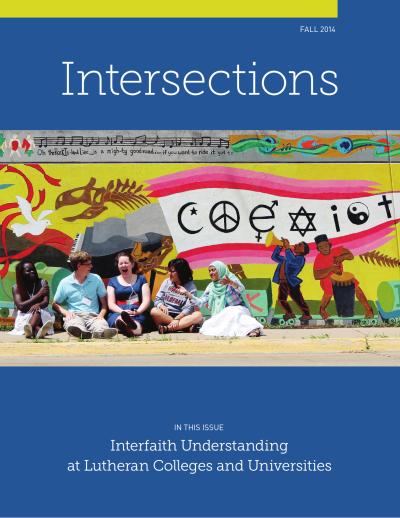
Schone, raised in a small conservative Central Illinois congregation, recounts how Augustana’s Interfaith Understanding group and Interfaith Youth Core gave her the first chance to befriend Muslim, Unitarian Universalist, and atheist peers, and how she hopes to bring the joy of those friendships back to her home church through the power of storytelling.
-
 Article
Why Interfaith Work is Not a Luxury: Lutherans as Neighboring Neighbors
Martha E. Stortz
No. 44 · Fall 2016
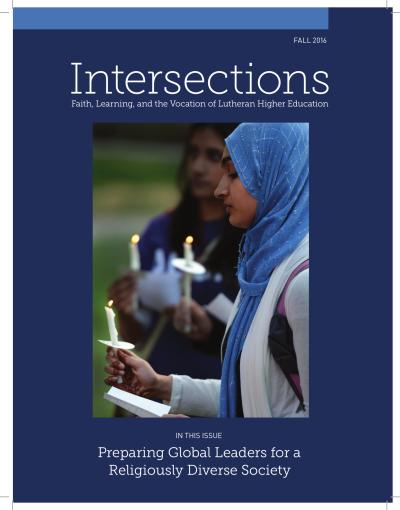
Stortz argues that interfaith work is not a luxury but a constitutive commitment of Lutheran higher education — institutions she describes as both “faith-based and interfaith-dependent.” Reading the parable of the Good Samaritan as both an intra-faith and inter-faith encounter, she offers a four-fold matrix of theological reflection, spiritual engagement, social action, and everyday experience as portals into the work of being neighbor.
-
 Article
The Face of the Neighbor: An Interview with Four Capital University Faculty About Their Recent Visit to Cuba
Brian Forry Wallace, Michael Yosha, Reg Dyck, Susan Narita
No. 7 · Summer 1999
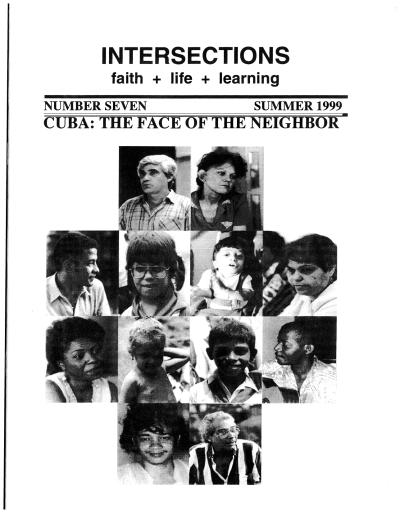
Four Capital University faculty—political scientist Brian Wallace (returning to Cuba a third time after the 1994 boat lift), English professor Reg Dyck, ESL teacher Susan Narita, and political scientist Michael Yosha—recount their summer 1998 trip with Pastors for Peace, describing Cuban priorities of education, health care, and military (in that order), the cultural richness of Havana from sixteenth-century cloisters to Miramar, the Cuban Foreign Service’s vision of a Scandinavian-style democratic socialism, the counter-productive U.S. embargo (including its effect on kidney dialysis machines), Castro’s 1991 reconciliation with religious communities, and a recurrent image of a little girl named Marguerite singing at a school for amputee and terminally ill children. The interview was conducted by Capital senior Jessica Brown and Tom Christenson.
-
 Institutional Focus
LibGuide: Introduction to Womanist Theology
Elli Cucksey
No. 56 · Fall 2022
Cucksey, the head librarian at Trinity Lutheran Seminary, recounts how Beverly Wallace’s Introduction to Womanist Theology class — the first offering of the ELCA Seminaries’ Womanist Theology Initiative — led her to build a publicly available LibGuide that amplifies Black women’s voices and gathers the resources of the course for future students.
-
 Article
Women Presidents in Higher Education: How They Experience Their Calling
Aimee Goldschmidt, Gary McLean, Katherine A. Tunheim
No. 42 · Fall 2015
Drawing on in-depth interviews with fifteen women college presidents and a transformative-learning-theory framework, Tunheim, McLean, and Goldschmidt trace a three-stage journey — identifying, interpreting, and pursuing the call — and ask what the language of vocation contributes to the preparation and mentoring of women leaders in higher education.
-
 Article
Vocation of the Lutheran College and Religious Diversity
Darrell Jodock
No. 33 · Spring 2011
Jodock describes a “third path” for Lutheran colleges that is both rooted in the Lutheran tradition and inclusive of religious diversity — an alternative to sectarian and non-sectarian default models — and identifies six interlocking features of the Lutheran tradition (giftedness, an engaged God, wisdom, caution about claims to know, community, and an emphasis on service and community leadership) that shape how such a college engages interreligious dialogue and civil discourse.