Heresy, I’ve been told, is an occupational hazard of being a theologian, and I think the point is well taken. Invoking the truth is a risky project, one requiring a light but unhesitant hand, and a bold enough presentation to make one’s vision real. In what follows then, I hope to speak forcefully, though without presumption, in the belief that such an approach can serve our conversations most well.
In his reflections on Lutheran higher education, Mark Schwehn invites us to think again on the nature of truth—perhaps even Truth with a capital T—and suggests that our continued ability to seek and speak the truth might be central to the task at hand. I will follow Schwehn’s invitation and insight, and take a few first steps down the path he offers. My contention here is that a renewed understanding of the role and relevance of Truth can shape our future and our self understandings in remarkable ways, and can re-enliven our vocation as church-related colleges and universities.
To begin, I’d suggest that we discard a few popular conceptions of truth which have not, I think, proved helpful. Most significantly, truth is not fruitfully understood as a matter of information. We live in the self-touted information age, and have seen the limited promise of information. New information, however precise and timely, might make us more comfortable, more secure, and perhaps even more wealthy, but information alone is insufficient fare to sustain us. Our information may be accurate or not, but is never true.
The quality of our teaching can and should be a first priority…because we believe that truth is an event that happens in the classroom, and that good teaching and good learning involve giving birth, individually and in conversation, to our own relations to the truth.
Second, truth is best not seen as an object. We may collect facts and figures and descriptions of the world, but these remain information. Truth is not a prize to be won, nor an heirloom to be passed down, nor a formula to be memorized. Instead, truth is an event, met and explored in the living of it.
And finally, the truth is not merely words about the truth. Our language may successfully invoke the truth, and will shape and direct our understandings, but can never encompass or exhaust the whole. Indeed, the best discussions of truth are self-effacing, and plan in advance to fall short. Honest discussions of the truth make no presumption to permanence, but point beyond themselves.
With these conceptions set aside, the truth remains as the ultimate source and the ultimate goal of all our choosing. For our vision of the truth, of life’s meaning and value, of our circumstance and possibility, both shapes and is shaped by all our actions. Our relationship to the truth is borne out in our priorities, in the risks we take and the sufferings we bear, in the hopes which sustain us and the dreams we pursue. In short, the truth represents the primordial question we are always already answering with our lives.
This remains at best a partial treatment, inviting more careful qualification and development if space and time would allow. Yet even these meager beginnings are enough to spur our conversation, and suggest their own path for exploring our institutional calling. For against this backdrop, our church-related colleges and universities are easily seen as among the few places today where we can still seek the truth in all of its richness and urgency. To suggest that our task is unique would be false, and to argue that we are the best qualified to perform this task can only serve as a self-congratulatory diversion. It is enough that this is our task, and one for which we are remarkably well suited. Our church-related colleges and universities, educational communities which are grounded in faith and reason together, remain as one of the few public forums fully open to the life of the spirit, fully prepared to ask and answer our lives’ most urgent questions. Moreover, in pursuing this task well, we can easily respond to those who might misunderstand or misconstrue our relation to the church as some sort of retail outlet for religious doctrine. In this vision, church and church-related college are twin communities, linked together by their common loyalties to the truth. Like the church at its best, the church-related college can genuinely equip all its members—its faculty and staff, students, and alumni—to live reflectively, to act responsibly, and to choose well.
With these thoughts come immense practical implications for our teaching and learning. Most obviously, this approach brings a renewed emphasis on classroom teaching. Many have linked the decline of church-related higher education to the emerging prominence of the large research universities. For all of their accomplishments, these research institutions have reinforced a small-minded vision of truth: truth as something to be measured, collected, quantified and published. Within this vision, universities serve as factories of information, first produced in the laboratories, and then “delivered” in the lecture hall. Within this framework, the classroom too easily degenerates into merely a loading dock, for unloading booty collected elsewhere. Ironically enough, our understandings of truth have faced much the same assault from another source: the growing number of technical colleges with their focus on training and their celebration, as one advertising campaign has put it, of “hire education.” None of this is meant to insult, but to stress instead that we, as church-related colleges and universities, have taken up a different and deeper commission. The quality of our teaching can and should be a first priority, not only because excellence is nice and good teaching sells, but because we believe that truth is an event that happens in the classroom, and that good teaching and good learning involve giving birth, individually and in conversation, to our own relations to the truth. Kierkegaard’s rich image of the teacher as midwife deserves our careful attention once again.
This is no call for even less research support for our faculties, but simply a suggestion that we reflect our research energies back toward the classroom, or even more personally as sustenance for our own truth journeys. Indeed, a key feature of such an approach is to convene a faculty engaged in their own journeys alongside of their students. In short, we need brave and articulate professors who can and will profess, who can and will publicly own and defend their thoughts, opinions and conclusions. Playing “the devil’s advocate” may well be amusing sport, but scarcely serves as effective teaching today. Perhaps in an earlier age, hiding one’s own position served well to dethrone the pretensions of an absolute perspective, but this is not our highest problem. I would suggest that most of our students are quite at home with the thought that they have a “right” to their own opinions, but are ill-equipped to articulate, defend and explore their own thoughts. They need examples of clear thinking and careful conversation; they need reference points and foils against which to respond. To give them anything less than our own best ideas, carefully and reflectively held, is to bear false witness—to pretend that ideas are mere playthings and that the stakes are trivially low.
We honor our Lutheran heritage, not by defending it or preserving it as a museum piece, but by testing it, exploring it, and putting it to work.
To be sure, we must always guard against shallow agreements, against our students’ desires to agree with us and to be our intellectual allies, but this charge is already part and parcel of our vocation as teachers. And the wide field of ideas is best explained and explored by one who has moved deeply, carefully, and passionately into a position of one’s own, not by one who pretends only to be a spectator.
As students as well, this approach to truth can bring a renewed focus and challenge to our endeavors. Our studies bring skills and credentials, but more importantly they bring us into relation to the truth, into our own sense of purpose and direction, however crass or noble. Ultimately, our education involves taking up the tools which promise to sustain us through a richly unfolding, lifelong relationship to the truth. Past generations, in their seemingly quaint idiom, have spoken of “moral education,” of teaching virtues and building character, and we can do well to rediscover the full import of such a project. We should teach the virtues, not so much to promote decent and civilized behavior, but to equip ourselves and our students for fruitful and enduring relationships to the truth. We should teach courage, both to live our convictions and to bravely confront the shortcomings of our lives. We should teach discipline, to hone and polish our efforts and guard against sloppy thinking. We should teach patience, to persevere on a journey into truth which is new each day. And we should teach love, so that we might care for and enjoy a world over which we so desperately seek mastery.
These suggestions may seem well and good for the humanities, and perhaps especially for core courses in philosophy and religion, but more difficult to apply in other fields. But I have in mind here a conversation over truth which engages all the disciplines. To borrow Tillich’s phrase, the dimension of depth is explored in all our studies. No field is immune to the human condition. Every fact is value laden, shaped by a context of interests and priorities. Beauty and precision can be explored and appreciated in mathematics and music courses alike. And who can deny the need for a genuine, reflective value-laden foundation for our training in journalism, law, health care and education?
For an example, I would comment on certain difficulties in one of my own fields of experience: economics. Introductory courses (and indeed every textbook I’ve seen) typically begin with a simplistic discussion of the difference between facts and values, and a quick division of economic debates into positive and normative statements. Economists are not without values, but normative discussions are subsequently ignored, or simply deferred beyond the end of the course. The professional difficulty, I think, is that economists, as a rule, have no formal training in addressing questions of value. This may not be troubling so long as economists content themselves with ostensibly positive questions, but normative matters invariably arise. Economic study revolves around a handful of striking assumptions—about human motivation, the importance of animals, the nature of hedonism, and the value of wealth—assumptions which bring many urgent questions about the values which inform and affirm our studies. And the sad problem remains that these questions urgently call for answers, answers which might fruitfully be developed by trained economists and economic students who were also trained in the task of moral inquiry. And this remains an even bigger problem for all who believe responsible living involves responsible voting, saving, spending, and investing.
My second example also comes from economics, but applies as well, I think, to other fields which pursue empirical inquiry through statistical techniques. In teaching and doing empirical work, we most frequently begin with a handful of elegantly simple statistical tools to organize, summarize, and explore the evidence. Most typically, we set up our statistical tests to carefully limit (to 10%, or 5% or 1%) the chances of mistakenly finding relationships where none really exist. And there are good reasons for beginning here. The math is straightforward enough; the test is easily explained, and our conclusions are readily comparable with those of our colleagues.
This approach may be a good example of skeptical scientific inquiry, and may serve well as an opening strategy for exploring the world. But it can also foster remarkably poor habits for careful, responsible choosing and thinking. When taught alone, or as the common model of “thinking scientifically,” it too easily encourages our students to endorse a policy of waiting, of deferring action until the evidence and our algorithm tell us what we can confidently believe. Sometimes this posture of waiting may be appropriate. But at other times, when possible threats to our health, our environment, our families and our cultures are contemplated, such a stance may be imprudent, irresponsible, unnecessarily costly—and even disastrous. So we need to equip our students to discern these different times, to understand the stakes, and to realize that the absence of scientific proof does not absolve us from choosing.
In closing these thoughts, I would add three last observations. First, I have pursued this argument in a wholly secular idiom, and have done so by choice, not necessity. We need to begin, I think, with a commitment to keeping our conversations and our schools accessible to outsiders, for whom the vocabulary of faith does not yet resonate. Nonetheless, this is no call to jettison our familiar symbols, terms, and stories. To touch on but a few possibilities, the imagery of sin and grace, idolatry, revelation, confession and conversion continues to guide and shape our thinking in wonderful ways, and can bring a greater richness to our conversations. I envision here a project of faithful translation, and a promising journey of rediscovery. Moreover, such an effort should not be seen as a plea for watering down our Christian symbols, but as a call for making them real and relevant once again. We must urgently address the painful possibility that most of our students, and even many of our colleagues, have but a shallow understanding of the Christian faith. And we must resist the trend of becoming nominally Christian, with the language of faith a self-contained jargon that merely decorates our lives.
Second, the journey into truth provides a natural and promising way for re-embracing the Lutheran tradition which has shaped us. Our tradition’s vigor stems from its fruitfulness—from its continued potential for shaping, guiding, and sustaining our efforts. As such, we honor our Lutheran heritage, not by defending it or preserving it as a museum piece, but by testing it, exploring it, and putting it to work. And it promises to serve us well. The theology of glory, for instance, meshes nicely with a vision of truth as information, to be triumphantly captured and shared around. Luther’s theology of the cross, however, rejects this notion of redemption as a trophy to be won, or borrowed, or inherited, and suggests a truth that must be re-encountered daily, by our sinful, saintly selves. To follow up on one of Professor Benne’s suggestions, a renewed confidence in our tradition, and a renewed commitment to seeking and speaking the truth, will bring a refined logic to our recruitment agendas. We need excellent, competent professors, and part of their competence must be their ability to converse on matters of truth both within their fields of expertise and across the university at large. Moreover, a significant fraction of these conversation partners—in Benne’s terms a “critical mass”—can and should be steeped in the Lutheran tradition.
Finally, I would suggest that we need to carefully prepare our students for living in a world of Untruth. Their relationships to truth will unfold against a world of false goods and false gods, and we must equip them to resist the lure of the crowd, to humbly guard against self delusion, and to face the loneliness of being different. Indeed, with Julian of Norwich, we may strengthen them, and ourselves, with her famous thought that “all will be well, and all will be well, and all manner of things will be well.” But we might well pass along her other insight: that God does not promise that we won’t be tested, nor that we won’t be tried, but only that we will not be overwhelmed.
-
 Editorial
From the Publisher
James M. Unglaube
Unglaube welcomes readers to the inaugural issue of Intersections, crediting Editor Tom Christenson and Capital University, and announces the new annual Vocation of a Lutheran College Conference whose continuing dialogue the journal exists to enhance. He gives thanks to the Lilly Endowment for a sizable grant supporting the 1996 conference, campus dialogues, and the birth of the publication.
-
Editorial
From the Editor
Tom Christenson
Christenson, feeling like a proud parent, welcomes readers to the inaugural issue and acknowledges three people without whom the publication would still be just an idea: Naomi Linnel of the ELCA office for Higher Education and Schools, publisher Jim Unglaube, and Capital University president Josiah Blackmore. He invites readers’ reactions, suggestions, and active involvement as editors, reviewers, authors, artists, and critics in shaping the dialogue across the ELCA college and university family.
-
Article
The Future of Lutheran Higher Education
Mark Schwehn
Schwehn’s keynote, framed against Otto Paul Kretzmann’s October 1940 inaugural at Valparaiso, organizes itself around four topics: the idea of a Christian University (Lutheran schools as a tributary of the Christian intellectual tradition, voices in a conversation in the spirit of H. Richard Niebuhr and Alasdair MacIntyre rather than phases of James Burtchaell’s devolutionary scheme); the pursuit of truth (against Foucauldian reduction of truth to power, with Hilary Putnam, toward a cruciform discipleship that discovers truth ambulando); the critique of knowledge (developing Christian theories of knowing in conversation with Benne, Lotz, Wolterstorff, LeClerc, and Augustine); and Christianity and liberal learning (objectivity refurbished as Thomas Haskell’s ascetic self-discipline, and the recovery of texts that have claims upon us).
-
Response
"Whose Future?" or "Social Justice and the Lutheran Academy?"
Marsha Heck
Heck argues that the future of Lutheran higher education lies less in defining Lutheran distinctiveness than in moral action grounded in face-to-face relationships with others. Drawing on David Lotz’s two-kingdoms theology of citizenship, Ernest Simmons’s relational reading of Luther, Arthur Preisinger’s indictment of the German Lutheran misreading of two kingdoms during the Third Reich, Starla Stensaas of Dana College, and Paulo Freire’s dialectic of empowerment, she calls Lutheran colleges to integrate moral reflection with moral action—to move students’ muscles against what is not true as well as to feel truths in their bones.
-
Response
Knowing and a Tradition to be Known
Kurt Keljo
Keljo, University Pastor at Capital, embraces Schwehn’s vocational call but challenges his epistemological framing. We are called to bear witness to the Truth more than to pursue it; truth and power need not be dissociated when power is understood cruciform-ly as love and service; alongside objectivity, a case can be made from the tradition for connected knowing (image of God, idolatry, repentance, Incarnation). Christians offer not a particular epistemology but a foundation for epistemology—a tradition to be known. He closes with James Fowler’s four marks of the “public church”: particularly Christian, prepared for pluralism, balancing intimacy with public engagement, and unafraid of ideological pluralism in confident, nondefensive civility.
-
Response
Lutheran Colleges: The Context for the Conversation
Thomas Templeton Taylor
Taylor of Wittenberg engages Schwehn’s first argument by sketching the institutional predicament of Lutheran colleges through three converging forces: the collapse of differences among old-line Protestant groups in the wake of ELCA-era ecumenism (with Robert Wuthnow); the secularization of American higher education described by George Marsden; and the post-war decline of liberal arts colleges under pressure to professionalize. The result is an “in-between stage” in which Lutheran colleges retain rhetoric without substance. Following Richard John Neuhaus’s “Eleven Theses,” he argues that, for a time at least, Lutheran colleges’ institutional affiliations must remain actively Lutheran if they are to remain in any sense Christian.
-
Institutional Focus
Diversity and Dialogue: Gustavus Adolphus College
Florence D. Amamoto
Amamoto, a third-generation Japanese-American Buddhist who teaches American literature at Gustavus Adolphus and regularly attends daily chapel, writes as an “inside outsider.” Engaging Schwehn’s closing call to refurbish the Lutheran college, she argues that church-related colleges are vitally important to society, that “refurbishing” must take up diversity, and describes how Lutheranism is manifest at Gustavus: Christ Chapel as the highest point on campus, the ecumenical chapel program led for thirty years by Chaplain Richard Elvee, the Nobel Conferences that pair scientists with philosophers and theologians, the First-term Seminar and Tuesday Conversations, the India study-abroad program organized by Deane Curtin, and the Sponberg Chair in Ethics. She names the pressures of money, secularization, and the publications-driven push for “excellence” that threaten this creative tension.
-
Institutional Focus
Continuing the Dialogue: Augustana College
Sandra C. Looney
Looney describes Augustana College, Sioux Falls, debating and renaming its values—Christian, Liberal Arts, Community, Excellence, Service—under the leadership of religion professor Dr. Arthur Olsen and the T’N’T (“Through Thick and Thin”) committee, in the wake of ELCA Region III’s “What Does It Mean to be a College of the Church?” conversations. She describes Augustana’s 56% Lutheran student body, daily 10 a.m. chapel, dual Christmas Vespers in Our Savior’s Lutheran Church and St. Joseph’s Cathedral, the Capstone classes on moral and aesthetic issues, and the ongoing work of enlarging Augustana’s conversation to include Native American, Jewish, and Islamic voices.
-
 Editorial
From the Publisher
James M. Unglaube
No. 2 · Winter 1997
Unglaube reports on the second annual Vocation of a Lutheran College conference of August 1996, where Walter Bouman of Trinity Lutheran Seminary addressed “What is Lutheran; What is the Lutheran Tradition” (biblical, catholic, evangelical, sacramental, world-affirming—the world “received, enjoyed, served as God’s Gift”). He previews presentations by Wendy McCredie of Texas Lutheran and Baird Tipson of Wittenberg on how the Lutheran tradition is embodied in its colleges, and Bob Vogel’s challenge in “Coherence—And Now what?” that the tradition comes to life in how faculty give expression to their beliefs and values in the classroom and with colleagues.
-
 Article
Why Diversity and Civic Engagement Don't Talk to Each Other on College Campuses: The Need for Public Work
Jose Marichal
No. 25 · Spring 2007
Marichal opens with Thurgood Marshall’s line from Milliken v. Bradley and traces the “decoupling” of campus diversity and civic engagement initiatives back to their shared grounding in Benjamin Barber’s “thin” or pluralist democracy. Reviewing CIRCLE data on youth political disengagement, the limits of mandatory volunteerism, and persistent residential segregation, and drawing on Mary Ann Glendon, Lani Guinier, Caryn McTighe Musil, and Richard Rorty, he argues that only Harry Boyte’s notion of “public work” can bind diversity and civic engagement together—and contends that Lutheran colleges, with their understanding of vocation as call into the world, are uniquely positioned to build that infrastructure.
-
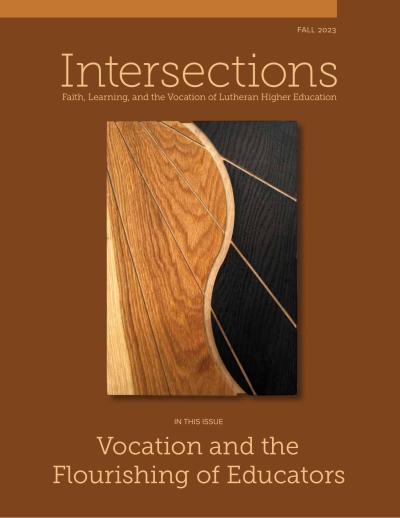 Editorial
From the Editor: So That We, Too, May Flourish
Colleen Windham-Hughes
No. 58 · Fall 2023
Windham-Hughes introduces the 2023 VLHE conference theme of educator flourishing, drawing on Dr. Monica Smith’s plenary challenge — “How can we flourish if only some are centered and others are at the margins?” — and invites readers to ground themselves in Us/We, the cover art by Augustana graduate William Hatchet, and join the conversation.
-
 Response
Beyond Data: The Poetry of Faith — A Response to Robert W. Funk
Mark Allan Powell
No. 5 · Summer 1998
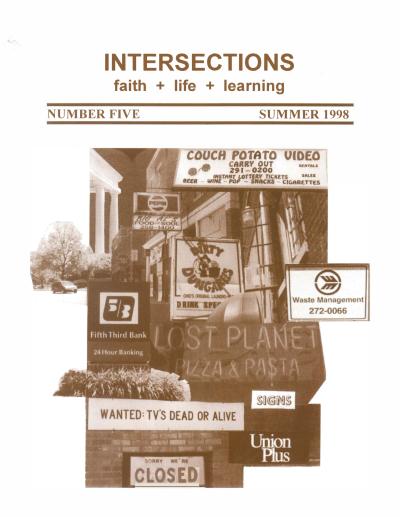
Powell, professor of New Testament at Trinity Lutheran Seminary, responds to Funk not as a New Testament scholar (Meier, Raymond Brown, and others can rehearse those debates) but as a Christian and a pastor. He challenges Funk’s closing implication that the institutional church’s “only function” is to protect Christian privilege (citing the ELCA’s 28 colleges, 1378 early childhood centers, AIDS hospices, and more), questions the suspicion of “derivative” faith, and proposes that piety is to theology what poetry is to prose—arguing, against Funk and with Marcus Borg, for a wholistic faith that holds history and myth, data and devotion, head and heart together.
-
 Article
Why Did the Chicken Cross the Road? A Homily on Liminality and Vocation
Lori Brandt Hale
No. 45 · Spring 2017
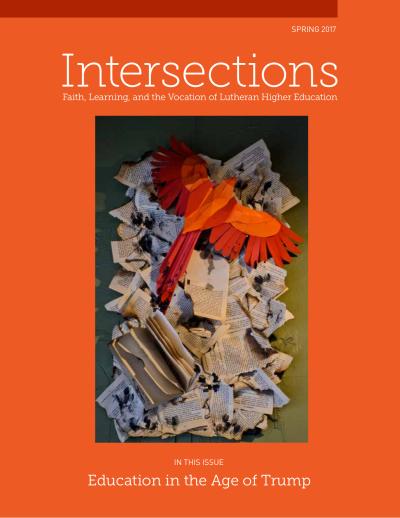
Drawing on Wes Moore’s The Other Wes Moore, Warren St. John’s Outcasts United, Victor Turner’s anthropology of liminality, and Dietrich Bonhoeffer’s poem “Who Am I?”, Hale considers how Hmong, Muslim, Latinx, LGBTQ+, non-traditional, and other students live in “double liminal” spaces — and asks whether liminality might itself be a place of transformation in conversations about vocation.
-
 Article
Renewing a Sense of Vocation at Lutheran Colleges and Universities: Insights from a Project at Valparaiso University
Marcia Bunge
No. 14 · Summer 2002
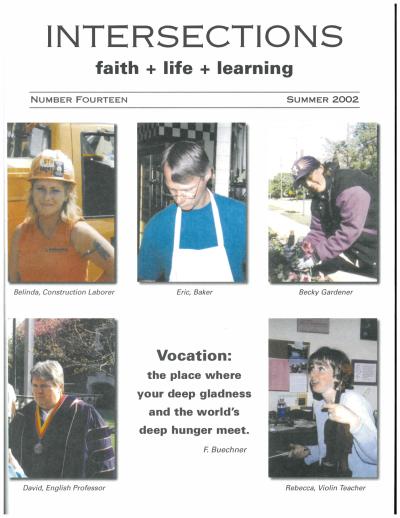
Bunge, director of the process for writing Valparaiso’s nearly two-million-dollar Lilly grant on the Theological Exploration of Vocation, argues that contemporary culture’s reduction of vocation to either paid work or self-fulfillment requires Lutheran institutions to renew attention to a rich theological concept rooted in Luther’s expansion of vocation beyond the priesthood. She outlines eight low-cost “doorways”—caring adults, prayer, worship leadership, music and the arts, service, cross-cultural experience, church camps and wilderness, study and reflection—and describes Valparaiso’s two-program structure: a Campus-Wide Program weaving vocation into Freshman Core Courses and chapel life, and a Church Vocations Program for students considering full-time ministry. She closes with four troubling questions for any institution carrying out such a grant: what faith traditions can learn from one another, how to involve parents, whether faculty and staff have space to reflect on their own vocations, and whether daily institutional practices—family policies, treatment of low-paid staff, environmental responsibility, obligations to the wider community—actually reflect a commitment to love of neighbor.