Health Food in the Inner City: An Interview with Brian Noy about Augsburg's Campus Kitchen
Intersections No. 36 · Fall 2012
What is Campus Kitchen? How does it serve the needs of the community?
The Campus Kitchen at Augsburg College works to make healthy food accessible to all in and around the Cedar Riverside Neighborhood. The program is a component of the Sabo Center for Citizenship and Learning and shares the goal of creating a healthy community through education and service. The Kitchen provides for basic needs, service learning, leadership development, and genuine engagement between the college and the community. We have four components that all work to make learning happen though connections with food and the community:
- Food to Share: 2,000 meals are served each month by volunteers and service learners to youth programs, homeless shelters, seniors, and community centers. Most of the meals are created from the surplus food from A’viands/Augsburg Dining; some are prepared from scratch in our Campus Cooking Classes.
- Food to Grow: Our community garden provides over 80 spaces for organizations and people from the neighborhood and campus to grow their own food, as well as food for the meal program.
- Food to Buy: Our two farmers markets on campus and at the Brian Coyle Community Center allow local producers to provide for the nutritional needs of the community. Markets run on Tuesdays through the summer and even accept EBT/food stamps.
- Food to Know: Educational programming helps college students, neighborhood youth, and others make connections between food, health, and the environment by developing cooking and gardening skills.
How does this program bring Augsburg and the neighborhood together?
Clearly, the low income neighborhood that Augsburg calls home can use fresh and healthy meals. The garden originally aimed to beautify a blemished corner of campus, and to provide growing spaces to the many interested gardeners who live in the nearby high-rise apartment buildings. There is also no nearby grocer that sells a substantial selection of fresh produce, and the farmers market fills that niche.
Our meal program is now led by student leaders with support from students who volunteer from their own interest, or have a service-learning requirement in a course. The garden includes about 100 individual plots, 25 of which are managed by students, 25 by Augsburg employees, 25 by neighbors, and 25 by community organizations, including clinics, schools, and churches.
In fact, Augsburg has a deep history of training the neighborhoods’ immigrant community, beginning with its Norwegian teachers, social workers, and pastors. That history continues today as we serve Somalis, Mexicans, and others. The program clearly demonstrates the college’s commitment to service-learning and experiential education across lines of race, education, income, and religion.
It sounds like a really successful program. Do you face ongoing challenges?
It’s a great program, one that offers a lot of room for creativity. The garden is a great example of a campus space that has been fully integrated with the community, where all sorts of amazing (and sometimes dramatic) connections occur. In it, we have students working alongside other newer and often lifelong gardeners and farmers from all over the world. The biggest challenge is with liability and licenses concerns; we need to make sure that our activities fit into the expectations of insurers and city inspectors. It always works out, but seems to occupy a disproportionate amount of time and resources.
How did you come to these sustainability efforts? What’s next?
I was an undergraduate at Augsburg, and I loved working with campus and community members to make a sustainable campus and neighborhood. I have that same feeling now as a staff member as I work with idealist and creative students. Now that the program is nearly a decade old, and the heart of our operation is well established, we have more energy and time to explore other creative avenues, such as the farmers market and connections to other local farms.
-
 Editorial
From the Publisher
Mark Wilhelm
Wilhelm argues that the rhetoric framing ELCA higher education as a binary between “secular” and “religious” is “hokum”: there is a third way of doing higher education from a Christian perspective that is religious in motivation and practice but on the ground looks secular. After more than half a century of debates, he calls on ELCA presidents to “do something” in 2013 to move forward in shared mission and vocation.
-
Editorial
From the Editor
Jason A. Mahn
Mahn introduces the issue through Norman Wirzba’s The Paradise of God and the Genesis 2 vocation given to Adam to care for adamah—arguing that “vocation” is the Lutheran name for an incarnational, creation-centric theology of kenosis and that Lutherans bring distinctive theological gifts to environmental work even if no absolutely unique perspective on caring for creation.
-
Institutional Focus
Vocation for Life: A Report on a New Initiative for Alumni
A report on “Vocation for Life,” a collaborative initiative of ELCA-related colleges and universities to make vocational exploration available to alumni across the country regardless of which school they attended. The first pilot retreat—“Explore Your Life’s Calling,” in Rochester, Minnesota in November 2011, facilitated by Tom Morgan of Augsburg, Chris Johnson of Gustavus, and Tom Scholtterback of Concordia using the Circles of Trust approach—is described.
-
Article
A Traveler's Manifesto for Navigating the Creation
Ann Pederson
Pederson asks who we are, where we are, and how then we shall live within the Epic of Evolution and the doctrines of creation, incarnation, and imago dei. Drawing on John 3:16 (“For God so loved the cosmos…”), Luther on God’s presence “in the veins of a leaf,” Augustine’s City of God, Phil Hefner’s “created co-creator,” Joseph Sittler’s “Called to Unity,” and Norman Maclean’s Young Men and Fire, she argues for a cosmic reading of incarnation in which all of creation—not only the human—bears the image of God.
-
Institutional Focus
Facing Tornados and Climate Change: An Interview with Jim Dontje about Environmental Innovation at Gustavus
Jim Dontje
Dontje, director of the Johnson Center for Environmental Innovation at Gustavus Adolphus College, describes the Center’s work with solar thermal and photovoltaic systems, LEED certification of Beck Hall, recycling and conservation initiatives, the Linnaeus Arboretum, and the difficult work of building consensus around climate response—reflecting on how Gustavus’s 1998 tornado recovery shaped a community capable of collective action, and on how the “Lutheran identity” both restrains and energizes the college’s environmental ethos.
-
Article
A Lutheran Ethic of Environmental Stewardship
Jim Martin-Schramm
Martin-Schramm sketches a Lutheran ethic of environmental stewardship organized around four moral norms inherited from World Council of Churches discussions and developed by Presbyterian and ELCA social statements: sustainability, sufficiency, participation, and solidarity. He grounds each norm in scripture and the Lutheran tradition—the theocentric doctrine of creation against rampant anthropocentrism, the incarnation against destructive dualisms, Christ in community against modern individualism, and accountability to God for future generations—arguing that this “ethic of ecological justice” offers a common moral vocabulary for engaging environmental policy debates that would otherwise collapse into cost-benefit analysis.
-
Institutional Focus
Putting Principles into Practice: An Interview with Kenneth Foster about Concordia's Sustainability Council
Kenneth Foster
Foster, chair of Concordia College’s President’s Sustainability Council, describes the Council’s formation under President William Craft in 2011 as a re-energization of stalled task-force work, its coordination with grass-roots campus initiatives, and its strategy of moving from principles to practice in stewardship of natural resources at a Lutheran liberal arts college.
-
Article
Climate Justice, Environmental Racism, and a Lutheran Moral Vision
Cynthia Moe-Lobeda
Moe-Lobeda argues that the vocation of a Lutheran college is to prepare students for Thomas Berry’s “great work”: forging a sustainable relationship between the human species and the planet while diminishing the gap between those who have too much and those who have not enough. She develops a three-fold “moral vision” rooted in Luther’s theology of the cross—seeing what is (climate injustice and environmental racism for what they are), seeing more just and sustainable alternatives, and seeing God’s saving presence at work—and offers it as a distinctive Lutheran contribution to the panhuman and interfaith challenge of our day.
-
Institutional Focus
Farming and Eating Locally: An Interview with Garry Griffith about Augustana's Farm2Fork Program
Garry Griffith
Griffith, Director of Dining at Augustana College (Rock Island), describes the Farm2Fork program’s shift from pre-packaged food to fresh produce sourced from local farms (beginning with Jim Johansen of Wesley Acres in Moline), the Augie Acres campus garden tended by students in learning-community courses, the bio-diesel conversion of used fryer oil for greenhouse heat and farm equipment, and the stewardship calling that grounds these efforts in Augustana’s Lutheran identity.
-
Article
Sustaining Sustainability
Baird Tipson
Tipson—former Provost of Gettysburg College, President of Wittenberg University, and President of Washington College—reads Romans 12:2 (“be not conformed to this world…”) against Victor Ferrall’s Liberal Arts at the Brink and the contemporary financial reality of small Lutheran colleges. He tells three case-study stories from Washington College’s Center for the Environment and Society—the Chino Farms partnership, the Chesapeake Semester, and the acquisition of the work boat Callinectes—to show how presidents must engage “the world” to secure resources for sustainability work without being conformed to it.
-
 Article
Rich and Poor in an Era of Globalized Religion and Economies: Challenges to Lutheran Colleges
Pamela K. Brubaker
No. 25 · Spring 2007
Brubaker opens with two World Council of Churches communion stories—a generous Aymara potato meal in Bolivia and a gated invitation-only lunch at a prosperous immigrant German Lutheran church in Brazil—to frame the question of which stance Lutheran colleges will adopt toward diversity. Drawing on Richard Hughes and Ernest Simmons on Lutheran “ecumenical confessionalism,” Linell Cady, Ulrich Beck, Held and McGrew, the World Bank’s 2006 Equity and Development report, Mark Juergensmeyer’s Global Religions, Harvey Cox on the Market as God, the WCC’s “economy of life” / AGAPE document, and Larry Rasmussen on universal human rights, she argues that part of the academic work of Lutheran colleges is to educate for critical citizenship by questioning neo-liberal assumptions and equipping students to claim social, economic, cultural, civil, and political rights for the whole human family.
-
 Reflection
Dreaming God's Dream: A Sermon on Isaiah 56:1-2, 6-8
Stephan K. Turnbull
No. 34 · Fall 2011
Preached at the 2008 “Savvy with Substance” Convocation of the ELCA at Central Lutheran Church, Minneapolis, this sermon by parish pastor Stephan K. Turnbull (First Lutheran Church, White Bear Lake) sets the small dreams of pastors and academics—balanced budgets, peaceful congregations, coherent midterm papers—over against the prophet’s dream in Isaiah 56 of a God who gathers all nations to a house of prayer for all peoples. Turnbull calls educators, preachers, and church leaders to articulate God’s dream of getting the world back through the dying of Jesus the Messiah and the resurrection’s first fruits of new creation.
-
 Article
Turning to a Reproductive Justice Framework for Inclusive Dialogue across Differences
Jenny M. James
No. 57 · Spring 2023
James makes the case that a reproductive justice framework, rooted in the work of black feminist scholars and activists, gives educators tools to overhaul polarized pro-choice/pro-life conversations and to host inclusive dialogues across differences of race, sexuality, gender identity, and faith.
-
Article
A Reconsideration of the Political Approach to Abortion
Sophia Cruz Ponce
No. 57 · Spring 2023
Cruz Ponce argues that the pro-life versus pro-choice binary distracts from the underlying social factors that lead to unwanted pregnancies, and proposes a reframed political approach focused on mandated sex education, free contraception, and crisis pregnancy centers that address the social, political, and economic barriers women face.
-
Article
The Duty to Teach and Restore Bodily Autonomy: Reflections from the Classroom
Cynthia Richards
No. 57 · Spring 2023
Richards reflects on a Narrative Medicine course she taught at Wittenberg University in the wake of the Dobbs decision, in which students examined cultural “first recognitions” of the reproductive body and discovered that almost none had ever had a way of talking openly about their reproductive selves — an alienation she calls educators to address.
-
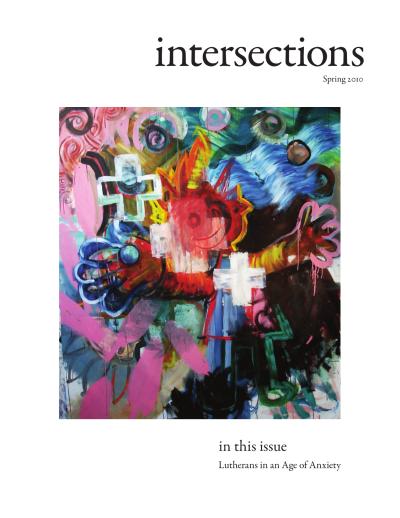 Article
Hope in a Period of Economic Decline
Rebecca Judge
No. 32 · Spring 2010
Judge reads the 2008-2009 recession against the panic-free 1982 downturn and argues that this panic comes from the genuine surprise of a generation that had been told—by George Will and others—that business cycles had been tamed by deregulation, globalization, and Greenspan. Drawing on Luther’s “Trade and Usury” and Large Catechism, Paul Tillich, Stephen Marglin, Karl Polanyi, and Larry Summers, she critiques the “crude utilitarianism” of Homo economicus and benefit-cost analysis, finding hope in the possibility that this recession will renew a national conversation about moral obligation to neighbor in a market whose “raging bull” has broken out of its squeeze chute.