I believe that what the world needs is a fresh spiritual roadmap that helps us navigate and interpret our place within the universe, from both cosmic and familial perspectives. This spiritual vision must be told as a story so that we can find ourselves within it. The Epic of Evolution is a place to start. As a Christian, I believe that God is present in the creatures of the entire cosmos. Genesis 1, John 1, and Colossians 1 reveal, albeit in somewhat different ways, the same epic narrative of our evolution.
We are created critters—companion species of God’s own making. John 3:16 should be re-translated: “For God so loved the cosmos…” God’s love is so much bigger, wider, and deeper than we can ever imagine. Martin Luther wrote that God is present both in the veins of a leaf and in the elements of the Eucharist (57-59). Our worldly table is set with bread and wine. Doxologies seem appropriate for such a credo: Thanks be to God for this most amazing world.
This essay and journey through the cosmos begins with three questions: Who are we? Where are we? How then shall we live? These are questions not only about the meaning of the being and becoming of human identity, but also about the nature and action of God’s grace in the world. Typically, these questions are addressed by at least three central Christian theological loci: the doctrine of creation, the doctrine of the Incarnation, and the interpretation of the imago dei (humanity as the image of God). It is no surprise to Christians that the center of the Incarnation is the person of Jesus Christ. But it might be a stretch for some Christians to imagine that the promise that God has become flesh is not only in a person, but also in a place—in the creation. For Christian theology, the imago dei is the doctrine that explains the relationship of humans to God and this doctrine has been used almost exclusively to reveal that humans alone are created in the image of God. As we shall see, this narrow interpretation fails to explain our relationship not only to God, but also to ourselves and the rest of creation. From my theological perspective, Christians need to expand the notion of what Incarnation means and what it means to be created in the image of God so that the scope of God’s creative and redemptive action and work indeed reaches to the scope of all things—from the outer reaches of space to the inner reaches of our hearts. Otherwise, our understanding of God’s work is constricted by our fears of extending it beyond our reach.
The place to answers questions of the who, where, and how of human life is with the quotidian—with the daily details, within the scope of the cosmos. We must live and travel in both the cosmic and local realms at the same time. If we ignore one or the other, we can be become displaced. To be the creature of God that God calls us to be requires a kind of dual citizenship—within the details of our daily life, attending to the needs of our neighbors, while always knowing we are part of a much greater cosmos whose future is still unfolding.
The Local with Cosmic Implications
To figure out who I am, I decided to go to Iowa (isn’t that what most people do?), via the outskirts of Sioux Falls. On a recent warm spring day, I downloaded directions from MapQuest and began my journey through technological innovation from the urban landscapes of Sioux Falls to the rural farms and fields of Iowa. The first destination—the corporate headquarters of Sanford Research—is located on the very edge of Sioux Falls near the interstate. I drove in on the road marked by a sign in the Sanford blue that simply said, “Road to the Cure.” The sign is placed near the corporate Logos which reads: “dedicated to the work of health and healing.” Once a month I drive from my home to this sprawling landscape of healthcare which is surrounded by white rail fences, duck ponds, and neatly trimmed grasses. When I enter the building, I often feel like an interloper in this world of scientific research. But that is my purpose, to come as the “outside” member on the institutional research board (IRB) for Sanford. On their website, Sanford claims the following: “We are changing the landscape of science and health care. Our growing team of more than 200 researchers is focused on identifying new therapies and treatments for some of the world’s leading health concerns. It’s our goal to find solutions that will cure illness, eradicate disease and improve the lives of people in our communities and around the world” (“Sanford”). I have friends who work on breast cancer research while others hope to find a cure for Type I diabetes. Such research in medicine and healthcare is changing the landscape of what it means to be human in ways that most of us still think of as happening only in some kind of B-Hollywood action movie.
“To be the creature of God that God calls us to be requires a kind of dual citizenship—within the details of our daily life…while always knowing we are part of a much greater cosmos.”
In another Sanford building, closer to my home, the sciences of human reproductive medicine are housed. I have met with and listened to the amazing research of the scientists who practice reproductive endocrinology and medicine. Babies are created, made in vitro from donor sperm and donor eggs. Embryos can be implanted in gestational surrogates. And now with the recent advances in the sciences of genetics, embryos are genetically screened for potential lethal anomalies. Who are we? And where are we? Sometimes it feels like a land of science fiction where we are venturing into worlds we barely know or understand. And yet all of these human reproductive technological advances begin somewhere else, most likely in the fields of Iowa or in veterinary laboratories.
I continue my techno-journey as I leave Sanford headquarters and head southeast. As I drive through the rolling fields near the Big Sioux River, I cross the South Dakota border and into Iowa. About forty five miles away, I find another corporate landscape: Trans Ova. This one, however, is not urban. Surrounded by large metal gates and rails, I see hundreds of cattle with tags on their ears. They munch on hay, glaring at me as I drive by. Trans Ova’s website explains its mission: “To become the global leader in the application of innovative and reproductive technology.” And their vision is “to serve our clients by assisting them in increasing the genetic impact of their ‘success’ in their breeding programs.” Trans Ova uses some of the same reproductive technologies that the Sanford Health Fertility and Reproductive lab does, namely, embryo transfer and in vitro fertilization (IVF). But Trans Ova also clones cattle and “works closely with clients to understand their breeding goals, and ultimately help clients advance and extend superior genetics” (“Trans Ova”).
What happens in the barns and labs of Trans Ova is only a field or two away from the human labs of Sanford Research. If indeed we are related to all of creation, then I understand what it means to be created in wholly and maybe holy new ways. Reproductive technologies move from non-human to human in just a few small steps. In some weird way, I both feel and know that I’m related to these cattle. In fields not far from Trans Ova are the transgenic cattle created at Hematech, a company that “has developed the world’s first large animal platform technology to produce fully human antibodies using the latest advances in gene engineering and transfer to produce new biopharmaceuticals that help fight disease” (“Hematech”). Inside a circle of about seventy five miles, I am learning that what it means to be a creature of God is much more complicated than I ever imagined.
And while I have discovered that the world around me is much bigger, deeper, and wider than I could have imagined, I have also learned that it is much smaller, more intimately related, more complicated than I can comprehend. I have traveled to places which have redefined for me what it means to be a creature, to be created, and to be related to the rest of the world. I claim that what we have understood by the imago dei—to be created in the image of God—is much too small and constricted. If being created in the image of God has something to do with our relationships with other creatures, then this is the place from we will start our exploration. They are strange worlds indeed and require new maps for these new worlds, these techno-scapes. So, if I am going to venture into strange new worlds, I want to do so as those who have gone before me—with the tools and companions of my fellow-travelers.
The Book of Nature, the Book of Scripture
Christians before me have used two books as sources to navigate their quests for meaning: the book of nature and the book of scripture. These sources have shaped the way we interpret the theological doctrines of Incarnation and imago dei.
Let us begin with St. Augustine who read the two great books—of scripture and nature—to explore and understand what it means to be a creature of God. Augustine practiced the art of lectio divina (“divine reading,” i.e. study through meditation and prayer) not only with the Christian scriptures, but also with the book of nature. He wrote:
Some people, in order to discover God, read books. But there is a great book: the very appearance of created things. Look above you! Look below you! Note it. Read it. God, whom you want to discover, never wrote that book with ink. Instead He set before your eyes the things that He had made. Can you ask for a louder voice than that? Why, heaven and earth shout to you: “God made me!” (Augustine, Book XVI)
To open the book of nature is to venture into a landscape of vast dimensions and microscopic elements. We use giant telescopes to explore the galaxies that spiral into an ever-expanding universe and powerful microscopes to examine the DNA in our cells, the map of our human genome. And located somewhere in between the infinite reaches of the universe and the minute strands of DNA are human beings. I can only respond with wonder, amazement, and mystery. I am both a child of God created to be on this planet called Earth and a child of the universe that is still on its voyage to that which is becoming new. Scientists remind us that the voyage of the universe from its inception in the Big Bang until now has taken approximately 14-15 billion years and the journey is still unfolding. I’m both on my own journey through my lifetime, trying to make sense of it all, and also part of a much larger voyage, that of God’s voyage, that is moving in, with, and under me (compare Hefner 55-56). The large and small of it—somewhere in between, in medias res—we are travelers on the way, looking upward and heavenward, inward and internally.
“Located somewhere in between the infinite reaches of the universe and the minute strands of DNA are human beings. I can only respond with wonder, amazement, and mystery.”
Creation is the starting place from which I navigate and interpret the message that God so loves this cosmos that God gave God’s only son. The theologian that has blazed the theological trail for me is Joseph Sittler, a Lutheran theologian. Joseph Sittler was, and still is, ahead of his time. He listened to the cultural sirens around him and interpreted their warning calls. Scientists, poets, artists, and writers were all saying the same thing: Pete Seeger published his political song, “Where Have All the Flowers Gone” and Bob Dylan sang his war protest song, “Blowin’ in the Wind.” Rachel Carson published her famous book, The Silent Spring in 1962, warning us that chemicals pesticides were causing environmental devastation.
During these same turbulent times, in his prophetic address to the World Council of Churches, Sittler warned that the church was not paying attention to these cultural warning signs. Like Dietrich Bonhoeffer’s earlier warnings to the churches in Nazi Germany, Sittler feared that churches focused only on their own piety and institutional trappings and rituals. Churches were reducing the gospel of good news about the wide scope of God’s love and grace for the world to the small place of personal salvation and heavenly hereafters. Sittler claimed that the message of the Christian gospel preached in congregations was too small. According to Sittler, the place in which God’s grace was at work was much larger, grander, and wider than we could ever imagine. In other words, when Christians translate John 3:16, they should remember that God so loved the cosmos, not just the world of their own personal lives. God, the Word incarnate, is the God of the whole cosmos. The opening words of Genesis, “In the Beginning,” reflect the same words that launch St. John’s Gospel: “In the Beginning was the Word.” The early Greek and Hebrew poets seemed to have greater imaginations than we often do. While they open worlds with their words, we have used words to close off and constrict our worlds.
The biblical heart of this cosmic Christology is in Colossians:
The Son is the image of the invisible God, the one who is first over all creation. Because all things were created by him: both in the heavens and on the earth, the things that are visible and the things that are invisible. Whether they are thrones or powers, or rulers or authorities, all things were created through him and for him. He existed before all things, and all things are held together in him. He is the head of the body, the church, who is the beginning, the one who is firstborn from among the dead so that he might occupy the first place in everything. Because all the fullness of God was pleased to live in him, and he reconciled all things to himself through him—whether things on earth or in the heavens. He brought peace through the blood of his cross. (Col. 1:15-20)
So, if God is in Christ, and in all things, God is also pleased to live in us. I heard it once said that Martin Luther explained grace this way: when we look into the mirror, we know that we can be pleased with our image, because we are looking into the image of God’s gracious love for us. How different we might be if we reflected on this icon of mutual pleasure between God and us.
To explain the cosmic vision of Colossians, Sittler used the image of an orbit. Our redemption is only meaningful when it swings within the bigger orbit of God’s creation (Sittler 39-40). I quote him at some length:
We must not fail to see the nature and size of the issue that Paul confronts (in Col. 1:15-20) and encloses in this vast Christology. In propositional form it is simply this: a doctrine of redemption is meaningful only when it swings within the larger orbit of a doctrine of creation…. Unless the reference and the power of the redemptive act includes the whole of human experience and the environment, straight out to its farthest horizon, then the redemption is incomplete. There is and will always remain something of evil to be overcome. And more. Men and women in their existence will be tempted to reduce human redemption to what purgation, transformation, forgiveness, and blessedness is available by an “angelic” escape from the cosmos of natural and historical fact. (Sittler 39-40)
Sittler’s words shatter our narrow worldviews. In much the same way, scientists have shattered the self-centeredness of our worldview and our seemingly grand place within it. We credit Galileo and Copernicus with replacing our earth-centered world view with a heliocentric one. And the implications of Darwin’s The Origins of Species and recent discoveries by Crick/Watson/Franklin about DNA have charted new territories with maps of the human genome. Sittler was saying the same thing as the scientists: Our world is so much bigger, deeper, and wider that we can ever imagine. And while we are important actors in the theatre of nature, we are not always at the center of the stage. We must interpret our place within the larger scope of God’s gracious actions in creation.
It might be wise to travel back to Iowa—to those cattle at Trans Ova. Those transgenic species, created with cattle and human DNA, are our brothers and sisters. And so are the researchers and scientists who have created them. Such complicated relationships are part of this creation of God. We are called to love and serve our neighbor. But who is our neighbor? I never thought I’d have to travel to Iowa to really understand the implications of that question.
Sittler says we should look to the farthest horizon, and step out with our neighbors, in “caring-relationship with nature,” who is our sister and brother (compare Hefner 65). We can start with our kinfolk, our sisters and brothers. We are one among God’s creatures, giving praise to God. These words are radical to me precisely because I went to Iowa and saw my bovine kin—those in whom the collusion of science, technology, DNA, and God’s intentions for the world come together in a crazy, complex family tree of creatureliness.
“While we are important actors in the theatre of nature, we are not always at the center of the stage.”
To be created in the image of God is to be made for relationship with all of creation and with God. Sometimes I might wonder about my family tree, whose roots and limbs are expanding with new species—hybrids of machine and human, human and non-human, animal and plant. Transgenic and trans-cultural, my relatives, like me, are co-companions of God’s creating and human co-creating, animal making and machine designing. All of a sudden, my family tree looks much stranger than before and I’m not sure what a reunion with all of creation would be like. What new species have yet to emerge in this crazy world? What really will it mean to preach and think about a new heaven and a new earth?
Cosmic Dimensions of Incarnation and Imago Dei
Now that we are more grounded in the familiar landmarks of our tradition, we can expand our vision of what it means that God is incarnate in the world, and that we are created in the image of God. These two theological loci, reshaped and expanded, will give us new theological definitions to help sort through another important question: How then shall we live? Gregory Peterson, a Lutheran theologian and philosopher, explains that the specific term “image of God” is found in the book of Genesis in three places: 1:26-27, 5:1-13, 9:1-7. The interpretation of these texts and specific doctrine has a long and varied history and they have been used to distinguish and separate humans from the rest of the creation. However, Peterson makes clear that the modern ecological crisis and influence of evolutionary sciences have challenged the traditional notion that we alone are made in the image of God (Peterson). He along with other theologians such as Philip Hefner claim that “nature itself shares in the image of God” (Hefner 273).
We must theologically relocate the imago dei into the landscape of the whole created order. Who we are is related to where we are. Because we come from the terra firma, and God is the ground of our being, I would define the image of God as: the vocation of the created order—to be and become freely that which fulfills God’s gracious purposes and intentions for the creation. Specifically, for human beings, humans are created co-creators, and the meaning and purpose of human life comes from their placement within the natural world (Hefner 57). This locates our relationship with God and with the rest of the world. We are both free and interdependent.
Part of our own displacement stems from the fact that for too long we have fancied ourselves to be above nature or separate from it. Instead of honoring our call to care for nature, we have dominated, domesticated, and romanticized it. We assume that nature is the backdrop on the stage in which only we are the stars. I have tried to establish that such a drama about ourselves is wrong-headed, even dangerous. We must examine more closely the complicated and complex images of nature and humans that we find today. For example, when we hike in the wilderness we take our GPS with us. Everywhere we go we take our gadgets. There is literally no place in the world that remains untouched by humans and human technology. We blend together—nature, technology, humans, and animal. We are not separate, but related. We are more like hybrids, or mutts—a blending of natural and artificial, human and machine, animal and plant. Our natural world is techno-natural.
“Part of our own displacement stems from the fact that for too long we have fancied ourselves to be above nature or separate from it. Instead of honoring our call to care for nature, we have dominated, domesticated, and romanticized it.”
We are techno-sapiens rooted and entangled in techno-natures. The imago dei must reflect the cyborgs, hybrids that we really are. The human being has evolved from homo sapiens to techno-sapiens. This does not mean that we are less or more human, but that being human and human becoming means we are intertwined and inseparable from the technologies we use. We need new boundaries and roadmaps for interpreting the imago dei.
In, With, and Under: Incarnations in the Connections
I can think of no other event that has rekindled my imagination about my relationship between the natural world, human beings, and technologies than the South Dakota floods of 2011. Here a disaster unfolded that didn’t seem to obey the boundaries between “natural” and “human.” From where the Missouri River begins its natal journey at the headwaters in Three Forks, Montana to the landscapes it carves in the Dakota plains, I watched and learned about the mighty river during that summer. The mountain streams of southern Montana that form the Missouri River flooded the farms, homes, and businesses in the prairie landscapes of the Dakotas, Nebraska, and Iowa. Record snow packed in the mountains of Montana and then melted into the turbulent runoff that surged into the Jefferson, Madison, and Gallatin rivers. The three rivers did not look like the clear, placid mountains streams that win blue ribbons for fly fishing. Instead they tumbled forward and flooded over their banks. The waters that give life to the valleys are the very waters that destroyed life along the way.
But their destruction was not alone some “force of nature,” or some “act of God.” The Missouri River, once barely touched by the effects of humankind, carves its path with the help of human dams, levees, and drainage systems. We, along with the “forces of nature,” co-created the depths of the river basins, measured its flow on charts we decipher online, and fought against its very torrents by frantically building large berms of white sand bags. The mighty Missouri marks the threshold between drought and flood, creation and destruction, west and east, turbulence and placidness. We stand on the threshold: knowing how powerless we are over such a mighty river and yet how powerful we are when we can change the course of its tumultuous comings and goings.
No one should claim that we can “go back” to some kind of pristine, pure wilderness (as if there ever was such a place), anymore than we can “go back” to some kind of pure, pristine Garden of Eden (as if there ever was such a place). Such cultural and theological naiveté is dangerous. We are here and now, and can only move ahead. But how we do so is a theological and ethical concern. If we think that nature is only the backdrop for human activity, or if we claim that God only acts in human hearts, or if we separate non-human nature from human nature, then we misunderstand what it means to be created in the image of God. If we are created for relationship with the entire world, then we must reflect on, live with, and care about all those with whom we are related. We are located in the connections between public and private, technology and nature, human and non-human. And God is in, with, and under these connections that we make.
“If we think that nature is only the backdrop for human activity, or if we claim that God only acts in human hearts, or if we separate non-human nature from human nature, then we misunderstand what it means to be created in the image of God.”
While the rest of creation has been given the gift of freedom to create, humans bear special responsibility for the particular freedom they have been given. No other creature can cause such suffering to others. While the potential for natural evil has been present from the beginning of creation, moral evil seems to belong alone to human beings, even if it is never completely separate from the natural world. We are all in this together in ways that can either save or destroy the world.
In his last book, posthumously published, Norman Maclean wrote about the 1949 Mann Gulch fire near Helena, Montana. Young Men and Fire is a drama about the power of fire and the lives of the young men who fight it. Fifteen firefighters, the elite Smokejumpers, dropped from the skies to fight a forest fire, and all but three died. Their story, told by Maclean, is framed by suffering and tragedy. Through the metaphors of life and death, and the pilgrimage he takes through their steps along the way to death, Maclean extends the power of fire not only from the landscapes of Montana, but also to the mushroom clouds of nuclear power and fire. For Maclean, “The atomic mushroom has become for our age the outer symbol of the inner fear of the explosive power of the universe” (295). Perhaps Maclean wrote Young Men and Fire so that we don’t forget how close life is to death, creativity to annihilation.
Most interesting to me is Maclean’s comment as he remembers the way that the Ponderosa pines burst into flames in the Mann Gulch fire: “The world then was more than ever theological, and the nuclear was never far off” (294). Maclean gets it: God is in the connections between life and death, on the ragged edge, and so are we. Our vocation is to understand what those connections mean so that our future is not one of annihilation by fire but of living into a wholesome and life-giving future with those with whom we are connected. We have been baptized into the waters of life and with the fire of the Holy Spirit. Elements of creation, joined together with the promise of God’s word, stand firm as a promise that God will bring life out of death, hope out of despair. Our faith is formed in the ecological, evolutionary elements of God’s creative and redeeming work. More often than not, I am both in awe and completely baffled by it all.1
Endnotes
1. This paper will be part of two chapters in my upcoming book entitled, The Geography of God’s Incarnation. Used here with the permission of Wipf and Stock Publishers.
Works Cited
Augustine, St. City of God. Trans. Henry Bettenson. London: Penguin, 1984.
Hefner, Philip. The Human Factor. Minneapolis: Fortress, 1993.
Hematech. Accessed 1 Nov. 2012, http://www.hematech.com
Luther, Martin. “That These Words of Christ, ‘This is My Body,’ etc., Still Stand Firm Against the Fanatics,” Luther’s Works (American Edition), volume 37. Philadelphia: Muhlenberg, 1961.
Maclean, Norman. Young Men and Fire. Chicago: University of Chicago Press, 1992.
Peterson, Gregory R. “Imago Dei.” Encyclopedia of Science and Religion. 2003. Encyclopedia.com. Accessed 1 Nov. 2012, http://www.encyclopedia.com
Sanford Research. Accessed 1 Nov. 2012, http://www.sanfordresearch.org
Sittler, Joseph. “Called to Unity.” Evocations of Grace: Writings on Ecology, Theology, and Ethics. Eds. Steven Bouma-Prediger and Stephen Bakken. Grand Rapids: Eerdmans, 2000. 38-50.
Trans Ova Genetics. Accessed 1 Nov. 2012, http://www.transova.com/company.html
-
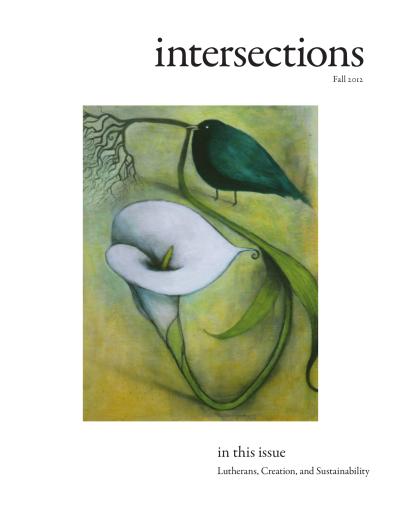 Editorial
From the Publisher
Mark Wilhelm
Wilhelm argues that the rhetoric framing ELCA higher education as a binary between “secular” and “religious” is “hokum”: there is a third way of doing higher education from a Christian perspective that is religious in motivation and practice but on the ground looks secular. After more than half a century of debates, he calls on ELCA presidents to “do something” in 2013 to move forward in shared mission and vocation.
-
Editorial
From the Editor
Jason A. Mahn
Mahn introduces the issue through Norman Wirzba’s The Paradise of God and the Genesis 2 vocation given to Adam to care for adamah—arguing that “vocation” is the Lutheran name for an incarnational, creation-centric theology of kenosis and that Lutherans bring distinctive theological gifts to environmental work even if no absolutely unique perspective on caring for creation.
-
Institutional Focus
Vocation for Life: A Report on a New Initiative for Alumni
A report on “Vocation for Life,” a collaborative initiative of ELCA-related colleges and universities to make vocational exploration available to alumni across the country regardless of which school they attended. The first pilot retreat—“Explore Your Life’s Calling,” in Rochester, Minnesota in November 2011, facilitated by Tom Morgan of Augsburg, Chris Johnson of Gustavus, and Tom Scholtterback of Concordia using the Circles of Trust approach—is described.
-
Institutional Focus
Facing Tornados and Climate Change: An Interview with Jim Dontje about Environmental Innovation at Gustavus
Jim Dontje
Dontje, director of the Johnson Center for Environmental Innovation at Gustavus Adolphus College, describes the Center’s work with solar thermal and photovoltaic systems, LEED certification of Beck Hall, recycling and conservation initiatives, the Linnaeus Arboretum, and the difficult work of building consensus around climate response—reflecting on how Gustavus’s 1998 tornado recovery shaped a community capable of collective action, and on how the “Lutheran identity” both restrains and energizes the college’s environmental ethos.
-
Article
A Lutheran Ethic of Environmental Stewardship
Jim Martin-Schramm
Martin-Schramm sketches a Lutheran ethic of environmental stewardship organized around four moral norms inherited from World Council of Churches discussions and developed by Presbyterian and ELCA social statements: sustainability, sufficiency, participation, and solidarity. He grounds each norm in scripture and the Lutheran tradition—the theocentric doctrine of creation against rampant anthropocentrism, the incarnation against destructive dualisms, Christ in community against modern individualism, and accountability to God for future generations—arguing that this “ethic of ecological justice” offers a common moral vocabulary for engaging environmental policy debates that would otherwise collapse into cost-benefit analysis.
-
Institutional Focus
Putting Principles into Practice: An Interview with Kenneth Foster about Concordia's Sustainability Council
Kenneth Foster
Foster, chair of Concordia College’s President’s Sustainability Council, describes the Council’s formation under President William Craft in 2011 as a re-energization of stalled task-force work, its coordination with grass-roots campus initiatives, and its strategy of moving from principles to practice in stewardship of natural resources at a Lutheran liberal arts college.
-
Article
Climate Justice, Environmental Racism, and a Lutheran Moral Vision
Cynthia Moe-Lobeda
Moe-Lobeda argues that the vocation of a Lutheran college is to prepare students for Thomas Berry’s “great work”: forging a sustainable relationship between the human species and the planet while diminishing the gap between those who have too much and those who have not enough. She develops a three-fold “moral vision” rooted in Luther’s theology of the cross—seeing what is (climate injustice and environmental racism for what they are), seeing more just and sustainable alternatives, and seeing God’s saving presence at work—and offers it as a distinctive Lutheran contribution to the panhuman and interfaith challenge of our day.
-
Institutional Focus
Farming and Eating Locally: An Interview with Garry Griffith about Augustana's Farm2Fork Program
Garry Griffith
Griffith, Director of Dining at Augustana College (Rock Island), describes the Farm2Fork program’s shift from pre-packaged food to fresh produce sourced from local farms (beginning with Jim Johansen of Wesley Acres in Moline), the Augie Acres campus garden tended by students in learning-community courses, the bio-diesel conversion of used fryer oil for greenhouse heat and farm equipment, and the stewardship calling that grounds these efforts in Augustana’s Lutheran identity.
-
Article
Sustaining Sustainability
Baird Tipson
Tipson—former Provost of Gettysburg College, President of Wittenberg University, and President of Washington College—reads Romans 12:2 (“be not conformed to this world…”) against Victor Ferrall’s Liberal Arts at the Brink and the contemporary financial reality of small Lutheran colleges. He tells three case-study stories from Washington College’s Center for the Environment and Society—the Chino Farms partnership, the Chesapeake Semester, and the acquisition of the work boat Callinectes—to show how presidents must engage “the world” to secure resources for sustainability work without being conformed to it.
-
Institutional Focus
Health Food in the Inner City: An Interview with Brian Noy about Augsburg's Campus Kitchen
Brian Noy
Noy, Director of Campus Kitchen at Augsburg College in Minneapolis, describes the Kitchen’s four-fold program—Food to Share (2,000 meals per month from surplus dining-services food and Campus Cooking Classes), Food to Grow (an 80-plot community garden), Food to Buy (two farmers markets that accept EBT/food stamps), and Food to Know (educational programming)—and the deep history of Augsburg’s service to the immigrant communities of the Cedar Riverside neighborhood, now Somali and Mexican as well as historically Norwegian.
-
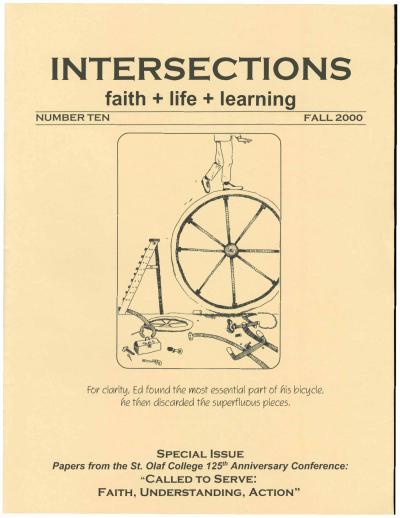 Article
Faith, Understanding, and Action
Paul J. Dovre
No. 10 · Fall 2000
Dovre frames the St. Olaf 125th anniversary—originally read as part of a presentation with the St. Olaf Cantorei and organist Paul Manz—around T.F. Gullixson’s story of an immigrant woman who “turned her face to the west wind” and the 1874 gathering at the Holden parsonage of B.J. Muus, Harold Thorson, O.K. Finseth, K.P. Haugen, and O.O. Osmondson. He weaves Anselm’s “faith seeks understanding,” Harold H. Ditmanson on the universal relevance of Christian faith, and the music of Venatius Honorius Fortunatas, John Rutter, Herbert Brokering, Ralph Vaughan Williams, and John Tavener into a meditation on faith as motive, understanding as modus, and action as consequence, against the “ill winds” of poverty, child homicide, AIDS, and consumer gluttony.
-
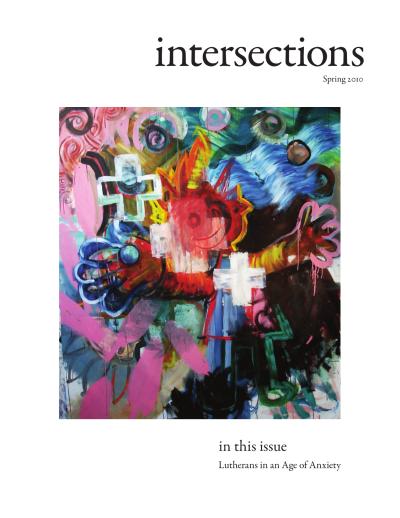 Article
Hope in the Face of Ecological Decline
Jason Peters
No. 32 · Spring 2010
Peters reads our ecological crisis—a campus “Birth Control Tree,” feminized fish, population, climate, water, and soil—through Alexander Pope, William Blake, Søren Kierkegaard, and C. S. Lewis’s The Abolition of Man, and argues that the modern project of mastering nature has made despair (the unconscious form Kierkegaard named) our condition. He calls for three reorientations: practical (assigning value to domestic arts and place over disciplinary specialization), philosophical (dismantling the Baconian/Machiavellian/Cartesian project of control), and theological (recovering the Church’s rejection of Gnosticism so that grace comes to us by means of nature, not in contempt of it).
-
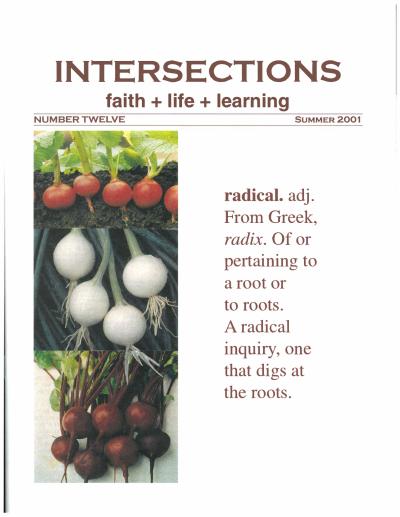 Editorial
From the Editor
Tom Christenson
No. 12 · Summer 2001
Christenson introduces three pieces from the summer 2000 Vocation of a Lutheran College Conference at Dana College—noting that Leonard Schulze was asked to keynote before becoming executive director of DHES—and recommends Peter C. Hodgson’s God’s Wisdom: Toward a Theology of Education and Douglas Sloan’s Faith and Knowledge: Mainline Protestantism and American Higher Education for their accounts of how faith and knowledge have been dissociated in modern higher education and what it might take to recover their connection.
-
 Article
The Skeptical Theologian's Dictionary
Carl Skrade, Spencer Porter
No. 4 · Winter 1998
Porter and Skrade offer selections from a mock-lexicon of theological terms: answer, church, faith, God, grace, hope, justification, love, prayer, sin, soul, and theology, among others. Each entry begins with a standard definition and then unsettles it—answer reminds the reader that in theology and poetry the questions matter more than their answers; church alternates between “the mystical Body of Christ” and ordinary human gatherings whose machinery often obscures the gospel; God is the One whose name we are told not to take in vain and yet whose name we keep using; prayer is communion with God yet often degenerates into a list of demands. The form’s irony exposes the gap between the language of theology and its lived realities—a sober, witty corrective for Lutheran classrooms and chapels alike.
-
 Book Review
The Religious Genealogy of College: Interrogating the Ambivalence of Delbanco's College
George Connell
No. 39 · Spring 2014
Connell reads Andrew Delbanco’s College: What It Was, Is, and Should Be alongside Concordia’s Vision Statement for the Humanities and Martha Nussbaum’s Not for Profit, tracing Delbanco’s ambivalent engagement with the religious origins of American college. He asks whether Delbanco’s “college idea” can survive cut off from the religious rootstock that nourished it, and proposes that church-related colleges may serve best not as a “usable past” but as a “usable present.”
-
 Institutional Focus
Scriptures That Inspire Work for Diversity, Equity, Inclusion, and Justice
Altheia Richardson, Angie Hambrick, Caryn Riswold, Colleen Windham-Hughes, Deanna Thompson, Marcia Bunge, Robert Clay
No. 61 · Spring 2025
9 min audio
A companion list of biblical verses — from Genesis 1:27 and Galatians 3:28 to Micah 6:8 and Luke 4:18-19 — that grounded NECU’s drafting of So That All May Belong, organized by the four DEIJ commitments and offered as an invitation to share other texts that ground and sustain the work.