James M. Unglaube
Director, Colleges and Universities
ELCA Division for Higher Education and Schools
-
 Editorial
The Vocation of a Lutheran College: Some Transitional Thoughts
James M. Unglaube
No. 4 · Winter 1998
Unglaube offers final reflections on thirty years in Lutheran higher education as he leaves the ELCA Division for Higher Education and Schools to join Carthage College, his alma mater. He recalls colleague Richard Solberg’s influence, the closing of Upsala College in 1995, the Higher Education and Namibia program shared with Naomi Linnell, the growth of endowments from $70 million to $1 billion in 25 years, and the Vocation of a Lutheran College project he credits Paul Dovre with inspiring. He likens the twenty-eight ELCA colleges to flowers on a rose bush—same Lutheran tradition, each blossom different—requiring constant nurture if the partnership between church and college is to thrive.
-
 Editorial
From the Publisher
James M. Unglaube
No. 3 · Summer 1997
Unglaube opens the journal’s second year by previewing the 1997 Vocation of a Lutheran College conference at Carthage, which will examine the Lutheran tradition from outside (Richard Hughes of Pepperdine on the Lilly Endowment’s Models for Christian Higher Education; David Johnson, President of the University of Minnesota at Morris and Luther College graduate, on the tradition from the public sector) and inside (Ann Pederson of Augustana in Sioux Falls; Timothy Lull of Pacific Lutheran Theological Seminary), and previews Eric Eliason’s emerging proposal for an Academy of Scholars in Lutheran Higher Education modeled on NEH/NSF-style summer seminars.
-
 Editorial
From the Publisher
James M. Unglaube
No. 2 · Winter 1997
Unglaube reports on the second annual Vocation of a Lutheran College conference of August 1996, where Walter Bouman of Trinity Lutheran Seminary addressed “What is Lutheran; What is the Lutheran Tradition” (biblical, catholic, evangelical, sacramental, world-affirming—the world “received, enjoyed, served as God’s Gift”). He previews presentations by Wendy McCredie of Texas Lutheran and Baird Tipson of Wittenberg on how the Lutheran tradition is embodied in its colleges, and Bob Vogel’s challenge in “Coherence—And Now what?” that the tradition comes to life in how faculty give expression to their beliefs and values in the classroom and with colleagues.
-
 Editorial
From the Publisher
James M. Unglaube
No. 1 · Summer 1996
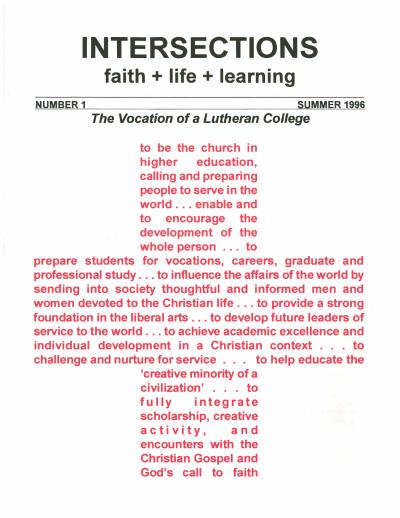
Unglaube welcomes readers to the inaugural issue of Intersections, crediting Editor Tom Christenson and Capital University, and announces the new annual Vocation of a Lutheran College Conference whose continuing dialogue the journal exists to enhance. He gives thanks to the Lilly Endowment for a sizable grant supporting the 1996 conference, campus dialogues, and the birth of the publication.
-
Number 3
No. 3 · Summer 1997
The Summer 1997 issue of Intersections gathers essays on the environment, the education of desire, and hiring policies. H. Paul Santmire offers three mandates for the Lutheran college’s care for the earth; Gregg Muilenburg argues the core of Christian education is the education of Christian desire. A discussion on mission and hiring pairs Bruce Reichenbach for “critical mass” hiring, Wendy J. McCredie for “creative education,” and Harry Jebsen on the “moving target” of church and curriculum. Gary Fincke offers two poems; Chuck Huff closes with “Confessions of a Collaborator.”
-
Number 2
No. 2 · Winter 1997
The Winter 1997 issue of Intersections—“The Vocation of a Lutheran College, II”—features Walter R. Bouman’s lead essay naming five continuing themes of the Lutheran tradition (biblical, catholic, evangelical, sacramental, world-affirming), with responses from Steven Paulson, Kimberly and Jon-David Hague, Jane Hokanson Hawks, Ben Huddle, and Chuck Huff probing Lutheran praxis, curriculum, mentoring, and campus “outsiders.” Brian Forry Wallace offers two poems, and Baird Tipson closes with a focus on Wittenberg University’s “American” Lutheran heritage.
-
Number 1
No. 1 · Summer 1996
The inaugural Summer 1996 issue of Intersections launches the journal alongside the first Vocation of a Lutheran College Conference at Capital University. Mark Schwehn’s keynote “The Future of Lutheran Higher Education” frames the Christian university around the pursuit of truth and liberal learning, with responses from Marsha Heck, Kurt Keljo, Thomas Templeton Taylor, John Rehl, Florence Amamoto, and Sandra C. Looney probing moral action, witness, secularization, and lived Lutheran identity.